
what-is-temp-staffing
What Is Temp Staffing? How It Works for Employers & Workers
Roughly 16 million Americans work temporary jobs each year, and the companies that hire them rely on staffing agencies to keep that pipeline moving. If you're asking "what is temp staffing,"...
Written by: Saply Team
What Is Temp Staffing? How It Works for Employers & Workers
Roughly 16 million Americans work temporary jobs each year, and the companies that hire them rely on staffing agencies to keep that pipeline moving. If you’re asking “what is temp staffing,” you’re likely either exploring it as a hiring strategy, considering temp work yourself, or trying to sharpen your understanding of an industry you already operate in. Either way, getting the fundamentals right matters, because temp staffing touches everything from workforce flexibility to how candidates are sourced, formatted, and submitted to clients.
At its core, temp staffing is a three-party arrangement: a staffing agency recruits and employs workers, then places them at client companies for a defined period. Simple enough on paper. In practice, though, agencies juggle candidate pipelines, CV formatting to client standards, job matching, compliance, and tight turnaround times, all while competing on speed. That’s exactly the workflow Saply was built to support, helping staffing teams automate CV tailoring and formatting so they can focus on placing the right people faster.
This article breaks down how temporary staffing actually works, step by step, for both employers and workers. You’ll learn what makes it different from direct hiring, when it makes strategic sense, and the real pros and cons on each side of the arrangement. Whether you run a staffing desk or you’re evaluating temp agencies for the first time, you’ll walk away with a clear, practical understanding of the model.
What temp staffing is and how it differs
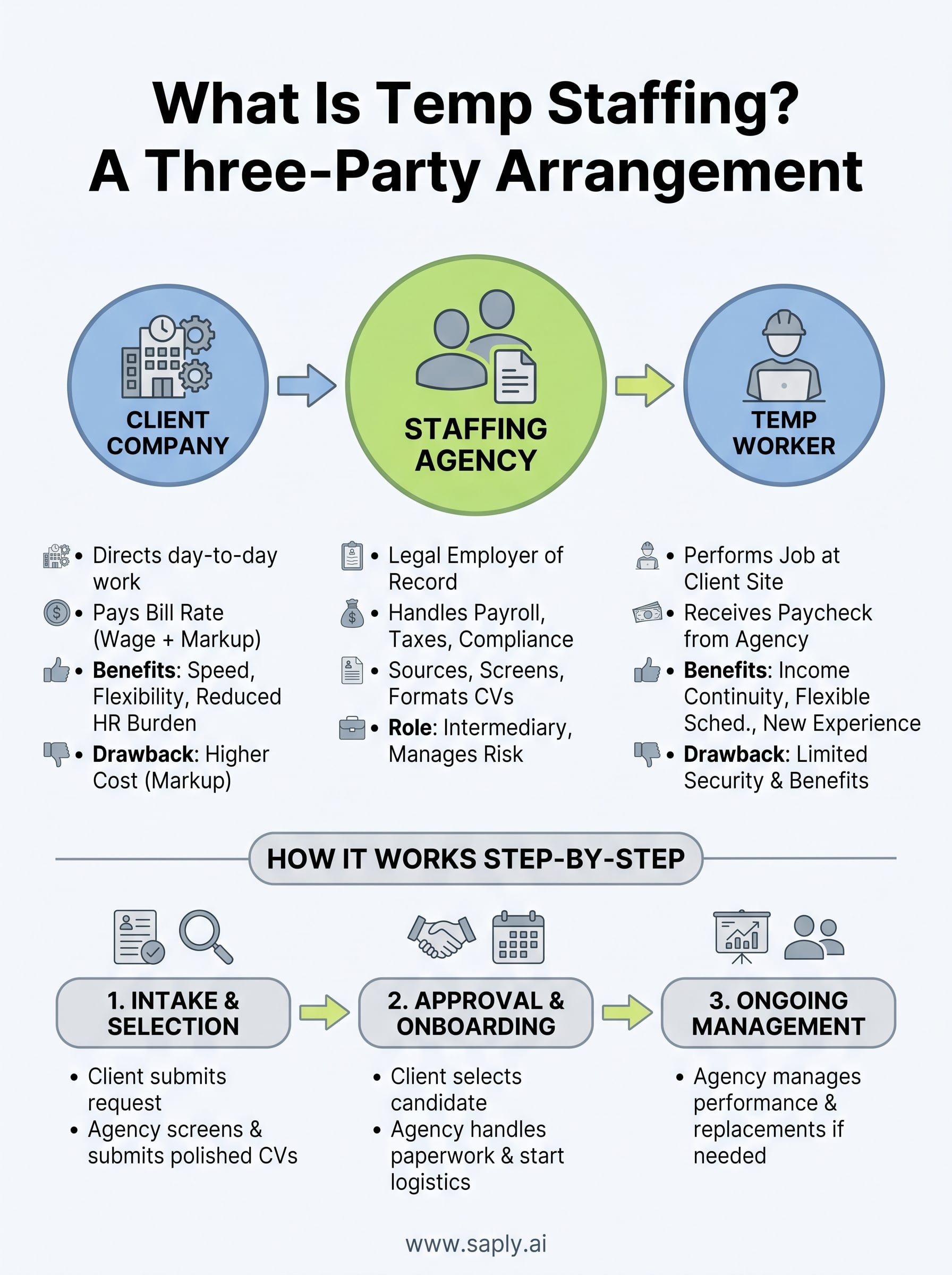
Temp staffing, short for temporary staffing, is a hiring model where a staffing agency recruits workers and places them at client companies for a fixed period. The phrase what is temp staffing points to a model that involves three parties instead of the usual two, which is where most of the confusion starts. The agency acts as the legal employer of the worker, handling payroll, taxes, and compliance, while the client company directs the day-to-day work.
The three-party structure
The three parties in temp staffing are the staffing agency, the worker, and the client company. Each has a distinct role. The agency sources, screens, and places candidates. The worker performs the job at the client’s site. The client pays the agency a bill rate that covers the worker’s wages plus the agency’s markup for its services and overhead.

The client company controls the work, but the agency controls the employment relationship.
This separation matters both legally and practically. Because the agency is the employer of record, payroll tax obligations and employment compliance sit with the agency, not the client. That’s a real operational advantage for companies that need workers fast without taking on full HR responsibility.
How temp staffing differs from direct hiring and contract work
Direct hiring means the company employs the worker itself, with no intermediary involved. Temp staffing adds the agency as the employer of record, which changes the legal and financial structure entirely. Contract staffing typically involves longer engagements and more specialized skill sets, while temp work covers shorter durations and higher-volume, often generalist roles. Freelance work sits in a different category because the worker operates as an independent contractor, with no agency managing compliance or placement logistics on your behalf.
Why employers and workers use temp staffing
Both sides of this arrangement have practical reasons for choosing the temp model. Understanding what is temp staffing from each angle clarifies why it drives significant workforce spending across industries every year.
Why employers use temp agencies
Employers use temp agencies primarily for speed and workforce flexibility. You can bring qualified workers in within days, cover demand spikes, and fill leave gaps without committing to a permanent hire.
The agency also handles payroll, compliance, and benefits administration. That means your internal HR team avoids the administrative overhead that typically comes with onboarding new employees.
Temp staffing lets employers scale their workforce without the costs and complexity of traditional hiring.
Why workers choose temp roles
Workers choose temp positions for income continuity, flexible scheduling, and access to new employers. If you’re between jobs or exploring a new field, a temp placement gets you in front of real companies fast.
Many temp roles also convert to permanent positions when performance aligns with client expectations, which makes temp work a practical entry point for long-term employment.
How temp staffing works step by step
Understanding what is temp staffing operationally means following a clear sequence, from identifying a need to a worker’s first day on site. Each step involves a handoff between you, the agency, and the candidate.
From client intake to candidate selection
You start by submitting a staffing request to the agency, detailing the role, required skills, expected duration, and start date. The agency then searches its database, runs outreach, and screens candidates through interviews and background checks. Recruiters format and tailor CVs to match your requirements before sending submissions for your review.
Speed at this stage matters because the first strong submission often determines who gets the placement.
Agencies that work efficiently here submit polished, role-specific CVs quickly rather than flooding your inbox with unformatted profiles that require extra review time.
From approval to day one
Once you select a candidate, the agency handles all employment paperwork, compliance checks, and onboarding logistics. The worker reports to your site on the agreed start date. Throughout the assignment, the agency stays available to address performance concerns or contract adjustments so you’re not managing those issues alone.
If the fit isn’t right, the agency steps in to replace the worker quickly.
Pay, fees, and who employs the temp worker
One of the most misunderstood parts of what is temp staffing is who actually writes the worker’s paycheck. Even though the temp works at your facility every day, the staffing agency is the legal employer of record. That distinction shapes everything from tax obligations to benefits eligibility.
The employer of record
Because the agency holds employer status, payroll taxes, workers’ compensation, and unemployment insurance all fall on the agency, not on you as the client. You avoid the compliance burden that comes with direct employment, which is a major reason companies use temp arrangements for short-term needs.
How bill rates and markup work
You pay the agency a bill rate, not a salary. That bill rate includes the worker’s hourly wage plus the agency’s markup, which typically covers payroll taxes, administrative costs, insurance, and the agency’s profit margin. Markups generally range from 25% to 75% above the base wage depending on the role and market.

The worker receives their agreed hourly pay from the agency regardless of what markup the agency charges you.
Workers rarely see the bill rate you negotiate with the agency, and their compensation is set during the agency’s own hiring process, separate from your client agreement.
Pros, cons, and how to choose a temp agency
Knowing what is temp staffing is one thing; deciding whether it fits your situation is another. Both employers and workers get real advantages from the model, but there are genuine tradeoffs worth understanding before you commit.
The real advantages and drawbacks
For employers, the primary benefit is speed combined with reduced HR burden. You fill gaps fast without taking on long-term employment commitments. The downside is cost: bill rate markups mean you pay more per hour than a direct hire would cost at the same wage. For workers, temp roles offer fast income and exposure to multiple employers, but they often come with limited benefits and no job security.
If the agency carries the compliance risk, you get flexibility but pay a premium for it.
What to look for in a temp agency
Start by evaluating the agency’s specialization in your industry. An agency that consistently places workers in your sector will have faster turnaround and better-screened candidates than a generalist firm. You should also assess how the agency handles CV preparation and submission quality, since poorly formatted profiles slow down your review process and reflect directly on submission speed. Ask about replacement guarantees, ATS integrations, and how they handle compliance in your specific state or jurisdiction.
Key takeaways
What is temp staffing at its core? It’s a three-party model where a staffing agency employs workers and places them at client companies for a defined period. The agency handles payroll, compliance, and candidate preparation, while the client controls the day-to-day work. Employers get speed and workforce flexibility; workers get fast income and real exposure to new employers.
Both sides make tradeoffs. Clients pay a bill rate markup that covers more than just the worker’s wage, and workers often accept limited job security in exchange for flexibility. Choosing the right agency comes down to specialization, submission quality, and how fast they can deliver screened, role-ready candidates.
For staffing agencies managing high volumes of CV submissions, speed and quality at the formatting stage directly shape placement outcomes. Saply helps recruitment teams automate CV formatting and tailoring so you spend less time on administrative prep and more time placing the right candidates faster.