
contractor-to-permanent
Contractor to Permanent: A Proven Recruiter Playbook for Talent Conversions
contractor-to-permanent
Written by:
contractor-to-permanent
Flipping a contractor to a permanent employee is more than just a hiring tactic; it's one of the smartest talent acquisition strategies in a recruiter's playbook. Think of it as the ultimate "try-before-you-buy" model. You get to see a professional in action—how they handle pressure, collaborate with the team, and fit into the company culture—long before any permanent offer is on the table. This isn't just about filling a seat; it's about making a placement that sticks.
The Growing Case for Contractor to Permanent Conversions

The traditional, rigid line between contractors and full-time staff has faded. In its place is a massive strategic opportunity. For years, we’ve seen the job market prize agility, and the contract-to-hire path has evolved from a niche option into a go-to strategy for building stronger, more resilient teams.
This isn't just a trend driven by companies wanting flexibility. Talented professionals are also looking for more than just a paycheck; they want to find the right fit without locking themselves into a role that looks good on paper but feels wrong in practice. The contractor model serves as a two-way street, giving both the company and the individual a chance to confirm the match is real before making it official.
Before diving into the playbook, it's crucial to have the fundamentals down. The differences between these two employment types impact everything from compensation to compliance.
Contractor vs Permanent Employee At a Glance
Attribute | Contractor | Permanent Employee |
|---|---|---|
Commitment | Fixed-term, project-based | Long-term, ongoing |
Compensation | Higher hourly/daily rate; no benefits | Salary + benefits (health, retirement) |
Taxes | Manages own taxes (e.g., 1099 in US, IR35 in UK) | Taxes withheld by employer (e.g., W-2 in US) |
Integration | Project-focused, less integrated | Deeply integrated into company culture |
Training | Expected to have all necessary skills upfront | Receives ongoing training and development |
Flexibility | High degree of autonomy and flexibility | Adheres to company policies and schedule |
This table highlights the core distinctions you'll navigate during the conversion process. Each point represents a key area for negotiation and planning.
Why This Model Works So Well
The logic is beautifully simple. You're basing a hiring decision on months of real-world performance, not just a few hours of interviews. A polished resume can tell you what a candidate has done, but watching them work for three months tells you who they are—their work ethic, their problem-solving grit, and how they handle feedback.
The single biggest advantage of the contractor-to-permanent pathway is de-risking the hiring process. A bad hire can cost a company thousands in lost productivity and recruitment fees. This model acts as an extended, paid working interview.
By the time you’re ready to draft an offer, the guesswork is gone. You know for a fact that this person delivers quality work, gets along with the team, and genuinely understands the company's mission. There are no day-one surprises because they’ve already had ninety of them.
A Market Driven by Flexibility and Skill
The contingent workforce is no longer a small fraction of the labor market. Globally, a staggering 40% of the workforce is now made up of contract or contingent workers. This isn't just a statistic; it's a fundamental shift in how companies find talent, as detailed in reports from outlets like Procurious. For recruiters, this massive talent pool is a goldmine. The real strategic win, however, is identifying the top performers within that pool and converting them into loyal, long-term assets.
This approach is particularly effective in fast-moving fields like IT and consulting, where a short-term project can easily reveal a need for a permanent strategic role. The benefits for you and your clients are undeniable:
Reduced Time-to-Hire: Why start a six-week search from scratch? You have a pre-vetted, high-performing candidate already integrated into the team. The hiring process shrinks from months to weeks, or even days.
Lower Recruitment Costs: You can eliminate the heavy costs associated with advertising, external search fees, and countless hours spent screening and interviewing unknown candidates.
Higher Retention Rates: People who have already test-driven the job, the team, and the culture are far more likely to stay. They’ve made an informed decision to commit, dramatically reducing turnover.
Identifying Your Next Great Permanent Hire
I’ve seen it a hundred times: a rockstar contractor who crushes every project, but just isn’t cut out for a permanent role. On the flip side, I’ve seen good contractors who show all the signs of being an incredible long-term employee. The skills are different, and as a recruiter, your job is to spot the difference.
Moving from a contractor to permanent position is a mindset shift. You're looking for someone who doesn't just clock in and complete tasks. You’re searching for the person who starts acting like part of the team long before their contract is up—someone who thinks beyond their statement of work and gets invested in the company's future.
Look for the Employee Hiding in Plain Sight
Solid performance is table stakes. If a contractor isn't hitting their project milestones, this conversation is a non-starter. But assuming they are, that's where the real evaluation begins. You need to look for the intangibles that signal they're ready to be more than just temporary help.
I find it helps to build a simple framework around performance, cultural alignment, and personal ambition. This gives you a solid business case when you go to bat for a candidate, moving beyond "they do good work" to "they will make this team better."
Here are the signs I always look for:
Proactive Problem-Solving: Do they just point out problems, or do they show up with solutions? A future leader sees an issue and has already thought through a few ways to tackle it.
Voluntary Collaboration: Are they joining team meetings they don't have to be in? Do they offer to help colleagues or share what they know without being prompted? That's a huge green flag.
Genuine Curiosity: You'll notice they start asking bigger-picture questions. They want to know about the company's long-term plans, what other teams are working on, or what career paths look like. This shows they’re thinking about a future there.
Living the Company Values: Do their actions line up with what the company preaches? If the client is all about customer obsession, does the contractor go the extra mile for them without being asked?
Reading the Subtle Cues
I once placed a software developer on a six-month contract. Her code was impeccable, no question. But what made her stand out was what she did outside her specific duties. She noticed a couple of junior developers were wrestling with a new framework, so she put a brown-bag lunch session on the calendar to walk them through it.
That wasn't in her contract. She didn't have to do that. But that one small act of initiative proved she was a team-builder and a mentor. It showed she was invested in more than just her own success. That's the kind of evidence that makes the temp-to-perm conversation a slam dunk.
The best candidates for conversion are the ones who start acting like an owner before they ever have ownership. They see a gap and fill it—not because it’s their job, but because it’s the right thing for the business.
This "extended working interview" is incredibly powerful. The data backs it up, too. According to research from the American Staffing Association, temp-to-perm conversions have remarkably high success rates. It’s a testament to how well this model works for confirming cultural fit, which is often the hardest thing to gauge in a traditional interview process.
Do They Actually Want to Be Here?
The final piece is ambition, but it has to be pointed in the right direction. You need to know if they see a real future with the company or if this is just a convenient stop on the way to something else.
This requires some direct, but carefully worded, conversations. You can learn a lot by asking open-ended questions like:
"What parts of this project have you enjoyed the most?"
"Where do you see your career going in the next couple of years?"
"If you had a magic wand, what's one thing you'd change about how this team operates?"
Listen closely to their answers. Are they using "we" when they talk about team successes, or is it all "I"? Do their career goals line up with real opportunities within the organization? This kind of holistic evaluation is a key part of the job, especially for recruiters managing the entire hiring lifecycle. If you want to dive deeper into this, our guide on what is 360 recruitment is a great resource.
When you combine hard performance data with these softer, more nuanced observations, you'll have an undeniable case. You can confidently tell your client that you haven’t just found them a skilled professional—you’ve found their next great team member.
Managing the Conversion From Conversation to Offer
When it comes to a contractor to permanent conversion, timing is everything. Move too fast, and you can seem presumptuous. But if you wait too long, you’ll watch a competitor snatch up your star performer who saw the same potential you did.
Here’s a playbook for navigating that journey, from the first "what if" conversation right through to a signed offer letter.
The sweet spot for kicking things off is usually 60-90 days before the contract is up. This buffer gives you plenty of runway to handle internal approvals, build a solid business case, and negotiate the offer without anyone feeling rushed. The last thing you want is to be scrambling with a last-minute offer that feels like a complete afterthought.
Starting the Conversion Conversation
Broaching the topic is a delicate dance. You need to gauge interest without making any promises you can't keep. Your first move should be to sit down with the hiring manager, armed with all the performance data you’ve gathered.
A great way to get the ball rolling is with a simple, open-ended question. Try something like: "I've been really impressed with [Contractor's Name]'s work on the [Project Name]. Have you given any thought to what the team looks like after their contract ends?"
This non-committal opener gets them thinking strategically. Your goal is to guide the conversation so the hiring manager starts articulating the contractor's value on their own. You're just there to help them connect the dots and arrive at the logical conclusion: converting them is the smartest move.
Building an Unbeatable Business Case
Once the hiring manager is on your side, you need to win over other key players like HR and finance. This is where a rock-solid business case becomes your best friend. This isn't just about saying, "They're a great worker." You need to show the concrete ROI.
Your business case should zero in on a few key areas:
Cost Savings: Run the numbers. What would it cost to recruit a brand new permanent hire from scratch? Think ad spend, agency fees (that’s you!), and the countless hours spent screening and interviewing. Put that number right next to the streamlined cost of converting a known quantity.
Risk Reduction: A new hire is always a gamble, no matter how good they look on paper. The contractor, on the other hand, is a proven asset. Frame the conversion as a way to sidestep the massive financial and cultural risks that come with a bad hire.
Preservation of Knowledge: Don't forget to highlight all the institutional and project-specific knowledge the contractor has already absorbed. If they walk, all that expertise walks out the door with them, forcing the team to start over and slowing down productivity.
This visual breaks down the key pillars to focus on when you're making your case—it all comes down to their performance, how they fit the culture, and their own ambition.
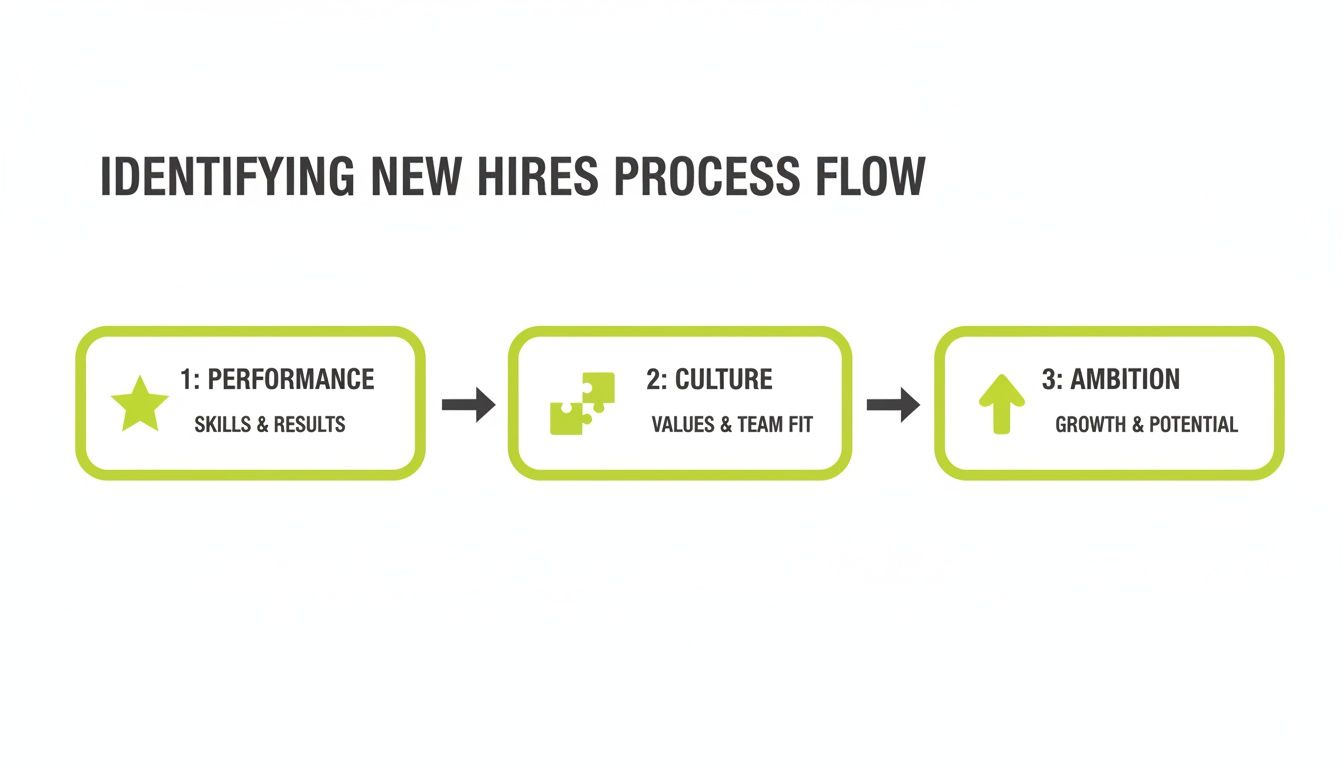
As the flow shows, a candidate has to be a triple threat—excelling in performance, fitting the culture, and showing real ambition—to be a top-tier conversion candidate.
Perfecting Your Pitch with Smart Tools
To give your business case that extra punch, you need to present the contractor's story in a compelling way. This is where your skills as a recruiter come into play, turning raw data into a persuasive narrative. Think of it as an internal sales pitch where your candidate is the product.
Before you present to leadership, take the contractor’s original CV and give it a makeover. Don't just list their duties; showcase their on-the-job wins with quantifiable results. This is where a tool like Saply.ai can be a real game-changer. You can upload their resume and quickly generate tailored summaries and value highlights that directly tie their contributions to the client's big-picture goals. It turns a standard CV into a powerful internal sales document.
A well-packaged candidate profile does more than just list skills; it tells a story of impact. Showcasing how a contractor has already delivered value makes the decision to convert them from a 'maybe' to a 'must-have.'
This mindset of actively selling your candidate internally is a core part of modern recruiting. To dig deeper into this approach, check out our piece on why recruiting is sales.
Scripting the Key Conversations
Walking into these conversations with confidence comes from being prepared. Having a few talking points in your back pocket can make all the difference.
With the Hiring Manager: "Based on [Contractor's Name]'s performance, especially their initiative on the [Specific Task], I think there's a strong case for bringing them on full-time. They've already proven their value, they’re a fantastic cultural fit, and converting them would save us the time and cost of a full search. What are your thoughts on exploring this?"
With the Contractor (Gauging Interest): "Your work here has been outstanding, and the team really values your contributions. As we get closer to your contract end date, I wanted to check in—have you thought about what your next step looks like? If a permanent role were to open up here, is that something you might be open to discussing?"
These scripts are designed to open doors, not force a decision. They position you as a strategic partner who’s thinking ahead for both the client and the candidate, keeping the contractor to permanent process moving forward smoothly.
Crafting the Offer and Navigating Compliance
Alright, this is the moment where many otherwise smooth contractor-to-permanent conversions fall apart: the offer. Moving a great candidate from a contractor's day rate to a permanent salary package is tricky. One wrong move, one miscalculation, and all your hard work can unravel in an instant.
The biggest hurdle you'll face is often psychological. A contractor sees their high day rate, then looks at a permanent salary, and gets immediate sticker shock. Your job is to reframe the entire conversation from a single number to the total compensation picture.
Benchmarking and Building the Total Package
A contractor’s rate is intentionally inflated. It has to cover their self-employment taxes, lack of benefits, zero paid time off, and the risk that comes with short-term gigs. Your offer needs to break down the hidden—but very real—value of a permanent role.
When you're putting the permanent offer together, a good starting point is to translate their old pay structure into a comparable salary. Using a day rate to salary conversion guide is a lifesaver here. It gives you a data-backed baseline to ensure your numbers are both competitive and fair, helping you build a logical bridge for the candidate.
From there, you have to paint the full financial picture. This isn't just about salary. It's about everything else they're gaining:
Health and Dental Insurance: Don't just say "we offer insurance." Quantify it. "The company covers 80% of your premium, which is worth an extra $8,500 per year to you."
Retirement Contributions: If there’s a 401(k) or pension match, spell it out. A 5% match on a $100,000 salary is a straight-up $5,000 bonus each year.
Paid Time Off (PTO): Contractors don't get paid for holidays or vacations. Do the math for them. "You'll get 15 days of PTO plus 10 paid holidays. That's 25 paid days you didn't have before, worth over $X,XXX."
Bonuses and Stock Options: Include any performance-based incentives that add to their long-term earning potential.
This detailed breakdown shifts the focus from one big number to a comprehensive package that, in most cases, proves to be a better financial deal.
Contract Rate to Permanent Salary Conversion Guide
Translating a contractor's rate into a compelling permanent salary is more art than science, but this table can help you ground your offer in reality. Remember, the goal is to show the candidate the full value beyond just the base pay.
Contract Rate (Hourly) | Estimated Annual Contract Revenue | Equivalent Permanent Salary Range (Factoring in Benefits & Taxes) | Key Negotiation Points |
|---|---|---|---|
$60/hour | $124,800 | $85,000 - $95,000 | Emphasize PTO (worth ~$9,200), health insurance contributions, and retirement matching. |
$80/hour | $166,400 | $110,000 - $125,000 | Highlight the value of bonuses, career progression, and job security not present in contract work. |
$100/hour | $208,000 | $135,000 - $150,000 | Focus on total compensation, including potential stock options, higher 401k match value, and leadership opportunities. |
$125/hour | $260,000 | $160,000 - $180,000 | For top-tier talent, discuss long-term incentives, significant bonus potential, and the stability of the role. |
By breaking it down this way, you help the candidate see the stability and security that comes with a permanent role, which often makes up for a lower on-paper salary figure.
Tackling Compliance Head-On
Compliance is the silent killer of conversions. A misstep here can create huge legal and financial headaches for everyone involved. Two areas demand your absolute focus: co-employment risk and tax regulations.
Co-employment risk happens when a client treats a contractor like a full-blown employee—setting their hours, managing them directly, and providing their tools—without putting them on the payroll. A conversion is the perfect solution, but the transition has to be clean and meticulously documented.
The switch from a 1099 (in the US) or outside-IR35 (in the UK) contractor to a W-2/PAYE employee is a big deal for tax purposes. Make sure the final contractor payment is processed correctly and that the new payroll setup is ready to go from day one of their permanent role.
Don’t let administrative details derail a great offer. A clear, documented process protects your client from misclassification penalties and gives the candidate a smooth financial transition. It’s a huge trust-builder right out of the gate.
Remember, the appeal of contracting is strong. A recent Talent International poll found that 54% of permanent workers would consider switching to contracting by 2026. This shows just how much people value flexibility. Your permanent offer has to be compelling enough to compete not just with other perm jobs, but with the allure of the contract lifestyle itself.
Your Offer Letter Checklist
A vague offer letter is an invitation for confusion and painful, last-minute renegotiations. Your offer document needs to be airtight, leaving no room for interpretation. Think of it as the final sales pitch and the first official agreement.
Make sure every offer you send covers these critical points:
Official Job Title: The specific, official title for the permanent position.
Detailed Responsibilities: A summary of their core duties, who they'll report to, and key expectations.
Start Date: The official first day as a permanent employee.
Compensation Breakdown: Clearly list the base salary, pay schedule, and the specifics of any bonus or commission structure.
Total Benefits Package: Itemize the major benefits (health, dental, vision, retirement) and point them to where they can find the full details.
Paid Time Off: State the exact number of vacation days, sick days, and paid holidays.
Contingencies: Include any conditions for employment, like a background check or signing an NDA.
Acceptance Deadline: Give them a clear deadline to sign and return the offer.
By meticulously crafting the offer and getting ahead of compliance issues, you remove friction and make it incredibly easy for your candidate to say "yes." This turns what could be a complex negotiation into a smooth, professional final step in the contractor to permanent journey.
The Final Mile: Onboarding and Measuring Your Conversion Success

It’s easy to breathe a sigh of relief when the offer is signed. But for a truly successful contractor to permanent conversion, this is where the real work begins. The transition period is your chance to prove this was a smart move and make sure your candidate feels like a valued, permanent part of the team—not just someone whose payroll status changed.
I’ve seen too many companies drop the ball here. They assume that since the person already knows the team and the job, they don’t need proper onboarding. That's a huge mistake. Their relationship with the company has completely changed. They’re no longer a temporary specialist; they’re a long-term investment. This unique position requires a special kind of onboarding.
Build an Onboarding Plan for a New Employee, Not a New Hire
A standard Day One orientation is a waste of everyone's time. This person doesn’t need a tour of the building or a meet-and-greet with colleagues they’ve worked alongside for months. Their onboarding needs to focus on the mindset shift from a contract gig to a career.
Your plan should cover the things that truly matter to someone who just committed to the company long-term:
A Deep Dive on Benefits: Don't just email a PDF. Get them a dedicated meeting with HR to walk through the 401(k), health insurance choices, and any other perks. This is your chance to reinforce the "total compensation" package you sold them on.
A Real Career Pathing Session: The hiring manager needs to sit down with them and talk about the future. What does success look like in 12 months? What training and development is on the table? This conversation signals that the company is genuinely invested in their growth.
The 30,000-Foot View: As a contractor, their focus was probably heads-down on a specific project. It’s time to pull them into bigger strategic conversations. Show them how their work connects to broader company goals that extend far beyond their team’s immediate tasks.
Essentially, you're graduating them from a temporary guest to a full-fledged citizen of the company. It’s your job to help them widen their perspective.
Define Their First 90 Days as a Permanent Employee
While their performance as a contractor got them the job, their objectives now need to change. A permanent employee’s goals are far different from a contractor’s statement of work. You’ll want to work directly with the hiring manager to map out a clear 30-60-90 day plan.
First 30 Days: The focus here is on the foundational shift. Get all the new hire paperwork done, make sure they understand the performance review cycle, and get them access to any systems reserved for permanent staff. The goal is to move them from just doing tasks to owning processes.
Next 60 Days: This is about deeper integration. Goals should now involve things like leading a small project, mentoring a junior colleague, or identifying a process improvement. They have a unique "insider-outsider" view, so encourage them to use it.
By 90 Days: They should be firing on all cylinders. Goals should be results-driven and tied directly to the team’s long-term KPIs. This is also the perfect time for a formal check-in with their manager to review how things are going and fine-tune their goals for the rest of the year.
The goal of a specialized onboarding plan is to re-recruit your new employee. It validates their decision to commit and accelerates their transition from a temporary contributor to a long-term strategic asset.
A structured plan like this prevents that awkward "in-between" feeling where a newly converted employee isn't sure what's expected of them. For more ideas on how to structure these stages, it's worth reviewing some general recruitment process best practices.
How to Prove Your Conversion Program Is Working
Your job isn't over once the onboarding plan is in motion. To really show your value as a strategic talent partner, you need to track the results. Good data turns your one-off wins into a powerful business case for doing more conversions.
Here are the key metrics that truly matter.
The KPIs That Prove Conversion Success
Conversion Rate: This one’s straightforward. What percentage of eligible contractors are you converting to permanent roles? A high rate shows you’re sourcing excellent temp talent that managers want to keep.
12-Month Retention Rate: This is the gold standard. Are these converted employees still with the company a year later? A retention rate of 85% or more is a fantastic sign that you're making quality, long-term placements and validating the "try-before-you-buy" approach.
Time-to-Fill (Converted vs. External): This is a huge one for showing ROI. Compare the time it takes to complete a conversion versus sourcing, interviewing, and hiring an external candidate for a similar role. The difference is often weeks, if not months, of saved time and gained productivity.
Hiring Manager Satisfaction: After the conversion is complete, send a quick survey to the hiring manager. Ask them to rate the process, the candidate's performance, and their overall satisfaction. This qualitative feedback is incredibly powerful when you present it alongside the hard numbers.
Tracking these outcomes creates a feedback loop that does more than just prove your ROI. It gives you the insights you need to make every future contractor to permanent placement even more seamless and successful.
Your Contractor to Permanent Conversion Questions Answered
Even the smoothest contractor-to-permanent playbook can get messy. When you start talking about money, long-term commitment, and competing offers, that's where deals are truly made—or lost. I've been there, and I know how tense these moments can be.
Let’s get straight into the most common—and trickiest—questions that come up, so you can handle them with confidence.
What Is a Standard Conversion Fee?
First things first, let's talk about getting paid. The conversion fee is what you charge a client to make your contractor their own permanent employee. There isn't a single, universal "standard," but the most common approach is a sliding scale based on the contractor's time on the job.
The longer they've been working, the lower the fee. It's a fair system for everyone. Your client gets a well-deserved discount because you've already earned revenue from the contract, and you still get rewarded for making a great long-term match.
Here’s a typical fee structure I've used and seen work well:
0-3 Months on Contract: The fee is usually 20-25% of the employee’s first-year annual salary.
3-6 Months on Contract: This often drops to around 15-20%.
6-12 Months on Contract: You might see this go down to 10-15%.
After 12 Months: Many agreements allow the client to convert the contractor for no additional fee at this point.
The most important thing? Get these terms spelled out clearly in your initial client agreement. It will save you a world of headaches later on.
How Do You Handle a Counteroffer?
It's the moment every recruiter dreads. You’ve done all the work, and suddenly, your star contractor has a counteroffer. Don't panic. The first thing you need to do is keep a level head and bring the conversation back to why they wanted the permanent role in the first place.
Was it the stability? The chance to lead a team? Better benefits? A counteroffer is almost always just a knee-jerk reaction with more money.
A counteroffer rarely solves the underlying reasons a person wanted to leave a situation. It’s often a short-term financial patch that papers over long-term career dissatisfaction. Remind your candidate of the bigger picture.
Get in front of them and be transparent. Acknowledge that it's flattering to get a counteroffer, but then pivot back to their career goals. Ask pointed questions like, "What was it about this permanent role that got you excited? How does that career path compare to what this counteroffer really means for you in a year's time?" This forces them to think beyond the dollar signs and focus on what truly matters to them.
What if the Contractor Wants to Remain a Contractor?
This happens more often than you might think. Some of the best talent out there genuinely prefers the freedom and higher day rates that come with contracting. If you’ve put together a fantastic permanent offer and they turn it down because they love their independence, don't try to force it.
Respect their choice. Pushing someone into a role they don’t want is just asking for them to leave a few months down the road. Instead, turn this into a chance to strengthen your relationship.
You could say something like, "I totally get it, and I respect that. We value your contributions so much that we wanted to lock you in for the long haul. Since you prefer to stay on contract, let's talk about extending your current assignment instead."
This approach does two powerful things:
You keep a top performer engaged with your client.
You prove to both the contractor and the client that you're a flexible partner focused on the best solution, not just on closing a perm deal.
Sometimes, the best move in a contractor to permanent negotiation is admitting that the current setup is already the perfect fit.
Ready to stop wasting time on manual resume formatting and start closing more placements? With Saply.ai, you can transform any CV into a client-ready, branded document in minutes, right from your inbox or Google Docs. Cut your submission prep time and give every candidate the professional presentation they deserve. Start your free trial at https://www.saply.ai.