
high-volume-hiring
The High Volume Hiring Playbook for Modern Recruiters
high-volume-hiring
Written by:
high-volume-hiring
Let's be real for a moment. That tidal wave of applications you get for every single job posting? It’s not going away. The days of getting 50 resumes for a role are long gone; now, we're seeing hundreds. This isn't just a headache—it’s the new normal, driven by economic shifts and a workforce that's more global and remote than ever.
The secret isn’t just to survive this chaos. It's to build a system that turns the flood of applicants into your biggest competitive advantage.
Conquering the New Reality of Recruitment

The game has changed. Whether you’re at a staffing firm or on an in-house team, the old model of carefully reviewing a small pool of candidates just doesn't work anymore. Now, you’re facing a mountain of resumes for almost every opening, from frontline workers to highly specialized roles.
This isn’t a mark of failure. It's simply the result of a new market. Companies are casting a wider net, and candidates are applying to more jobs than ever. The unfortunate side effect? Recruiters are buried in admin, spending their days sifting through CVs instead of doing what they do best: building relationships and closing placements.
The Pain Points of Modern Recruiting
The daily reality for anyone managing high volume hiring is brutal. There’s incredible pressure to fill roles fast because every empty seat can mean lost revenue, delayed projects, or unhappy customers. This "need for speed" environment creates some serious problems.
Recruiter Burnout: Who wants to manually screen hundreds of nearly identical resumes all day? It's mind-numbing work that leads to exhaustion and, frankly, high turnover on our own teams.
Lost Revenue: Every great candidate who gets lost in your inbox or drops out because your process is too slow is a missed placement fee or a critical role left unfilled.
Inconsistent Quality: When you're rushing, it's impossible to evaluate everyone consistently. Gut feelings take over, and you end up sending a mixed bag of candidates to your clients or hiring managers.
The core issue is simple: the traditional ways of recruiting were never meant to handle this kind of scale. They buckle under the pressure, causing great people to be overlooked and critical business operations to stall.
Shifting from Chaos to Competitive Edge
The teams that are winning today have stopped seeing the application flood as a problem. They see it for what it is: a massive talent pool just waiting to be tapped. The breakthrough comes when you stop trying to manage the volume by hand and start building an intelligent system to do it for you.
This means getting serious about modern tools and workflows. Automation isn't just a nice-to-have anymore; it's essential for any real high volume hiring strategy. Smart systems can take on the repetitive, soul-crushing tasks that are holding your recruiters back. This kind of systematic approach is central to what we call 360 recruitment.
By letting technology handle initial screening, CV formatting, and basic candidate comms, your team is freed up to focus on what actually matters. They can finally spend their time engaging with top-tier candidates, digging into client needs, and making strategic decisions. A tech-forward approach is the only way you’re going to scale your operation, prevent your team from burning out, and capture the revenue that’s currently drowning in your inbox. This playbook will show you exactly how to build it.
Building a Scalable Talent Sourcing Engine
Building a hiring process that doesn’t crack under pressure starts way before you get your first application. It all begins with a solid, strategic blueprint you build with your clients or internal hiring managers. A truly scalable sourcing engine isn’t just about finding people; it’s about consistently finding the right people, time and time again.
The bedrock of this is smart workforce planning. Instead of asking a vague question like, "How many people do you need?", you have to dig deeper. Get into the specifics of their business goals, projected customer demand, and any seasonal spikes they’re expecting.
If a client needs to hire 50 customer service reps in Q3, that's not just a number—it’s a direct response to a business need. Your job is to translate that business problem into a concrete sourcing plan. This kind of collaboration sets clear, achievable hiring goals, aligns expectations on both sides, and puts an end to the last-minute panic that defines so much of high volume hiring. You shift from being a reactive order-taker to a strategic partner.
Diversifying Your Sourcing Channels
Let's be blunt: relying only on job boards for high-volume recruiting is a recipe for failure. Sure, they bring in plenty of applications, but the quality is all over the place, and you're fighting for attention against every other company out there. To build a reliable pipeline, you need to get creative and adopt a multi-channel strategy that actively finds talent where they actually spend their time.
A modern sourcing engine pulls from several streams at once. Think of it like an investment portfolio—diversification minimizes your risk and boosts your returns. Your channels should reflect that same thinking, blending pools of both active and passive candidates.
Employee Referral Programs: Your current team members are your best recruiters. A well-designed referral program can quickly become your top source of quality hires. You just have to offer clear, compelling incentives and make it ridiculously easy for employees to share job openings.
Targeted Social Media Campaigns: Go beyond just posting a link on LinkedIn. Use targeted ads on platforms like Facebook, Instagram, and even TikTok to reach specific demographics, which is especially effective for entry-level or hourly roles. Show off your company culture and the real-world perks of the job.
Community Partnerships: Get involved with local colleges, vocational schools, and community groups. Hosting a virtual career fair or sponsoring a local event can build a powerful employer brand and create a direct pipeline of fresh talent.
The real goal here is to create a constant, steady flow of applicants from different places. When one channel slows down, the others can pick up the slack. This ensures your talent pipeline never runs dry and is a core part of treating recruiting like a sales function.
Tapping into Global Talent Pools
The hunt for talent isn’t limited by borders anymore. Going global with your hiring is becoming a major competitive advantage, especially for roles that support large-scale operations. We're seeing high-volume hiring explode in regions like Southeast Asia and Latin America as companies scale up their support and back-office teams.
This isn’t just about finding cheaper labor; it's a strategic move. The data shows companies are tapping into specialized talent pools to gain speed and resilience. Think of the boom in finding English-fluent customer support agents in South Africa or detail-oriented process specialists in SEA. This global approach unlocks huge, high-potential talent pools that can deliver the volume and skills you need to meet intense demand. It's a powerful way to build a resilient, 24/7 sourcing engine.
High Volume Sourcing Channel Effectiveness
Choosing the right channels is just as important as the technology you use to manage them. If you're looking for insights into the top platforms, this breakdown of the 12 Best Talent Acquisition Software Platforms For 2025 is a great starting point.
The table below gives you a quick comparison of the most common channels to help you decide where to focus your energy and budget.
Channel | Typical Candidate Volume | Candidate Quality | Cost & Speed |
|---|---|---|---|
Job Boards | High | Variable | Low cost, fast initial volume, but requires heavy screening. |
Referrals | Medium | High | Low cost, high speed-to-hire, but limited by network size. |
Social Media | High | Medium | Moderate cost, can be very fast with targeted ad campaigns. |
Talent Pools | High | High | Higher initial investment but offers the best long-term ROI. |
By weaving these different channels together—from internal referrals to global talent markets—you create a multifaceted and tough-as-nails sourcing machine. This kind of system won't just handle today's hiring needs; it will be ready to scale for whatever demand spike you throw at it tomorrow.
Using AI and Automation to Accelerate Screening

Let's be honest, the biggest bottleneck in any high volume hiring campaign is the mountain of applications you have to review. This is where speed, efficiency, and frankly, your sanity go to die. Traditional recruiting just wasn't built for this kind of scale.
This is exactly why AI and automation have gone from industry buzzwords to essential tools in a modern recruiter's toolkit. Instead of manually opening every single CV, you can use technology to handle the initial, repetitive screening. That frees you up for the work that actually matters: engaging with qualified candidates.
Moving Beyond Manual Resume Review
Picture this: you've posted a project manager role and received 150 applications. Your client is demanding a shortlist of the top five candidates by the end of the day. Reading, assessing, and comparing every resume yourself is completely out of the question. This is where automation becomes your most valuable player.
AI-powered tools can instantly read through resumes, pulling out key qualifications, skills, and experience. They can flag the candidates who meet your non-negotiables, allowing you to focus your energy on a much smaller, more relevant pool of talent.
The goal isn't to replace your judgment, but to supercharge it. Automation handles the high-volume, low-complexity work, while you make the final, nuanced decisions. This is the key to scaling your efforts without sacrificing quality.
The payoff is immediate. A task that once took an entire day of manual work can now be done in minutes. In a market where top candidates get snapped up in just a few days, that speed is everything.
The Power of Smart CV Processing
We’ve all seen it. Resumes come in every format imaginable—messy Word docs, crookedly scanned PDFs, you name it. This inconsistency makes it a nightmare to compare candidates and slows you down when you need to get CVs in front of a client.
This is another area where AI tools, like our own Saply.ai, can make a huge difference. You can upload a disorganized CV, and the system will instantly reformat it into a clean, professional, and branded template. But it does more than just fix the layout; it analyzes the content against your job description.
Tailoring Content: AI can automatically draft summaries that zero in on a candidate's most relevant skills and experience for that specific role.
Highlighting Value: The system can build bullet points that pitch the candidate's value, explaining why they are a great fit.
Ensuring Consistency: Every single resume you submit to a client looks polished and follows the same format, reinforcing your brand's commitment to quality.
This kind of automation turns a tedious admin chore into a real strategic advantage. You can present top-tier talent faster and more persuasively than your competition.
Automating Initial Screening and Communication
In the fast-paced world of recruitment, simply managing the flood of applications is a major challenge. In fact, 25% of employers rank it as a top hiring headache. To get ahead, an impressive 48% of hiring managers now use AI for resume screening, which dramatically cuts down on manual review and helps them spot true talent faster. You can dig into more recruitment statistics on how teams are adapting over at JobScore.
To really pick up the pace, think about setting up an automated job application system to manage the initial, repetitive tasks. These systems can run 24/7, engaging candidates the moment they hit "apply."
Real-World Application of AI Screening
Let's walk through a practical example for a high-volume call center role. You need to hire 30 agents who are fluent in Spanish and have at least one year of customer service experience.
Instead of sifting through every application, you set up a smart, automated workflow. Your application process starts with two simple, AI-powered "knockout" questions:
"Are you fluent in Spanish?"
"Do you have 1+ years of customer service experience?"
The system instantly archives anyone who answers "no" to either question, and everyone who answers "yes" is automatically advanced. Those qualified candidates immediately get an email with a link to schedule a brief phone screen, which syncs directly with a recruiter's live calendar availability.
This whole process happens without a single recruiter having to lift a finger. Your team starts their day with a calendar full of pre-vetted, interested candidates, not an inbox overflowing with unqualified applicants. This proactive approach is fundamental to making any high volume hiring strategy a success.
Designing Repeatable Workflows That Actually Scale
Having the right tech stack is a good start, but it's repeatable processes that will truly let you scale a high-volume hiring program. Without a documented, consistent workflow, the best software in the world just creates faster chaos. A solid workflow is your guarantee that every candidate gets the same quality experience and your team isn’t starting from scratch with every new role.
Before you even think about your ATS, get back to basics. Grab a whiteboard or a notebook and physically map out the entire candidate journey. I mean every single step, from the moment an application lands to the final offer acceptance. This simple visual exercise forces you to confront every touchpoint and decision point in your process.
Standardizing Your Communication Cadence
In the world of high-volume recruiting, silence is your worst enemy. Candidates who feel like they’re shouting into a void will drop out and move on to the next opportunity. Remember, even rejected applicants can impact your employer brand, so a positive experience is critical for everyone. This is where standardized communication templates become your secret weapon.
You need a pre-approved message for every key stage of the hiring process.
Application Acknowledgment: An immediate, automated email confirming you've received their application. This tiny step provides huge peace of mind, letting candidates know they haven't been lost in a digital abyss.
Interview Invitations: A clear, concise message with all the details they need, plus a direct link for self-scheduling. This cuts down on the endless back-and-forth and empowers the candidate.
Polite Rejections: A respectful and empathetic message for candidates who aren't the right fit this time. Never ghost anyone. It’s a fast way to damage your reputation and alienate a potential future talent pool.
Load these templates directly into your ATS or communication tools. The trick is to find the right balance between automation and a human touch—write them to sound like they came from a person, not a machine.
Building Automated Triggers in Your ATS
Once you have your communication templates locked in, it's time to build automated triggers inside your Applicant Tracking System. This is where your workflow map transforms from a static drawing into a dynamic engine that actively pushes candidates through the funnel. Your ATS should become the command center for your entire high volume hiring operation.
Think of triggers as simple "if-then" rules you can set up. For example: IF a candidate's resume is scored above 85%, THEN the system automatically moves them to the "Phone Screen" stage and sends the scheduling invitation.
This kind of automation is a game-changer. It frees up your recruiters from the constant grind of manual, repetitive tasks. Instead of babysitting their pipeline, they can trust the system to handle the basics and focus their energy on high-value conversations. This is a core part of the recruitment process best practices that you see in all high-performing teams.
A Sample Workflow for a Customer Support Role
Let's walk through what a simple but effective workflow could look like for a typical high-volume customer support role. You can easily adapt this blueprint for almost any frontline position.
Stage | Action | Communication Trigger |
|---|---|---|
1. Application Received | A candidate applies through a job board or your career page. | Instant automated email: "Thanks for applying!" |
2. Initial Screening | The system automatically screens for deal-breaker keywords (e.g., "1+ year experience"). | Candidates who don't meet the criteria get a polite rejection email. |
3. Qualified Pool | Candidates who pass the screen are moved to the "Qualified" stage. | The recruiter gets a notification to review this much smaller, focused pool. |
4. Phone Screen | The recruiter either calls the candidate or sends a self-scheduling link for a quick chat. | Automated email: "Invitation to schedule a brief call." |
5. Hiring Manager Review | Candidates who pass the phone screen are sent to the hiring manager. | Automated notification: "New candidate for your review." |
6. Offer | The hiring manager gives the green light to make an offer. | The offer letter is automatically generated and sent out. |
A structured approach like this creates both speed and consistency. Every recruiter is on the same page, and every candidate moves through a logical, predictable process. This isn't just about being efficient—it’s about building a fair and transparent system where the best talent can shine without getting lost in the shuffle.
Tracking Performance and Sidestepping Common Hurdles
Having a repeatable workflow is a huge win. But let’s be honest—the real magic happens when you start measuring what actually matters. In the world of high-volume hiring, speed is a given, but moving quickly in the right direction is what separates the best from the rest. Without the right metrics, you’re just guessing, unable to prove your team's value or spot a process breakdown before it costs you.
This is where you stop chasing vanity metrics and focus on the handful of Key Performance Indicators (KPIs) that truly tell the story of your hiring engine. Elite teams I've worked with know this: a few core numbers tied directly to business goals are worth more than a dozen fluffy ones.
The Only KPIs That Really Count in High-Volume Recruiting
You can't improve what you don't track. For any large-scale hiring push, these three metrics are non-negotiable. They give you a complete picture of your process's speed, cost-effectiveness, and ultimate success.
Time to Fill: This is your classic speed-run metric. It’s the total number of days from the moment a job requisition is opened to the day a candidate accepts the offer. In high-volume roles, every day saved on Time to Fill can directly impact revenue and operational readiness.
Cost per Hire: Think of this as your financial reality check. It accounts for every penny spent to get one person hired—from job board advertising to your recruiters' time. Getting this number down is how you prove your recruiting function is a profit center, not a cost center.
Quality of Hire: Moving fast is pointless if your new hires are out the door in a few months. Quality of Hire is the ultimate measure of success, and you can track it with concrete data like 90-day retention rates. Simple hiring manager satisfaction surveys also provide a fantastic qualitative check.
The sweet spot is a low Time to Fill paired with a high Quality of Hire. That's how you know you've built a process that's not just fast, but also delivers talent that actually sticks around and performs.
How to Spot—and Fix—the Mistakes Everyone Else is Making
Even the most seasoned teams can stumble when the pressure is on. The challenges are only getting tougher. Looking toward 2026, we're seeing an application surge that has doubled since 2022. This means 25% of employers are now calling application overload a primary challenge. And with 65% of job seekers saying the search is harder than ever, you simply can't afford unforced errors. You can see more on how the global talent market is shifting in this analysis from HR Executive.
Here are a few of the most common pitfalls I see teams fall into, plus some straightforward advice on how to get back on track.
A simple, repeatable workflow is your best defense against these common errors.
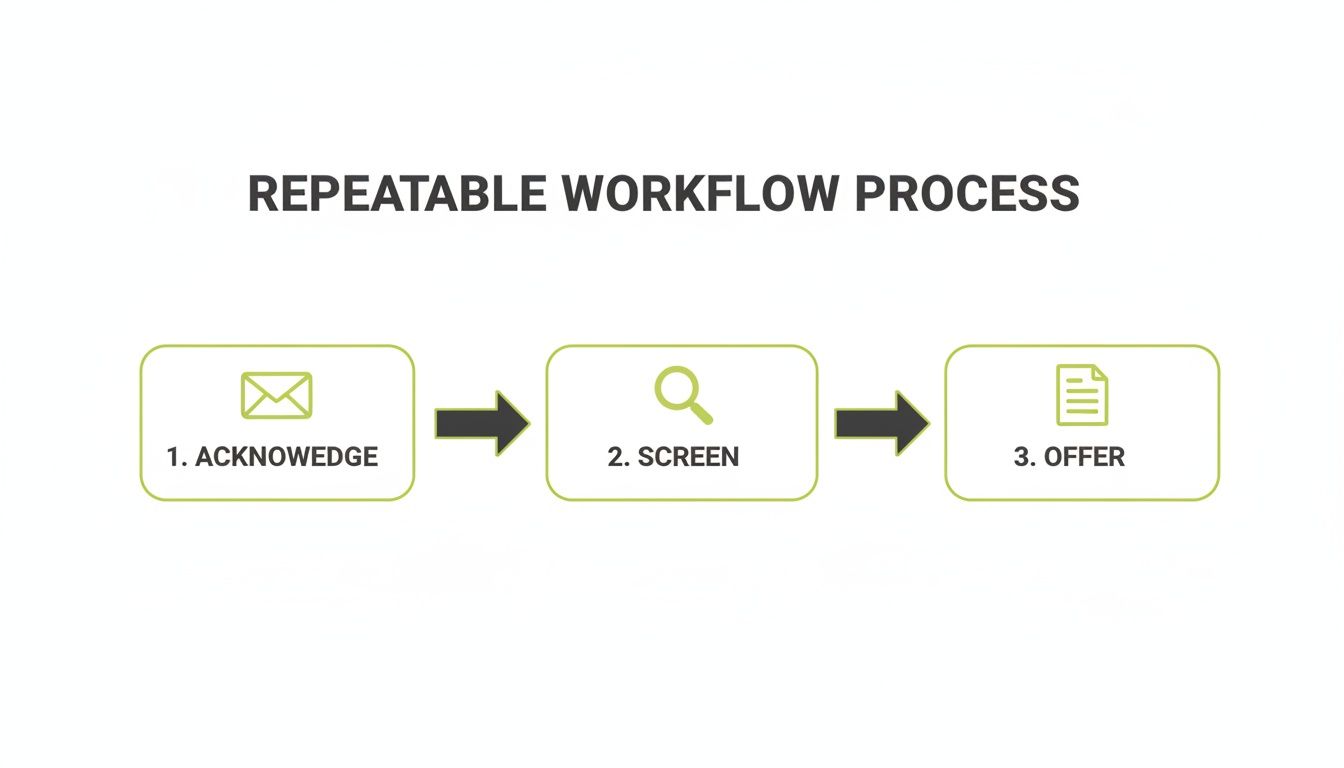
Keeping your process tight around these core stages—Acknowledge, Screen, and Offer—builds the consistency needed to scale effectively.
The Pitfall: Sacrificing Candidate Experience for Speed
This is the most frequent and damaging mistake. In the frantic rush to fill roles, it’s all too easy to treat candidates like entries in a database. Communication drops, feedback is non-existent, and applicants are left wondering what happened. This "ghosting" doesn't just lose you a candidate; it poisons your employer brand.
The Fix: Automate with a human touch. Your ATS should be your best friend here. Set up instant confirmation emails for every application and, just as importantly, automated rejection notices for those not moving forward. A polite, timely "no" is infinitely better than silence. Every applicant deserves respect, and this simple step protects your reputation for future hiring.
The Pitfall: Ignoring Compliance and Data Privacy
When you’re juggling thousands of applications, the risk of a compliance nightmare skyrockets. I’ve seen teams store resumes on shared drives or pass around personal data in emails—practices that can lead to massive legal and financial penalties under regulations like GDPR or CCPA.
The Fix: Make security your default setting. All candidate data must live in a secure, centralized system, whether that's your ATS or a dedicated resume management platform. Build clear data handling, storage, and deletion rules directly into your workflow. A process that's secure by design is your best defense against costly human error.
Frequently Asked Questions About High Volume Hiring
Even the most well-thought-out playbook can't anticipate every question. When you're shifting gears from traditional recruiting to a high-volume model, new challenges and questions are bound to pop up. Let's tackle some of the most common ones we hear from teams making this transition.
How Can We Maintain a Positive Candidate Experience?
When you’re processing hundreds or thousands of applications, it's easy for the candidate experience to suffer. But keeping your employer brand strong is critical. The key is to find the right balance between smart automation and meaningful human interaction.
Start with instant, automated acknowledgements. A simple email confirming you've received their application is a small thing that makes a big difference. It tells candidates they haven’t been tossed into a void and that you’re on top of your game.
This automation buys your recruiters time to focus where it matters most: on qualified candidates moving forward. Instead of sending another generic email, have a recruiter record a quick, personal video or make a brief phone call. These personal touches are what people remember.
The golden rule is to give everyone closure. A polite, templated rejection notice from your ATS is infinitely better than silence. Every single person who took the time to apply deserves that respect, no matter the outcome.
What Are the Most Critical KPIs to Track?
It’s tempting to get lost in a sea of data, but you really only need a handful of key performance indicators (KPIs) to know if your hiring engine is running smoothly. The right metrics will tell you exactly what’s working and what isn’t.
We tell our clients to focus on these four essentials:
Time to Fill: This is the big one. It measures the number of days from opening a job requisition to getting an offer accepted. A shorter time-to-fill means you’re moving fast and directly supporting business operations.
Quality of Hire: Speed is great, but not if you're hiring the wrong people. You can track this with hard data like 90-day retention rates or by sending simple satisfaction surveys to hiring managers.
Cost per Hire: This is your budget's reality check. Tally up every expense—from ad spend to technology fees—to see what it truly costs to bring someone on board. It helps you justify your budget and spend it wisely.
Source of Hire: Where are your best hires coming from? This metric shows you which channels deliver quality candidates, so you can stop wasting money on what doesn't work and double down on your best sources.
By keeping a close eye on these KPIs, you’ll have the insights you need to spot bottlenecks, make smarter decisions, and continuously improve your high volume hiring process.
What Is the Best Way to Choose AI and Automation Tools?
With so many tools on the market, picking the right one can feel daunting. The secret is to start with your problem, not the product. Look at your team’s daily workflow and find the single biggest time-suck. Is it the mind-numbing hours spent screening resumes? The back-and-forth chaos of interview scheduling? The tedious work of reformatting CVs?
Once you’ve named the problem, you can hunt for tools built to solve it. Look for platforms designed with recruiters in mind—the ones that integrate cleanly with the tools you already use, like your email or document software. The goal is to give your team superpowers, not force them into a clunky new system.
Always insist on a live demo, and if you can, run a small pilot with a few team members. Judge any potential tool on three simple things:
Ease of Use: How long does it take for a busy recruiter to get comfortable with it?
Real-World Impact: Does it actually save a meaningful amount of time on that bottleneck you identified?
Data Security: Is it fully compliant with regulations like GDPR and CCPA?
Finally, think about where you'll be in a year. Choose a tool that can grow with you, whether you’re hiring 50 people this quarter or 500 the next. A good technology investment should solve today's problems and be ready for tomorrow's.
Stop drowning in CVs and start closing deals faster. Saply.ai uses AI to instantly reformat, tailor, and enrich resumes, turning messy documents into client-ready submissions in minutes. See how much time you can save and book a demo today.