
how-many-pages-should-your-resume-be
How Many Pages Should Your Resume Be? Ideal Length Revealed for 2026
how-many-pages-should-your-resume-be
Written by:
how-many-pages-should-your-resume-be
Let's get one thing straight: the old "one-page resume" rule is a total myth for most professionals in 2026. If you have any significant career history, a two-page resume is now the standard. What really matters is the quality and relevance of what's on the page, not cramming your entire career into a single sheet of paper.
The One-Page Resume Rule Is Obsolete

For decades, we were all told that a resume spilling onto a second page was a fast track to the “no” pile. That advice is officially dead. Recruiters and hiring managers today actually prefer a more detailed resume, especially for roles that require a solid track record of accomplishments.
The numbers back this up. A recent 2026 survey found that 68.6% of HR professionals now favor two-page resumes. Only 21.6% still cling to the old single-page preference. Think about it: recruiters only give your resume a quick initial scan—about seven seconds—so they need to see compelling, in-depth information right away. The extra page gives you the space to provide that crucial context.
A Quick Guide to Resume Length
So, how long should your resume be? It really depends on where you are in your career. While it might feel strange to go beyond a single page, understanding when a two-page resume works best is key to presenting your value effectively.
To make things simple, here’s a quick breakdown of what works best at different career stages.
Resume Page Count at a Glance by Experience Level
This table offers a straightforward guide to help you land on the right resume length based on your years of experience.
Experience Level | Recommended Page Count | Focus |
|---|---|---|
Entry-Level (0–5 Years) | 1 Page | Potential, education, and key projects |
Mid-Career (6–15 Years) | 2 Pages | Quantifiable achievements and career progression |
Senior/Executive (15+ Years) | 2–3 Pages | Leadership impact, strategy, and extensive history |
As you can see, the more experience you have, the more space you'll need to tell your professional story.
At the end of the day, your resume is a marketing document, not just a historical record. This is a core idea we dig into in our post explaining how https://www.saply.ai/blog/recruiting-is-sales. Your goal isn't to hit a specific page count; it's to give a hiring manager enough relevant, powerful information to be convinced they need to interview you.
How Your Career Stage Shapes Your Resume's Length
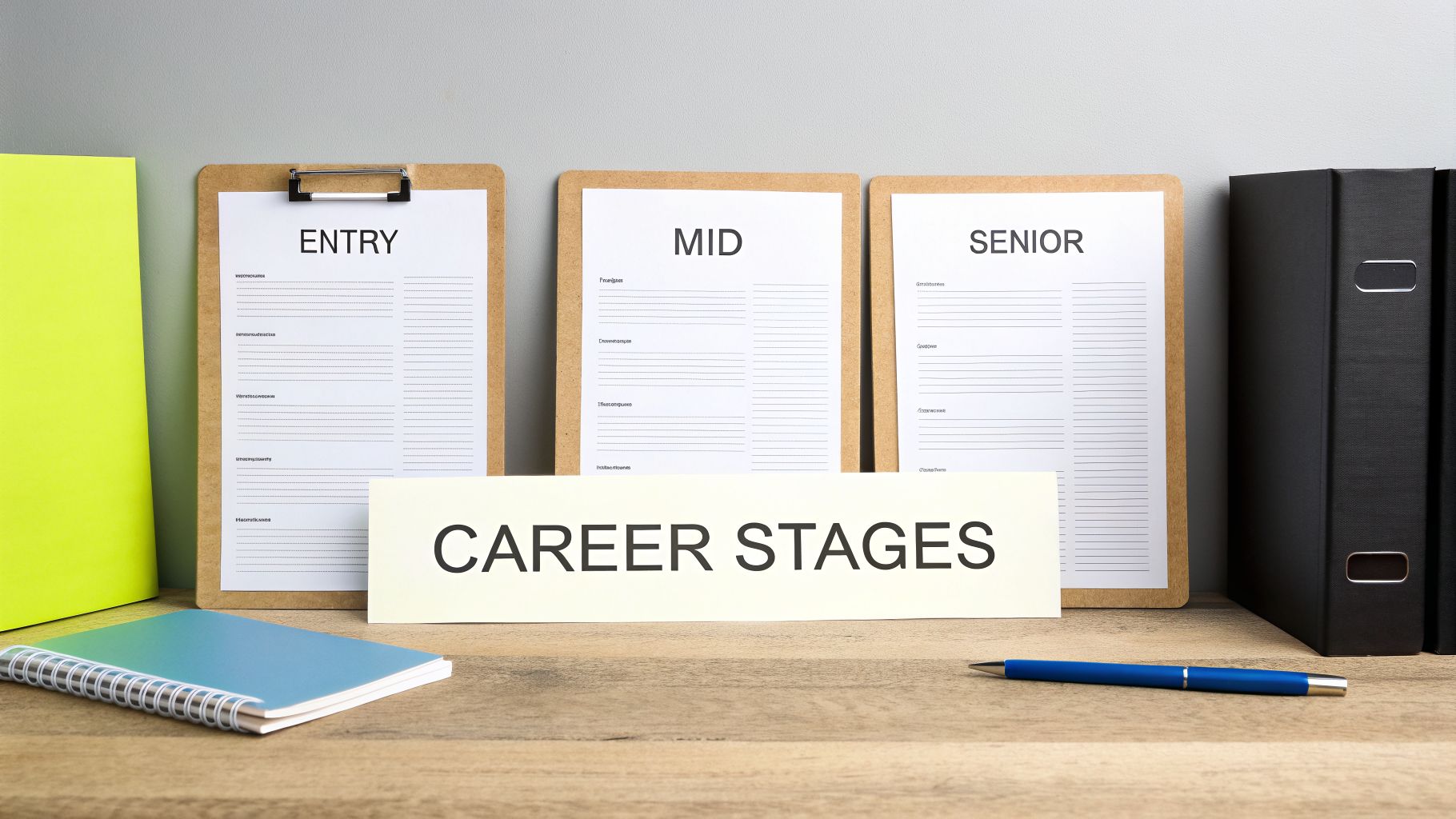
Think of your resume's length like a movie trailer. A quick, 30-second spot is perfect for a straightforward comedy, but a sprawling epic needs a full 2-minute trailer to even hint at its scope. Your career is that story, and the single biggest factor in determining your resume's length is how far along you are in your professional journey.
The right page count immediately signals your seniority to a hiring manager. A crisp one-pager from a new grad says, “I’m focused and know what’s relevant.” A more detailed two-page document from a seasoned pro communicates, “I have a deep history of delivering results.”
Let’s break down the standard expectations for each career stage.
Entry-Level Professionals (0-5 Years of Experience)
If you’re a student, recent graduate, or have less than five years of experience under your belt, the rule is simple: stick to one page. No exceptions. At this point in your career, your story is all about potential. Recruiters want a quick, high-impact summary of your education, internships, projects, and core skills.
A single-page limit forces you to be ruthless in your editing, which is a good thing. It proves you can prioritize information and communicate clearly—skills that are valuable in any job. Trying to pad your experience to fill a second page with clever formatting or fluff is a classic mistake. It just makes you look unfocused.
Expert Tip: Your one-page resume should be a highlight reel, not the full game tape. Its job is to deliver a powerful, concentrated dose of your qualifications and make the recruiter want to learn more.
Mid-Career Professionals (6-15 Years of Experience)
Once you’ve logged more than five or six years in the workforce, your story has more chapters. You've held different roles, managed projects, and—most importantly—have a track record of accomplishments you can back up with numbers. This is when a two-page resume is not only acceptable but often necessary.
Trying to cram a decade of meaningful experience onto a single page does your career a huge disservice. You’re forced to gut the very details and metrics that prove your value. A second page gives you the room you need to show your career progression, detail key wins with hard data, and build a convincing narrative around your expertise.
Senior and Executive Leaders (15+ Years of Experience)
For senior managers, C-suite executives, and academics with a long list of publications, a resume can easily extend to two or even three pages. When your career is defined by long-term strategic vision and a deep history of leadership, you simply can't tell that story in a single page without it looking like a table of contents.
The data backs this up. A longer resume often signals deeper experience and leads to better results for seasoned candidates. For example, in fields like consulting, where project leaders are scrutinized, professionals with over 10 years of experience who use a two-page resume see 2.3 times more callbacks. You can find more data-driven advice on how the career stage dictates resume length from Wobo.ai.
How Recruiters and ATS View Resume Length
To get the resume length right, you have to think like the people—and the software—reading it. Your resume faces two very different audiences: a human recruiter scanning for a quick impression and an Applicant Tracking System (ATS) analyzing it for keywords. Each one "reads" differently, and your resume has to appeal to both.
Let's bust a common myth: recruiters don't automatically toss resumes that are longer than one page. The truth is a bit more complicated. They do only spend a few seconds on their first pass, but a well-designed two-page resume isn't an issue if it’s easy to scan and full of relevant information.
A recruiter's first goal isn't to read your life story. It's to find quick proof that you’re a match for the job. A longer, well-organized resume can actually hand them that proof on a silver platter.
This is why readability is everything. A two-page wall of text is an instant turn-off and will absolutely fail the seven-second scan. But a resume with plenty of white space, clear headlines, and sharp bullet points does the work for the recruiter, guiding their eyes right to your biggest wins.
The ATS Perspective on Resume Length
So, what about the software? Don't worry, modern Applicant Tracking Systems aren't programmed to punish you for a longer resume. In many cases, it’s quite the opposite. An ATS works by parsing your document for keywords and skills that line up with the job description.
A slightly longer resume simply has more room for those keywords to appear naturally. This can actually boost your match score with the system, improving your odds of making it through the filter and onto a recruiter's screen.
Here’s a quick look at what each one wants:
Human Recruiters: They crave scannability and relevance. They won't fight through a dense two-page document, but they'll appreciate a clean one that clearly lays out your experience and accomplishments.
Applicant Tracking Systems (ATS): They care about keywords and content. An ATS doesn’t get tired, so a longer resume packed with relevant terms often performs better than a short one with less detail.
The real trick is finding the perfect balance. You need enough keyword-rich detail to impress the ATS, but the document must be so well-structured that it instantly wins over a human reviewer. This is a crucial element of modern recruitment process best practices that top candidates have mastered.
As you think about how these two gatekeepers see your resume, remember they often look at your professional brand online, too. To make sure your story is consistent and compelling, take some time to update and optimize your LinkedIn profile for success. In the end, a longer resume can be a powerful tool, but only if its design makes your value impossible to ignore.
Why Word Count Is the Real Metric for Success
We’ve all obsessed over whether our resume should be one page or two. But that's not really the right question to ask. The real secret to a resume that gets noticed isn’t about the number of pages—it’s about the number of words.
Think about it this way: two resumes can both be two pages long. One might be a dense, 1,200-word wall of text that’s impossible to skim. The other could be a crisp, 700-word document that gets right to the point. Which one do you think a busy recruiter will actually read?
When you shift your focus from pages to words, you're forced to be more strategic and concise. Every word has to earn its spot, which is exactly the kind of disciplined writing that lands interviews.
The Data-Backed Sweet Spot
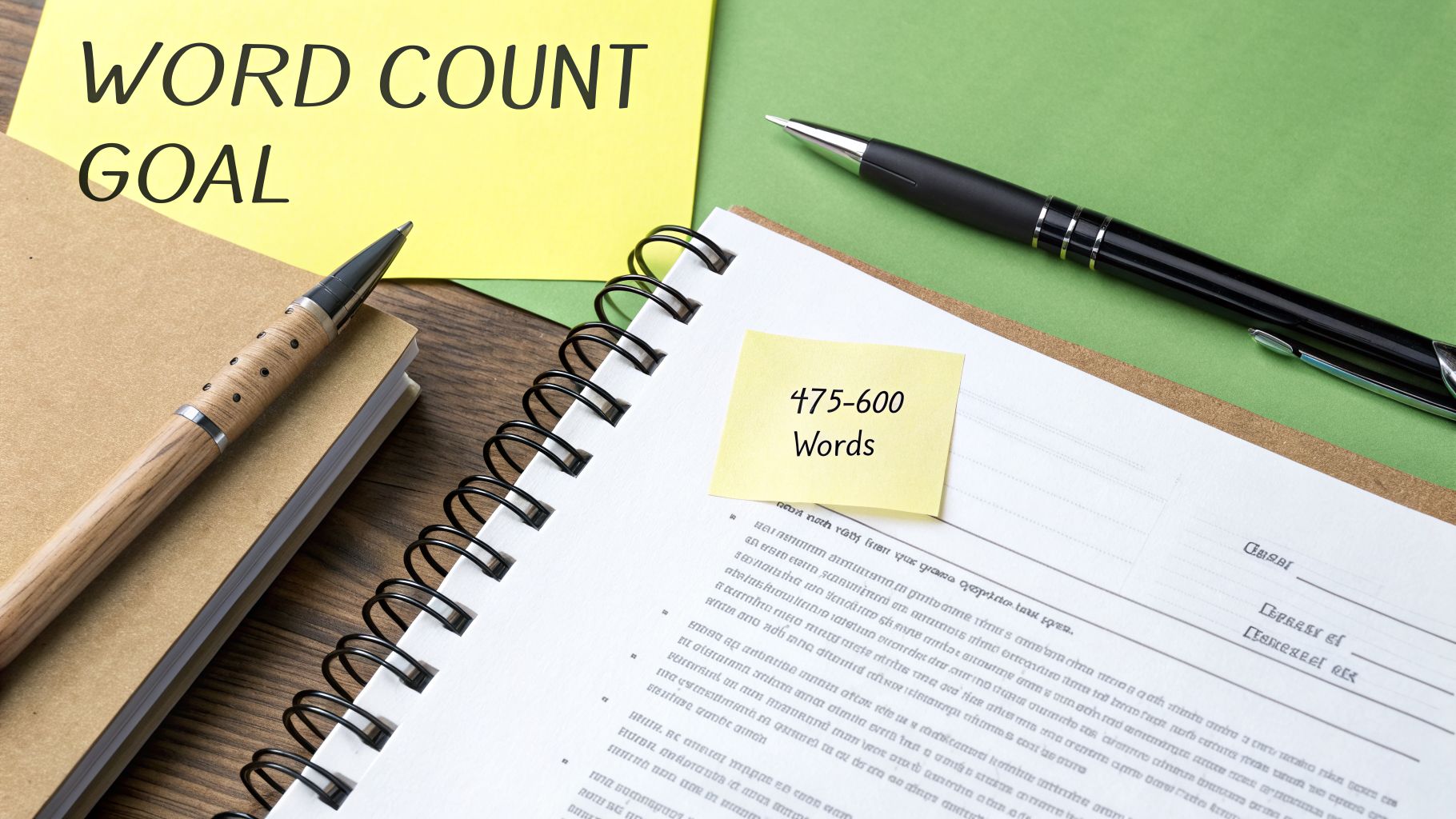
This isn't just a hunch; the numbers back it up. An in-depth analysis of over 6,000 job applications revealed a fascinating pattern. Resumes with a word count between 475 and 600 words achieved an 8.2% interview rate—nearly double the average.
Even more telling, the study found that resumes going over 600 words saw a staggering 43% drop in callbacks. The message is clear: more is not better. You can see the full study and its methodology on AIApply.co.
This 475-600 word range works because it’s detailed enough to showcase your most impressive accomplishments but short enough to keep a recruiter from losing interest. It strikes the perfect balance.
Your resume’s job isn't to tell your entire life story. Its job is to efficiently deliver just enough high-impact information to make the recruiter pick up the phone.
Translating Pages into Words
So, how does this all translate back to page length? Instead of just aiming for a page count, aim for a specific word count within that page count. This approach ensures your content is both thorough and easy to digest.
This table outlines the ideal word count ranges for resumes based on career level to maximize impact and callback rates.
Optimal Resume Word Count by Seniority
Career Level | Experience | Optimal Word Count | Typical Page Count |
|---|---|---|---|
Entry-Level | 0-5 Years | 300-500 Words | 1 Page |
Mid-Career | 6-15 Years | 475-600 Words | 1-2 Pages |
Senior/Executive | 15+ Years | 600-900 Words | 2 Pages |
This framework encourages you to make every word count instead of just filling up space. For a senior-level pro, a two-page resume shouldn't be a 1,500-word novel; it should be a tightly edited 800-word summary highlighting the absolute best achievements from the last decade.
To hit these targets, you have to be ruthless about cutting the fluff. Go through your resume line by line and replace vague duties with hard numbers. Instead of "Responsible for employee retention," try "Drove a 28% uplift in employee retention by implementing a new feedback program." That’s the kind of powerful, concise language that gets you a call.
Formatting a Multi-Page Resume That Gets Read
So you've decided on a two-page resume. That's a great start, but it's only half the job. A two-page resume that looks like a dense wall of text is just as likely to get tossed as a one-pager that’s missing critical information.
The secret to making a longer resume work lies in smart formatting. Your goal is to create a visual roadmap that guides a busy recruiter’s eyes straight to your most impressive accomplishments. This isn't just about aesthetics; it's about making your value undeniable and easy to find in a six-second scan. A well-organized two-page resume will always outperform a cluttered one.
Transform Your Content with Impactful Bullet Points
One of the quickest ways to improve your resume is to ditch dense paragraphs and embrace metric-driven bullet points. This simple change forces you to move beyond listing duties and start showcasing tangible results. It’s the difference between telling someone what you did and showing them what you achieved.
Let's look at a quick before-and-after.
Before: "I was responsible for overseeing the company's social media presence across multiple platforms. My duties included creating and scheduling content, engaging with our online community, and analyzing performance metrics to inform our digital strategy and improve overall brand reach."
This is fine, but it’s all description and no proof. The recruiter has to dig to find the value.
After:
Drove a 45% increase in audience engagement by launching a data-driven content series on Instagram and LinkedIn.
Grew follower count by 15,000 in six months through targeted community management and influencer collaborations.
Analyzed performance data to optimize posting schedules, resulting in a 20% boost in click-through rates.
See the difference? The "after" version is scannable, specific, and packed with quantifiable wins. Each bullet point acts as a powerful headline of your success. While older formats like the Europass CV have their purpose, modern resumes thrive on this dynamic, results-first approach. If you want to see how you can make this switch effortlessly, check out our guide on finding a better way than copy-pasting into Europass.
Essential Formatting Tips for Multi-Page Resumes
To keep a recruiter engaged all the way to the end of page two, your formatting has to be clean and consistent from top to bottom.
Add a Header on Page Two: This is non-negotiable. Always put a simple header on the second page with your name and "Page 2." If the pages get physically separated (it happens!), the hiring manager will know who it belongs to.
Use Consistent Fonts and Margins: Stick with a professional, easy-to-read font like Calibri, Arial, or Georgia in a 10-12 point size. Keep your margins between 0.5 and 1 inch to give your text room to breathe.
Leverage Clear Headings: Use bolded, slightly larger headings for sections like "Professional Experience" or "Key Projects." This breaks up the document visually and creates a clear, logical flow for the reader.
Practical Rules for Getting Your Resume Length Just Right
Understanding the theory is great, but now it’s time to get practical. When you're staring at your draft, deciding what to keep and what to cut can feel overwhelming. These rules will help you make those tough calls with confidence.
Think of it this way: every line on your resume is valuable real estate. The goal isn't just to fill the page, but to make sure every single word is working hard to sell your expertise.
The 10-Year Rule
Recruiters care most about what you've done recently. As a solid rule of thumb, concentrate your detailed, achievement-focused bullet points on jobs from the last 10 years. Anything older than a decade simply doesn't carry the same weight.
For example, if you’re a senior director now, no one needs a play-by-play of your first entry-level gig from 15 years ago. You can bundle older positions into a simple "Early Career" section, listing just the company and title. This frees up precious space for the accomplishments that matter today.
The Relevancy and Metrics Rule
For every single line on your resume, ask yourself one simple question: "Does this directly relate to the job I'm applying for?" Be ruthless. If a skill, project, or even an entire job description doesn't align with what the company is looking for, it has to go.
Once you’ve confirmed a point is relevant, your next job is to frame it around results, not just responsibilities. This is where you really start to stand out.
Instead of: "Responsible for managing social media accounts." Write: "Grew social media engagement by 45% in 6 months by launching a new content strategy."
Adding numbers turns a passive statement into a compelling story of your impact. It’s the fastest way to show a hiring manager what you can actually deliver.
Once you've sorted out your content and have a target length in mind, this decision tree can help you nail the final formatting touches.
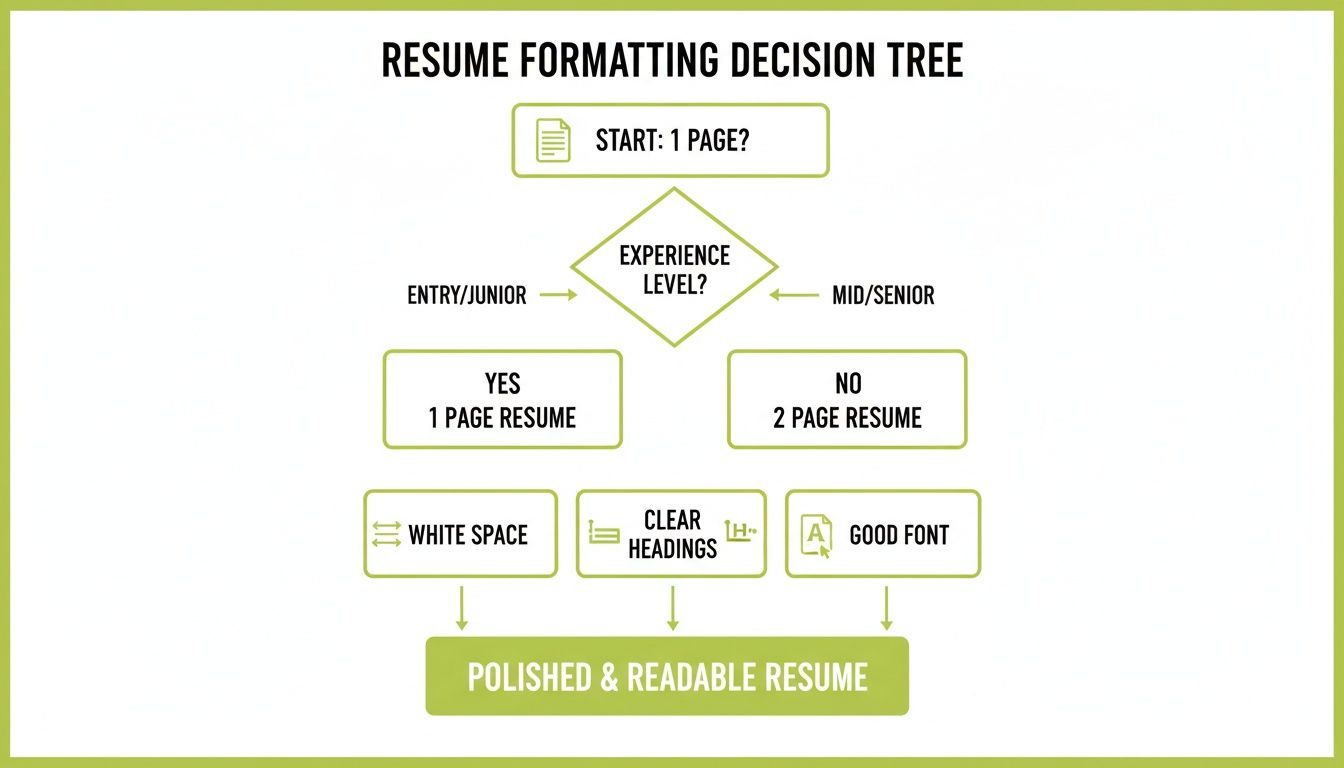
As you can see, the core principles of good design—like using plenty of white space, clear headings, and a professional font—are essential no matter how long your resume is. Readability is always key.
Frequently Asked Questions About Resume Length
Okay, so we've covered the general rules. But I know from experience that once you start applying them, the "what ifs" start to creep in.
Let's walk through a few of the most common questions I get about resume length so you can hit "send" with total confidence.
Should I Shrink Margins and Font to Fit a Two-Page Resume on One?
I see this all the time, and the answer is a hard no. Trying to cram two pages of content onto one by shrinking the margins or using a tiny font is one of the worst mistakes you can make. It immediately signals that you're prioritizing an arbitrary rule over the reader's experience.
A cramped, hard-to-read resume is an instant turn-off for a recruiter who has to review dozens, if not hundreds, of them. It just looks unprofessional.
Key Takeaway: A clean, spacious two-page resume is always better than a cluttered one-pager that makes someone squint. Stick to standard 1-inch margins and a professional font between 10-12 points.
Is a Three-Page Resume Ever Okay?
It can be, but you have to be in a pretty specific, high-level category for it to make sense. We're talking about a very small percentage of the workforce.
A third page might be appropriate for:
C-suite executives (think CEOs or CFOs) with decades of high-impact leadership and a long track record to document.
Academics or senior scientists who need space for extensive lists of publications, research grants, and speaking engagements.
Senior-level government officials applying for roles that demand an exhaustive career history.
For almost everyone else in the corporate world, two pages is the absolute limit. If your experience is spilling onto a third page, it’s a strong signal that you need to be more ruthless in your editing. A great strategy here is to create an "Early Career Summary" section to condense your oldest, least relevant roles.
Does Resume Length Change for Different Industries?
While the core principles we’ve discussed hold true pretty much everywhere—one page for entry-level, two for experienced pros—some fields do have their own quirks.
In highly technical fields like IT or engineering, a well-structured two-page resume is often expected. You need that space to detail specific projects, tech stacks, and critical certifications. On the other hand, for creative roles in areas like marketing or design, a concise resume that links out to a killer online portfolio often makes a bigger impact than an extra page of text.
No matter your industry, the data-backed advice is your best starting point.
At Saply.ai, we specialize in turning messy CVs into polished, client-ready submissions in just minutes. Our AI-powered platform helps recruiters reformat, tailor, and enrich resumes to win more roles, faster. See how it works.