how-ai-is-changing-recruitment
How AI Is Changing Recruitment: Use Cases, Benefits, Risks
Recruiters used to spend most of their day on tasks that had nothing to do with actually recruiting. Formatting CVs, tailoring resumes to job descriptions, screening applications one by one, all manua...
Written by: Saply Team
How AI Is Changing Recruitment: Use Cases, Benefits, Risks
Recruiters used to spend most of their day on tasks that had nothing to do with actually recruiting. Formatting CVs, tailoring resumes to job descriptions, screening applications one by one, all manual, all repetitive, all time-consuming. That’s how AI is changing recruitment: by taking over the work that slows teams down and letting them focus on the parts that require human judgment. For staffing agencies handling high volumes of candidates, this shift isn’t theoretical anymore, it’s already reshaping daily operations.
AI now touches nearly every stage of the hiring process, from sourcing and screening to matching candidates with open roles. The technology has moved well beyond chatbots and keyword filters. Today’s tools can analyze a CV against a job description, score the match, flag skill gaps, and format the resume to agency standards, all in seconds. At Saply, we’ve built exactly this kind of AI-powered workflow for staffing teams, so we’ve seen firsthand how these capabilities play out in practice.
But AI in recruitment isn’t all upside. There are real risks around bias, data privacy, and over-reliance on automation that every agency should understand before going all-in. This article breaks down the specific use cases where AI delivers measurable results, the benefits worth paying attention to, and the risks that need honest consideration. Whether you’re already using AI tools or evaluating your options, this overview will give you a clear picture of where the technology stands right now and where it’s headed.
What AI is changing in recruitment
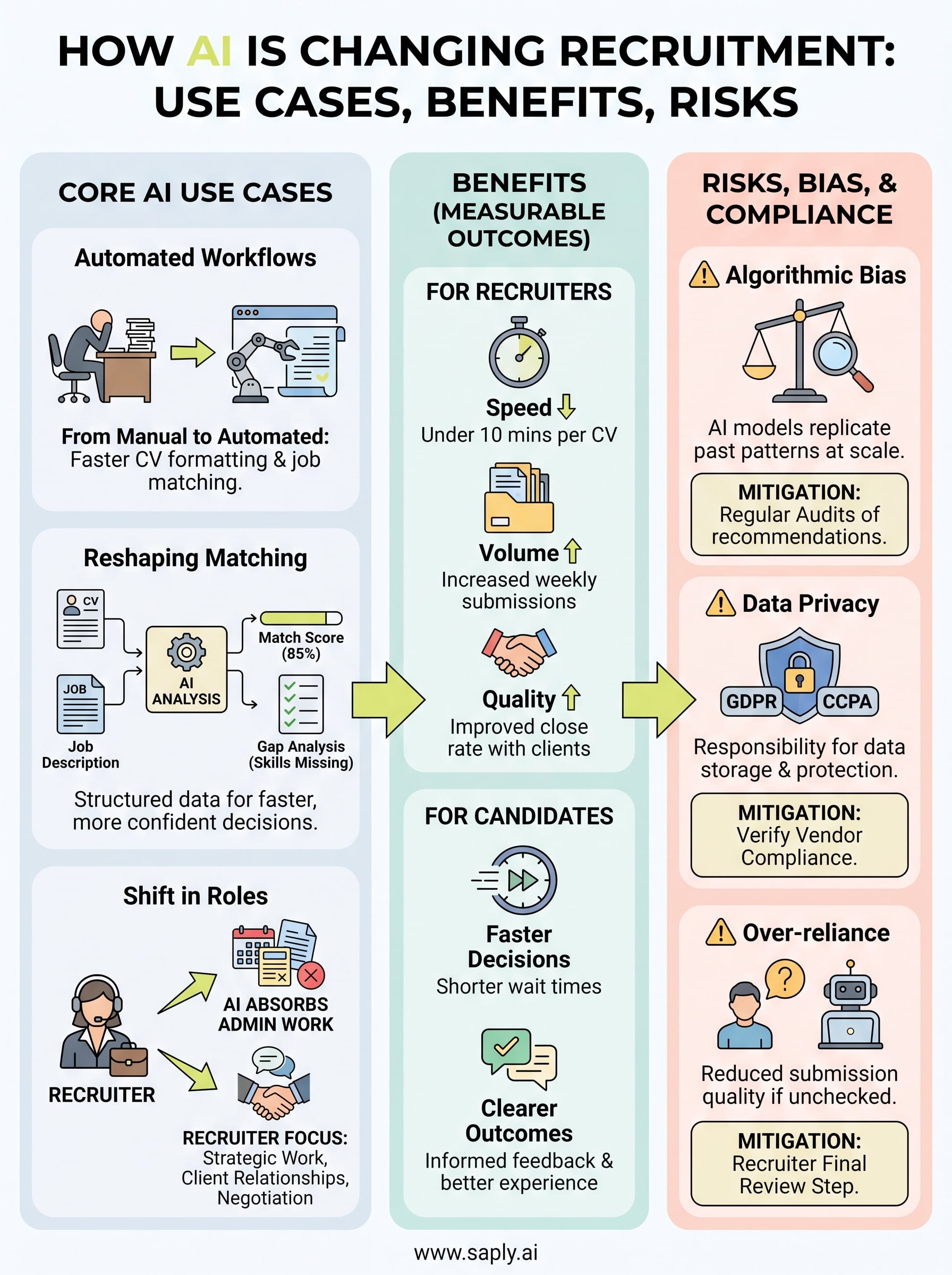
Recruitment has always had two distinct sides: the strategic work of building relationships, understanding client needs, and making placement decisions, and the administrative work of formatting documents, screening applications, and moving data between systems. AI is changing the second category fast. It’s not replacing recruiters; it’s absorbing the tasks that consumed hours of their day without adding real value to the process.
From manual tasks to automated workflows
Before AI tools became practical, a recruiter at a staffing agency might spend 30 to 60 minutes on a single CV, copying candidate details into a template, adjusting formatting, rewriting bullet points to match a job description, and then checking everything again before submission. Multiply that by 20 or 30 candidates a week, and you can see why submission volume had a hard ceiling.
AI-powered formatting and tailoring tools have cut that time down to minutes per CV, which directly increases how many candidates a team can submit in a given week.
Tools can now apply agency-branded templates automatically, pull job description requirements directly from an ATS, and generate a tailored resume that surfaces the most relevant experience. That same workflow that took an hour now takes a few clicks. For staffing agencies competing on speed of submission, that reduction is a real operational advantage.
How AI is reshaping candidate matching
Matching candidates to roles used to rely on keyword searches and recruiter instinct. AI-driven matching goes further by analyzing the full text of a CV against the complete requirements of a job description, including skills, certifications, experience levels, and inferred competencies. The result is a structured match score and gap analysis that tells you exactly where a candidate is strong and where they fall short before you pitch them to a client.

This is one of the clearest examples of how AI is changing recruitment in ways you can actually measure. Instead of relying on memory or instinct alone, your team gets structured data to make faster, more confident decisions about who to submit and who to hold back. That shift from gut-feel to data-backed decisions reduces placement risk and builds more credibility with clients over time.
The shift in recruiter roles
When AI handles formatting, tailoring, and initial screening, recruiters shift their time toward higher-value activities: client relationship management, sourcing harder-to-fill roles, and closing placements that require genuine persuasion and negotiation. That is not a minor operational change. It fundamentally alters what a recruiter’s day looks like and which skills actually matter in the role going forward.
Your team still needs to review AI output critically. The technology performs best when a recruiter stays involved in quality control and final judgment calls, particularly for senior or specialized placements where nuance matters. AI raises the floor on submission quality and speed; the recruiter raises the ceiling by applying context and relationship knowledge that no system can replicate on its own.
Why AI matters for recruiters and candidates
Understanding how AI is changing recruitment requires looking at it from both sides of the hiring process. Recruiters and candidates have different pain points, but AI tools address both in ways that create real improvements in how hiring actually happens. The impact isn’t abstract; it shows up in measurable outcomes like faster time-to-submit, higher placement rates, and a better experience for the people applying for jobs.
For recruiters: speed and submission quality
When your team submits candidates faster and with stronger CV presentation, your close rate with clients improves. That’s the core reason AI matters for recruiters at staffing agencies. You’re not just saving time internally; you’re changing how clients perceive your service. A well-formatted, tightly tailored CV that lands within hours of a role going live sends a signal about your agency’s capability that a slow, generic submission never does.
The recruiter who submits the right candidate first, with a CV that clearly matches the job requirements, wins the placement more often than the one with the better candidate who shows up second.
AI tools also reduce the cognitive load on your team by handling the parts of the job that require attention but not expertise. Formatting decisions, section alignment, and keyword optimization drain focus without building placement relationships. Removing them from your team’s daily workload frees up time for the work that actually differentiates your agency from competitors operating the old way.
For candidates: faster decisions and clearer outcomes
Candidates benefit from AI-assisted recruitment in ways that often go unnoticed. When your team uses AI matching and gap analysis, candidates get more informed feedback about where they stand relative to specific roles. Instead of vague rejections or silence, you can tell a candidate exactly which skills or certifications would strengthen their next application.
Shorter wait times between submission and client feedback also reduce the uncertainty that frustrates most job seekers. That improvement in experience reflects well on your agency and increases the likelihood that strong candidates return to you for future placements rather than going elsewhere.
Core AI use cases across the hiring funnel
Understanding how AI is changing recruitment gets clearer when you map specific tools to specific stages of your hiring funnel. Each stage has different bottlenecks, and AI addresses them in different ways. Knowing which use case applies where helps you evaluate tools based on your actual workflow rather than a vendor’s feature list.
Sourcing and initial screening
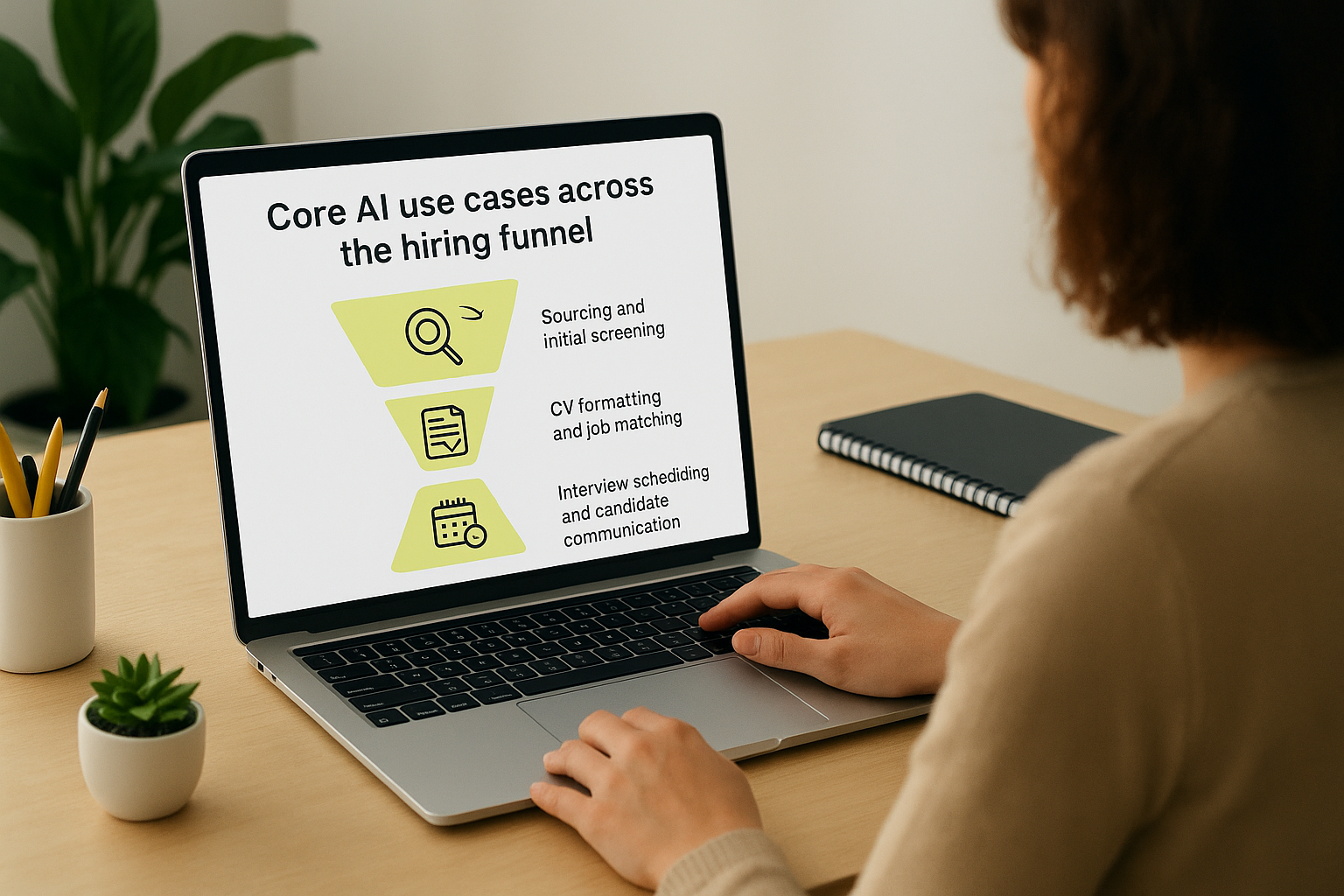
AI sourcing tools scan job boards, databases, and professional networks to surface candidates who match your open roles based on skills, experience, and location criteria. Automated screening then filters incoming applications before a recruiter reviews them, flagging the strongest profiles according to parameters you control. This cuts the time your team spends reading through applications that were never a realistic fit in the first place.
The faster you reach a qualified shortlist, the faster you put a strong candidate in front of your client.
CV formatting and job matching
This is where AI delivers the most immediate value for staffing agencies. Formatting tools apply your agency’s branded template automatically, removing the copy-paste work that used to consume a significant part of a recruiter’s morning. Job matching tools then analyze the formatted CV against a job description and return a structured score with identified gaps and strengths, so you pitch candidates with actual data behind the decision rather than instinct alone.
Tools like Saply handle both steps inside the document editors and ATS systems your team already uses daily, which means no new software to learn and no disruption to your existing submission workflow.
Interview scheduling and candidate communication
AI scheduling tools eliminate the back-and-forth of booking interviews by syncing calendars and proposing available time slots automatically. Automated messaging handles confirmation emails, reminders, and status updates without your team writing each one from scratch. That consistency raises the quality of candidate experience across every placement your agency manages without adding hours to your team’s week.
Each of these use cases targets a stage where manual effort has historically been the highest, which is exactly where AI delivers the most measurable return on investment.
Benefits you can measure and how to track them
AI benefits only matter if you can verify they’re real in your specific operation. One of the clearest signs of how AI is changing recruitment is that many of its advantages are actually quantifiable, not just anecdotal. Tracking the right metrics from the start helps you justify the investment, identify where tools are working, and course-correct quickly when they’re not delivering.
Submission speed and volume
The most immediate metric to track is time spent per CV, from receiving a raw candidate file to submitting a formatted, tailored resume to the client. Before implementing AI tools, log your baseline number. After implementation, measure the same task. Most staffing teams see this drop from 30 to 60 minutes per CV to under 10 minutes, which compounds quickly across a full week of submissions.
Track weekly submission volume alongside this number. If your team formatted 15 CVs a week before AI and now completes 40 with the same headcount, that increase is a direct, measurable outcome you can present to agency leadership.
The best way to build internal confidence in AI tools is to show leadership a clear before-and-after comparison using numbers your agency already tracks.
Placement rate and match quality
Placement rate (the percentage of submitted candidates who receive an offer) tells you whether AI-assisted matching is actually improving the quality of your submissions. If your match score and gap analysis are working, you should see this number improve over time as your team submits candidates with higher alignment to job requirements.
Track this metric per recruiter and per role type so you can identify where AI matching performs best and where human judgment still needs to carry more weight. Combine it with client feedback on submission quality to build a fuller picture of whether your AI investment is improving outcomes at the level that matters most: placing candidates faster and more reliably than before.
Risks, bias, and compliance in AI hiring
Any honest discussion of how AI is changing recruitment has to include the downsides. AI tools can reduce time-to-submit and improve match quality, but they also introduce new categories of risk that your agency needs to manage actively. Ignoring these risks doesn’t make them go away; it just means you encounter them after a problem has already surfaced.
Algorithmic bias in screening and matching
AI models learn from historical data, and if that data reflects past hiring patterns that favored certain candidate profiles, the model will replicate those patterns at scale. A screening tool trained on placements your agency made five years ago may systematically deprioritize candidates who don’t fit a profile your team has unconsciously defaulted to before.
The scale of AI means a biased model doesn’t make one bad call; it makes the same biased call thousands of times before anyone notices.
Your team should audit AI recommendations regularly by reviewing which candidate profiles get high match scores and which get filtered out. If you notice patterns tied to factors unrelated to job requirements, that’s a signal your tool needs reconfiguration or your training data needs review.
Data privacy and legal compliance
Candidate CVs contain personally identifiable information, and the moment you process that data through an AI tool, you take on responsibility for how it’s stored, used, and protected. Depending on where your candidates are located, you may have obligations under regulations like the GDPR or the California Consumer Privacy Act.
Before deploying any AI tool in your hiring workflow, confirm that the vendor has clear data handling policies and that their infrastructure meets the compliance standards your agency operates under. Ask specifically about data retention, third-party sharing, and where candidate information is processed.
Over-reliance on automation
AI tools work best as a support layer, not a replacement for recruiter judgment. When teams stop reviewing AI output critically, submission quality can actually decline because errors go unchecked and edge cases get mishandled. Build a review step into your workflow so that a recruiter always sees the AI recommendation before a CV reaches a client.
Final takeaways
The clearest takeaway from how AI is changing recruitment is that the technology already performs well for specific, high-volume tasks: CV formatting, job matching, and initial candidate screening. These are exactly the bottlenecks that slow staffing agencies down and place a hard ceiling on how many candidates your team can submit each week.
Your job isn’t to automate everything. The recruiters who get the most out of AI are the ones who use it to eliminate administrative drag while staying closely involved in the quality control and relationship work that actually wins placements. Treat AI output as a starting point, not a final answer.
If you want to see this in practice, try Saply’s AI-powered CV formatting and tailoring tools and measure the time savings for yourself. The free 14-day trial requires no credit card, so the only real barrier between your team and a faster submission workflow is taking that first step.