
how-to-improve-candidate-experience
How To Improve Candidate Experience: 10 Practical Steps
Most recruiters know that a clunky hiring process costs them talent. But fewer realize just how much of the candidate experience hinges on what happens after someone applies, the silence, the slow fol...
Written by: Saply Team

How To Improve Candidate Experience: 10 Practical Steps
Most recruiters know that a clunky hiring process costs them talent. But fewer realize just how much of the candidate experience hinges on what happens after someone applies, the silence, the slow follow-ups, the sloppy CV reformats that misrepresent a candidate’s actual skills. If you’re wondering how to improve candidate experience, the answer starts with fixing the operational bottlenecks that create friction for everyone involved.
For staffing agencies handling dozens (or hundreds) of open roles at once, speed and accuracy in candidate submissions directly shape how applicants perceive your process. A candidate whose CV is tailored well and submitted fast feels prioritized. One left waiting while a recruiter manually reformats their resume for the third time that day? Not so much. That’s exactly why we built Saply, to eliminate the formatting and tailoring busywork so recruiters can focus on the human side of hiring.
This guide breaks down 10 practical steps you can take right now to create a smoother, more respectful experience for every candidate who enters your pipeline.
What candidate experience means and why it matters
Candidate experience is the sum of every interaction a person has with your agency from the moment they see a job post to the moment they receive a final decision. It covers how clear your job descriptions are, how easy your application process feels, how quickly you respond, how well you run interviews, and whether you actually close the loop at the end. Each touchpoint either builds or erodes trust, and candidates remember the gaps more than the highlights.
What candidate experience actually covers
Most people assume candidate experience is mostly about being friendly during interviews. In reality, it spans the entire recruitment lifecycle, and the moments candidates remember most are often the administrative ones: waiting three days for a confirmation email, receiving a reformatted CV that misrepresents their skills, or hearing nothing after a final-round conversation. Every operational gap in your process becomes a signal to the candidate about how much you value their time.
Here’s a breakdown of the key touchpoints across the hiring lifecycle:
| Stage | Candidate touchpoint | What they notice |
|---|---|---|
| Discovery | Job posting | Clarity, relevance, tone |
| Application | Form or submission process | Ease, length, confirmation |
| Screening | Initial contact | Speed, professionalism |
| Interview | Structure and format | Respect, preparation |
| Submission | CV presentation to client | Accuracy, quality |
| Decision | Offer or rejection | Timing, honesty |
Why a poor experience costs you more than you think
When candidates have a bad experience with your agency, the damage extends well beyond that one placement falling through. Applicants share negative hiring experiences with their networks, on review platforms, and in professional communities. For staffing agencies, a single poorly handled candidate can discourage future talent from ever entering your pipeline, shrinking your available pool over time precisely when you need it most.
A negative candidate experience doesn’t just lose you one hire. It quietly reduces the number of strong candidates willing to work with your agency in the future.
Understanding how to improve candidate experience also directly affects your client relationships. When you submit candidates who are well-prepared, accurately represented, and fully informed about the role, your clients see a more professional operation. Faster, cleaner submissions signal that your agency runs with discipline. Sloppy handoffs, on the other hand, reflect poorly on your credibility regardless of how strong the underlying candidate actually is.
Staffing agencies occupy a unique position: you represent both the candidate and the client simultaneously. A recruiter who handles candidates carelessly is also weakening the product they deliver to clients, because the quality of the candidate experience directly shapes what ends up in a client’s inbox. That’s why improving candidate experience isn’t a soft HR priority; it’s a direct lever on agency revenue, reputation, and long-term growth.
Steps 1–2: Write clear jobs and simplify applying
The first two steps in how to improve candidate experience happen before you ever speak to an applicant. If your job postings are vague and your application process requires unnecessary effort, you lose strong candidates before they ever enter your pipeline. Fixing these two areas first gives every other improvement a foundation to stand on.
Step 1: Write job descriptions that tell candidates what they actually need to know
Most job postings fail candidates because they describe what the company needs internally, not what a candidate needs to decide whether to apply. A strong job description answers three things clearly: what the role actually involves day-to-day, what qualifications are required versus preferred, and what the candidate can expect in return (compensation range, location, contract type).
A job post that forces candidates to guess at the basics will attract fewer qualified applicants and more irrelevant ones, wasting everyone’s time.
Use this structure as a template for every posting:
| Section | What to include |
|---|---|
| Role summary | 2–3 sentences on the core purpose of the job |
| Key responsibilities | 4–6 bullet points, concrete tasks only |
| Required qualifications | Hard requirements, nothing aspirational |
| Preferred qualifications | Nice-to-haves, clearly labeled as such |
| Compensation and terms | Salary range, contract type, location or remote policy |
| Next steps | What happens after they apply and when |
Avoid padding your job posts with company mission statements or buzzword-heavy culture descriptions. Candidates skim, and anything that buries the practical details increases drop-off.
Step 2: Cut friction from your application process
Once someone decides to apply, every unnecessary step is a reason to quit. Long forms, mandatory account creation, and redundant uploads (like asking for a CV and then asking candidates to retype their work history) are the most common drop-off triggers you can fix immediately.
Keep your application process to these essentials: CV upload, contact details, and one or two role-specific questions. If a candidate can complete your application in under five minutes on a mobile device, you have removed the most common barrier to entry.
Steps 3–5: Set expectations and communicate fast
Once a candidate applies, your communication cadence becomes the loudest signal about how much you value their time. Most candidate frustration doesn’t come from rejection; it comes from silence and uncertainty. These three steps show you how to improve candidate experience by removing both.
Step 3: Tell candidates what your process looks like before they ask
After someone applies, send a confirmation message that maps out every stage they’ll move through and roughly how long each step takes. You don’t need to promise exact dates, but a rough timeline gives candidates something concrete to hold onto rather than wondering whether their application vanished.

Use this template for your initial acknowledgment message:
“Thanks for applying to [Role Title]. Here’s what to expect: we review applications within [X] business days, conduct initial screening calls in [timeframe], and aim to complete interviews within [timeframe]. You’ll hear from us at each stage regardless of the outcome.”
Candidates who understand the process are far less likely to withdraw early or accept a competing offer while waiting for news from you.
Step 4: Respond to screening-stage candidates within one business day
Speed at the screening stage is a competitive differentiator. Strong candidates are typically in multiple pipelines at once, and a slow first response from your agency signals that working with you will feel like friction. Set a firm internal standard: every candidate who passes your initial review gets a response within one business day.
If your volume makes that difficult to manage manually, use templated email responses triggered by ATS status changes to handle the first touchpoint automatically while a recruiter follows up personally for qualified candidates.
Step 5: Send a status update every five business days, even when nothing has changed
Most agencies only contact candidates when there’s news. Proactive silence-breaking updates keep candidates engaged and prevent them from assuming the worst. A short message that says “we’re still in review and expect to move forward by [date]” takes thirty seconds to send and dramatically reduces candidate drop-off during longer hiring cycles.
Steps 6–8: Run respectful, structured interviews
The interview stage is where most candidates form their strongest impressions of your agency. How you run interviews signals whether your process is organized or improvised, and it’s one of the highest-leverage areas when thinking about how to improve candidate experience across a high-volume pipeline.
Step 6: Send candidates prep materials before every interview
Candidates perform better and feel more respected when they know what to expect going in. Send a confirmation message 24–48 hours before any interview that covers the format, the names of interviewers, the estimated duration, and whether they should prepare anything specific. You remove unnecessary anxiety and give them a fair chance to show up at their best.
Use this pre-interview message template:
“Hi [Name], your interview for [Role Title] is confirmed for [date/time]. You’ll be speaking with [Interviewer Name], [Title]. The session will take approximately [X] minutes and will focus on your experience in [key area]. Bring any questions you have about the role.”
Step 8: Use a consistent structure for every interview
Unstructured interviews produce inconsistent outcomes and leave candidates feeling like they stumbled through a casual conversation rather than completed a fair evaluation. Build a standard set of questions for each role type and use the same format across every candidate for that opening.

A basic structured interview format looks like this:
| Section | Time allocation |
|---|---|
| Role overview and context | 5 minutes |
| Candidate background questions | 15 minutes |
| Role-specific competency questions | 15 minutes |
| Candidate questions | 10 minutes |
Consistent structure also reduces evaluation bias, which protects your agency and improves the quality of the submissions you send to clients.
Step 8: Brief your interviewers on each candidate before the call
Nothing signals disrespect faster than an interviewer who clearly hasn’t read the CV. Require every interviewer to review the candidate profile at least 30 minutes before the session. Include a short briefing note with the candidate’s key background, the role they’re interviewing for, and two or three specific areas worth probing.
Prepared interviewers ask sharper, more relevant questions, which makes the conversation more valuable for both sides and reflects well on how your agency operates.
Steps 9–10: Close the loop and improve
The final two steps in how to improve candidate experience are where most agencies fall short. Closing the loop means giving every candidate a clear outcome, and improving means using their feedback to sharpen your process over time. Both steps compound in value the more consistently you apply them.
Step 9: Send a decision to every candidate, including rejections
Every candidate who enters your pipeline deserves a final answer, regardless of whether you’re moving forward. Ghosting rejected candidates is the single most common complaint across recruitment, and it costs agencies more goodwill than almost any other operational failure. A brief, honest rejection message takes less than two minutes to send and protects your agency’s reputation in the long run.
A candidate you reject today may be the strongest fit for a role you post six months from now. How you close the loop determines whether they’ll apply again.
Use this template for rejection messages at any stage:
“Hi [Name], thank you for your time during our process for [Role Title]. We’ve decided to move forward with another candidate whose background more closely matches the current requirements. We’ll keep your profile on file for future openings that may be a better fit. We appreciate you considering us.”
Keep your rejection messages short, specific where possible, and free of hollow phrases like “we’ll keep you in mind” unless you mean it. Candidates can tell the difference between a genuine message and a copy-paste brush-off.
Step 10: Collect candidate feedback and measure it
Sending a short post-process survey gives you direct insight into where your candidate experience breaks down. Ask candidates to rate specific touchpoints rather than their overall experience, and you’ll get actionable data instead of vague sentiment.
Send this three-question survey after every completed process:
| Question | Response format |
|---|---|
| How clear was the information you received at each stage? | 1–5 scale |
| How satisfied were you with our response times? | 1–5 scale |
| What one thing would have improved your experience? | Open text |
Review responses monthly, flag the most common friction points, and assign a specific fix to each one. Candidate feedback is the most direct signal your agency has for where the process is actually breaking down.
Next steps
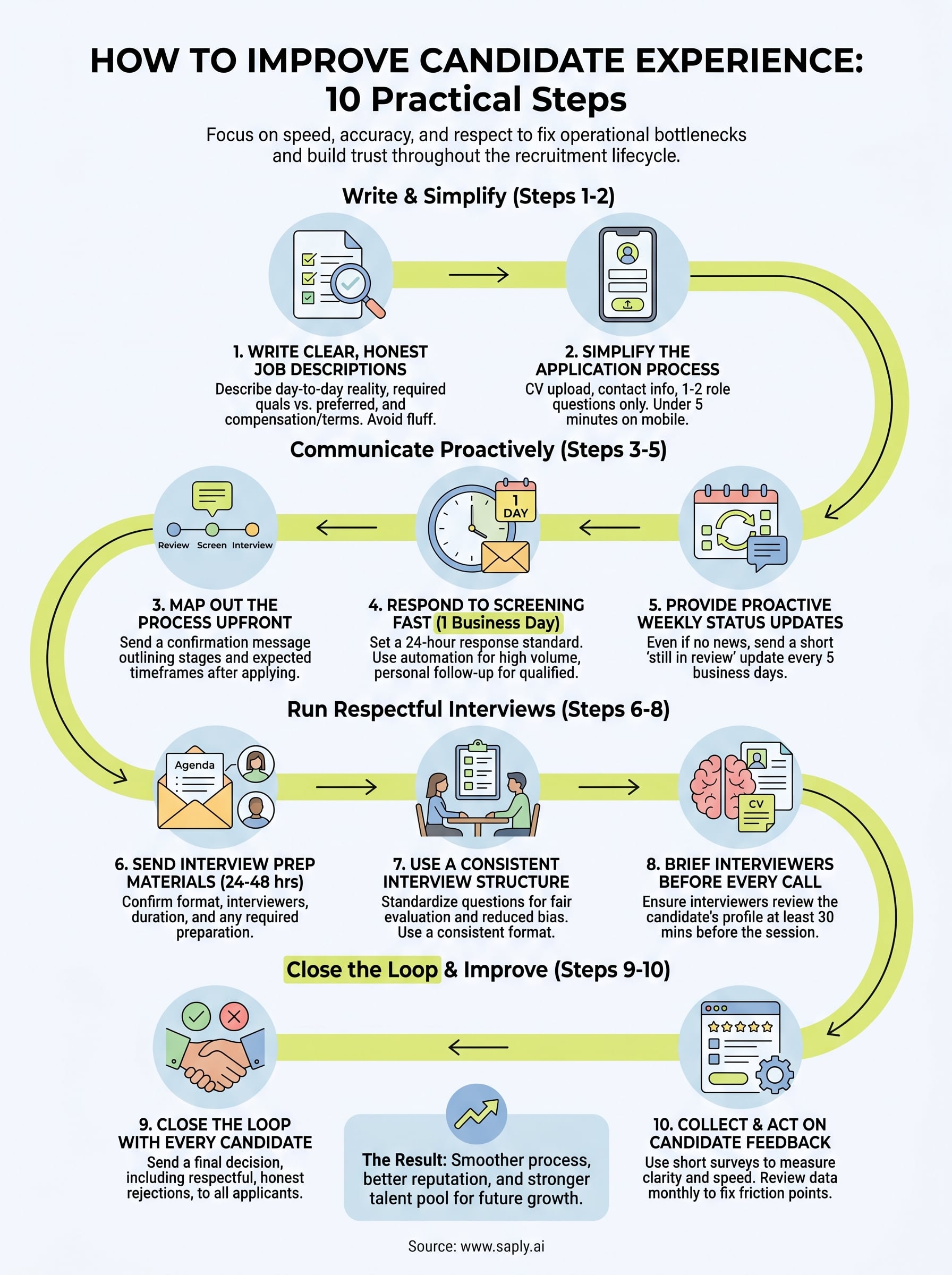
You now have a complete picture of how to improve candidate experience across every stage of your pipeline, from the job post to the final decision. The 10 steps in this guide work together: fixing your job descriptions makes your communication cleaner, structured interviews make your submissions stronger, and closing the loop builds the kind of reputation that keeps strong candidates coming back to your agency.
Start with the steps that address your biggest current gap. If candidates go quiet mid-process, focus on Steps 3 through 5. If your submission quality is inconsistent, the interview structure and CV accuracy steps will have the highest immediate payoff.
For staffing agencies that want to eliminate the CV formatting and tailoring bottleneck that slows down submissions and frustrates candidates, Saply’s AI-powered recruitment platform handles that work automatically so your team can stay focused on the human side of hiring. Try it free for 14 days with no credit card required.