
what-is-a-skills-gap-analysis
What Is a Skills Gap Analysis? Steps, Examples, Template
Every open role comes with a set of requirements, and every candidate brings a unique mix of abilities. The disconnect between the two is exactly what a skills gap analysis helps you identify. It's a...
Written by: Saply Team
What Is a Skills Gap Analysis? Steps, Examples, Template
Every open role comes with a set of requirements, and every candidate brings a unique mix of abilities. The disconnect between the two is exactly what a skills gap analysis helps you identify. It’s a structured process for comparing the skills your workforce (or a candidate) currently has against the skills actually needed, whether that’s for a specific position, a department, or an entire organization. For staffing agencies handling high volumes of submissions, understanding this gap is the difference between pitching a strong match and wasting a client’s time.
A skills gap analysis isn’t just an HR exercise reserved for annual reviews. It’s a practical tool that recruiters and staffing consultants use to make smarter placement decisions, flag development needs, and build a case for why a candidate fits, even when their resume doesn’t check every box. At Saply, our CV-to-job matching feature does exactly this at scale, automatically surfacing skill gaps, certifications, and strengths against job requirements so recruiters can pitch with confidence.
This guide breaks down what a skills gap analysis involves, walks you through each step with examples, and gives you a ready-to-use template. Whether you’re evaluating internal teams or screening candidates for client roles, you’ll leave with a clear framework you can put to work immediately.
What a skills gap analysis is and why it matters
At its core, what is a skills gap analysis comes down to a simple question: what skills do you need, and what skills do you actually have? It’s a structured process that compares the required competencies for a role, team, or organization against the competencies currently present. The gap between those two things is what you act on, whether by training existing people, hiring new ones, or restructuring how work gets done.
The definition broken down
A skills gap analysis isn’t a single test or form. It’s a diagnostic framework that works at multiple levels: you can run it across an entire organization to plan future hiring, across a department to spot where training is needed, or at the individual candidate level to assess whether someone fits a specific role. Each level requires different data sources, but the underlying logic stays the same: map what exists against what’s needed, then close the distance.
The analysis typically involves three core components. First, you identify the skills required for a given context. Second, you assess the skills that are actually present through interviews, performance data, or resume analysis. Third, you measure the size of each gap and decide how to respond. That third step is where most of the decision-making happens, and where the analysis generates real value.
A skills gap analysis only produces useful results when the required skills are clearly defined first. Vague requirements lead to vague gaps and vague action plans.
Why it matters for recruiters and workforce planners
For staffing agencies and internal HR teams alike, a skills gap analysis is a decision-making tool built directly into the placement process. It answers the question every recruiter faces when reviewing a candidate: does this person actually fit the role, and if not, how far off are they? Without a structured approach, those judgments rely on intuition and pattern-matching, which introduces inconsistency and risk into every submission.
Beyond individual placements, workforce planning at the organizational level depends on knowing where skill deficits exist before they become operational problems. When you can quantify gaps, you can make the case for specific hires, justify training budgets, and plan headcount around real needs rather than assumptions. The practical benefits include:
- Faster, more confident candidate submissions backed by data
- Clearer client conversations about candidate fit and trade-offs
- Targeted training investments rather than broad, unfocused programs
- Better alignment between hiring decisions and actual business goals
- Reduced risk of poor placements that cost time and damage client relationships
Step 1. Set scope, roles, and business goals
Before you collect a single data point, you need to decide what you’re analyzing and why. Skipping this step leads to a sprawling process that produces data nobody knows how to act on. Start by answering three questions: who is this analysis for, which roles does it cover, and what business outcome is it meant to support?
Choose the right scope level
Your analysis can operate at three distinct levels, and the right choice depends on your immediate need. Organization-wide scope makes sense when you’re planning headcount for a new service line or preparing for growth over the next 12 to 24 months. Team or department scope fits when a specific group is underperforming or when a new project demands capabilities the team doesn’t currently have. Individual scope is what staffing agencies use most often: evaluating a single candidate against a specific job description to determine fit and flag gaps before submission.

Mixing levels in one analysis creates confusion. Pick one scope level, run it through to completion, and expand scope in a separate pass if needed.
Getting the scope wrong at the start wastes more time than any other mistake in the process.
Anchor the analysis to a real business goal
A skills gap analysis without a clear business goal attached to it is just a data collection exercise. The goal gives the analysis direction and tells you which gaps actually matter. If your goal is to reduce time-to-fill for technical roles, you focus on the skills that slow down placements. If the goal is expanding into a new industry vertical, you focus on competencies your current bench lacks for that market.
Write the goal down in one sentence before you move forward. For example: “Identify the skills our current candidates lack for mid-level software engineering roles so we can improve match rates for [client name] by Q3.”
Step 2. Define required skills and proficiency levels
Once you’ve locked in your scope and business goal, the next task is building a precise skills inventory for the role or function you’re analyzing. This step answers a central question in any skills gap analysis: what does “qualified” actually mean for this position? Without a defined list of required skills and clear proficiency benchmarks, you have no consistent standard to measure candidates or employees against, and your gap scores will mean different things to different people.
Break skills into categories
Start by dividing required skills into two main categories: technical skills (hard skills) and behavioral skills (soft skills). Technical skills for a software engineering role might include Python, SQL, and system design. Behavioral skills for the same role could include written communication, problem-solving under pressure, and cross-functional collaboration. Keeping these categories separate makes it easier to prioritize and assess them independently during the evaluation stage.
Use the job description, client requirements, or internal performance data as your starting point. If you’re working on a client placement, ask the hiring manager directly what separates a good hire from a great one. That conversation often surfaces critical skills not listed in the formal job spec.
The skills list you create here becomes the measurement standard for every candidate or employee you assess, so invest real time in getting it right.
Set proficiency levels with a scale
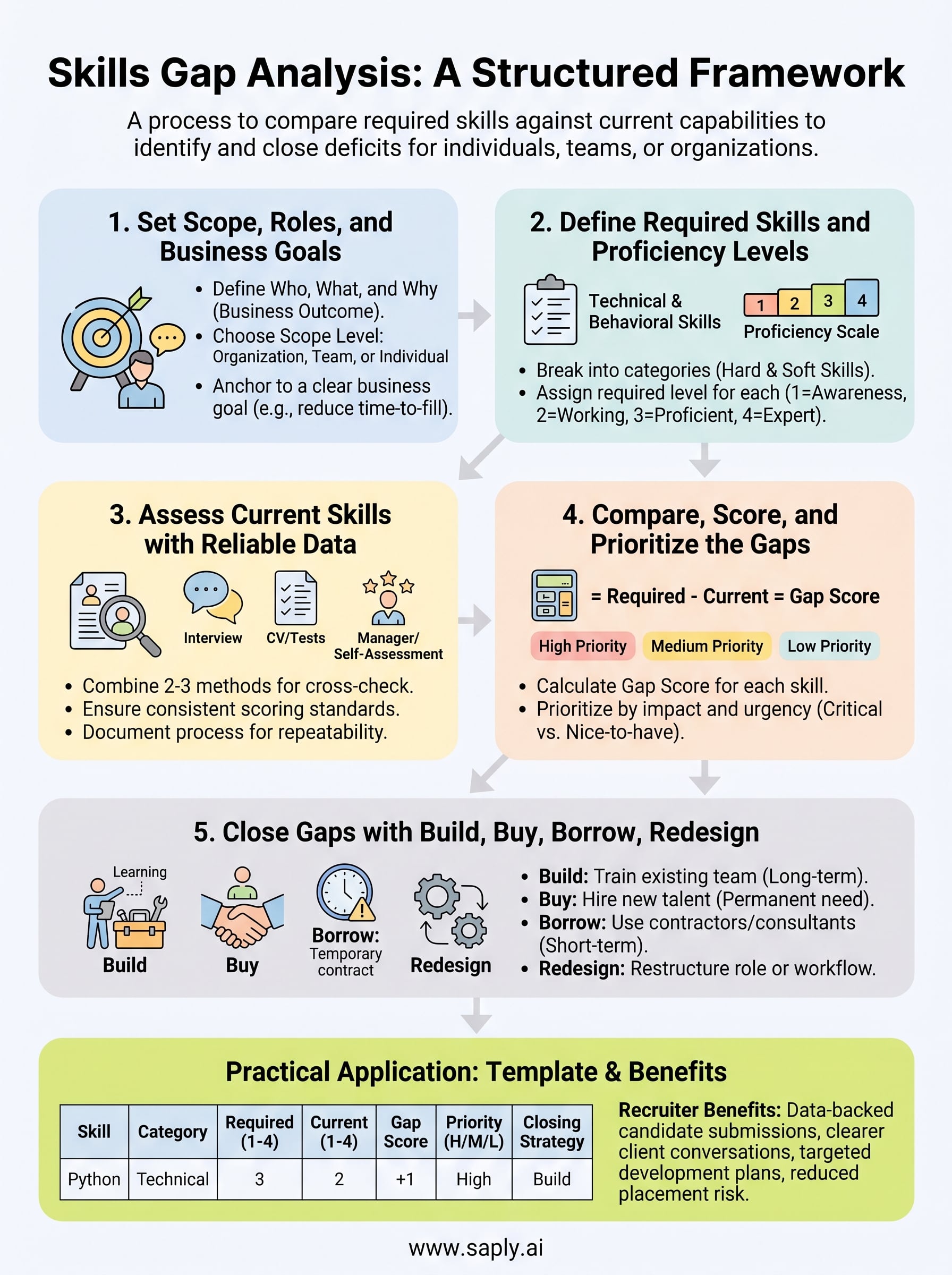
Once you have your skills list, assign a required proficiency level to each item. A simple 1-to-4 scale works well in practice:
| Level | Label | What it means |
|---|---|---|
| 1 | Awareness | Knows the concept, no hands-on experience |
| 2 | Working | Can apply with guidance or supervision |
| 3 | Proficient | Applies independently in most situations |
| 4 | Expert | Leads others, handles complex or novel cases |
Define the required level for each skill before you assess anyone. This removes subjectivity from the evaluation and gives you a clear, repeatable scoring standard across all candidates or team members you review.
Step 3. Assess current skills with reliable data
This is where what is a skills gap analysis moves from definition to practice. You now need to measure the skills that actually exist in your candidate pool or workforce. Most people underestimate this step: the quality of your data here determines whether your gap analysis produces actionable results or just numbers nobody knows what to do with.
Choose your assessment methods
No single method captures the full picture, so combine two or three sources to cross-check what you find. For candidate evaluations, structured competency interviews, work sample tests, and CV analysis against your skills list are the most practical tools. For internal workforce assessments, manager ratings, self-assessments, and performance review data all contribute useful signal.
Here are the most common methods and when each works best:
| Method | Best for | Limitation |
|---|---|---|
| Structured interview | Behavioral and soft skills | Relies on interviewer consistency |
| Work sample or skills test | Technical skills | Takes time to administer |
| CV analysis against skills list | Fast initial screening | Candidate may overstate skills |
| Manager ratings | Internal workforce | Subject to personal bias |
| Self-assessment | Internal workforce | Often inflated without calibration |
Pair self-assessments with at least one external data source so you have a check against inflated or deflated scores.
Avoid common data quality traps
The biggest risk at this stage is inconsistent scoring, where one evaluator applies the proficiency scale strictly and another applies it loosely. Before you start collecting data, align everyone involved on what each proficiency level looks like in practice. Walk through one or two concrete examples per skill so your scale means the same thing across every evaluator.
Your data collection process should also be documented and repeatable. Running this analysis again in six months means nothing unless you use identical methods both times, because only then can you tell whether gaps are actually closing or just being scored differently.
Step 4. Compare, score, and prioritize the gaps
With required proficiency levels set and current skills assessed, you now subtract one from the other to get your gap score for each skill. This is where the practical output of understanding what is a skills gap analysis becomes visible: a structured, scoreable list of deficits you can act on rather than a vague impression of how well someone fits a role.
Calculate the gap score
Subtract each person’s current proficiency level from the required proficiency level for each skill. A positive number means a gap exists; zero means the requirement is met; a negative number means the person exceeds the requirement for that skill.
| Skill | Required level | Current level | Gap score |
|---|---|---|---|
| Python | 3 | 2 | +1 |
| System design | 4 | 2 | +2 |
| Written communication | 3 | 3 | 0 |
| SQL | 3 | 4 | -1 |
Run this calculation across every skill in your inventory and record the results in a single consolidated sheet so you can see the full picture at once.
A large gap in a core skill matters more than a small gap in a secondary one, so never treat all gap scores as equal.
Prioritize by impact, not just size
Not every gap carries the same weight. A gap score of +2 on a critical skill is more urgent than a gap score of +1 on a nice-to-have. Assign each skill a priority tier (High, Medium, Low) based on how essential it is to the role’s core function.
Focus your action plan on High-priority gaps first. Medium and Low gaps can inform development conversations or future hiring criteria, but they should not delay decisions on placements or team investments where the critical skills are already met.
Step 5. Close gaps with build, buy, borrow, redesign
Identifying gaps is only useful if you do something with the results. Once you have a prioritized list of skill deficits, you have four practical levers to close them. Each lever fits a different situation, and choosing the wrong one wastes time and budget. The goal here is to match your response strategy to the nature and urgency of each gap.
The four closing strategies
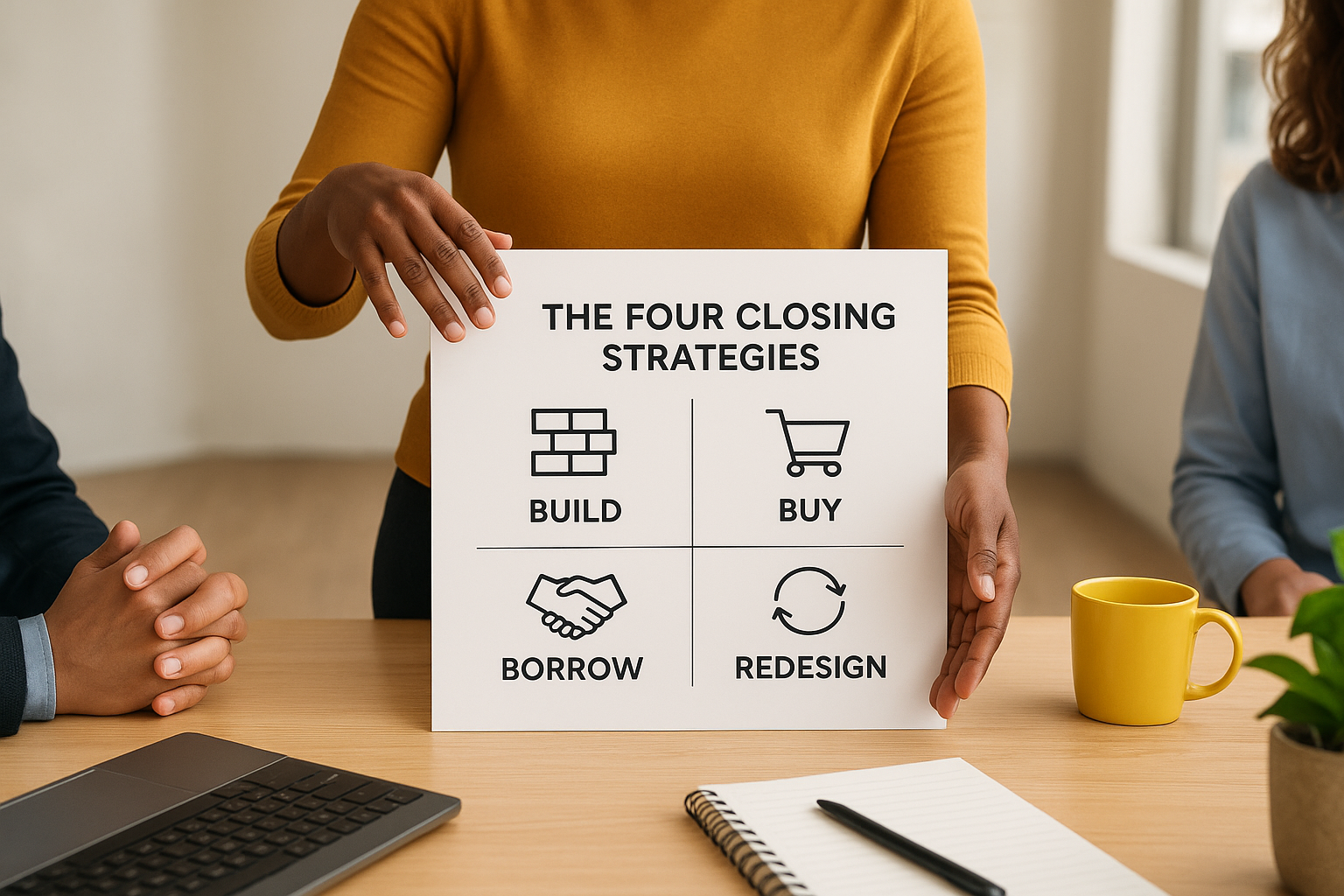
Every response to a skills gap falls into one of four categories. Build means developing the skill in people you already have through training, coaching, or structured practice. Buy means hiring someone who already carries the skill at the required proficiency level. Borrow means bringing in the capability temporarily through contractors, consultants, or agency placements without adding permanent headcount. Redesign means restructuring the role or workflow so the gap no longer blocks performance, for example by splitting responsibilities or automating a task.
| Strategy | Best fit | Watch out for |
|---|---|---|
| Build | Long runway, transferable skill, motivated team | Slow for urgent or highly specialized gaps |
| Buy | Critical skill, no internal path, permanent need | Higher cost, longer time-to-fill |
| Borrow | Short-term project, specialized or niche skill | Dependency risk if extended too long |
| Redesign | Role mismatch, process inefficiency, automation potential | Requires manager buy-in and clear communication |
Matching the strategy to the gap
Your priority tier from Step 4 drives this decision. High-priority gaps in core skills typically call for Buy or Build, depending on how quickly you need the capability. A gap that blocks a client delivery next month is not a training problem; it requires immediate access to the skill, which means Borrow or Buy.
Never default to training just because it feels like the safe choice. Match the urgency of the gap to the speed of the response.
Lower-priority gaps give you more flexibility. Use those for structured development plans that build capability over one to two quarters without disrupting current operations.
Use examples and a copy-ready template
Theory only takes you so far. Seeing what is a skills gap analysis applied to a real scenario and having a copy-ready template in hand makes it far easier to run your first analysis without building everything from scratch.
Example: Staffing agency candidate evaluation
A recruiter at a staffing firm receives a brief for a mid-level data analyst role. The client requires SQL at level 3, Python at level 3, data visualization at level 2, and stakeholder communication at level 3. The candidate’s CV and structured interview place them at SQL level 4, Python level 2, data visualization level 3, and stakeholder communication level 2.
| Skill | Required | Current | Gap |
|---|---|---|---|
| SQL | 3 | 4 | -1 |
| Python | 3 | 2 | +1 |
| Data visualization | 2 | 3 | -1 |
| Stakeholder communication | 3 | 2 | +1 |
The recruiter flags Python and stakeholder communication as medium-priority gaps and notes that the candidate’s SQL and visualization scores exceed requirements. This gives them a data-backed pitch: the candidate is a strong fit with two addressable gaps the client can close through structured onboarding.
A concrete gap score turns a vague “close but not quite” into a specific, discussable trade-off you can bring directly to your client.
Copy-ready template
Use this table as your starting point for any role you analyze. Replace the placeholder rows with skills from your job brief, fill in the scores as you assess, and document your response strategy before you submit.
| Skill | Category | Required (1-4) | Current (1-4) | Gap score | Priority (H/M/L) | Closing strategy |
|---|---|---|---|---|---|---|
| [Skill name] | Technical | |||||
| [Skill name] | Technical | |||||
| [Skill name] | Behavioral | |||||
| [Skill name] | Behavioral |
Copy this table into a Google Sheet or Word document and run it for every role you analyze. Adding a “closing strategy” column forces you to commit to a specific action for each gap rather than leaving results sitting unused with no follow-through.
Put your skills gap analysis to work
Now you know what is a skills gap analysis and exactly how to run one from start to finish. You have a five-step process, a scoring method, real examples, and a copy-ready template you can use on your next role brief today. The framework works whether you’re screening a single candidate or planning headcount across an entire department. None of it requires specialized software or a dedicated analyst; it requires clear requirements, consistent scoring, and a deliberate decision about how to close each gap you find.
For staffing teams handling high submission volumes, running this analysis manually on every role adds up fast. Saply’s CV-to-job matching automates the heaviest parts of this process, surfacing skill gaps, strengths, and match scores directly inside the tools your recruiters already use. Start your free trial and cut the time between receiving a brief and submitting a confident, data-backed candidate.