
how-to-do-a-skills-gap-analysis
How to Do a Skills Gap Analysis: Steps, Examples, Template
Every open role comes with a wish list of skills, and every candidate brings a different mix of what's required. The gap between those two sides is where recruiters either waste hours or make smart de...
Written by: Saply Team
How to Do a Skills Gap Analysis: Steps, Examples, Template
Every open role comes with a wish list of skills, and every candidate brings a different mix of what’s required. The gap between those two sides is where recruiters either waste hours or make smart decisions. Knowing how to do a skills gap analysis gives you a structured way to measure that difference, whether you’re evaluating a single candidate against a job description or assessing an entire talent pipeline for a client.
For staffing agencies handling dozens of submissions per week, identifying skill gaps manually is a bottleneck. You’re reading through CVs, cross-referencing job requirements, and making judgment calls under time pressure. That’s exactly why we built Saply’s CV-to-job matching feature, it automatically surfaces skill gaps, certifications, and strengths against specific job requirements so recruiters can pitch candidates with confidence instead of guesswork.
But whether you use automation or a spreadsheet, the underlying process matters. This guide walks you through each step of a skills gap analysis, from defining the skills that matter to scoring candidates and acting on the results. You’ll also find practical examples and a ready-to-use template to get started right away.
What a skills gap analysis is and when to use it
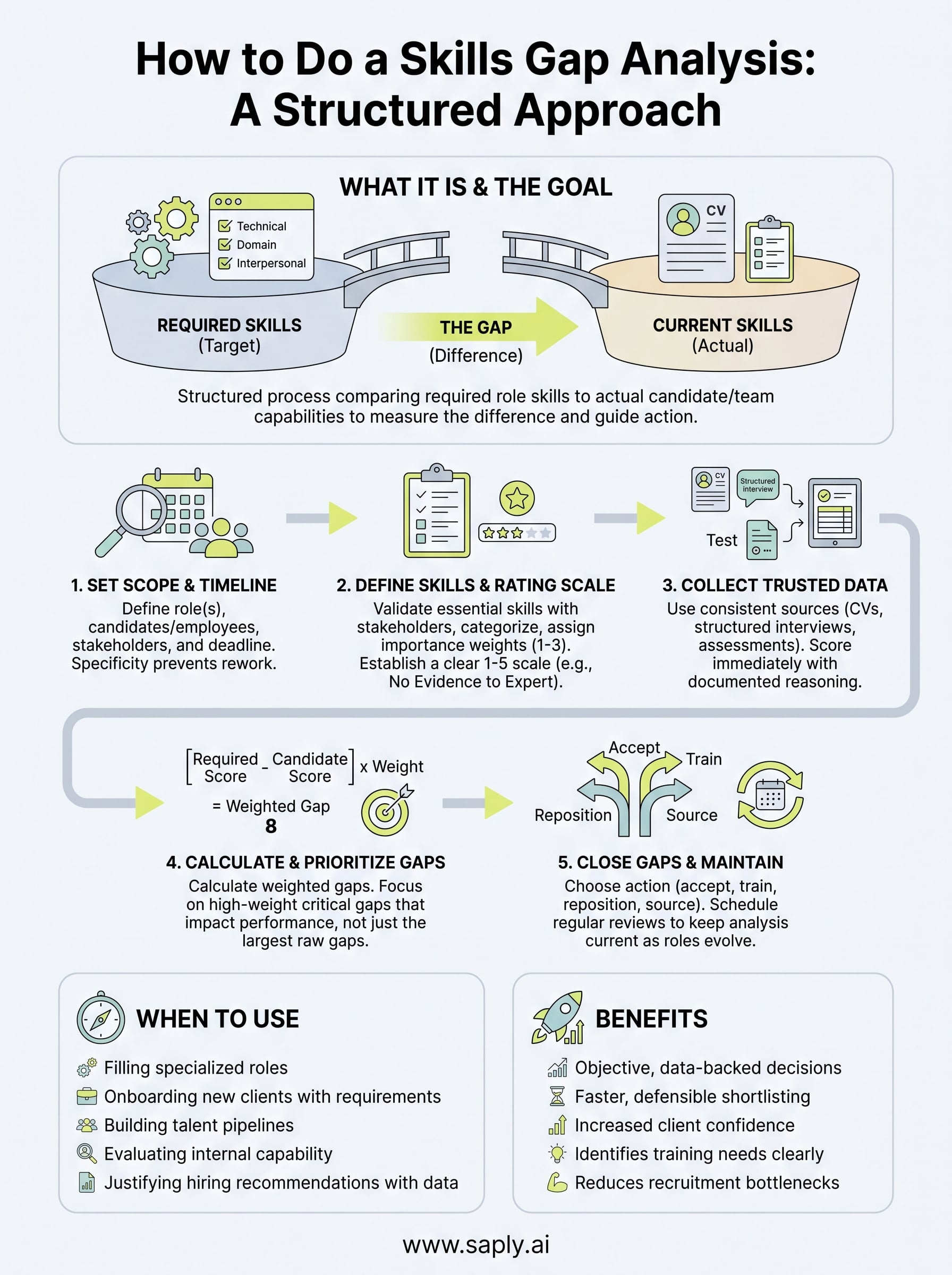
A skills gap analysis is a structured process for comparing the skills a role requires against the skills a person or team currently has. The output is a clear picture of what’s missing, what’s strong, and where training, hiring, or repositioning is needed. At its core, it answers one question: is there a match between capability and requirement, and if not, how wide is the gap?
The core components
Every skills gap analysis, regardless of scale, shares the same basic structure. You define a target skill set based on role requirements, you measure actual skills through assessments or structured reviews, and then you calculate the difference. The target represents what a fully capable person in that role should be able to do. The current state reflects what your candidate, employee, or team can actually do today. The gap is everything that falls between those two points.
The gap itself is not the problem. It is the data that tells you what action to take next.
A useful analysis also assigns weights to skills based on how critical each one is to the role. Not every gap carries the same consequence. A candidate missing a “nice to have” certification is a different situation from a candidate missing a core technical skill the role depends on daily. Separating high-priority gaps from low-priority ones requires a rating scale and some form of skill weighting, which is why those elements are essential when you learn how to do a skills gap analysis properly.
When to run a skills gap analysis
You do not need a specific trigger to run one, but certain situations make them especially valuable. Use a skills gap analysis when:
- Filling a specialized role where multiple candidates have overlapping but not identical qualifications
- Onboarding a new client who has specific technical or compliance requirements you need to screen candidates against consistently
- Building a talent pipeline for an account and trying to understand what the current pool covers versus what the client will need in 6 to 12 months
- Evaluating internal team capability before taking on a new contract type or sector
- Justifying a hiring recommendation to a client with evidence-based match data rather than a recruiter’s intuition alone
What it looks like in practice
Here is a simplified example to make this concrete. Suppose you are filling a project manager role. The client requires PMP certification, experience with agile methodology, and stakeholder reporting skills. You have three candidates, each with a different background. A skills gap analysis lets you map each candidate against those three requirements on a consistent scale so the comparison is objective, not memory-based.
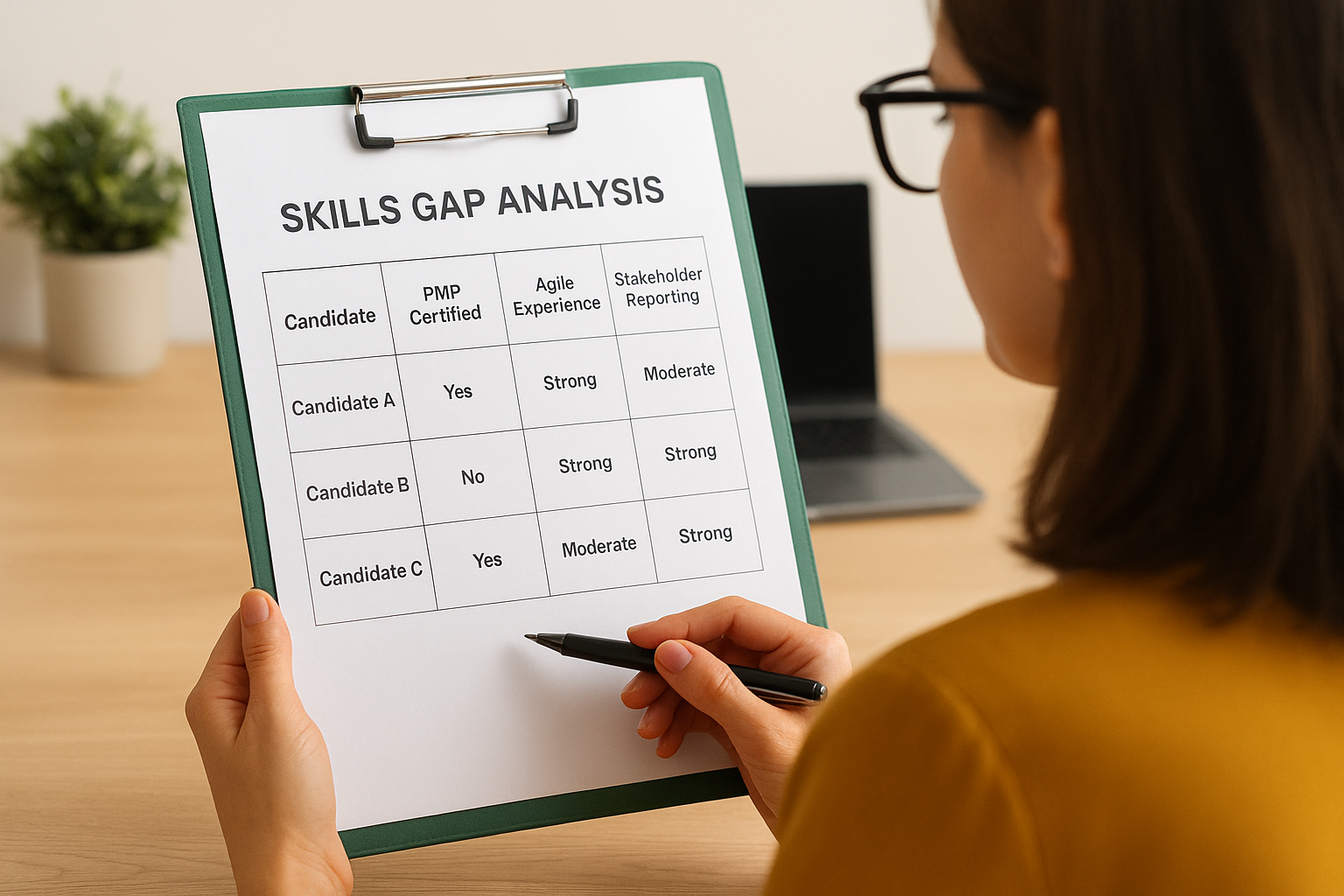
| Candidate | PMP Certified | Agile Experience | Stakeholder Reporting |
|---|---|---|---|
| Candidate A | Yes | Strong | Moderate |
| Candidate B | No | Moderate | Strong |
| Candidate C | Yes | Strong | Strong |
Candidate C is the clear fit based on this snapshot. Candidate A carries a moderate gap in stakeholder reporting that may or may not matter depending on the role’s daily demands, and that distinction is worth discussing with your client. Candidate B carries the highest risk because the certification gap is a hard requirement, not a preference. Without this kind of structured comparison, you are relying on recall and gut feel when presenting options. With it, you have a defensible, data-backed shortlist that builds client confidence in your process and your candidates.
Step 1. Set your scope, stakeholders, and timeline
Before you collect a single data point, you need to define what you are actually analyzing. Scope determines whether your analysis covers one candidate, a batch of 20, or an entire department’s talent pipeline. Rushing past this step is the most common reason skills gap analyses produce results nobody acts on, because the data ends up covering too much or too little to be useful.
Define what you’re analyzing
Start by writing one clear sentence that states the purpose of this specific analysis. For example: “We are evaluating five shortlisted candidates for a senior data analyst role against the client’s stated requirements.” That sentence forces you to be specific about the role, the candidate population, and the intended outcome before anything else. If you cannot write that sentence clearly, your scope is still undefined and you are not ready to move forward.
Specificity at the start saves significant rework later when stakeholders disagree on what the analysis was supposed to cover.
Next, list the skill categories you plan to assess. Keep it manageable. For most recruitment-focused analyses, three to six skill categories per role is enough to produce a meaningful comparison without creating a scoring exercise so complex it never gets finished.
Identify your stakeholders
Your stakeholders are the people who will use the results. In a staffing context, that typically means the recruiter leading the search, the account manager handling the client relationship, and the hiring manager on the client side who understands what the role actually demands day to day. Each of these people brings different knowledge, and your analysis is stronger when you gather input from all three before you finalize the required skill list.
Set a realistic timeline
Decide upfront how long this analysis will take and when you need the results. A single-role candidate comparison can realistically be completed in a few hours. A pipeline assessment covering 30 candidates across multiple roles needs a week or more, especially if you are collecting data through structured interviews or skills assessments rather than CV review alone.
Use this planning template before you start:
| Planning Element | Your Answer |
|---|---|
| What role or roles are you analyzing? | |
| How many candidates or employees are in scope? | |
| Who supplies the required skills list? | |
| Who reviews and approves the final output? | |
| When do results need to be ready? |
Filling in that table is one of the most practical ways to keep a how to do a skills gap analysis project on track from the start.
Step 2. Define required skills and a clear rating scale
Once your scope is set, you need to pin down exactly which skills the role demands and establish a consistent scale for measuring them. This step is where most skills gap analyses either produce reliable data or fall apart. Vague skill definitions lead to inconsistent scoring, and inconsistent scoring makes your results impossible to act on when it matters most.
Build your required skills list
Start by pulling skill requirements directly from the job description. Then validate that list with the hiring manager or client contact who knows what the role actually involves day to day. Job postings often include aspirational requirements that do not reflect what candidates need to perform on day one, so confirming priorities with a decision-maker separates the must-haves from the nice-to-haves before you score anyone.
Separating required skills from preferred skills before you evaluate any candidate protects you from disqualifying strong candidates based on criteria the client has not truly committed to.
Group your confirmed skills into two to three categories such as technical skills, domain knowledge, and interpersonal skills. Keeping categories broad makes the list easier to manage and prevents the analysis from becoming unwieldy. Aim for no more than eight total skills per role to keep the exercise actionable. Use this template as your starting point:
| Skill | Category | Priority (Required / Preferred) | Weight (1-3) |
|---|---|---|---|
Filling in that table before you score a single candidate keeps your evaluation grounded in what the role actually needs rather than what you recall from the last similar search.
Choose a rating scale that works for your team
Your rating scale needs to be simple enough that multiple reviewers apply it consistently. A five-point scale works well for most recruitment contexts. The critical piece is writing a clear description for each level so two different recruiters score the same candidate the same way. Without that consistency, your scores reflect individual interpretation rather than actual candidate capability.
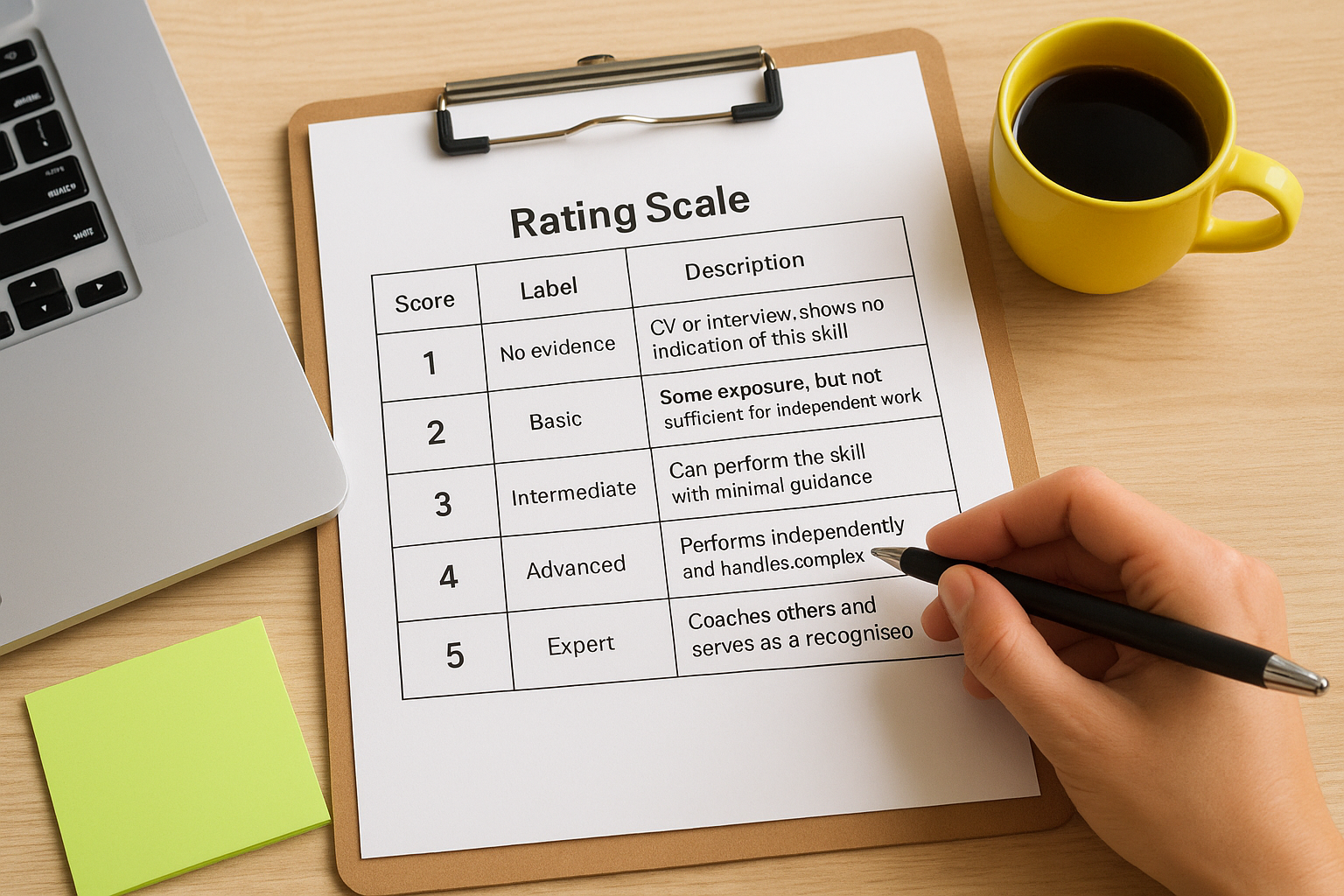
Use this scale when learning how to do a skills gap analysis across multiple candidates:
| Score | Label | Description |
|---|---|---|
| 1 | No evidence | CV or interview shows no indication of this skill |
| 2 | Basic | Some exposure, but not sufficient for independent work |
| 3 | Intermediate | Can perform the skill with minimal guidance |
| 4 | Advanced | Performs independently and handles complex situations |
| 5 | Expert | Coaches others and serves as a recognized resource |
With your skills list and rating scale locked in, you are ready to collect the data that makes the scores meaningful.
Step 3. Collect current skills data you can trust
Your skills list means nothing if the data you collect to score against it is unreliable. Inconsistent sourcing is the single biggest threat to a useful skills gap analysis: if one recruiter scores a candidate from a CV review while another scores a different candidate from a structured interview, your resulting scores are not comparable. Before you collect any data, decide which sources you will use and apply them uniformly across every candidate in scope. Mixing methods mid-process produces apples-to-oranges comparisons that erode the credibility of your shortlist with clients.
Consistent data collection methods are what separate a skills gap analysis that drives decisions from one that gets filed and forgotten.
Choose the right data sources
Several data sources work well depending on your timeline and the depth of analysis you need. CV review is the fastest starting point and suits initial screening of a large candidate pool, but it only captures what candidates choose to include. Structured interviews with a fixed set of skill-specific questions give you more reliable data because every candidate answers the same prompts in the same order, making direct comparison straightforward without relying on memory.
Here are the most common data sources and when each one fits:
| Data Source | Best For | Limitation |
|---|---|---|
| CV review | Initial screening of a large candidate pool | Candidate-controlled, can be incomplete |
| Structured interview | Validating specific skills with depth | Time-intensive per candidate |
| Skills assessments or tests | Technical roles requiring proof of capability | Requires upfront preparation |
| Reference checks | Verifying real-world performance on specific skills | Depends on referee candor |
| Work samples or portfolios | Creative, technical, or project-based roles | Not always available or comparable |
Score candidates consistently
Once you have selected your data sources, assign each candidate a score for each skill using the rating scale you defined in Step 2. Score immediately after reviewing each candidate’s data while the details are still fresh. Waiting too long allows recall gaps to distort your ratings, pushing scores toward general impressions rather than specific evidence tied to each individual skill.
Document the reasoning behind each score in one clear sentence. For example: “Scored 4 on stakeholder reporting because CV references quarterly executive presentations delivered to a 200-person department.” That single sentence makes your reasoning auditable if a client pushes back on your shortlist. Following this discipline as part of how to do a skills gap analysis turns every score into a defensible data point rather than a recruiter’s gut call.
Step 4. Calculate the gaps and prioritize what matters
With scores in hand, you can now run the calculation that turns raw ratings into actionable gap data. Subtract each candidate’s skill score from the required target score for that skill. A candidate who scores a 3 on a skill with a required level of 5 carries a gap of 2 points for that skill. Repeat this across every skill in your list and you have a gap profile that tells you where each candidate falls short and by how much.
Calculate the weighted gap score
Not all gaps carry equal weight, which is why the priority column you set in Step 2 matters here. Multiply each gap score by the weight you assigned to that skill to produce a weighted gap score. Skills rated 3 (highest priority) amplify gaps significantly, while skills rated 1 (lower priority) reduce the impact of a shortfall. Adding all weighted gap scores together gives you a single total gap score per candidate that reflects actual role fit rather than a raw average.
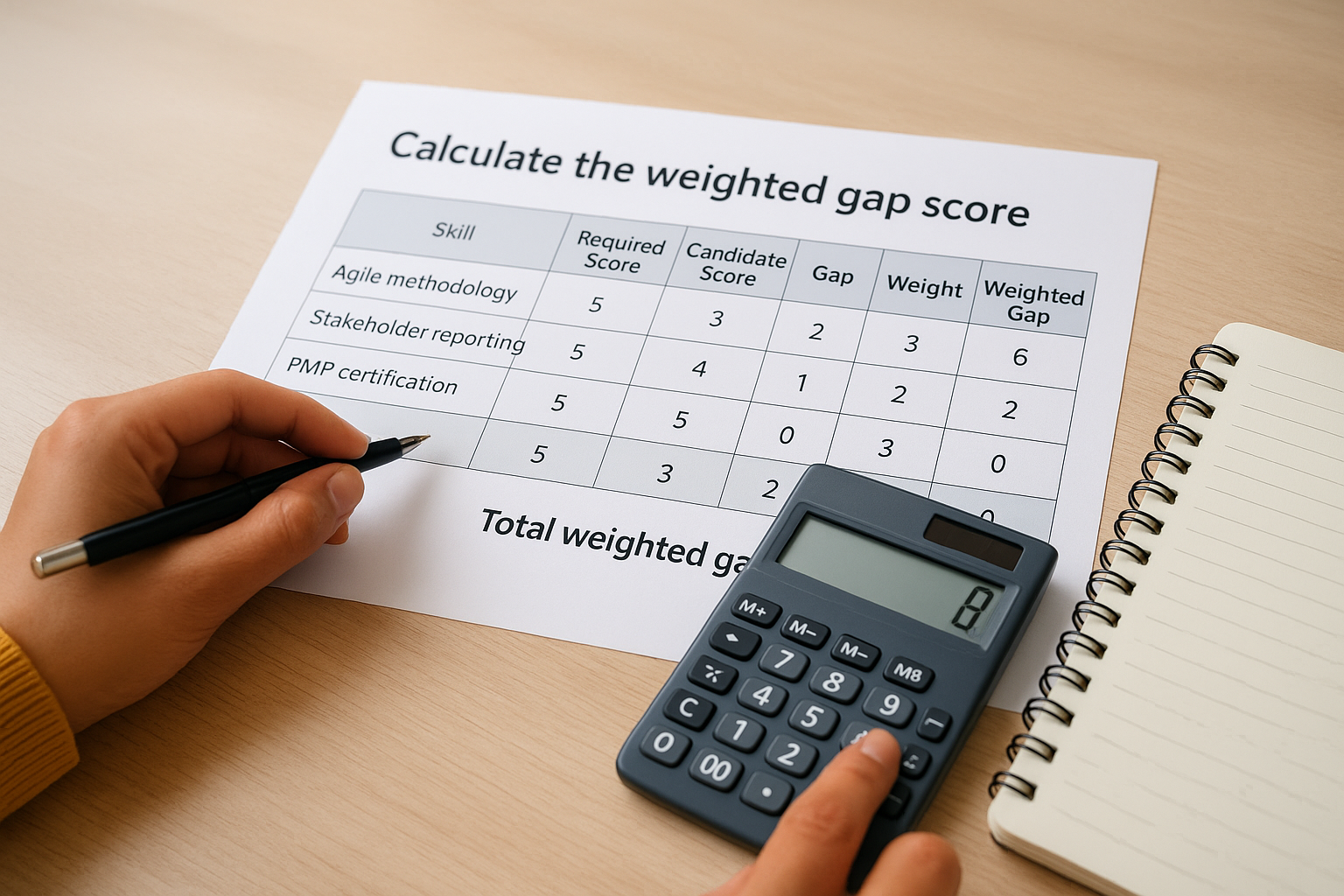
Use this template to complete the calculation:
| Skill | Required Score | Candidate Score | Gap | Weight | Weighted Gap |
|---|---|---|---|---|---|
| Agile methodology | 5 | 3 | 2 | 3 | 6 |
| Stakeholder reporting | 5 | 4 | 1 | 2 | 2 |
| PMP certification | 5 | 5 | 0 | 3 | 0 |
| Total weighted gap | 8 |
The lower the total weighted gap, the stronger the candidate’s fit for the role. Comparing totals across all candidates gives you an objective ranking you can present to a client with full transparency behind every number.
Prioritize by impact, not size
Once you have total gap scores for all candidates, resist focusing only on the largest raw gaps. A high-weight gap in a critical skill is far more consequential than a large gap in a peripheral one. When applying how to do a skills gap analysis in a way that decision-makers trust, you need to flag the gaps that would directly limit on-the-job performance from day one.
A candidate with one critical gap in a must-have skill is a higher risk than a candidate with three moderate gaps in lower-priority areas.
Review each candidate’s weighted gap breakdown by skill category before finalizing your shortlist. That breakdown tells you not just who scored best overall, but where each candidate’s risks concentrate and whether those risks are manageable given the client’s specific context and timeline.
Step 5. Close the gaps and keep the analysis current
A skills gap analysis only creates value if you act on what it reveals. Once you have your weighted gap scores and candidate rankings, the next task is deciding what to do with each gap, and building a system to ensure your analysis stays accurate as roles evolve, candidates develop, and client requirements shift. Treating the output as a one-time document rather than a living reference is the most common way this kind of structured work goes to waste.
The goal is not to produce a perfect report. It is to take the right action faster and repeat that process consistently.
Choose the right closure action for each gap
Different gap types call for different responses, and matching the action to the gap type is what makes the closure stage practical rather than generic. For candidate-level gaps found during recruitment, your options fall into four categories: accept the gap if the client confirms it is non-critical, develop the candidate through pre-placement training or certification support, reposition the candidate toward a better-fitting role in your pipeline, or continue sourcing for a stronger match on the critical skills.
Use this table to match each gap type to the most appropriate action:
| Gap Type | Recommended Action |
|---|---|
| Critical skill, hard requirement | Continue sourcing or disqualify for this role |
| Critical skill, bridgeable quickly | Discuss short-term training with candidate before submission |
| Preferred skill, low weight | Accept and note in client briefing |
| Multiple moderate gaps across categories | Reposition candidate to a role with a closer baseline fit |
When applying how to do a skills gap analysis at scale across a full pipeline, this decision table removes the need to judge each gap situation from scratch and speeds up your shortlisting process significantly.
Schedule regular updates to keep your analysis accurate
Skill requirements change as client mandates shift, technology evolves, and industry standards update. Set a fixed review cadence for each active analysis so your data does not become misleading over time. For high-volume accounts, a monthly review of your required skills list is a practical baseline. For lower-volume or longer-term pipelines, quarterly reviews typically keep the data reliable without creating excessive overhead.
Use this simple maintenance template to track when each analysis needs a refresh:
| Role or Pipeline | Last Updated | Next Review Date | Key Skills to Revalidate |
|---|---|---|---|
Keeping that table current takes less than 30 minutes per review cycle and prevents your gap scores from drifting out of sync with what clients actually need when a role opens.
Next steps
You now have a complete framework for how to do a skills gap analysis that produces results you can act on, whether you are comparing three candidates for a single role or managing a full pipeline for a long-term client account. The process works when you define scope clearly, score consistently, weight by priority, and revisit the data on a regular schedule. None of those steps require expensive tools. A well-structured spreadsheet and the templates in this guide are enough to get started today.
Where time becomes a constraint is when you are running this process manually across dozens of submissions per week. Saply automates the CV-to-job matching layer of this work, surfacing skill gaps, certifications, and strengths against specific job requirements without requiring you to leave the tools you already use. If you want to see how that fits into your current workflow, try Saply’s CV matching free for 14 days and compare the output against your next shortlist.