
how-to-run-a-recruitment-agency
How to Run a Recruitment Agency: Operations, Sales & Scale
Knowing how to run a recruitment agency takes more than placing candidates in open roles. It requires building repeatable systems for sales, operations, and delivery, then scaling those systems withou...
Written by: Saply Team

How to Run a Recruitment Agency: Operations, Sales & Scale
Knowing how to run a recruitment agency takes more than placing candidates in open roles. It requires building repeatable systems for sales, operations, and delivery, then scaling those systems without letting quality slip. Whether you’re launching from scratch or tightening up an agency that’s already billing, the operational details determine whether you grow or stall.
Most agency owners figure this out the hard way: the bottleneck isn’t finding candidates or winning clients. It’s everything in between, formatting CVs, tailoring submissions, managing compliance, keeping your pipeline moving. That’s exactly why we built Saply, an AI-powered plugin that handles CV formatting and tailoring directly inside the tools recruiters already use, so agencies can submit faster and spend less time on admin.
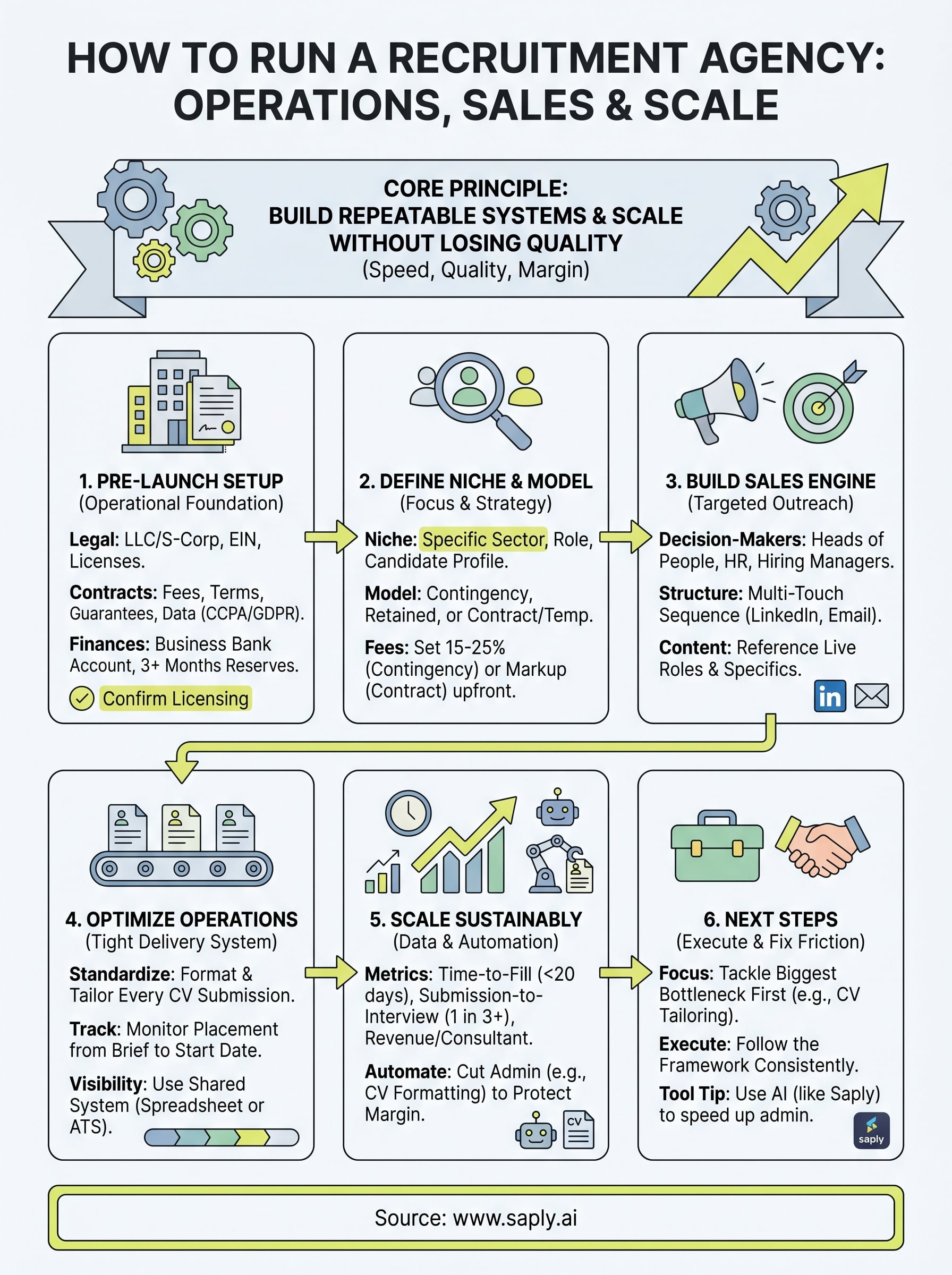
This guide breaks down the full picture: choosing your niche, setting up legally, building a sales engine, structuring your operations, hiring your team, and scaling sustainably. Each section covers practical steps you can act on, not theory. By the end, you’ll have a clear framework for running a recruitment agency that’s built to last, and built to compete on speed, quality, and margin.
What to set up before you take clients
Before you pitch a single client or submit one CV, you need the operational foundation in place. One of the most overlooked aspects of learning how to run a recruitment agency is that most new owners chase revenue first and scramble to build infrastructure later, which creates legal exposure and operational chaos. Getting the basics right before you open the door to clients makes the difference between a business that scales cleanly and one that collapses under its first growth spurt.
Legal structure and registration
Your first task is registering your business as a legal entity. In the US, most recruitment agencies operate as an LLC or S-Corp, since both protect personal assets while keeping administrative overhead manageable. An LLC is typically the right starting point: it separates your personal liability from the business, allows pass-through taxation, and costs relatively little to set up in most states. Once you’ve chosen your structure, register with your state’s Secretary of State office, obtain your Employer Identification Number (EIN) through the IRS, and confirm whether your state requires a staffing-specific license (some do, particularly for healthcare or temp staffing).
Confirm your licensing requirements before you sign any client contracts. Placing workers without the correct license exposes you to fines and voids your agreements.
Complete this checklist before taking clients:
- Register your LLC or corporation with your state
- Obtain your EIN from the IRS
- Check your state’s staffing license requirements
- Register for state unemployment insurance if you plan to employ contractors or temps
- Obtain general liability insurance and professional liability (errors and omissions) coverage
Contracts and compliance
Every client and candidate relationship needs a written contract before work begins. For clients, your agreement should cover your fee structure (retained, contingency, or flat-fee), replacement guarantees, payment terms, and rights over candidate data. For candidates, you need a consent form covering data usage, especially if you operate under regulations like CCPA in California or handle EU candidates under GDPR.
Draft both documents before your first outreach. If budget allows, have an employment attorney review them. At minimum, your client services agreement must cover these clauses:
| Clause | What to include |
|---|---|
| Fee type | Contingency %, retained amount, or flat fee |
| Payment terms | Net 30, deposit on engagement, or milestone-based |
| Replacement guarantee | Typical window is 30 to 90 days |
| Exclusivity | Whether you work the role exclusively |
| Candidate ownership | Who owns the candidate profile data |
Finances and banking
Running an agency means managing cash flow gaps that can stretch weeks or months, especially on contingency models where you only get paid after a candidate starts. Open a dedicated business bank account the day you register your entity, then set up a simple accounting system to track invoices, outstanding fees, and expenses. Build at least three months of operating expenses in reserve before you take on fixed overhead like office space or full-time hires. Treating your finances as a system from day one keeps you from making desperate decisions when a placement falls through or a client delays payment.
Define your niche, services, and business model
One of the clearest decisions that separates agencies that win clients fast from those that spin for months is niche selection. Generalist agencies compete against everyone and differentiate against no one. When you know exactly which sector, role type, or candidate profile you serve, you can build a candidate pipeline, speak a client’s language, and close faster. This is foundational to understanding how to run a recruitment agency that actually grows.
Pick a niche you can own
Your niche should sit at the intersection of three factors: a sector you understand, a market with consistent hiring demand, and a space where you have at least some existing relationships or knowledge. Tech, healthcare, finance, logistics, and legal services all carry strong permanent and contract hiring volume. Narrowing further works in your favor: “mid-level software engineers for fintech startups” is far more compelling to a hiring manager than “IT recruitment.”
The more specific your niche, the stronger your positioning, and the faster you build the credibility that converts cold outreach into signed agreements.
Choose your service model
Your service model defines what you sell and how you deliver it. Most agencies operate on one of three models, and each carries distinct cash flow and margin implications. Choosing the wrong model for your cash position is one of the fastest ways to stall early growth.
| Model | How it works | Best for |
|---|---|---|
| Contingency | You get paid only when a candidate is placed | Early-stage agencies building volume |
| Retained | Client pays upfront to secure your focus | Senior or niche searches |
| Contract/temp staffing | You place workers on a pay-and-bill basis | Agencies that can manage payroll float |
Set your fee structure
Contingency fees in the US typically run 15% to 25% of a candidate’s first-year base salary, depending on seniority and sector. Retained searches usually involve an upfront payment of one-third of the estimated total fee. Contract staffing works on a markup over the worker’s pay rate, usually 20% to 50% depending on role type and benefits structure.
Set your rates before your first client call. Walking into a negotiation without a clear fee schedule weakens your position and signals that your business isn’t fully operational yet.
Build a sales engine and win first clients
Winning clients early in your agency’s life comes down to focused outreach and a repeatable sales process, not a large budget or a recognizable brand. Most new agency owners scatter their energy across too many prospects and never build enough momentum with any one segment. Understanding how to run a recruitment agency means treating sales as a system with clear inputs, defined steps, and consistent follow-through, so you can predict where your next client is coming from.
Target the right decision-makers
Your outreach should go directly to the people who own the hiring decision, which in most cases means Heads of People, HR Directors, or Hiring Managers at companies in your niche. Start by building a list of 50 to 100 target companies that match your specialty, then identify the right contact at each using LinkedIn. Prioritize companies with active job postings in your niche, since they’re already spending on hiring and are easier to convert than companies with no immediate need.
Targeting companies with live job openings shortens your sales cycle and gives you a natural, specific conversation starter from the first message.
Build your initial prospect list using this structure:
| Column | What to track |
|---|---|
| Company name | Target organization |
| Contact name | Decision-maker’s full name |
| Role | Title of your contact |
| Open roles | Current vacancies in your niche |
| Outreach status | Cold, contacted, replied, meeting booked |
Structure your outreach sequence
Cold outreach works best when it follows a consistent sequence rather than a single message. Use this five-touch sequence over three weeks:

- LinkedIn connection request with a short, specific note referencing their industry
- LinkedIn message tied to an open role or recent hire they posted
- Email introducing your agency and one relevant placement example
- Follow-up email three days later with a specific candidate profile or market insight
- Final LinkedIn message offering a 15-minute call with a clear agenda
Keep every message short and role-specific. Reference their actual open positions, their sector, or a mutual connection where possible. Generic messages get deleted.
Deliver placements with a tight operating system
A signed client agreement means nothing if your delivery is inconsistent. Knowing how to run a recruitment agency well means building a repeatable process for every placement, from the moment a client sends a brief to the day a candidate starts. Without that system, your output depends entirely on individual effort, and individual effort doesn’t scale reliably once you’re running multiple roles at once.
Standardize your submission workflow
Every CV you send to a client represents your agency’s judgment. If that CV is poorly formatted, misaligned to the job description, or missing key details, you lose credibility before the interview stage. Standardizing your submission workflow protects your reputation and lets your team move fast without cutting corners on quality.
A formatted, tailored CV submitted within the hour consistently outperforms a sloppy one sent the same day.
Build every submission around these steps:
- Receive the job brief and confirm the must-have criteria with the client
- Source and shortlist candidates who match the core requirements
- Format each CV to your agency template
- Tailor the CV content to the specific role and job description
- Write a short candidate summary covering fit, availability, and salary expectations
- Submit via your agreed channel with a clear, specific subject line
Track every placement from brief to start date
Losing a placement mid-process is expensive, whether it comes from a candidate who drops out or a client who goes quiet. Track every active role in a shared system so your whole team has real-time visibility on where each placement stands. A simple spreadsheet works when you’re small; most agencies shift to an ATS as volume grows.

Use this tracking structure for each active role:
| Stage | Key action |
|---|---|
| Brief received | Confirm criteria and agree timeline |
| Shortlist ready | Send CVs with candidate summaries |
| Interviews scheduled | Confirm logistics for both sides |
| Offer stage | Manage expectations and negotiation |
| Placed | Confirm start date and raise invoice |
Review this tracker daily as a team so nothing stalls without notice. Assign one owner per role and set a follow-up date for any stage that hasn’t moved in 48 hours.
Scale with metrics, tech, and cash flow
Scaling is where most agency owners discover that effort alone stops being enough. When you’re running multiple consultants, dozens of active roles, and several client relationships at once, you need data and systems making decisions, not just instinct. Understanding how to run a recruitment agency at scale means choosing the right metrics to track, cutting admin time with the right tools, and keeping your cash flow stable so growth doesn’t outpace your bank balance.
Track the numbers that drive decisions
You can’t manage what you don’t measure. At the agency level, three core metrics determine whether you’re scaling profitably or just getting busier: time-to-fill, submission-to-interview ratio, and revenue per consultant. Time-to-fill tells you how fast your delivery engine is moving. Submission-to-interview ratio shows whether your CVs are hitting the mark with clients. Revenue per consultant tells you whether your team is operating at a productive rate or carrying dead weight.
If your submission-to-interview ratio drops below one in three, your CV quality or candidate targeting is the problem, not your sourcing volume.
Review these metrics weekly, not monthly. Set clear benchmarks for each, then hold your team accountable to them in a short standing meeting every Friday.
| Metric | What it measures | Target benchmark |
|---|---|---|
| Time-to-fill | Days from brief to placed candidate | Under 20 days |
| Submission-to-interview ratio | CVs sent vs. interviews booked | 1 in 3 or better |
| Revenue per consultant | Billing output per team member | Set by your sector average |
Automate the admin to protect your margin
Every hour a recruiter spends on manual CV formatting or copy-pasting candidate data is an hour not spent on calls, sourcing, or client relationships. As your team grows, that lost time compounds fast. Tools that handle repetitive submission tasks automatically protect your margin without adding headcount. Plug automation into your existing workflow first, including your ATS, document editors, and email, before you consider building new systems from scratch. The goal is fewer manual steps between a candidate coming in and a CV going out, so your team can focus on the work that actually moves placements forward.
Next steps
Knowing how to run a recruitment agency at every stage, from setup through scale, gives you a real advantage over competitors who are still figuring it out as they go. The framework in this guide covers the core decisions you need to make: your legal structure, niche, fee model, sales process, delivery system, and growth metrics. None of it works unless you execute consistently, but now you have a clear sequence to follow.
Your next move is to pick one area where your agency has the most friction and fix it first. If CV formatting and tailoring is eating hours your team should be spending on client calls and sourcing, that’s the place to start. Saply’s AI-powered CV plugin fits directly into the tools your recruiters already use, cutting submission time without adding new software to learn. Try it free for 14 days and see how much time your team gets back.