
staffing-agency-best-practices
5 Staffing Agency Best Practices to Boost Speed-to-Hire
Every open role that stays unfilled costs your client money, and costs your agency credibility. The difference between a placement and a missed opportunity often comes down to how quickly you can get...
Written by: Saply Team

5 Staffing Agency Best Practices to Boost Speed-to-Hire
Every open role that stays unfilled costs your client money, and costs your agency credibility. The difference between a placement and a missed opportunity often comes down to how quickly you can get a qualified candidate in front of the hiring manager. That’s why staffing agency best practices in 2026 aren’t just about sourcing better candidates; they’re about removing the bottlenecks between finding talent and submitting them.
Yet many agencies still lose hours each week to manual CV formatting, inconsistent candidate presentations, and slow internal handoffs. These aren’t minor inefficiencies, they’re the exact friction points that drag out your speed-to-hire and let competitors beat you to the punch. At Saply, we work with staffing teams daily and see firsthand how operational changes paired with smart automation can cut submission times dramatically.
This article breaks down five practices that directly impact how fast your agency fills roles. Some are process shifts, others are technology decisions, but each one is built around a single goal: getting qualified candidates submitted faster without sacrificing quality. Whether you’re running a lean team or scaling operations, these are the levers that actually move the needle.
1. Standardize and tailor CVs fast with Saply
One of the most impactful staffing agency best practices you can implement is eliminating manual CV prep from your workflow. Every minute your recruiters spend reformatting a candidate’s CV by hand is a minute they’re not sourcing, screening, or building client relationships.
Why this removes friction in speed-to-hire
Formatting and tailoring CVs manually creates a bottleneck before a single candidate ever reaches the client. Saply automates both steps, letting your team submit polished, role-ready CVs in a fraction of the time it previously took, which directly compresses your speed-to-hire.
How Saply fits into a recruiter’s daily workflow
Saply runs as a plugin inside Microsoft Word, Google Docs, and Outlook, so your recruiters never switch to a new application or change how they already work. They receive a raw CV, apply your agency template with one click, and tailor the content to the job description without leaving the tool they have open.

How to use job matching to submit stronger shortlists
Saply’s CV-to-job matching analysis flags skill gaps, highlights relevant strengths, and assigns each candidate a match score against the role requirements. Use that score to rank your shortlist before sending, so you only submit candidates who genuinely fit.
Submit fewer, stronger candidates rather than flooding a client with marginal fits, and your placement rate will climb faster than your submission volume.
Where Saply plugs into your stack
The platform connects directly with Bullhorn, Carerix, and Spott, pulling job descriptions automatically so your team never copies and pastes between systems. Additional ATS integrations are available on request, keeping your tech stack clean.
When to use a formatted CV vs a tailored CV
Use a formatted CV when presenting a candidate speculatively or to a client already familiar with your agency templates. Switch to a tailored CV when you have a specific job description in hand and want to maximize fit before submission, since clients respond faster when the CV clearly maps to what they asked for.
2. Run a tight intake to prevent rework
Among all staffing agency best practices, a tight intake prevents the most downstream rework. When you skip the details upfront, you end up chasing shifting requirements mid-search and resubmitting candidates who never had a real chance.
The intake call agenda that prevents “moving targets”
Structure every intake call around three fixed blocks: role context, candidate profile, and submission logistics. Covering all three gives you a documented brief you can actually execute against without circling back to the client.

How to write a role scorecard recruiters can execute on
Translate your intake notes into a one-page scorecard with specific, measurable criteria. Recruiters should be able to screen any candidate against it in under five minutes without asking for clarification.
How to define must-haves vs trainables vs deal-breakers
Split requirements into three tiers upfront. Must-haves set your bar; trainables give you flexibility; deal-breakers cut the process before you burn time on a poor fit.
Defining these tiers clearly before you source a single candidate eliminates more rework than any technology shortcut.
How to set submission rules and response SLAs
Lock in submission format and feedback timelines with the client before you send the first CV. Without this agreement, your team spends days chasing responses instead of filling the role.
How to align on pay rate, bill rate, and start date early
Confirm compensation expectations and target start date during intake, not after your first shortlist lands. Discovering a mismatch at that stage kills placements you have already invested real time in.
3. Build a repeatable screening and submission workflow
A consistent screening process is one of the core staffing agency best practices that separates high-volume agencies from reactive ones. Without a repeatable structure, each recruiter runs their own version of the process, creating inconsistent candidate quality and unpredictable timelines.
How to screen for skills, motivation, and availability fast
Run every candidate through a fixed three-question block covering relevant skills, reason for moving, and confirmed availability. This gives you comparable data points across all candidates without extending call time.
How to validate skills without slowing down the process
Use short, role-specific tasks sent before the interview to filter mismatches early. A five-minute exercise signals real ability without creating a barrier that kills candidate engagement.
Validation doesn’t need formal testing; one targeted question often tells you more than a full assessment.
How to run structured interviews that compare candidates fairly
Lock down a standard question set tied directly to your role scorecard. When every recruiter asks the same questions, you can compare candidates objectively and build a shortlist the client will trust.
How to package a client-ready submission in one pass
Prepare the CV, match summary, and availability details together before sending anything. Clients make faster decisions when everything arrives in a single, organized package.
How to keep candidates warm between steps
Send a brief status update after each step so candidates stay engaged. Losing a qualified candidate to silence mid-process wastes all your sourcing work.
4. Bake compliance and safety into the process
Compliance gaps don’t just create legal exposure; they slow down placements when issues surface late. Following staffing agency best practices means building compliance checkpoints into the process from day one, not treating them as a final hurdle.
How to split responsibilities between agency and client
Define in writing who owns each obligation before the engagement starts. The agency typically handles payroll tax, workers’ comp, and benefits, while the client controls day-to-day supervision. Documented role splits prevent disputes when something goes wrong mid-placement.
How to handle worker classification and co-employment basics
Misclassifying a worker as an independent contractor creates serious liability. Confirm employment status upfront and review co-employment exposure with your legal team so your client agreements reflect actual working arrangements.
How to reduce risk with background checks and documentation
Run background checks and reference verification before a candidate starts, not after an offer is accepted. Keep signed copies of every required document in a single, accessible file for each placement.
Incomplete documentation is the most common reason a compliant placement still creates problems down the line.
How to protect temporary workers on safety and training
Ensure every temporary worker completes site-specific safety training before their first shift. Confirm the client provides the same onboarding materials they give direct hires.
How to manage data privacy when sharing candidate info
Share only the candidate data the role requires and never more. Use secure document transfer methods rather than unencrypted email when sending CVs or personal information to clients.
5. Track the right metrics and tighten the loop
Measuring the wrong numbers gives you a false picture of performance and no clear path to fix it. Following staffing agency best practices means tracking metrics that reveal where your process breaks down, not just how many placements you closed last month.
The speed-to-hire KPIs that actually change behavior
Focus on time-to-submit and time-to-feedback rather than total fill time alone. These stage-level numbers show exactly where delays accumulate so you can act on them directly.
- Time-to-submit: intake call to first CV sent
- Time-to-feedback: submission to client response
- Interview-to-offer ratio: shortlist quality per role
How to diagnose bottlenecks by stage
Map your average time at each stage from intake to offer accepted. When one stage consistently runs long, fixing it there moves your entire pipeline faster than optimizing anywhere else.
A single chronic bottleneck will erase gains you make everywhere else in the process.
How to run weekly pipeline reviews without busywork
Limit reviews to open roles, stage counts, and next actions. Keep it under 20 minutes so your team treats it as a useful tool, not overhead.
How to measure quality without slowing down
Track your interview-to-offer ratio as your primary quality signal. A declining ratio tells you shortlists are weakening before clients voice frustration.
How to turn wins and losses into process updates
After each placement or lost role, identify one concrete change to make. Small, consistent updates compound into a significantly stronger process over a full quarter.
Wrap Up
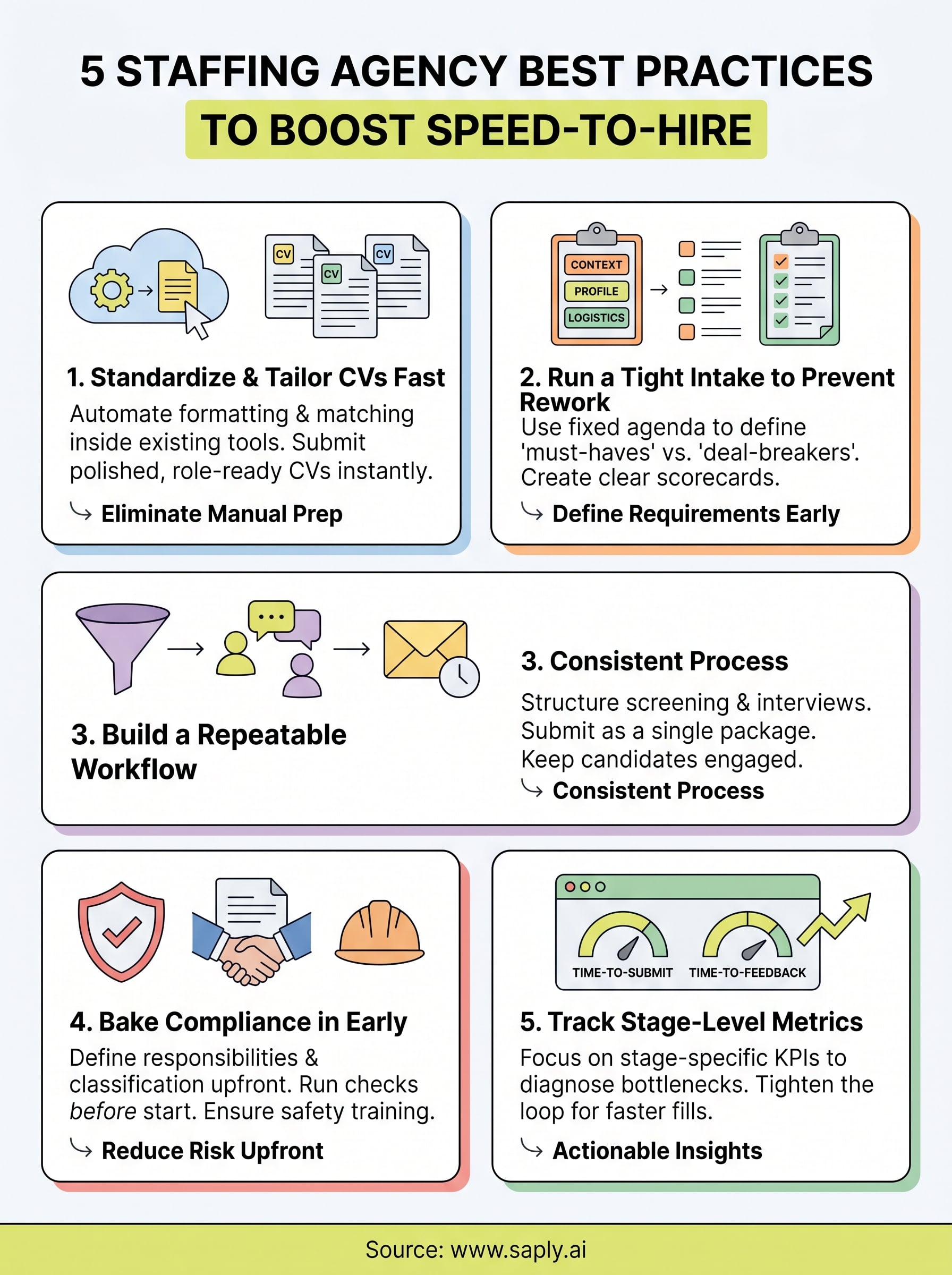
These five staffing agency best practices share a common thread: they each cut the time between identifying a candidate and getting that person in front of the right client. Standardizing your CV prep, tightening intake, running a repeatable screening process, building compliance in early, and tracking stage-level metrics together create a system that fills roles faster without adding headcount or sacrificing quality.
None of these practices require a complete operational overhaul. Start with the area where your team loses the most time today, fix that bottleneck, then move to the next. Small, deliberate improvements stack quickly when your team applies them consistently across every role.
If manual CV formatting and tailoring is the biggest drag on your submission speed, that’s the easiest place to start. Try Saply free for 14 days and see how much time your recruiters recover when CV prep runs on autopilot inside the tools they already use.