
candidate-experience-best-practices
8 Candidate Experience Best Practices to Win Top Talent
A clunky application process, weeks of radio silence, or a generic rejection email, any one of these can push a strong candidate straight to your competitor. For staffing agencies handling high volume...
Written by: Saply Team

8 Candidate Experience Best Practices to Win Top Talent
A clunky application process, weeks of radio silence, or a generic rejection email, any one of these can push a strong candidate straight to your competitor. For staffing agencies handling high volumes of roles and submissions, nailing candidate experience best practices isn’t just a nice-to-have. It’s a direct competitive advantage that determines whether top talent sticks with you or ghosts you mid-process.
The reality is that candidates judge your agency from the very first interaction. Every touchpoint, from how quickly you respond to how professionally you present their CV to clients, shapes their perception. A slow, disorganized process signals to candidates that their time doesn’t matter. And when skilled candidates have options, that signal is enough to make them walk. At Saply, we see this play out constantly: agencies that speed up CV formatting and tailoring through our platform don’t just save internal hours, they get candidates in front of clients faster, which directly improves the candidate’s experience of working with that agency.
This article breaks down eight proven practices that staffing teams can implement to strengthen every stage of the recruitment journey. Whether you’re looking to tighten communication loops, streamline your submission workflow, or build a reputation candidates actively seek out, these strategies will give you a concrete playbook to work from.
1. Make resumes role-ready fast with Saply
When a candidate hands over their CV, every hour your team spends manually reformatting and tailoring it is an hour that candidate waits without any news. Speed is a core part of candidate experience best practices, and slow submissions signal disorganization to candidates and clients alike. Saply automates the formatting and tailoring workflow so your team moves from raw CV to polished, role-ready submission in minutes rather than hours.
Why it matters for candidate experience
Candidates who work with your agency want to feel like their application is moving forward. When you hold a CV in your queue because your team is copy-pasting content between systems or reformatting manually, the candidate doesn’t see that internal work. They only experience the delay. That waiting period creates anxiety and gives a faster recruiter the opening to step in.
The faster you present a candidate to a client, the more confident that candidate feels in your agency’s ability to advocate for them.
What to do step by step
Start by integrating Saply directly into the tools your team already uses. Once it’s connected to Microsoft Word, Google Docs, or your ATS such as Bullhorn, Carerix, or Spott, follow this sequence for every submission:
- Import the raw CV from the candidate directly into Saply.
- Apply your agency’s custom template with one click to align formatting, sections, and typography.
- Feed in the job description from your ATS or manually, and let Saply’s AI tailor the CV to surface relevant experience.
- Review the match score and skill gap analysis before submitting to your client.
Templates and examples to use
Your agency should have a master CV template loaded into Saply before your first submission. Saply integrates your custom template within 48 hours of onboarding, so every formatted CV reflects your brand consistently. For tailoring, treat the job description as your primary input: the more specific and detailed the job description you provide, the sharper and more targeted the tailored output will be. A vague job description produces a generic result, so push clients to share full role briefs before you tailor.
Metrics and signals to track
Track time-to-submission per CV as your baseline metric. If your team currently spends 45 minutes formatting and tailoring a single CV, measure how that drops after adopting Saply. Also watch candidate response rates after submission: when clients receive well-matched CVs quickly, they respond faster, and candidates directly feel that momentum as a signal that your agency is working hard for them.
2. Remove friction from your application and intake
Every extra step you add to your application or intake process is a candidate you risk losing. High-volume staffing teams often inherit intake workflows that were built for a different era, long forms, email attachments, repeated data entry, and manual follow-ups that drain time on both sides.

Why it matters for candidate experience
Candidates measure your agency by how easy you make the early process. If your intake form asks for the same information already on their CV, or if applying through your system requires creating an account before they’ve even spoken to a recruiter, you’ve already created a negative impression. One of the most overlooked candidate experience best practices is auditing your own intake process from the candidate’s point of view.
A friction-heavy intake process tells candidates, before they’ve even met you, that working with your agency will be complicated.
What to do step by step
Reduce intake to the minimum viable steps needed to move forward. Here’s a practical sequence to follow:
- Limit your initial form to name, contact details, role interest, and CV upload.
- Collect additional information through a short intake call, not a second form.
- Use your ATS to auto-populate candidate profiles from uploaded CVs wherever possible.
- Send an automated confirmation within minutes of receiving an application.
Templates and examples to use
Your intake confirmation message should be short and specific. State what happens next, who will contact the candidate, and within what timeframe. Vague confirmations increase anxiety and inbound follow-up emails that cost your team time.
Metrics and signals to track
Track your application drop-off rate at each step. If candidates start your form but don’t complete it, that’s a direct signal that the process has too many barriers. Also monitor time-to-first-contact as a secondary metric.
3. Set expectations early and communicate often
Candidates don’t leave processes because they got bad news. They leave because they get no news. Silence is one of the most damaging mistakes staffing agencies make, and it’s entirely preventable. Following candidate experience best practices means treating communication as a core deliverable, not an afterthought.
Why it matters for candidate experience
When candidates know what to expect and when, their anxiety drops and their trust in your agency rises. Uncertain timelines force candidates to either follow up repeatedly, which wastes your team’s time, or assume they’ve been forgotten and move on. Neither outcome helps you fill roles faster.
A candidate who feels informed will stay in your process longer, even when the news is slow.
What to do step by step
Build a communication rhythm into every stage of your process so updates go out automatically or on a fixed schedule. Follow this sequence after every key event:
- Send a status update within 24 hours of submitting a CV to a client.
- Share client feedback as soon as you receive it, even if that feedback is just “still reviewing.”
- Set a clear next-step date at the end of every conversation with a candidate.
- Proactively reach out if a timeline changes rather than waiting for the candidate to ask.
Templates and examples to use
Your status update message should confirm what happened, what comes next, and when the candidate can expect to hear from you again. Keep it under five sentences.
Metrics and signals to track
Track inbound follow-up messages from candidates as your clearest signal. If candidates are constantly asking for updates, your communication cadence has gaps that need closing.
4. Write clear job descriptions and share the details
Vague job descriptions create problems at every stage of recruitment. When candidates don’t understand the actual role requirements, they show up to interviews underprepared, and your team submits CVs that miss the mark. A clear, detailed job description is foundational to several candidate experience best practices because it sets accurate expectations before the candidate invests time in the process.
Why it matters for candidate experience
Candidates want to know exactly what they’re applying for. When your job descriptions lack specific responsibilities, required qualifications, and compensation ranges, candidates fill in the gaps with assumptions that often don’t match reality. That mismatch leads to wasted interviews and candidates who feel misled.
A clear job description is the first honest conversation you have with a candidate.
What to do step by step
Push clients to give you complete role briefs before you post or pitch any candidate. When clients resist, explain that detailed descriptions reduce time-to-fill by filtering unqualified applicants earlier. Follow this sequence to build a stronger foundation for every submission:
- List required versus preferred skills separately.
- Include a realistic salary range rather than leaving compensation as a discovery item.
- State the interview process upfront, including the number of rounds and who the candidate will meet.
Templates and examples to use
Your standard job description template should cover a role summary, responsibilities, required qualifications, preferred qualifications, compensation range, and next steps. Keep the language plain and specific, and cut any filler phrases that don’t give candidates concrete information about the role.
Metrics and signals to track
Track your candidate withdrawal rate after the first interview. If candidates regularly drop out at that stage, your job descriptions may be creating expectations the role doesn’t actually meet.
5. Prepare candidates for every interview step
Candidates who walk into an interview without knowing the format, who they’re meeting, or what the client values are more likely to underperform and more likely to hold your agency responsible for the poor result. Interview preparation is one of the most direct candidate experience best practices you can act on because it immediately increases candidate confidence and your submission success rate.

Why it matters for candidate experience
An unprepared candidate is a nervous candidate, and a nervous candidate rarely performs at the level that gets them placed. Your responsibility as the recruiter doesn’t end when a client agrees to an interview. Candidates rely on you to give them the context they need to represent themselves well and walk in with genuine confidence.
When you set candidates up with solid prep, you demonstrate that your agency is genuinely invested in their success, not just the placement fee.
What to do step by step
Send a structured prep brief to every candidate before each interview stage. Cover the format, interviewers by name and title, the client’s core priorities, and any topics the client typically focuses on. Follow this sequence:
- Share the interview format (panel, one-to-one, technical, or case-based).
- Give a brief background on each interviewer using publicly available information.
- Flag two or three role-specific topics the candidate should be ready to address confidently.
Templates and examples to use
Your standard prep brief should fit on one page and cover format, interviewer context, key talking points, and logistics like time, location, and dress expectations.
Metrics and signals to track
Track your interview-to-offer conversion rate per recruiter and per client. A low conversion rate after strong CV submissions often signals gaps in candidate preparation, not candidate quality.
6. Run structured, respectful interviews every time
Unstructured interviews hurt candidates and hiring outcomes equally. When interviewers improvise questions or run over time without a clear agenda, candidates leave the room unsure how they performed, and your clients make inconsistent decisions. Building structured interviews into your standard process is one of the most overlooked candidate experience best practices because it creates a fair, predictable interaction that candidates can respect even if they don’t get the role.
Why it matters for candidate experience
Candidates form lasting impressions based on how interviews are conducted. A disorganized interview, one where the interviewer arrives late, asks irrelevant questions, or cuts the session short, signals that the client doesn’t value the candidate’s time. Your agency’s reputation is directly tied to how those client interactions go, so it’s worth investing in getting the format right.
A structured interview protects both the candidate’s experience and your client’s ability to make a confident, consistent decision.
What to do step by step
Work with clients upfront to agree on a consistent interview structure before any candidate sits down. Share that structure with candidates in advance so there are no surprises. Follow these steps:
- Confirm a fixed set of core questions the client asks every candidate for the same role.
- Set a hard time limit for each interview stage and stick to it.
- Brief the client to leave time at the end for candidate questions.
Templates and examples to use
Your client interview brief should include the question list, time allocation per section, and a reminder to give candidates a genuine opportunity to ask questions at the close.
Metrics and signals to track
Monitor post-interview candidate feedback scores collected through a short survey immediately after each interview. Low scores on interviewer preparedness or time management point directly to clients who need a structured briefing before the next round.
7. Close the loop and measure candidate experience
Most agencies track time-to-fill and submission volume, but fewer measure how candidates actually felt about the process. Closing the loop means collecting feedback at the end of every placement cycle and using that data to continuously improve.
Why it matters for candidate experience
Candidates who don’t get placed still form an opinion about your agency. That opinion travels, through referrals, reviews, and word of mouth inside their professional networks. Treating every candidate exit as a learning opportunity is one of the most underused candidate experience best practices available to staffing teams.
The agencies that grow fastest are the ones that treat rejected candidates as future clients, not closed cases.
What to do step by step
Build a feedback step into your standard process so it happens consistently, not just when a recruiter remembers to follow up. Use this sequence after every closed application:
- Send a short survey within 48 hours of the outcome, whether a placement or a rejection.
- Ask three to five questions covering communication clarity, interview preparation, and overall satisfaction.
- Review responses monthly as a team and flag recurring patterns.
Templates and examples to use
Your post-process survey should take under two minutes to complete. Ask candidates to rate specific touchpoints rather than the overall experience in a single score. Specific ratings give you actionable data rather than a general sentiment you can’t act on.
Metrics and signals to track
Track your Net Promoter Score from candidates alongside your placement rate. Rising NPS alongside stable placement volume signals that your process improvements are working across the full recruitment cycle.
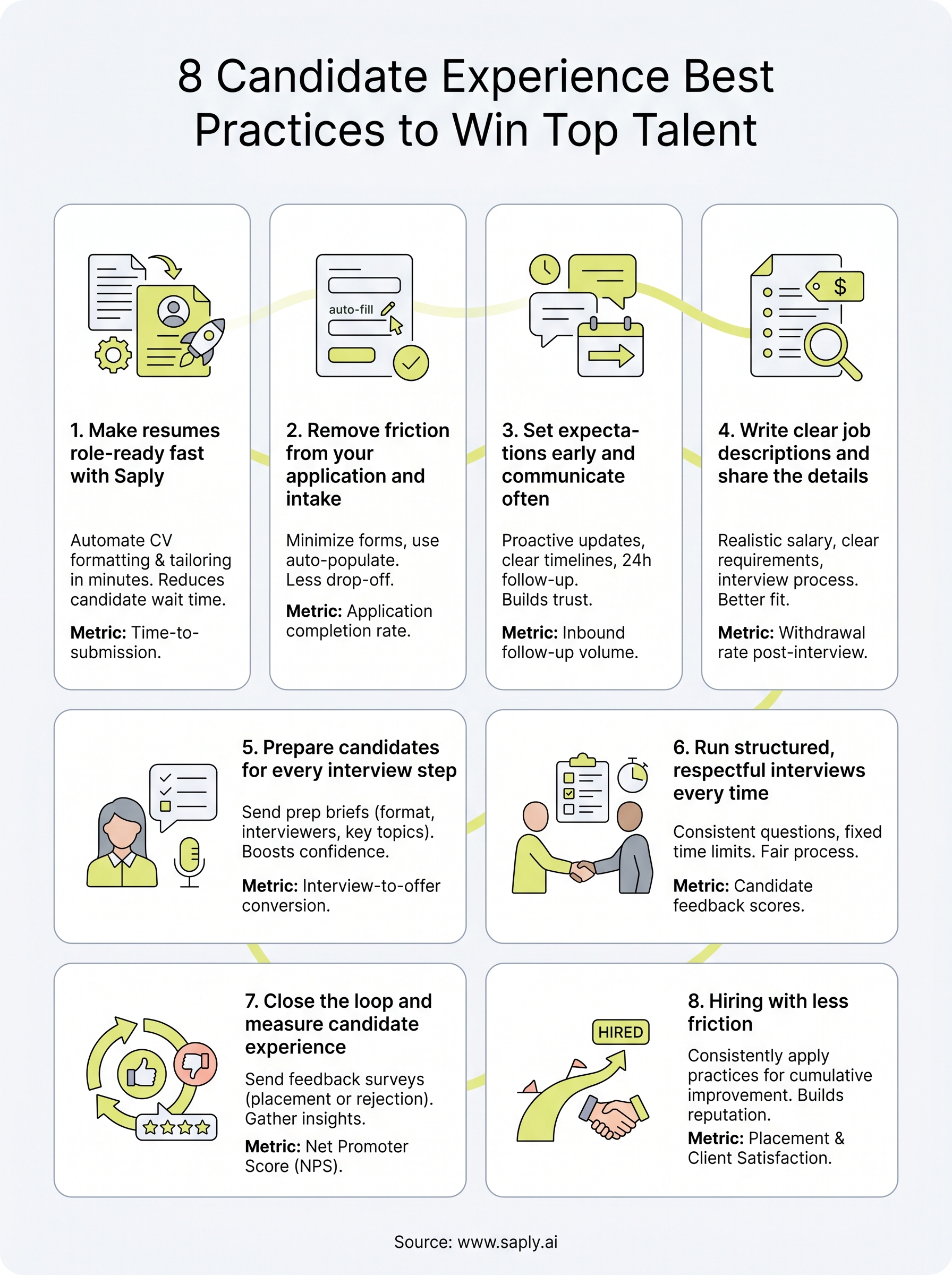
Hiring with less friction
Every practice in this list comes back to one core idea: candidates form opinions fast, and those opinions determine whether your agency builds a reputation that attracts talent or one that pushes it away. Applying these candidate experience best practices consistently, across every role and every recruiter on your team, is what separates agencies that grow through referrals from ones that constantly restart from scratch.
Start with the steps that give you the fastest return. Cutting CV formatting time reduces candidate wait time immediately, and clear communication eliminates the follow-up emails that slow your team down. Each improvement builds on the next, and over time, the cumulative effect shows up in your placement rates, your candidate NPS, and your client satisfaction scores.
If you want to reduce submission time without adding headcount, see how Saply automates CV formatting and tailoring so your team can focus on the work that actually requires human judgment.