
how-does-salary-benchmarking-work
How Does Salary Benchmarking Work? Steps, Data, And Ranges
Staffing agencies that submit candidates without understanding market pay rates risk losing placements to competitors who do. How does salary benchmarking work, exactly? It's the process of comparing...
Written by: Saply Team

How Does Salary Benchmarking Work? Steps, Data, And Ranges
Staffing agencies that submit candidates without understanding market pay rates risk losing placements to competitors who do. How does salary benchmarking work, exactly? It’s the process of comparing your internal compensation data, or your client’s, against external market rates to determine whether a role’s pay is competitive enough to attract and retain the right talent.
For recruiters, this matters more than it might seem at first glance. Salary benchmarking directly affects how you position candidates during submissions. If you’re tailoring a CV to a role that pays below market, you need to know that before you pitch. If you’re matching a candidate whose expectations sit above the range, you need that context early. At Saply, we help staffing agencies format and tailor CVs faster with AI, but the strategic side of placements, like understanding pay competitiveness, is just as critical to winning business.
This article breaks down the full salary benchmarking process: the data sources you’ll rely on, the steps to follow, and how to build ranges that actually hold up when clients and candidates push back.
Why salary benchmarking matters
Salary benchmarking affects every stage of a placement, from how you write a job brief to how you coach a candidate through an offer. Without market data behind you, you’re guessing at pay ranges, and guessing costs you placements. When you understand whether a role is priced fairly against the market, you can set realistic expectations early and avoid the frustration of a candidate declining at the final stage because the compensation was never right to begin with.
It keeps your candidates competitive
When you benchmark salaries before submitting a candidate, you walk into the process with a clear picture of what the market actually supports. Candidates who receive below-market offers often walk away, or worse, accept and leave within months, which damages your placement record and your agency’s reputation with that client. Knowing the going rate for a specific role in a specific location lets you advise candidates on what to expect and helps you filter out roles that simply won’t convert before you invest time tailoring a submission.
The best time to surface a pay mismatch is before you submit the CV, not after the client extends an offer.
You also protect yourself from the opposite problem: overselling a candidate’s salary expectations to a client who won’t move on budget. When you have benchmarked data supporting your position, you can push back on a client’s pay range with evidence rather than gut feeling, which is a much stronger place to negotiate from.
It strengthens your client relationships
Clients rely on staffing agencies to understand the talent market, and salary guidance is a core part of that expertise. If you walk into a client conversation with benchmarked data showing what similar roles pay across comparable markets, you position yourself as a strategic partner rather than just a CV delivery service. That shift matters when clients decide which agencies to call first for a new opening.
Accurate benchmarking also reduces time-to-fill for your clients. When pay is set at a competitive level from day one, you attract more qualified candidates, move through interviews faster, and close placements without renegotiating offers at the last minute. That kind of efficiency builds real trust and drives repeat business.
What data you need and where to get it
The quality of your salary benchmarking depends entirely on the data you start with. Understanding how does salary benchmarking work in practice means knowing which sources carry real weight and which ones give you numbers that don’t hold up when clients or candidates push back. You need a mix of external market data and internal placement history to build ranges that reflect reality rather than averages that hide wide variation.
Where to find reliable market data
Government labor statistics are your most defensible starting point. The U.S. Bureau of Labor Statistics publishes the Occupational Employment and Wage Statistics survey, which breaks down median and percentile pay by role, industry, and geographic area. These numbers update annually and give you a solid baseline before you layer in more current signals.

Free government data gives you defensible baselines, but it lags the market by 12 to 18 months, so always supplement it with live sources.
Beyond government data, industry salary surveys from professional associations provide more current and role-specific figures. Your own placement history is equally valuable, since it reflects what candidates in your market actually accepted, not what a survey respondent said they earned.
What details to collect
For each role you benchmark, you need more than just the pay figure. Context fields like seniority level, location, industry, and company size determine whether a comparison is valid. Without them, your ranges end up too broad to act on. Key data points to collect per role include:
- Job title and seniority level
- Location (city, state, or remote status)
- Industry vertical
- Company size by headcount or revenue
- Base pay, bonus, and total compensation
How salary benchmarking works step by step
Understanding how salary benchmarking works in practice comes down to following a repeatable sequence. Each step builds on the last, and skipping any one of them leads to ranges that collapse under pressure from candidates or clients.
Step 1: Define the roles you’re benchmarking
Start by identifying the specific roles you need data on before pulling any numbers. Generic job titles like “engineer” or “manager” produce ranges too wide to act on. You need to pin down the seniority level, core responsibilities, and location for each role first. The more precisely you define the role, the more valid your comparisons will be.
Step 2: Gather and filter your data
Pull figures from multiple sources at the same time: government surveys, professional association reports, and your own placement records. Once you have raw numbers, filter out data that does not match your role definition. Mismatched data points drag your averages up or down and make your final range unreliable. Keep only the figures that align with your exact role criteria.
Filtering bad data out of your dataset matters just as much as finding good data in the first place.
Step 3: Analyze and build your initial range
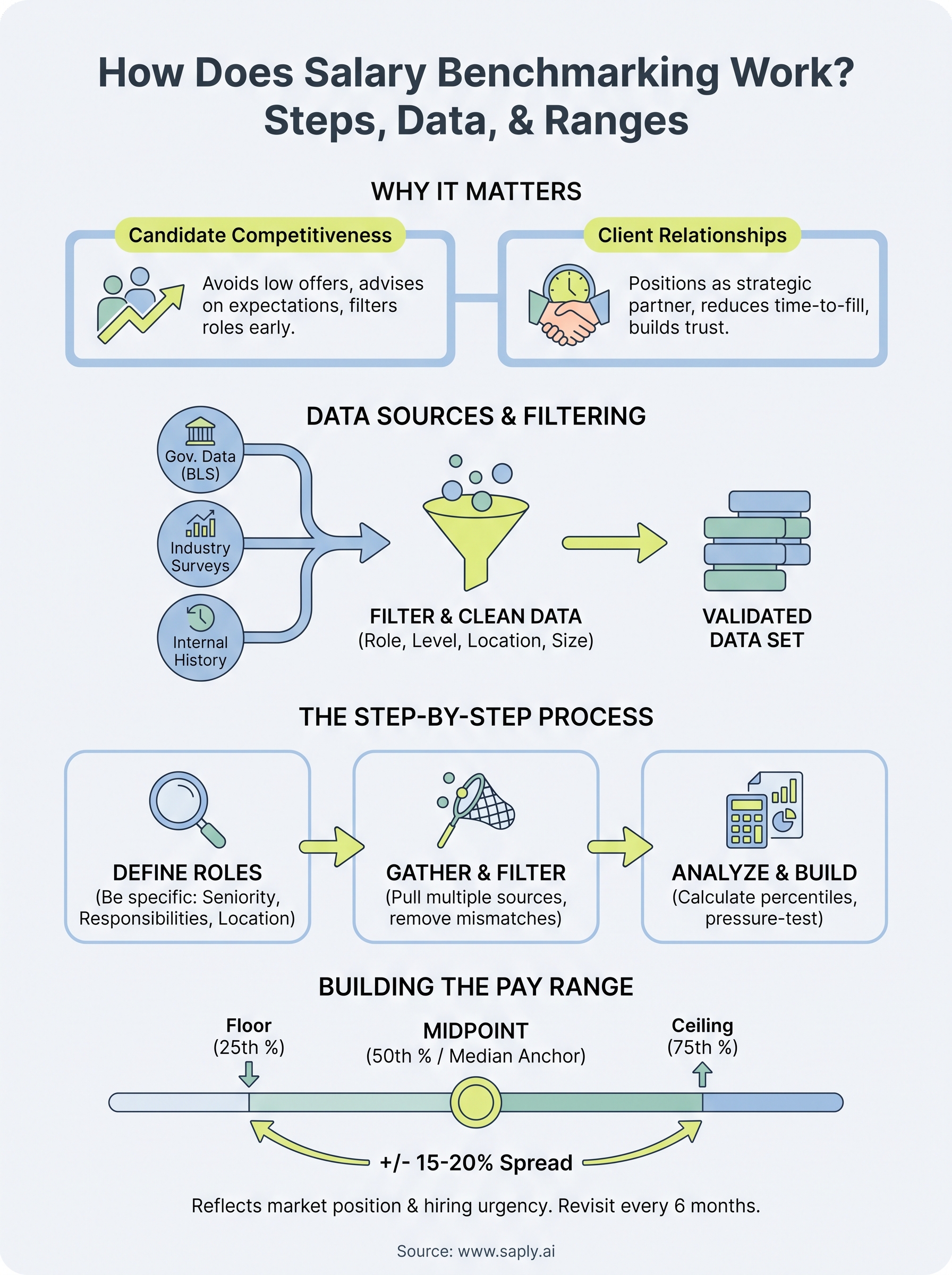
With clean data in hand, calculate the 25th, 50th, and 75th percentile pay figures for the role. Those three numbers give you a low, midpoint, and high for your working range. Use your internal placement history to pressure-test those figures against what candidates in your specific market actually accepted before locking anything in.
How to set pay ranges and percentiles
Once you have your percentile data, the next step is converting those numbers into a structured pay range that you can actually use in client conversations and candidate briefings. Understanding how does salary benchmarking work at this stage means recognizing that a single number is never enough. You need a range with a floor, a midpoint, and a ceiling that reflect your market position and hiring goals.
Choose your percentile anchor point
Your anchor point determines the competitive position you’re setting for the role. Most agencies target the 50th percentile (market median) as their midpoint for standard roles. If your client needs to attract talent fast or fill a highly specialized position, anchoring at the 75th percentile gives you a stronger pull. Roles with a large candidate pool can sit closer to the 25th percentile without hurting conversion rates.
The percentile you anchor to signals how aggressively your client wants to compete for talent, so align it with their actual hiring urgency.
Build the range around your midpoint
With your anchor set, extend roughly 15 to 20 percent above and below the midpoint to create your working range. This gives hiring managers room to adjust offers based on candidate experience without breaching the range’s boundaries. Keep the following in mind as you finalize the range:

- Set the floor at the point where qualified candidates would still accept
- Set the ceiling where the role stays financially justified for the client
- Revisit the range every six months to account for market shifts
Common pitfalls and best practices
Even when you understand how does salary benchmarking work at a process level, execution errors produce ranges that fail under real negotiating pressure. The most common mistake is treating benchmarking as a one-time activity. Markets shift, candidate expectations change, and what qualified candidates accepted last year may not reflect what they’ll accept today.
Pitfalls to avoid
Several execution errors routinely undermine the quality of salary benchmarks, even when recruiters are pulling from legitimate sources. Watch out for:
- Using a single data source: Government surveys lag the market by 12 to 18 months, so relying on one alone leaves you working with outdated figures.
- Mixing mismatched job titles: Comparing roles with different seniority levels or company sizes produces averages that don’t reflect any real situation accurately.
- Ignoring location differences: Pay varies significantly between metro and rural markets, and treating them as interchangeable skews your entire range.
A benchmarking range is only as reliable as the data you filtered out, not just the data you kept in.
Best practices to follow
Refresh your ranges at least twice a year and document when each benchmark was last updated so you always know whether you’re working with current data. When you present figures to clients, show the full range rather than a single midpoint, and explain what factors push compensation toward the ceiling, such as candidate experience or urgent timelines. That approach builds credibility and gives clients a framework for making decisions instead of a single number to push back on.
Next steps
Now that you understand how does salary benchmarking work from data collection through range-setting, the practical move is to apply this process to your next active role. Start with three roles you’re currently filling, pull figures from at least two sources, and build a percentile range you can actually use in your next client conversation. That hands-on run will expose any gaps in your process faster than reading more about it.
The wider lesson here is that benchmarking isn’t a one-time task you check off before moving on. It’s a repeatable workflow that gets sharper the more consistently you apply it. When your pay ranges are accurate and current, your candidate submissions carry more strategic weight, your clients trust your guidance, and your placements close faster. If you want to reduce the time you spend on manual CV work so you have more capacity for strategy like this, take a look at what Saply’s AI-powered CV formatting and tailoring can do for your team.