



How Executive Search Firms Work: Process, Fees, Timeline
Executive search firms operate nothing like your typical staffing agency or job board. They work on retainer, target candidates who aren't actively looking, and charge fees that can reach 30% or more...

Executive search firms operate nothing like your typical staffing agency or job board. They work on retainer, target candidates who aren’t actively looking, and charge fees that can reach 30% or more of a placed executive’s first-year compensation. Understanding how executive search firms work matters whether you’re a recruiter competing for the same talent, a hiring company considering one, or a candidate who just got a cold call from a headhunter.
The process is structured, confidential, and methodical, often spanning several months from kickoff to signed offer. Each phase, from defining the role to presenting a shortlist, follows a deliberate sequence that separates executive search from contingency recruiting and internal hiring.
This article breaks down the full executive search process step by step, explains the fee structures involved, and covers realistic timelines. At Saply, we help staffing and recruitment firms format and tailor candidate CVs in under 1 minute using AI built directly into the tools they already work in, so when you’re competing with retained search firms on speed and presentation, your submissions look sharp without the manual grind.
What executive search is and why companies use it
Executive search is a specialized recruitment model focused exclusively on filling senior-level roles, typically C-suite, VP, and board positions. Unlike posting a job and waiting for applications, executive search firms proactively identify and approach specific individuals who already hold comparable roles at other organizations. These candidates are not browsing job boards. They’re working, succeeding, and often not thinking about a move until a well-timed conversation reaches them.
Why companies hire executive search firms
When you understand how executive search firms work, you quickly see why organizations bring them in for high-stakes roles. A wrong hire at the VP or C-suite level can cost the business far more than the search fee. Leadership decisions shape company direction, culture, and performance for years, so companies want a process that is rigorous, confidential, and grounded in deep market knowledge rather than whoever happened to apply this week.
Executive search firms give companies access to candidates who would never respond to a job posting, which is often the entire point.
Your firm brings a pre-built professional network and structured research methodology, along with a process for evaluating fit beyond reviewing a resume at face value. For roles where discretion matters, such as replacing an underperforming executive before the transition becomes public, the confidential nature of retained search makes it the only practical option.
What kinds of roles executive search covers
Most executive search mandates focus on roles that carry significant organizational responsibility, including CEOs, CFOs, Chief People Officers, and VP-level leaders across functions like sales, technology, and operations. Some firms specialize by industry, focusing on sectors like healthcare, private equity, or financial services, while others operate as generalist search firms across multiple markets.
The common thread across every mandate is compensation level and strategic impact. If the role directly influences company performance and carries a total compensation package above a certain threshold, often $150,000 or more, it typically falls within executive search territory. That threshold varies by market and firm, but it explains why the process demands more time, rigor, and financial investment than filling an individual contributor position.
How executive search differs from recruiting agencies
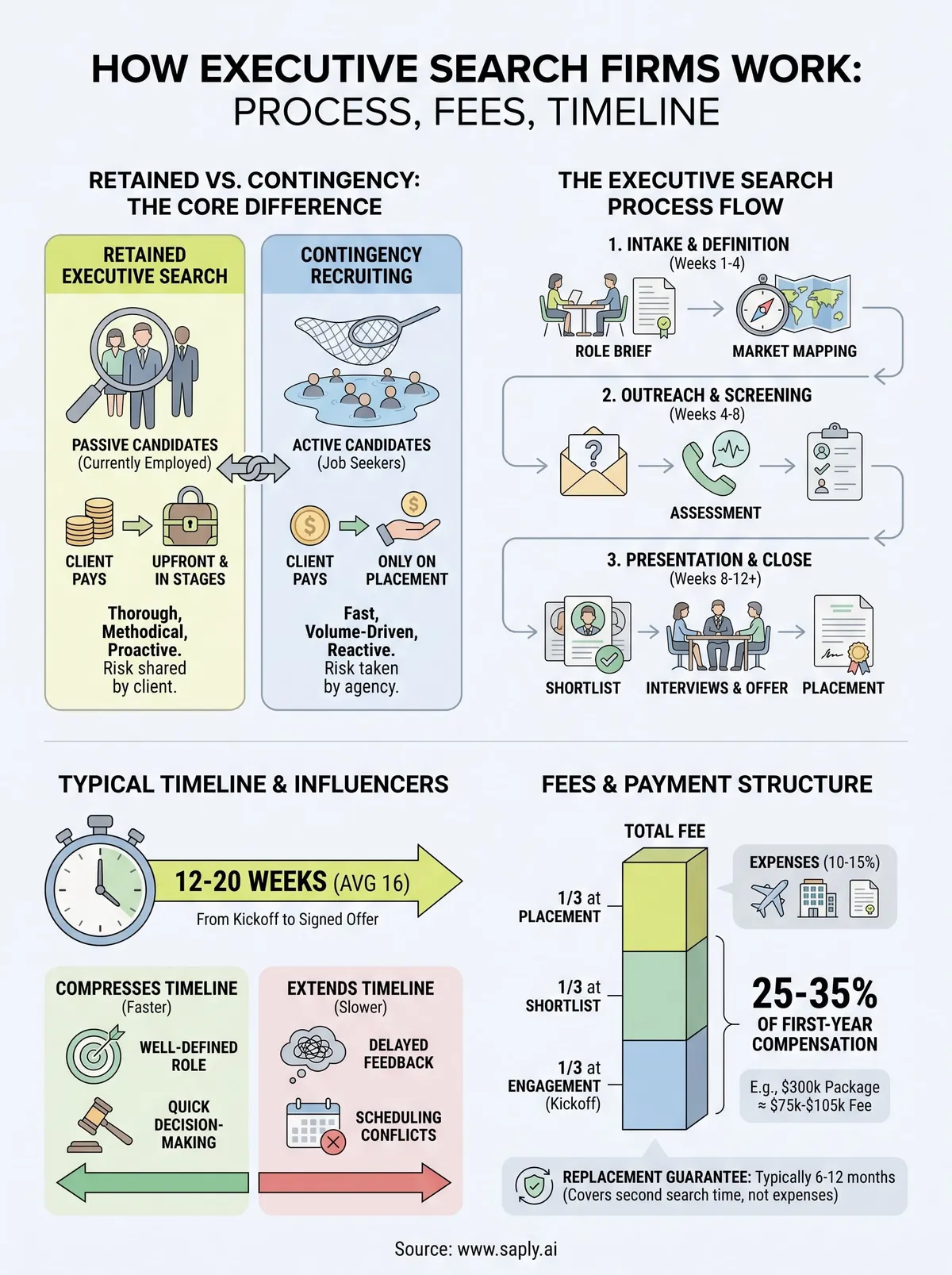
The clearest way to understand how executive search firms work is to contrast them with contingency recruiting agencies. A contingency recruiter gets paid only when a candidate is placed, which pushes them toward speed and volume. Executive search firms operate on a retainer model, meaning the client pays fees upfront regardless of outcome. That fundamental difference shapes everything from the sourcing approach to the depth of each candidate evaluation.
Retainer vs. contingency: who takes the financial risk
With contingency recruiting, the agency absorbs all financial risk and only earns a fee if the placement closes. That reality incentivizes working multiple clients at the same time and submitting candidates quickly rather than thoroughly. Retained search flips that model: the hiring company pays in stages, typically one-third at kickoff, one-third at shortlist, and one-third at placement. This structure gives the search firm the runway to be rigorous rather than reactive.

A retained search firm owes its full attention to one client per mandate because the work is already funded.
Candidate targeting and how sourcing differs
Contingency agencies typically work from active candidate pools, people who submitted applications or refreshed their profiles on job boards. Executive search firms build proprietary research to identify passive candidates, meaning professionals who are currently employed and performing well in comparable roles at other organizations. Your search firm reaches out directly, using network connections and structured market mapping, to approach people who would never encounter the role on their own.
How executive search firms run a search end to end
Understanding how executive search firms work at a process level helps you see why mandates take months rather than weeks. Each phase builds on the last, and skipping steps typically produces a weaker shortlist or a placement that doesn’t stick.

Phase one: intake and role definition
The search begins with a structured intake meeting between the search firm and the hiring company’s leadership team. Both parties define the role’s scope, reporting structure, compensation range, and the specific competencies required. This phase also surfaces any cultural or strategic fit criteria that won’t appear on a job description, such as the leadership style the team needs right now or the business challenges the hire must solve in the first six months.
Phase two: market mapping and candidate identification
Once the role is clearly defined, the firm builds a target list of candidate profiles by mapping the relevant market. Researchers identify individuals currently holding comparable roles at competitor or peer organizations. This is proprietary work, not a database search, and it produces a long list of passive candidates the company would never reach through job postings alone.
Phase three: outreach, screening, and shortlist presentation
The firm reaches out directly to target candidates and conducts structured screening conversations to assess interest, compensation alignment, and baseline fit against the role criteria. Strong candidates move into deeper interviews with the search firm before anyone is presented to the client.
The shortlist the client sees typically includes three to six candidates, each backed by a detailed written assessment, not just a CV.
Typical executive search timeline and what changes it
Most executive search mandates run 12 to 20 weeks from kickoff to signed offer, though the average sits closer to 16 weeks for senior leadership roles. That timeline assumes a clear role brief, an engaged hiring team, and candidates who can move through interviews without significant scheduling delays. When any of those variables slip, the search runs longer.
What the standard search schedule looks like
The first two to four weeks focus on intake and market mapping. Weeks four through eight cover candidate outreach and initial screening. The shortlist presentation typically lands around week eight to ten, followed by client interviews, reference checks, offer negotiation, and close. Understanding how executive search firms work helps you see why rushing the front end usually creates problems at the back end.
Compressing the market mapping phase produces a weaker candidate pool, and the client always notices when the shortlist arrives thin.
Your involvement as the hiring company matters at every stage. Delayed feedback between interview rounds is the single most common reason searches stretch beyond 20 weeks, because candidates at the senior level rarely stay available indefinitely.
Factors that extend or compress the process
Several variables push timelines in either direction. Poorly defined role criteria at kickoff force the firm to restart scoping work mid-search, sometimes adding three to four weeks before meaningful outreach begins. A hiring team with pre-agreed compensation parameters and clear decision-making authority consistently closes searches faster than committees where approval requires multiple rounds of internal alignment.
Executive search fees, contracts, and guarantees
Understanding how executive search firms work financially helps you budget accurately and avoid surprises when a contract lands on your desk. Retained search fees typically fall between 25% and 35% of the placed executive’s first-year total compensation, including base salary and target bonus. On a $300,000 package, that puts the fee somewhere between $75,000 and $105,000 before any additional expenses.
Fee structure and how retainers work
Most retained search firms split the total fee into three equal installments: one-third at engagement, one-third at shortlist delivery, and one-third at placement. This structure means you commit financially before seeing a single candidate name, which is a deliberate design that gives the firm the runway to run a thorough process rather than a rushed one.
Expense reimbursement for candidate travel, assessment tools, and research services typically adds another 10% to 15% on top of the base fee. Some firms bundle this into a flat rate, while others bill it separately at the close of each phase.
You are paying for a structured, confidential process run by professionals with access to candidates you simply cannot reach through standard channels.
Guarantee clauses and what they actually cover
Most retained search contracts include a replacement guarantee if the placed executive leaves or is terminated within a defined window, typically six to twelve months from start date. That guarantee usually covers the firm’s time for a second search but not the expenses billed during the original engagement.
Read these clauses carefully before signing, because the conditions that trigger a no-cost replacement search vary significantly between firms. Some contracts exclude departures caused by company restructuring or role elimination entirely, which leaves you funding a second search out of pocket.
Next steps
Now that you understand how executive search firms work, from retainer-based fee structures to 16-week search timelines, you can make more informed decisions about when to use one, how to compete against them, or how to partner effectively with your own clients. The key takeaways are straightforward: retained search is slower, more expensive, and more thorough than contingency recruiting, and that tradeoff is by design.
If you run a staffing or recruitment firm that handles senior-level placements, the speed and quality of your candidate presentations directly affects how you compete in this space. Sloppy formatting or generic CVs cost you mandates that your team worked hard to develop. Saply helps recruitment firms format and tailor CVs in under 1 minute using AI that plugs directly into Microsoft Word, Google Docs, and your ATS, so every submission you send looks polished and role-ready without adding hours of manual work to your process.