
how-to-build-a-talent-pool
Talent Pool Guide: How To Build a Talent Pool for Agencies
Most staffing agencies operate reactively, a client sends over a job order, and the scramble to find candidates begins. That approach works until it doesn't. When your competitors are submitting tailo...
Written by: Saply Team

Talent Pool Guide: How To Build a Talent Pool for Agencies
Most staffing agencies operate reactively, a client sends over a job order, and the scramble to find candidates begins. That approach works until it doesn’t. When your competitors are submitting tailored, role-ready resumes within hours, sourcing from scratch puts you at a serious disadvantage. Knowing how to build a talent pool changes the game entirely.
A well-maintained talent pool gives your agency a head start on every placement. Instead of starting from zero, you’re pulling from a pipeline of pre-qualified candidates you’ve already vetted, engaged, and organized. The result is faster submissions, stronger matches, and more placements closed, which is exactly the kind of speed and precision that wins in staffing.
This guide walks you through the full process: sourcing candidates, segmenting your pool, keeping it active, and making sure the talent you’ve collected actually gets used. We’ll also cover how tools like Saply fit into this workflow, once you’ve built your pipeline, formatting and tailoring CVs to specific roles in seconds (rather than hours) is what turns a good talent pool into a competitive advantage your clients notice.
What a talent pool means for agencies
A talent pool is not the same as your ATS candidate list. Most agencies confuse volume with value, assuming that a large database automatically means faster placements. A real talent pool is a curated, segmented group of candidates who are pre-qualified, categorized by role type and skill set, and kept warm through regular outreach. The distinction matters because a database collects names while a talent pool produces placements.
A list that goes stale is not a pipeline. It’s a liability.
Reactive vs. proactive sourcing
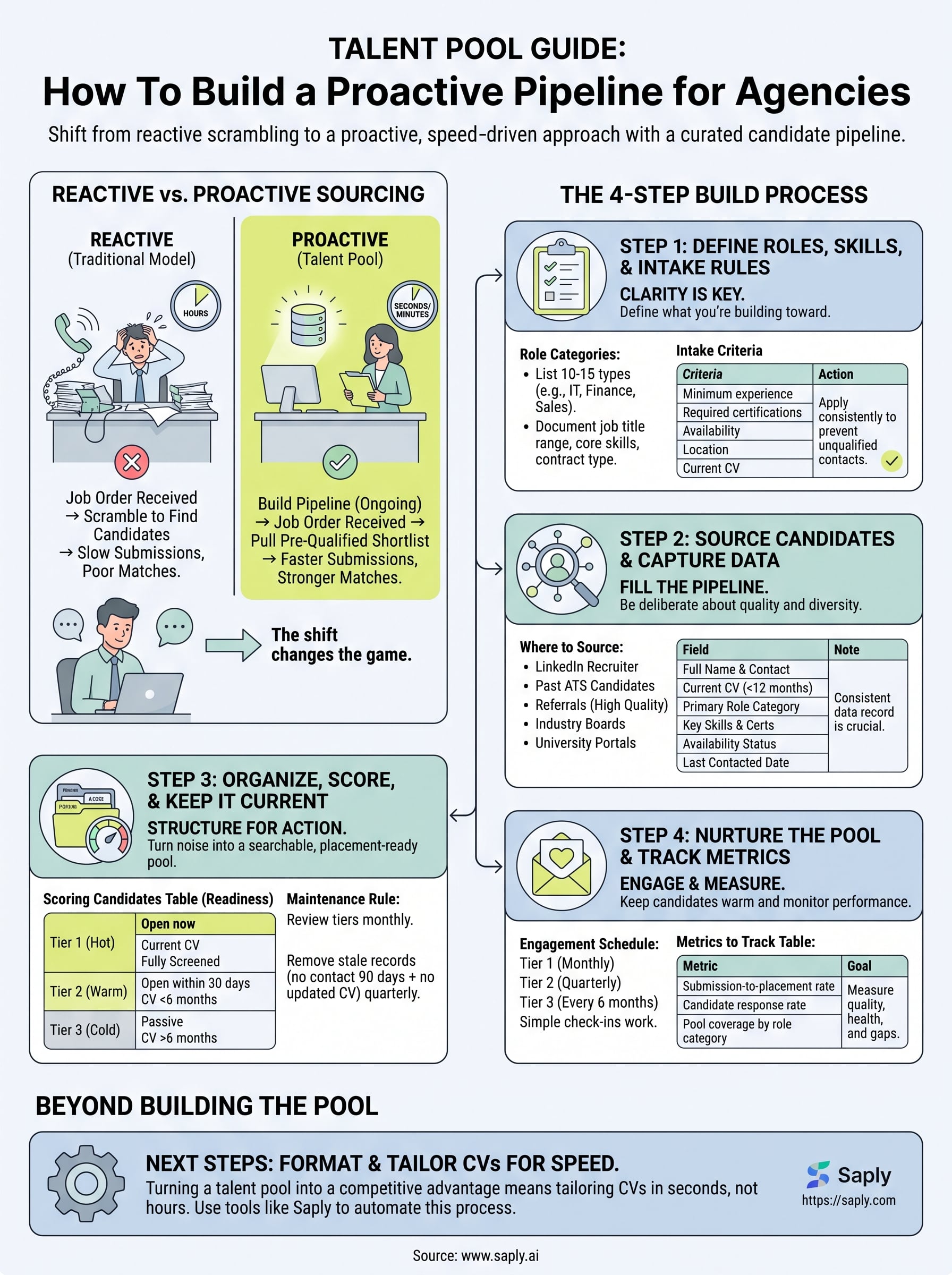
When you operate reactively, every new job order restarts your sourcing cycle from zero. You post, screen, and qualify candidates under time pressure, which increases the chance of a poor match and a slow submission. Proactive agencies build their pipeline before the order arrives, so when a client calls, they’re already holding a shortlist of qualified, submission-ready candidates.
Understanding how to build a talent pool means shifting your agency’s operating model. Instead of treating sourcing as a response to demand, you treat it as an ongoing function, similar to business development. That shift is what separates agencies that consistently win placements from those competing on speed and luck alone.
What belongs in a talent pool and what doesn’t
Not every candidate you’ve ever spoken to belongs in your active pool. A useful talent pool contains candidates who meet specific criteria, and keeping that bar clear is what makes the pool actually usable when a role comes in.
An active talent pool candidate should meet all of the following:
- Currently open to new roles or contract work
- Screened against at least one of your core placement categories
- Has up-to-date contact details and a current CV on file
- Falls within your agency’s active market focus
Candidates who are placed, unreachable, or outside your focus areas belong in an archived segment, not your working pipeline.
Step 1. Define roles, skills, and intake rules
Before you source a single candidate, you need to define what you’re building toward. Skipping this step is why most agencies end up with cluttered databases full of candidates that don’t map to any open order. When you understand how to build a talent pool that actually produces placements, the first move is always clarity on roles and intake standards, not outreach.
Set your role categories
Start by listing the 10 to 15 role types your agency places most often. Group them by function, such as finance, IT, logistics, or sales. For each group, identify the core skills and certifications a candidate needs to qualify for your active pool.
Each role category should document:
- The job title range it covers (for example, junior coordinator to senior manager)
- Must-have technical skills and any required certifications
- Typical contract type: permanent, contract, or temp
Build your intake criteria
Every candidate entering your pool should clear a consistent set of standards. This prevents your pipeline from filling with unqualified contacts that waste your team’s time when a real order lands. Use a simple intake checklist for each role category:

| Criteria | Example |
|---|---|
| Minimum experience | 3+ years in role function |
| Required certifications | Industry-specific licenses |
| Availability window | Open within 30 days |
| Location or remote fit | Matches client geography |
| CV on file | Current, dated within 12 months |
Intake rules only work if your team applies them consistently for every candidate, every time.
Step 2. Source candidates and capture data
With your intake rules set, you’re ready to start filling the pipeline. The sourcing channels you choose directly shape the quality and diversity of your talent pool. Part of knowing how to build a talent pool that delivers results is being deliberate about where you look, not just how many candidates you add.
Where to source candidates
Your best sources are the ones your target candidates actually use. Start with channels you already work, then expand strategically based on which roles are hardest to fill.
Strong sourcing channels include:
- LinkedIn recruiter searches filtered by skill, title, and location
- Past candidates in your ATS who are no longer placed
- Referrals from active contractors and recent placements
- Industry job boards relevant to your placement categories
- University career portals for entry-level pipeline building
Referrals from placed candidates often produce the highest-quality pipeline additions because trust is already built into the introduction.
What data to capture at intake
Every candidate entering your pool needs a consistent data record from day one. Inconsistent intake data makes it nearly impossible to search, score, or contact candidates efficiently when a live order lands.
Capture these fields for every candidate:
| Field | Notes |
|---|---|
| Full name and contact details | Phone and personal email |
| Current CV file | Dated, within 12 months |
| Primary role category | Matches your defined categories |
| Key skills and certifications | Pull directly from CV |
| Availability status | Open now, open within 30 days, or passive |
| Last contacted date | Update after every touchpoint |
Step 3. Organize, score, and keep it current
Raw candidate data sitting in your ATS is not a talent pool yet. Part of knowing how to build a talent pool that actually performs is structuring your records so your team can search, filter, and act on them without digging through noise. Organization and scoring are what turn a collection of contacts into a searchable, placement-ready pipeline.
Score candidates for placement readiness
Assign every candidate a readiness score based on how close they are to submission-ready. A simple three-tier system keeps this manageable without adding administrative overhead.

| Tier | Label | Criteria |
|---|---|---|
| 1 | Hot | Open now, current CV, fully screened |
| 2 | Warm | Open within 30 days, CV within 6 months |
| 3 | Cold | Passive, CV older than 6 months |
Tier 1 candidates should be your first call when a live order lands, not a fresh LinkedIn search.
Reviewing and updating tiers monthly prevents your hot list from filling with candidates who have already accepted other positions.
Remove stale records on a schedule
Set a quarterly audit rule: any candidate with no contact in 90 days and no updated CV gets moved to archived status. Your active pool stays lean and trustworthy, which means faster, more confident submissions when client demand spikes.
Step 4. Nurture the pool and track metrics
Building a pool is only half the work. A static list of names with no outreach becomes outdated within months, which means response rates drop and submission confidence falls with it. The final piece of knowing how to build a talent pool that consistently produces placements is keeping candidates engaged and measuring whether your pipeline is actually delivering.
Keep candidates engaged
Your outreach schedule does not need to be complicated. A simple touchpoint cadence keeps candidates warm without overwhelming your team. Reach out to Tier 1 candidates monthly, Tier 2 candidates quarterly, and Tier 3 candidates every six months with a re-engagement message.
A two-minute check-in email keeps your agency’s name in front of the right candidates exactly when they’re ready to move.
Use this template as your starting point:
- Subject line: Quick check-in from [Agency Name]
- Body: “Hi [Name], just checking in to see if your availability has changed. We have [role type] opportunities coming up and want to make sure we’re thinking of you.”
Metrics to track
Monitoring your pool’s performance tells you where your pipeline is strong and where it is losing value. Review these monthly:
| Metric | What it signals |
|---|---|
| Submission-to-placement rate | Overall pool quality |
| Candidate response rate | Engagement health |
| Pool coverage by role category | Sourcing gaps to address |
Next steps
Now you know how to build a talent pool that runs as a proactive system rather than a reactive scramble. You’ve covered every layer: defining intake rules, sourcing through the right channels, scoring candidates by readiness, and keeping your pipeline warm with consistent outreach. Each step compounds, and together they give your agency a real edge on every new job order that comes in.
The part most agencies leave on the table is what happens after the pipeline is built. Having qualified candidates ready is only valuable if you can format and tailor their CVs to specific roles before your competitors do. That is where the work converts into placements.
If your team still spends time manually reformatting candidate CVs or copy-pasting content to match job descriptions, try Saply’s CV formatting and tailoring tool to cut that process down to seconds, not hours.