
how-to-conduct-a-skills-gap-analysis
How To Conduct A Skills Gap Analysis For Your Team (5 Steps)
You know your team needs certain skills to hit its targets, but do you know exactly which skills are missing? Learning how to conduct a skills gap analysis gives you a clear, data-backed answer instea...
Written by: Saply Team
How To Conduct A Skills Gap Analysis For Your Team (5 Steps)
You know your team needs certain skills to hit its targets, but do you know exactly which skills are missing? Learning how to conduct a skills gap analysis gives you a clear, data-backed answer instead of a gut feeling. Without one, you’re guessing at training budgets, hiring the wrong profiles, and losing ground to competitors who already mapped their gaps months ago.
A skills gap analysis compares what your workforce can do right now against what your organization actually needs, today and six months from now. For staffing agencies and recruitment teams, this matters twice: once for your internal operations, and again every time you evaluate a candidate against a job description. That second part is exactly where tools like Saply come in, using AI-driven CV-to-job matching to flag skill gaps, missing certifications, and strengths before you pitch a candidate to a client.
This guide walks you through five concrete steps to run a skills gap analysis for your team, from defining the skills that matter to building a plan that actually closes the gaps. Each step includes practical actions you can start using this week, no consulting firm required.
Step 1. Understand the goal and what a skills gap is
Before you map anything, you need two things locked in: a clear definition of what a skills gap is, and a specific goal for the analysis. Without both, you’ll collect data that doesn’t point you toward any action.
What a skills gap actually means
A skills gap is the measurable difference between what your team can do right now and what it needs to do to hit a specific objective. That objective could be shortening candidate submission cycles, expanding into a new industry vertical, or improving candidate quality scores with a key client. The gap covers more than missing technical knowledge. It includes soft skills, certifications, tool proficiency, and process knowledge that affect daily output. For a recruitment team, a skills gap might look like consultants who know how to source candidates but struggle to tailor CVs quickly to match a job description, which slows down every submission.
A skills gap only becomes actionable when it’s tied to a specific, measurable outcome rather than a general sense that the team could perform better.
Why your goal shapes every step that follows
The goal you define here determines every other decision in how to conduct a skills gap analysis. A team trying to reduce submission time needs to measure different skills than a team trying to cut bad hires. Write your goal as one specific sentence before you collect any data. For example: “We want to reduce average CV-to-submission time from 45 minutes to 20 minutes within 90 days.” That sentence tells you exactly which skills to assess and which gaps to prioritize.
Your goal also sets the scope of the analysis, meaning whether you focus on one team, one role type, or the entire agency. Keeping the scope tight on your first analysis means you’ll actually finish it and turn the findings into a plan, rather than spending weeks gathering information that never leads to a hire or a training program.
Step 2. List the skills your team needs now and next
Once your goal is set, your next task in how to conduct a skills gap analysis is to build a complete list of skills the work actually requires. This step forces you to separate what people assume the team needs from what the job actually demands, and it shapes every scoring and prioritization decision you make in Step 3.
Split skills into two time horizons
Look at skills needed today to do current work at standard quality, and skills your team will need within the next six to twelve months as your business shifts. For a recruitment team, “today” skills might include CV formatting speed, ATS proficiency, and candidate screening accuracy. Future skills might cover AI-assisted matching tools, a new industry sector you’re targeting, or client-facing presentation skills for a contract you’re currently pitching.
Mixing current and future requirements into one undivided list creates confusion when you start scoring and setting priorities.
Build your skills inventory as a table
Organize your skills list in a table so each item carries a time horizon and priority level before you assess anyone. This format also makes it easy to share with managers and get alignment before the assessment phase.
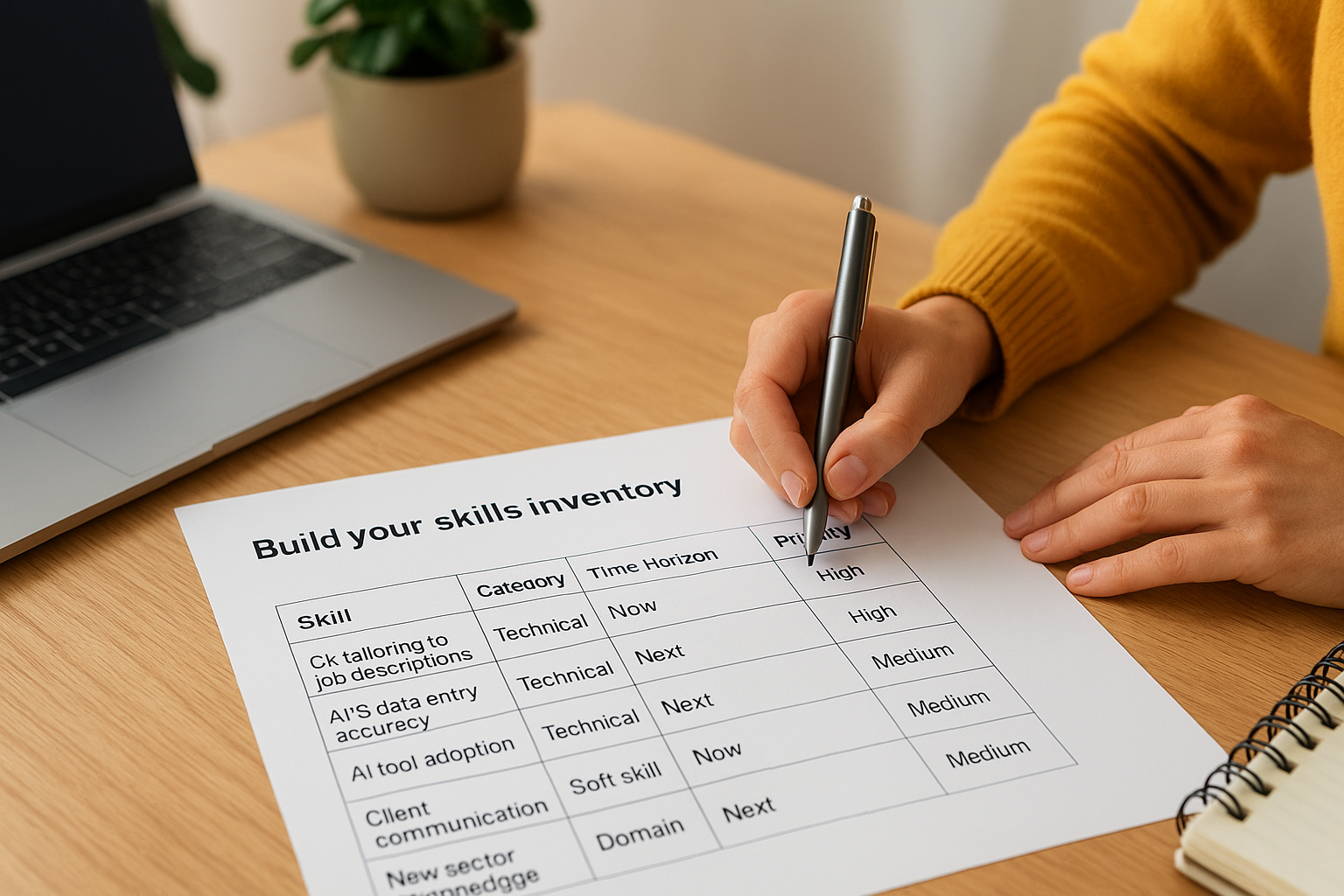
| Skill | Category | Time Horizon | Priority |
|---|---|---|---|
| CV tailoring to job descriptions | Technical | Now | High |
| ATS data entry accuracy | Technical | Now | High |
| AI tool adoption | Technical | Next | Medium |
| Client communication | Soft skill | Now | High |
| New sector knowledge | Domain | Next | Medium |
Step 3. Assess current skills with consistent evidence
Now that your skills list exists, the most error-prone part of how to conduct a skills gap analysis begins: measuring what your team actually knows and can do. The risk here is inconsistency. If one manager rates a skill based on a gut feeling while another uses observed output, your gap scores will be meaningless before you even run the numbers.
Choose your assessment methods
Three methods give you reliable, comparable data without overwhelming your team or your calendar. Use at least two of them to cross-check your findings.
| Method | What it measures | Best for |
|---|---|---|
| Work sample review | Actual output quality (e.g., a tailored CV) | Technical and process skills |
| Structured self-assessment | Perceived confidence by skill | Soft skills and tool proficiency |
| Manager observation | Real-time performance in context | Speed, accuracy, and judgment |
Collect evidence before you score anything
Run your chosen methods before assigning any scores, and keep the rating scale identical for every person you assess. A simple 1-to-4 scale works well: 1 means no working knowledge, and 4 means consistent high performance without support.
Collecting evidence first and scoring second removes the bias of letting your general impression of a person influence the rating.
Document each rating with a specific example so that when you review gaps in Step 4, you can explain every score with evidence rather than opinion.
Step 4. Score gaps and prioritize what to fix first
With evidence in hand, you’re ready for the most strategic part of how to conduct a skills gap analysis: turning raw scores into a prioritized action list. Not every gap deserves the same urgency, and this step ensures you spend your resources where they produce the most measurable return.
Calculate the gap for each skill
Subtract each person’s current score from the required proficiency level for that skill. If your standard for CV tailoring is a 4 and a consultant scores a 2, the gap is 2. Run this calculation across your full skills inventory so you have a clear numerical gap for every skill and every team member.
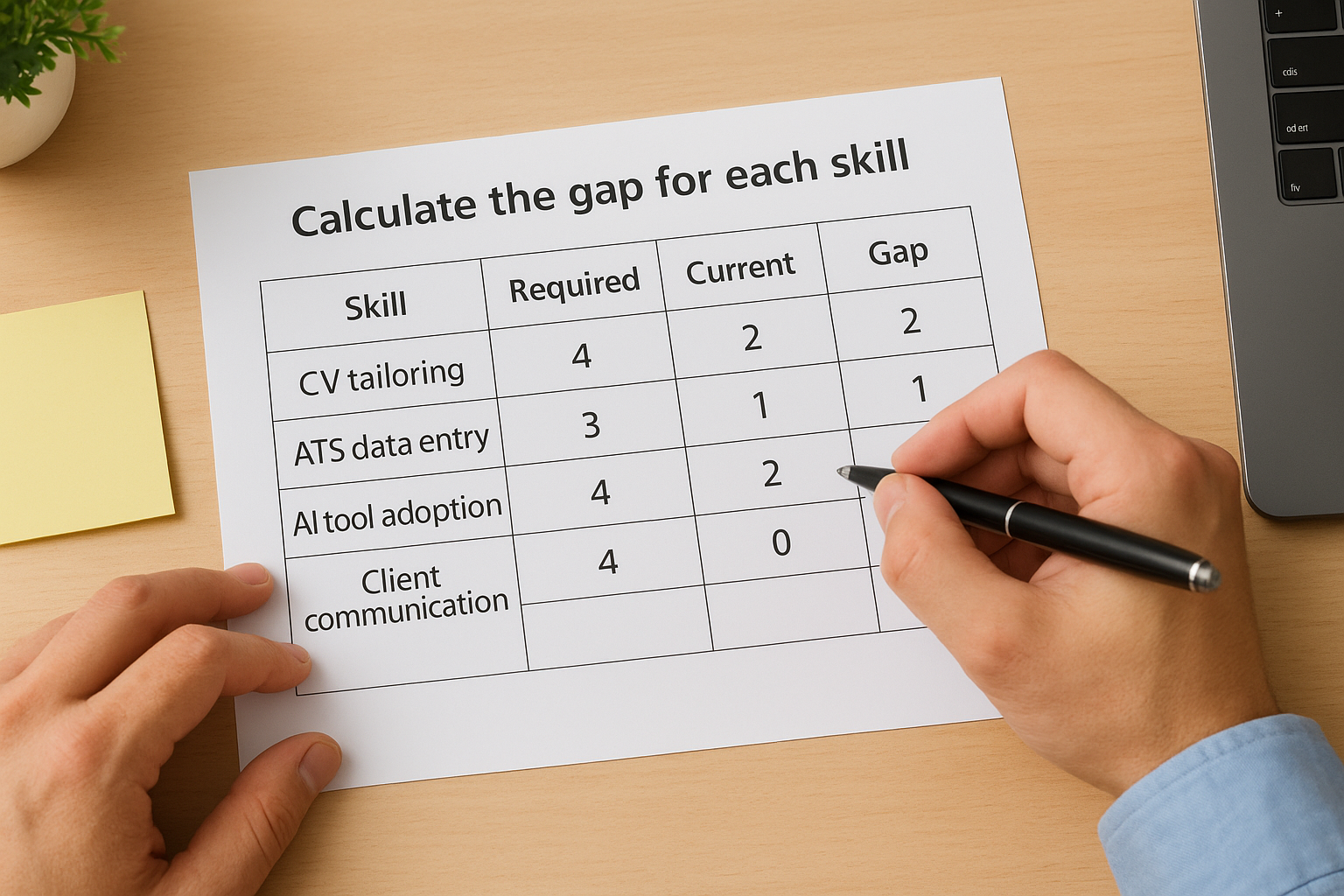
| Skill | Required | Current | Gap |
|---|---|---|---|
| CV tailoring | 4 | 2 | 2 |
| ATS data entry | 4 | 3 | 1 |
| AI tool adoption | 3 | 1 | 2 |
| Client communication | 4 | 4 | 0 |
Prioritize by impact, not gap size
A large gap in a low-priority skill ranks below a smaller gap in a high-priority, high-impact skill. Score each gap against two filters: how directly it affects your stated goal, and how quickly you can close it. Focus your first wave of action on high-impact gaps that are closable within 30 to 60 days, since those wins build momentum and demonstrate measurable progress fast.
Fixing the most visible gap first is tempting, but fixing the highest-impact gap first is what actually moves the numbers.
Step 5. Close the gaps with training, hiring, or tools
Scoring gaps tells you what is broken. This step tells you how to fix it. Each gap type responds better to a different solution, and choosing the wrong approach wastes time and budget on a problem that won’t actually shrink.
Match your solution to the gap type
Not every gap requires a new hire or a training course. Small gaps in existing skills respond well to structured coaching, peer shadowing, or short online courses. Larger gaps in critical skills, particularly ones where you need results fast, often justify bringing in someone who already performs at the required level. Use the framework below to match your gap score and timeline to the right solution.
| Gap size | Timeline | Recommended solution |
|---|---|---|
| 1 to 2 points | Under 60 days | Targeted coaching or self-paced course |
| 2 to 3 points | 60 to 90 days | Structured training with manager check-ins |
| 3+ points in a critical skill | Immediate need | Hire or contract a specialist |
Choosing training when hiring is the only realistic option within your timeline will delay results and frustrate both the team member and the manager.
Use tools to close operational gaps faster
Some gaps in how to conduct a skills gap analysis reveal process problems, not knowledge problems. If consultants are slow at CV tailoring because the workflow itself is inefficient, automation tools can close that gap in days rather than weeks, freeing your team to focus on higher-value work like candidate relationships and client communication.
Next steps
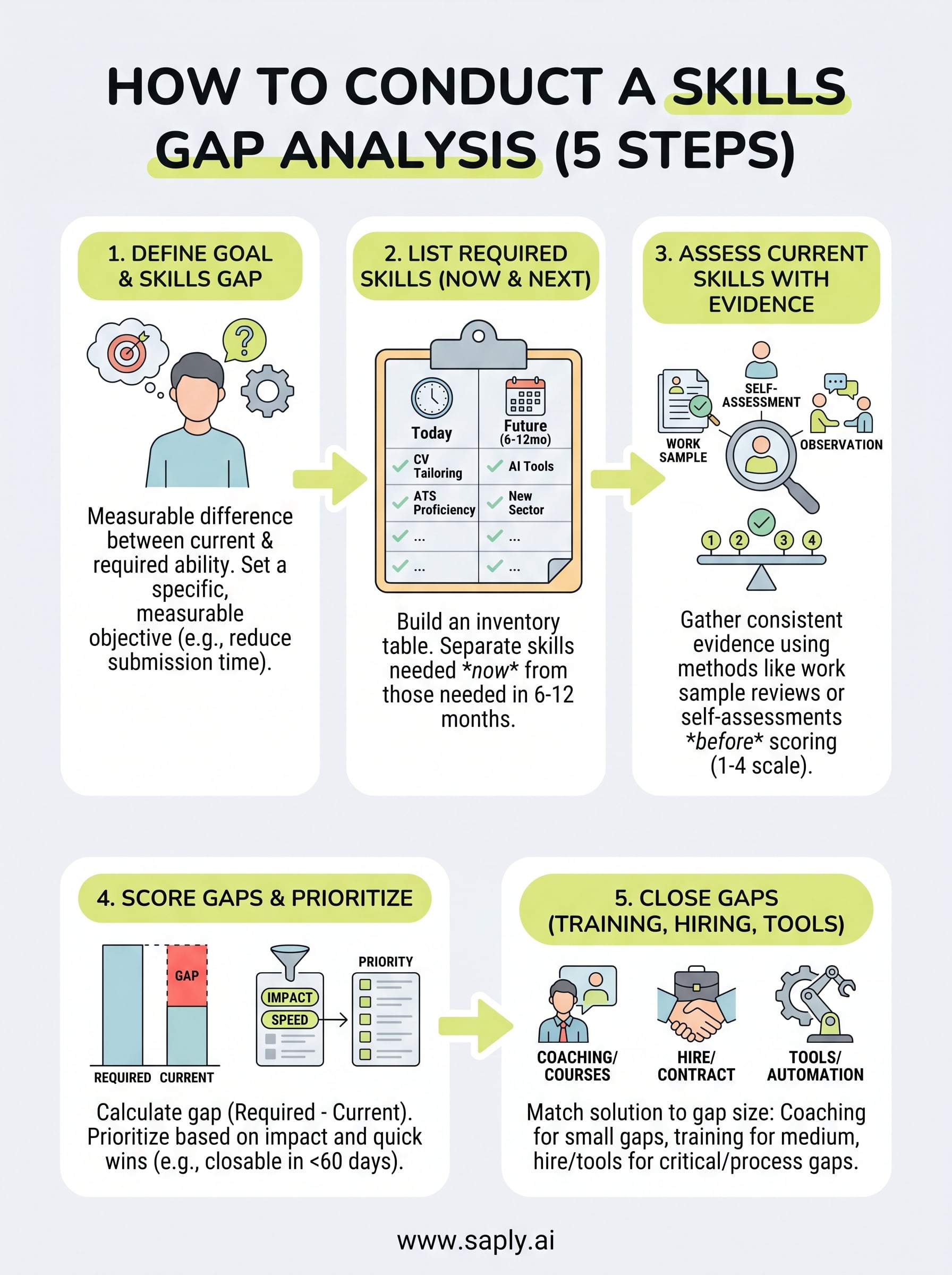
You now have a complete framework for how to conduct a skills gap analysis from goal-setting through closing the gaps. The five steps work together: define your goal, list required skills, assess with consistent evidence, score and prioritize gaps, then match each gap to the right solution. Running this process once builds a repeatable system your team can use every quarter as roles and business needs shift.
Start small if this is your first analysis. Pick one team and one specific goal, complete all five steps within two weeks, and use that run to refine your scoring scale and evidence collection before expanding to the full organization.
For recruitment teams where CV-to-job matching is part of the daily workflow, the gap assessment work gets significantly faster when the right tools support it. See how Saply automates CV tailoring and skill matching so your consultants spend less time on formatting and more time closing roles.