


How To Improve Diversity Recruiting: 9 Practical Tips
Most staffing agencies say they care about diversity. Fewer have a concrete plan for it. If you're trying to figure out how to improve diversity recruiting, the gap between intention and action usuall...

Most staffing agencies say they care about diversity. Fewer have a concrete plan for it. If you’re trying to figure out how to improve diversity recruiting, the gap between intention and action usually comes down to one thing: process. The way you source, screen, and present candidates either opens doors for underrepresented talent or quietly filters them out.
The good news? You don’t need to overhaul your entire operation. Small, deliberate changes to your recruiting workflow, from how you write job descriptions to how you format and present candidate CVs, can make a real difference. At Saply, we see this firsthand: when staffing teams use standardized CV formatting to present candidates, reviewers focus on skills and qualifications instead of getting distracted by inconsistent layouts or subjective presentation styles. That shift alone helps reduce unconscious bias at the submission stage.
This article breaks down nine practical tips you can start applying now. No corporate jargon, no vague mission statements, just actionable strategies that staffing agencies and recruitment teams can put to work to build a more inclusive hiring pipeline from the ground up.
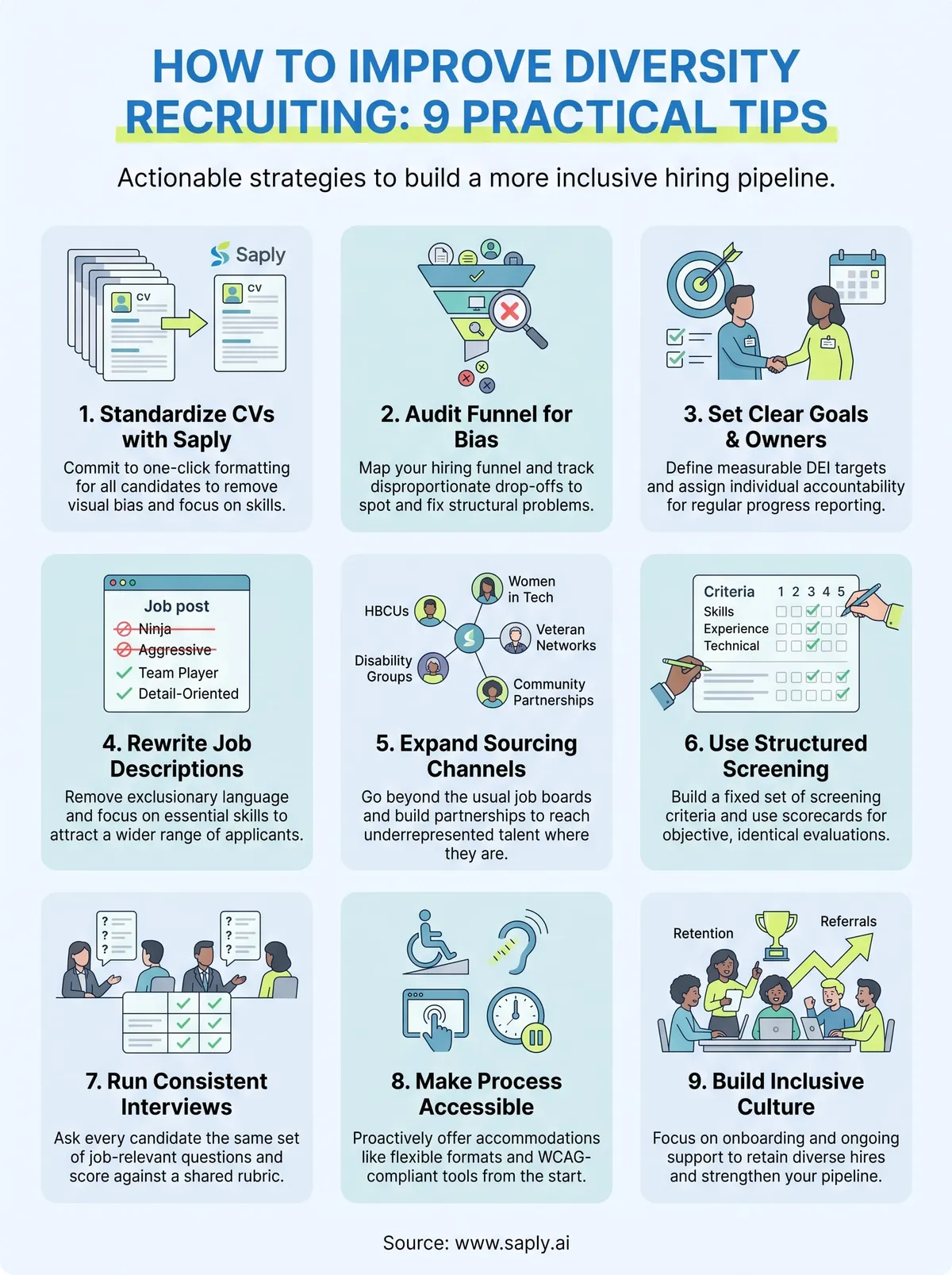
1. Standardize candidate submissions with Saply
One of the most overlooked steps in how to improve diversity recruiting is what happens before a candidate ever reaches the hiring manager: the CV submission. When candidates are presented in inconsistent formats, reviewers unconsciously focus on layout, structure, and presentation style rather than actual skills and experience. That bias works against underrepresented candidates who may have strong qualifications but present them in unfamiliar formats.
What to do
Commit to submitting every candidate in the same CV template, regardless of who they are or where their CV came from. Standardization removes the visual noise that triggers snap judgments. When a hiring manager sees ten CVs that all look identical in structure, they’re left with nothing to evaluate except qualifications and fit against the role.
A uniform CV format is one of the simplest structural changes you can make to reduce unconscious bias at the submission stage.
How to implement it
Use Saply’s one-click formatting to apply your agency’s template to any raw CV in under 1 minute. Connect Saply directly to your ATS (Bullhorn, Carerix, or Spott) so formatting happens as part of your normal workflow, not as an added step. Train your team to run every candidate through the same submission checklist before sending CVs to clients: consistent headers, uniform section order, and no personal identifiers that aren’t relevant to the role.
Tools and templates to use
Saply integrates with Microsoft Word, Google Docs, and Outlook, so your recruiters don’t need to learn new software. Your agency can upload a custom CV template, and Saply will apply it within 48 hours. From that point, every submission reflects your brand and a consistent structure. If your clients have specific formatting preferences, you can create separate templates for each and switch between them with one click.
Metrics to track
Track CV formatting time per submission before and after implementing Saply to measure efficiency gains. Also monitor hiring manager feedback rates: when clients stop commenting on formatting and start focusing purely on candidate fit, you’ll know standardization is working. Over time, track whether diverse candidates advance further in the funnel at rates closer to the overall average.
2. Audit your hiring funnel for drop-offs and bias
You can’t fix what you don’t measure. Bias in recruiting often hides in plain sight, showing up as patterns in your data rather than obvious individual decisions. Part of learning how to improve diversity recruiting is recognizing that underrepresented candidates may be applying in volume but dropping out before they ever reach a hiring manager.

What to do
Map every stage of your hiring funnel, from initial application to offer, and look for where specific groups drop out at higher rates. Focus on the transitions: application to phone screen, phone screen to interview, interview to shortlist. Disproportionate drop-offs at any stage point to a structural problem, not a talent shortage.
If diverse candidates aren’t advancing through your funnel, the issue is rarely the candidates.
How to implement it
Pull your placement data from the last six to twelve months and segment by sourcing channel, role type, and funnel stage. You don’t need to track protected characteristics directly, but patterns by sourcing origin or recruiter will surface quickly. Flag any stage where the pass-through rate differs significantly from your overall average and treat it as a priority to fix.
Tools and templates to use
Use your ATS reporting dashboard to generate stage-by-stage conversion reports. Most platforms, including Bullhorn, support custom reporting filters that let you slice data by date range, role, or recruiter, making it straightforward to spot outliers.
Metrics to track
Track funnel conversion rates at every stage and compare them across sourcing channels. Also monitor time-to-decision at each stage, since delays at specific points can indicate where implicit bias is slowing progress for certain candidates.
3. Set clear DEI goals and assign accountability
Vague commitments don’t move the needle. When it comes to how to improve diversity recruiting, the agencies making measurable progress are the ones that set specific targets and attach real ownership to them.
What to do
Pick two or three concrete, measurable DEI goals for the next quarter. Focus on outcomes like increasing the share of underrepresented candidates submitted for a specific role type or reducing drop-off rates at the phone screen stage. Avoid aspirational language and stick to numbers you can actually track.
Assign a named individual to each goal, not just a department. That person owns the number and reports on it regularly.
Goals without owners are just intentions.
How to implement it
Review your DEI metrics in your regular team meetings, alongside placement numbers, so they don’t get treated as a separate initiative. Set a cadence, weekly or monthly check-ins work well, and give the goal owner authority to make process adjustments without needing approval from above every time.
Tools and templates to use
A basic OKR (Objectives and Key Results) framework keeps goals visible and trackable. Document objectives and key results in a shared file your whole team can access. Most standard project management tools support this without any custom setup.
Metrics to track
Track goal completion rates each quarter and adjust based on what the data shows. Also compare recruiter-level performance on DEI targets to identify who needs additional coaching and where your process changes are having the most impact.
4. Rewrite job descriptions to attract a wider range of applicants
Job descriptions are often the first filter in your pipeline, and most of them quietly push people away before they ever apply. Research shows that gendered or exclusionary language in job postings reduces the diversity of your applicant pool before any recruiter makes a single decision. Fixing this is one of the most direct answers to how to improve diversity recruiting.
What to do
Cut any language that signals a narrow cultural fit or sets requirements that aren’t genuinely necessary. Replace credential-heavy requirements like “must have a degree” with skill-based alternatives when a degree isn’t actually needed for the role. Also remove coded language that research consistently links to lower application rates from underrepresented groups, such as:
- “Rockstar” or “ninja”
- “Aggressive self-starter”
- “Cultural fit” without a clear definition
The requirements you list set the ceiling for who believes they’re qualified enough to apply.
How to implement it
Run each job description through a bias-checking review before posting it. Ask someone outside the immediate team to read it and flag anything that feels exclusionary. Keep the required qualifications list short and move nice-to-haves into a separate “preferred” section so more candidates self-qualify instead of ruling themselves out.
Tools and templates to use
Build a shared job description template your team updates regularly, with a checklist that flags common exclusionary phrases before any posting goes live. Google’s re:Work program offers evidence-based guidance on structured, inclusive hiring practices your team can reference without adding new tools to the stack.
Metrics to track
Track applicant volume by role after updating your job descriptions and compare it to previous postings for the same role type. Also monitor application completion rates to see whether rewritten descriptions reduce drop-off before candidates even submit.
5. Expand sourcing channels and partnerships beyond the usual
If your sourcing strategy hasn’t changed in years, your candidate pool probably reflects that. Relying on the same job boards and referral networks repeatedly produces the same demographic results. A core part of how to improve diversity recruiting is deliberately going where underrepresented talent actually spends time and building relationships that bring those candidates to you consistently.
What to do
Stop defaulting to the same two or three sourcing channels and build a list of alternatives that reach different communities and professional networks. This includes Historically Black Colleges and Universities (HBCUs), women-in-tech groups, disability employment organizations, and veteran hiring initiatives. Partnering with these organizations gives you direct access to qualified candidates who rarely show up in standard applicant pools.
The candidates you never see aren’t absent from the workforce. They’re just not in your pipeline.
How to implement it
Reach out to community organizations and professional associations that serve underrepresented groups and propose formal referral or co-recruitment partnerships. Attend job fairs and events hosted by these groups rather than waiting for candidates to find your postings. Assign a specific recruiter to manage each partnership so the relationship develops consistently instead of fading after the first interaction.
Tools and templates to use
Build a sourcing channel tracker in a shared spreadsheet to log each partner organization, contact details, and candidate volume sourced per quarter. LinkedIn’s advanced search filters let you broaden candidate searches across industries, locations, and backgrounds when organic applications run short.
Metrics to track
Track candidate volume by sourcing channel each month and compare application-to-placement rates across channels. This tells you which partnerships generate qualified, hireable candidates and which ones only produce volume without results.
6. Use structured screening and consistent shortlisting criteria
Unstructured screening is where bias does the most damage. When different recruiters evaluate candidates using different mental checklists, the results reflect individual preferences rather than role requirements. A structured approach removes that inconsistency and gives every candidate a fair shot at advancing.

What to do
Build a fixed set of screening criteria before you start reviewing applications for any role, and apply it identically to every candidate you evaluate. List only the criteria that directly connect to job performance: relevant skills, specific experience, and any non-negotiable technical requirements. If it’s not on the criteria list, it shouldn’t factor into the decision.
Shortlisting decisions made without a shared rubric tend to reflect who the reviewer relates to, not who is most qualified.
How to implement it
Create a one-page screening scorecard for each role that rates candidates on three to five criteria using a simple numeric scale. Require every recruiter on the team to complete the same scorecard before discussing any candidate. This makes comparison objective and reviewable, which is one of the most direct answers to how to improve diversity recruiting at the screening stage.
Tools and templates to use
A basic spreadsheet works well for structured scoring grids. Build one template per role type and reuse it across your team. Your ATS may also support custom candidate rating fields that keep scores attached to candidate records automatically.
Metrics to track
Track inter-rater consistency by comparing scores when multiple recruiters evaluate the same candidate. Also monitor shortlist-to-interview conversion rates by recruiter to catch significant divergence that signals inconsistent criteria use.
7. Run interviews the same way every time
Interviews introduce more subjective judgment than any other stage in your hiring process. When interviewers ask different questions, score answers informally, or rely on gut feeling, you get results that reflect personal rapport rather than job-relevant skills. Structured interviews are one of the most evidence-backed answers to how to improve diversity recruiting, and they’re straightforward to implement.
What to do
Build a fixed question set for each role before interviews start and stick to it for every candidate. Every interviewer asks the same questions in the same order, and every answer gets scored against the same rubric. This removes the room for improvised follow-ups or rapport-based favoritism that unstructured interviews quietly allow.
When every candidate answers the same questions, you’re comparing responses, not personalities.
How to implement it
Write five to seven role-specific behavioral questions that require candidates to describe past actions rather than hypothetical ones. Pair each question with a scoring guide that defines what a strong, average, and weak response looks like. Brief your interviewers on the rubric before the first interview and require them to complete scores independently before discussing candidates as a group.
Tools and templates to use
A shared interview scorecard template in Google Docs or Microsoft Word keeps your team aligned without adding new software. Build one per role type, store it in a central folder, and update it after each hiring cycle based on what worked.
Metrics to track
Monitor inter-interviewer score alignment across candidates for the same role. Also track offer acceptance rates by candidate background to check whether your structured process is producing fair, defensible outcomes.
8. Make the process accessible with accommodations and flexibility
Accessibility gaps quietly eliminate candidates before you ever see their qualifications. A rigid, one-size-fits-all process creates unnecessary barriers for candidates with disabilities, caregiving responsibilities, or logistical constraints that have nothing to do with their ability to perform the role. Fixing this is a practical step in how to improve diversity recruiting that costs very little but removes real obstacles from your pipeline.
What to do
Review each stage of your hiring process and identify fixed constraints that don’t connect to actual job performance. Common barriers include in-person-only interview requirements, timed assessments without accommodation options, and application portals that aren’t screen-reader compatible. Remove or adapt each one before candidates encounter them.
How to implement it
Offer multiple interview format options from the start, including video calls and asynchronous responses, so candidates with transportation or scheduling limitations aren’t automatically at a disadvantage. Build a simple accommodation request step into your application flow so candidates can flag needs early without raising it awkwardly mid-process.
When you proactively offer accommodations instead of waiting to be asked, you signal that your process was built for everyone.
Tools and templates to use
Check that your application platform meets WCAG 2.1 accessibility standards, published by the W3C, which cover screen reader compatibility, keyboard navigation, and contrast requirements. A shared accommodation checklist helps your team respond to requests consistently rather than improvising each time.
Metrics to track
Track accommodation request rates to understand how many candidates need adjustments and whether your process makes it easy to ask. Also monitor drop-off rates at the application stage to catch accessibility barriers before they cut your pipeline.
9. Build a culture that keeps diverse hires and strengthens your pipeline
Improving diversity recruiting only pays off if the people you place actually stay. High turnover among underrepresented hires signals that the issue isn’t your sourcing or screening, it’s what happens after placement. Building a culture that retains diverse talent creates a self-reinforcing loop: satisfied employees refer others, and your pipeline grows without additional sourcing effort.
What to do
Focus on the onboarding and early experience your placed candidates receive. Diverse hires who feel unsupported in their first 90 days leave at higher rates, and when they do, you lose the placement fee and the relationship. Work with clients to ensure structured onboarding plans exist for every candidate you submit, not just senior hires.
Retention is the proof point that your diversity recruiting strategy actually works.
How to implement it
Conduct 30- and 90-day check-ins with every placed candidate to catch issues before they become resignations. Share what you learn with your clients in a constructive way and position it as placement quality support rather than criticism. This keeps you involved past the placement date and strengthens client trust.
Tools and templates to use
A simple check-in call template covering role satisfaction, team integration, and any support gaps gives your recruiters a consistent framework. Store responses in your ATS to spot patterns across clients and roles over time.
Metrics to track
Track 90-day and 6-month retention rates broken down by role type and client. Also monitor referral rates from placed candidates, since strong referral volume from diverse hires is one of the clearest indicators that your process and culture are genuinely working on how to improve diversity recruiting end to end.
A simple next step you can take this week
The nine strategies above cover the full picture of how to improve diversity recruiting, but you don’t need to tackle all of them at once. Pick one area where your process is weakest and fix that first. If inconsistent CV presentation is causing bias at the submission stage, start there.
Saply makes that first step easy. Your team can apply a standardized CV template to every candidate submission in one click, directly inside the tools you already use. That single change removes visual inconsistency from your pipeline and gives every candidate a fairer shot before a hiring manager ever sees their name.
You can test it with no commitment. Start your free 7-day trial of Saply and run your next batch of submissions through a consistent, bias-reducing format to see the difference it makes right away.