
how-to-measure-candidate-experience
How To Measure Candidate Experience: Metrics, Surveys, KPIs
Most staffing agencies know when their candidate experience is broken, ghosted applicants, negative Glassdoor reviews, candidates dropping out mid-process. But knowing something feels off isn't the sa...
Written by: Saply Team

How To Measure Candidate Experience: Metrics, Surveys, KPIs
Most staffing agencies know when their candidate experience is broken, ghosted applicants, negative Glassdoor reviews, candidates dropping out mid-process. But knowing something feels off isn’t the same as understanding how to measure candidate experience with actual data. Without concrete metrics, you’re guessing at problems instead of solving them, and losing placements you could have saved.
A strong measurement framework gives you visibility into every stage of the hiring process, from first application to final offer. It tells you where candidates disengage, what’s slowing down your pipeline, and whether your process helps or hurts your agency’s reputation. Staffing firms that track these numbers consistently outperform those that rely on gut instinct, they submit faster, retain more candidates, and win repeat business from clients. Tools like Saply already help recruitment teams cut hours off CV formatting and tailoring; measuring candidate experience picks up where that efficiency leaves off by making sure speed doesn’t come at the cost of quality.
This guide breaks down the specific metrics, survey methods, and KPIs you need to quantify candidate experience at your agency. You’ll walk away with a practical measurement system, not abstract theory, that you can start applying to your current recruitment workflow this week.
What candidate experience includes and why it matters
Candidate experience covers every interaction a job seeker has with your agency, from the moment they first encounter a job posting to the day they receive an offer or rejection. It is not just about whether candidates feel good. It is about whether your process is clear, respectful, and efficient enough to keep qualified people engaged through each stage. When you understand what candidate experience actually includes, you can measure it accurately rather than react to symptoms after the fact.
The stages that shape candidate experience
Most recruiters underestimate how many touchpoints a candidate moves through before a placement is made. Each stage below represents a moment where a candidate either gains or loses confidence in your agency:
- Awareness and attraction: Job postings, social media presence, employer brand materials
- Application process: Ease of applying, form length, mobile compatibility, confirmation messaging
- Screening and communication: Initial outreach, wait times between contacts, clarity of next steps
- Interview process: Preparation support, interviewer professionalism, scheduling flexibility
- Assessment stage: Relevance of tests or assignments, time required, feedback provided
- Offer and onboarding: Offer clarity, documentation, transition support before start date
- Rejection handling: Timeliness of rejection notices, whether any feedback is shared
Each of these stages generates data you can collect and act on. Understanding where candidates sit at any given moment is foundational to knowing how to measure candidate experience effectively across your full pipeline.
Most candidate drop-off happens not because the role was wrong, but because the process made candidates feel like an afterthought.
Why poor candidate experience hurts your business numbers
Poor candidate experience does not stay internal. Candidates who have a bad experience with your agency talk about it, on review platforms, in professional networks, and directly to other job seekers. Research from IBM indicates that a negative candidate experience causes a significant share of applicants to actively discourage others from working with the same organization. For staffing agencies operating in competitive talent markets, that kind of reputation damage directly shrinks your available candidate pool over time.
The financial impact is also direct. High candidate drop-off rates mean you are spending sourcing budget on applicants who leave before you can place them. When your time-to-fill stretches because candidates disengage mid-process, your clients notice. Repeated slow submissions or candidate withdrawals erode client relationships and reduce repeat business. Measuring candidate experience gives you the ability to catch these patterns before they become client-level problems.
What strong candidate experience actually delivers
Agencies that invest in tracking and improving candidate experience see measurable outcomes well beyond sentiment scores. Faster time-to-fill is one direct result, because candidates move through a cleaner process without confusion or unnecessary delays. You also see higher offer acceptance rates, since candidates who feel respected and well-informed are more likely to say yes when an offer arrives. Better candidate experience also increases the volume of referrals your agency receives organically, which lowers your cost-per-hire without requiring additional sourcing spend. These are not soft gains; they show up in your placement numbers, your revenue, and your client retention rate.
Step 1. Map the candidate journey and touchpoints
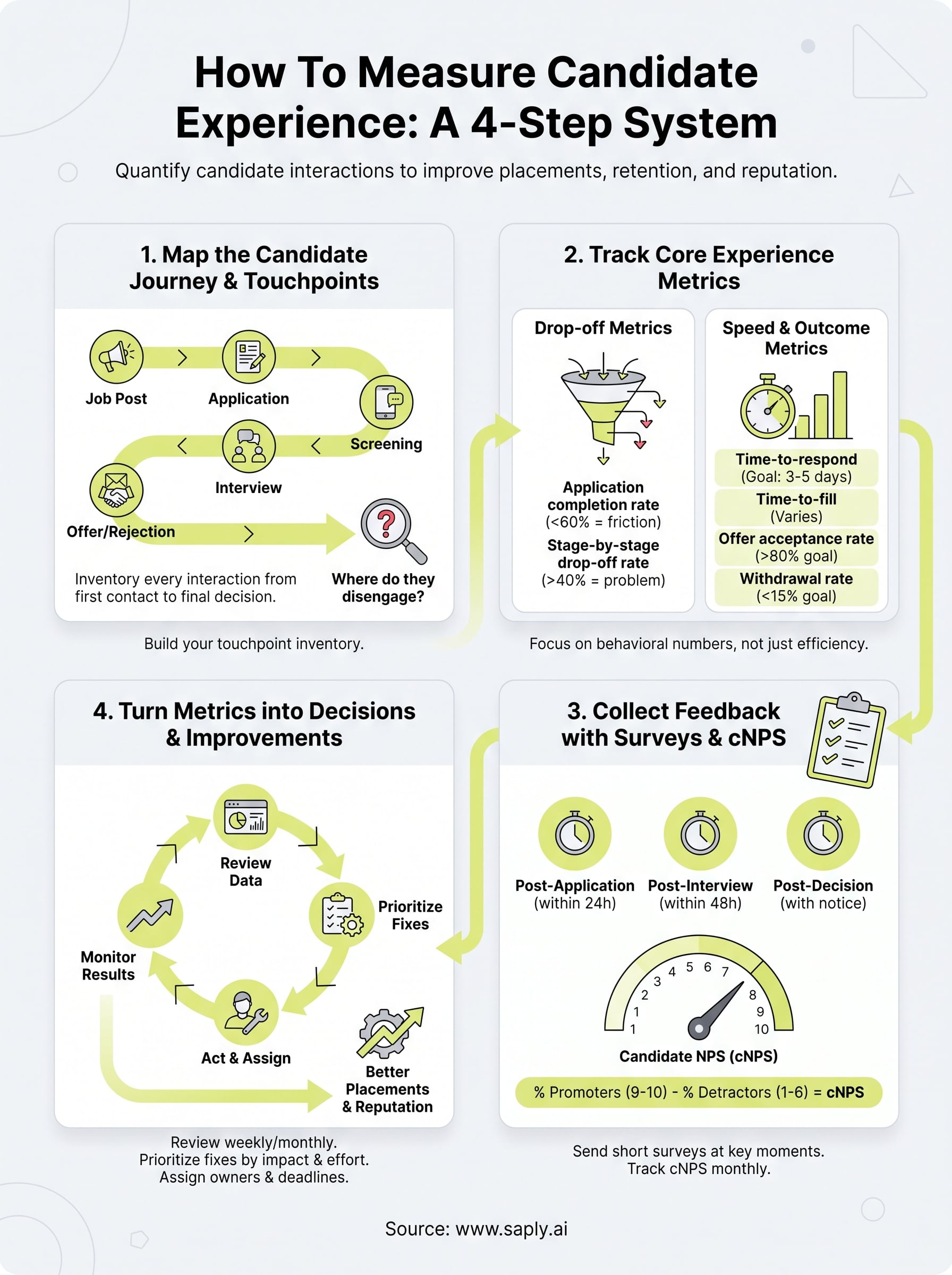
Before you track a single metric, you need to know where candidates actually go during your recruitment process. Mapping the candidate journey gives you a clear record of every touchpoint, which is the foundation for understanding how to measure candidate experience with precision. Without this map, you risk collecting data on the wrong stages while the real drop-off points stay hidden.
Build your touchpoint inventory
Start by listing every interaction a candidate has with your agency, from first contact through placement or rejection. Walk through your process as if you were the candidate, not the recruiter. Common touchpoints include the job posting, application confirmation email, screening call, CV submission, interview scheduling, interview itself, status updates, offer letter, and rejection notice. For each touchpoint, write down who owns it, what channel it happens on, and how long candidates typically wait before it occurs.

The touchpoints that feel routine to your team are often the ones that feel confusing or dismissive to candidates.
Use the table below to structure your inventory:
| Touchpoint | Channel | Owner | Avg. Wait Time | Measurement Opportunity |
|---|---|---|---|---|
| Job posting | Job board / website | Marketing | N/A | Application rate, bounce rate |
| Application confirmation | ATS | Instant | Open rate | |
| Screening call | Phone | Recruiter | 1-3 days | Candidate survey |
| CV submission | ATS / email | Recruiter | 1-5 days | Drop-off rate |
| Interview scheduling | Email / calendar | Recruiter | 1-3 days | Scheduling friction survey |
| Post-interview update | Email / phone | Recruiter | 1-5 days | Candidate NPS |
| Offer or rejection | Email / phone | Recruiter | Varies | Acceptance rate, exit survey |
Identify where candidates disengage
Once your touchpoint inventory is complete, look at each stage and ask where candidates stop responding or withdraw from the process. These are your highest-priority areas for measurement. Flag any touchpoints where your agency has no current feedback mechanism in place, since gaps in data collection almost always correspond to gaps in the candidate experience itself. Mark those stages first for survey deployment in Step 3.
Step 2. Track the core candidate experience metrics
Once your touchpoint map is complete, you need specific numbers to watch at each stage. Knowing how to measure candidate experience means choosing metrics that reflect real candidate behavior, not just internal process efficiency. The metrics below give you a clear picture of where your process supports candidates and where it pushes them away.
Application and pipeline drop-off metrics
This group of metrics tells you how many candidates fall out of your pipeline and exactly where they exit. Application completion rate measures the percentage of candidates who start an application and finish it; anything below 60% signals that your process creates friction candidates are unwilling to push through. Stage-by-stage drop-off rate tracks the percentage of candidates who exit between each recruitment phase, which pinpoints the specific touchpoints that need attention rather than leaving you to guess.
To calculate drop-off rate at any stage, use this formula:
Drop-off rate (%) = (Candidates entering stage - Candidates advancing)
                    ÷ Candidates entering stage × 100
A drop-off rate above 40% at any single stage is a strong signal that candidates are losing confidence in your process at that specific point.
Speed, response time, and offer metrics
Response speed directly shapes how candidates perceive your agency. Time-to-respond measures how long candidates wait between submitting an application and receiving any communication from your team; the standard benchmark is 3 to 5 business days for an initial reply. Use the table below to track your key time-based and outcome metrics against realistic targets:
| Metric | Formula | Target Benchmark |
|---|---|---|
| Time-to-respond | Days from application to first contact | 3 to 5 business days |
| Time-to-fill | Days from job opening to placement | Varies by role type |
| Interview-to-offer rate | Offers extended / Interviews completed × 100 | Above 30% |
| Offer acceptance rate | Accepted offers / Total offers extended × 100 | Above 80% |
| Candidate withdrawal rate | Withdrawals / Total active candidates × 100 | Below 15% |
Track offer acceptance rate and withdrawal rate together so you can see whether candidates are leaving because of your process or because the role itself was not the right fit. If acceptance rate drops while withdrawal rate rises, your experience metrics are telling you something specific broke down before the offer stage.
Step 3. Collect feedback with surveys and candidate NPS
Behavioral metrics like drop-off rates tell you what candidates do, but surveys tell you why they do it. Adding structured feedback collection to your process is one of the most direct ways to understand how to measure candidate experience from the candidate’s own perspective. Three survey moments matter most: post-application, post-interview, and post-placement or rejection.
When and how to send candidate surveys
Timing determines whether candidates actually complete your surveys. Send post-application surveys within 24 hours of a candidate finishing the application, while the experience is still fresh. Post-interview surveys should go out within 48 hours of the interview concluding. For rejected candidates, wait until the rejection notice is delivered, then include a short survey link in the same message. Keep every survey to five questions or fewer to protect completion rates.
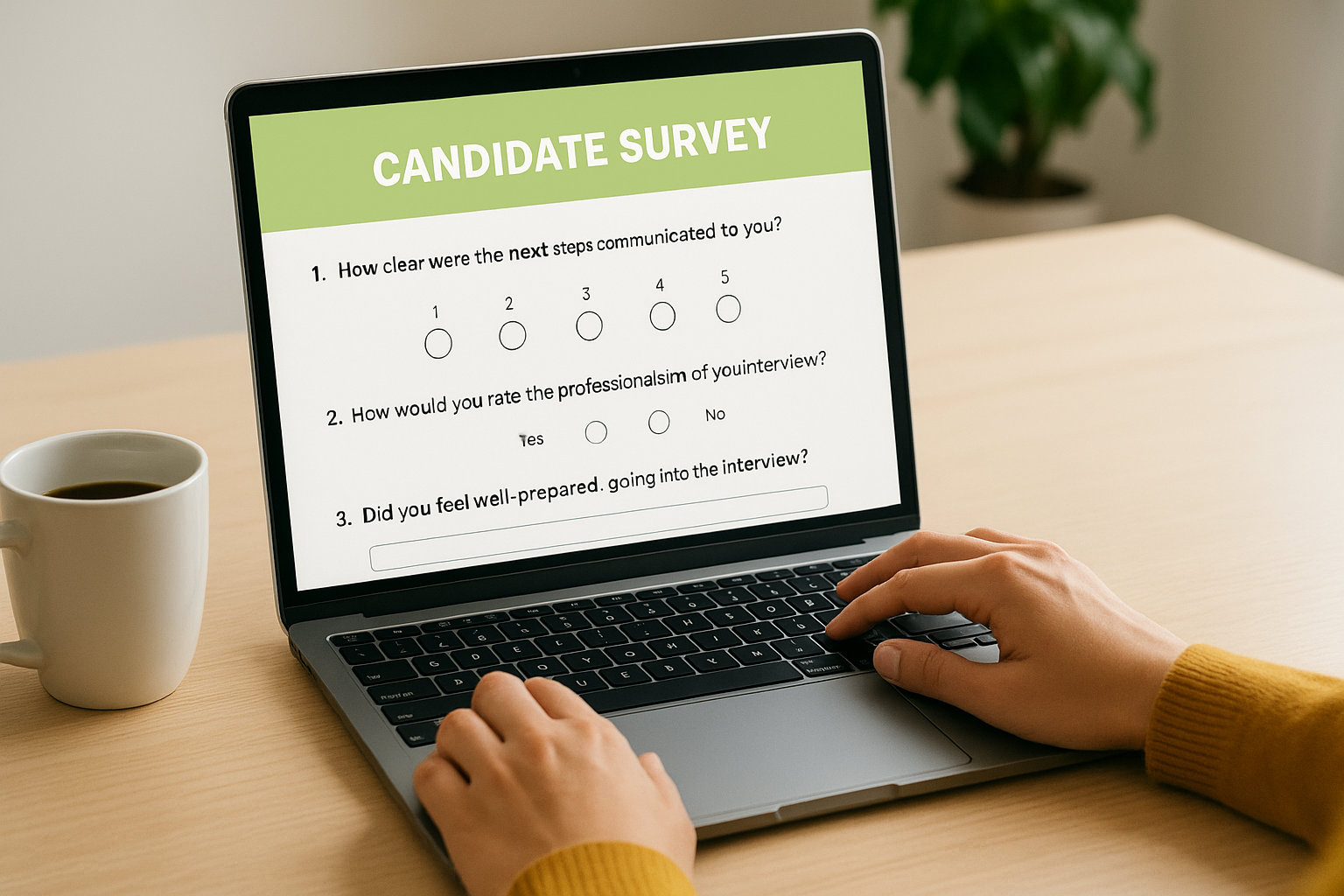
Use this template as your starting point for a post-interview candidate survey:
Subject: Quick feedback on your recent interview with [Agency Name]

Hi [First Name],

We'd love two minutes of your time to share how your experience felt.

1. How clear were the next steps communicated to you? (1-5 scale)
2. How would you rate the professionalism of your interview? (1-5 scale)
3. Did you feel well-prepared going into the interview? (Yes / No)
4. What could we have done differently to improve your experience? (Open text)
5. How likely are you to work with our agency again? (1-10 scale)

Thank you,
[Your Name]
Use candidate NPS to benchmark experience over time
Candidate Net Promoter Score (cNPS) measures how likely candidates are to recommend your agency to other job seekers, using that 1-to-10 question from the survey above. To calculate it, subtract the percentage of detractors (scores 1 to 6) from the percentage of promoters (scores 9 to 10). Passives (7 to 8) are excluded from the calculation. A positive cNPS means more candidates promote your agency than criticize it.
Track your cNPS monthly rather than quarterly so you catch drops fast enough to act before they shrink your candidate pool.
Review open-text responses alongside your cNPS number each month. Patterns in qualitative feedback will surface specific process problems that numeric scores alone cannot identify, giving you the context to make targeted fixes rather than broad, unfocused changes.
Step 4. Turn metrics into decisions and improvements
Collecting data is only half the work. Understanding how to measure candidate experience means nothing if your team reviews numbers once a quarter and then sets them aside. You need a regular process for converting what you track into specific changes to your recruitment workflow, assigned to real owners with clear deadlines.
Set review cadences that match your recruitment cycle
Your metrics need a consistent review schedule, not an occasional check-in when something feels wrong. Review your cNPS and survey responses weekly so you catch drops fast enough to respond before they affect live placements. Run a deeper monthly review that covers drop-off rates, time-to-respond, offer acceptance rate, and withdrawal rate together as a set. Looking at these numbers in combination shows you patterns that individual metrics hide on their own.
Use this review template to keep your monthly session focused:
Monthly Candidate Experience Review

Date:
Reviewer(s):

Metrics this month:
- cNPS:
- Application completion rate:
- Stage with highest drop-off (%):
- Average time-to-respond (days):
- Offer acceptance rate:
- Candidate withdrawal rate:

vs. last month:
- What improved:
- What declined:

Top 3 open-text themes from surveys:
1.
2.
3.

Actions to take this month:
- Action | Owner | Deadline
Prioritize fixes by impact and effort
Not every problem you uncover deserves the same urgency. Score each issue by two factors: how many candidates it affects and how much effort it takes your team to fix. A confirmation email that takes 20 minutes to update but eliminates confusion for every applicant gets done immediately. A full restructure of your interview scheduling system waits until you have bandwidth.
The fixes that move your numbers fastest are usually communication gaps, not process overhauls.
Build a simple backlog where each identified issue has an owner, a priority level (high, medium, low), and a target completion date. Review this backlog at the start of each monthly session and close out completed items before adding new ones. This keeps your improvements systematic rather than reactive, and it gives your team a clear record of what changed and when.
Next steps
You now have a complete system for how to measure candidate experience, from mapping touchpoints and tracking drop-off rates to running structured surveys and building a monthly review cycle. What you do with the data each week determines whether your agency actually improves or stays stuck in the same patterns.
Start with one action this week: build your touchpoint inventory. From there, add one survey, track your cNPS for 30 days, and run your first monthly review. Small, consistent improvements create the compound gains that show up in your placement numbers over time.
If your team is still spending hours on manual CV formatting before candidates even reach the interview stage, that time could go toward fixing the experience gaps you now know how to identify and track. Try Saply and free up your recruiters to focus on the relationship work that actually moves candidates forward.