
outplacement-services-pricing
Outplacement Services Pricing: Costs, Ranges, And Factors
When a company decides to lay off staff, one of the first questions HR asks is what outplacement services pricing will look like once contracts get signed. Providers quote everything from a flat per-e...
Written by: Saply Team

Outplacement Services Pricing: Costs, Ranges, And Factors
When a company decides to lay off staff, one of the first questions HR asks is what outplacement services pricing will look like once contracts get signed. Providers quote everything from a flat per-employee fee to tiered packages based on seniority, and without a clear reference point, it’s easy to either overpay or choose a program that leaves departing employees underserved. Budgeting gets harder when quotes bundle coaching hours, resume support, and job-search tools into a single number.
Most outplacement programs fall between a few hundred and several thousand dollars per employee, and the biggest cost drivers are program duration and how much one-on-one coaching is included versus self-service digital tools. Executive-level packages run higher because they include extended support and personal branding work.
This article breaks down typical price ranges by tier, explains what drives cost up or down, and gives you a framework for comparing vendors so you can match spend to the outcomes you actually need, whether that’s fast reemployment or minimizing legal risk after a reduction in force.
Why outplacement pricing matters for your budget
Outplacement isn’t a nice-to-have line item you can shrink without consequence. Severance packages already strain HR budgets during a layoff, and adding outplacement on top means finance teams want to see the return before signing off. Get the pricing wrong, whether by overpaying for features nobody uses or underpaying and leaving departing employees without real support, and the fallout shows up in employer brand damage, slower reemployment timelines, and sometimes legal exposure if the separation gets contested.
The link between price and legal risk
Companies facing a reduction in force (RIF) often treat outplacement as a risk-mitigation tool as much as a career service. Offering a documented, structured transition program can factor into negotiations around severance and can reduce the odds of a wrongful termination claim. The Equal Employment Opportunity Commission has repeatedly noted that how a company handles layoffs, including the support it provides afterward, can influence whether a dispute escalates into litigation. Cheap, bare-bones outplacement that looks like an afterthought doesn’t carry the same weight in these conversations as a program with real coaching hours behind it.
A well-priced outplacement program is cheaper than a wrongful termination lawsuit, and far cheaper than a damaged employer brand.
Budget line items that add up fast
Most buyers underestimate how many components sit inside a single outplacement quote. Understanding each piece helps you see where your money actually goes:
- Coaching hours: one-on-one sessions with a career coach, usually the biggest cost driver
- Digital platform access: self-service tools like resume builders, job boards, and skills assessments
- Program duration: three months versus twelve months changes the price dramatically
- Group workshops: webinars or in-person sessions on interviewing, networking, or salary negotiation
- Administrative support: account management, reporting, and onboarding for HR teams
Missing even one of these in a quote comparison can make a cheaper vendor look like a better deal when it’s actually offering less.
Reputation and retention effects
Employees who stay behind after a layoff pay close attention to how their former colleagues get treated. Survivors talk, and word travels fast through Glassdoor reviews, LinkedIn posts, and informal networks. A company that invests in solid outplacement support signals that it treats people fairly even when the relationship ends, which helps retain the employees who remain and makes future hiring easier. Skimping on this line item to save a few hundred dollars per head can cost far more in recruiting difficulty down the road.
Why the number alone doesn’t tell the story
Setting a budget without understanding what drives the number leads to bad comparisons. Two vendors quoting $1,500 per employee can offer wildly different levels of support, one bundling six months of weekly coaching and the other offering three months of app access with a single intake call. Treating outplacement pricing as a simple line-item cost, rather than a package of services tied to outcomes, is how HR teams end up disappointed with a program they thought they’d vetted carefully.
How to compare outplacement pricing across providers
Comparing outplacement quotes side by side only works if you’re comparing the same units of service. Ask every vendor for a breakdown that separates coaching hours from platform access fees, then normalize each quote to a per-employee, per-month figure. A provider quoting $2,000 for twelve months of support costs less per month than one quoting $1,200 for three months, even though the sticker price looks smaller.
Build a standardized comparison sheet
Before you request quotes, build a simple table you’ll fill in for every vendor. This forces sales reps to answer the same questions instead of pitching you their preferred bundle.
| Category | What to ask |
|---|---|
| Coaching model | 1:1, group, or hybrid? How many hours total? |
| Duration | How many months of active support? |
| Digital tools | Resume builder, job board access, skills tests included? |
| Reporting | Do you get placement or engagement data during the contract? |
| Guarantee | Is there a reemployment guarantee or extension clause? |
If a vendor can’t fill in every row of your comparison sheet, that’s a red flag about how the program is actually structured.
Ask about outcomes, not just features
Getting a list of features tells you what’s included, but it doesn’t tell you whether the program works. Push every vendor for their average time-to-reemployment and completion rate, and ask whether those numbers are tracked internally or verified by a third party. A provider offering a lower price with no outcome data is a bigger gamble than one charging slightly more with documented results across similar employee levels.
Negotiate volume and bundling
Providers almost always have flexibility on price when you’re purchasing outplacement for a larger group, so a five-person layoff and a 200-person RIF should never get the same per-head rate. Bundling outplacement with other transition services, such as career transition workshops or alumni networks, can also lower the effective cost per employee. Don’t accept the first quote as final, especially if you’re a repeat customer or signing a multi-year agreement; most vendors have room to move on price once they know you’re comparing options seriously.
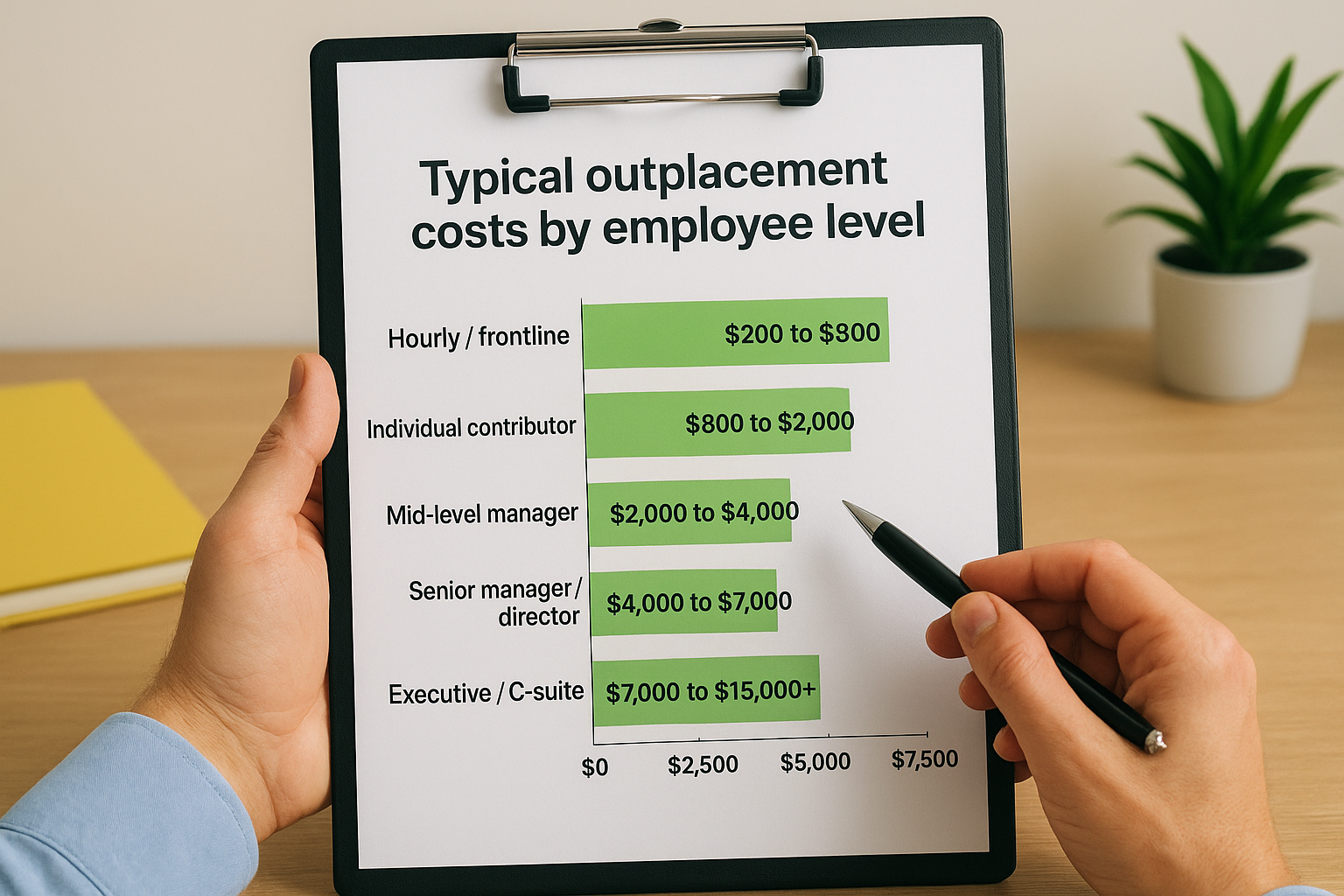
Typical outplacement costs by employee level
Outplacement pricing scales with seniority because higher-level employees need longer engagements, more specialized coaching, and often a dedicated executive coach rather than a shared pool of counselors. A frontline employee package might run three months with limited one-on-one time, while a C-suite package can stretch past a year and include personal branding, board-search strategy, and negotiation coaching. Knowing where your workforce falls on this spectrum before you request quotes keeps vendors from upselling you into tiers you don’t need.
A rough breakdown by level
Exact numbers vary by vendor, region, and contract length, but the ranges below reflect what most staffing and HR teams see when comparing proposals:
| Employee level | Typical duration | Approximate cost per employee |
|---|---|---|
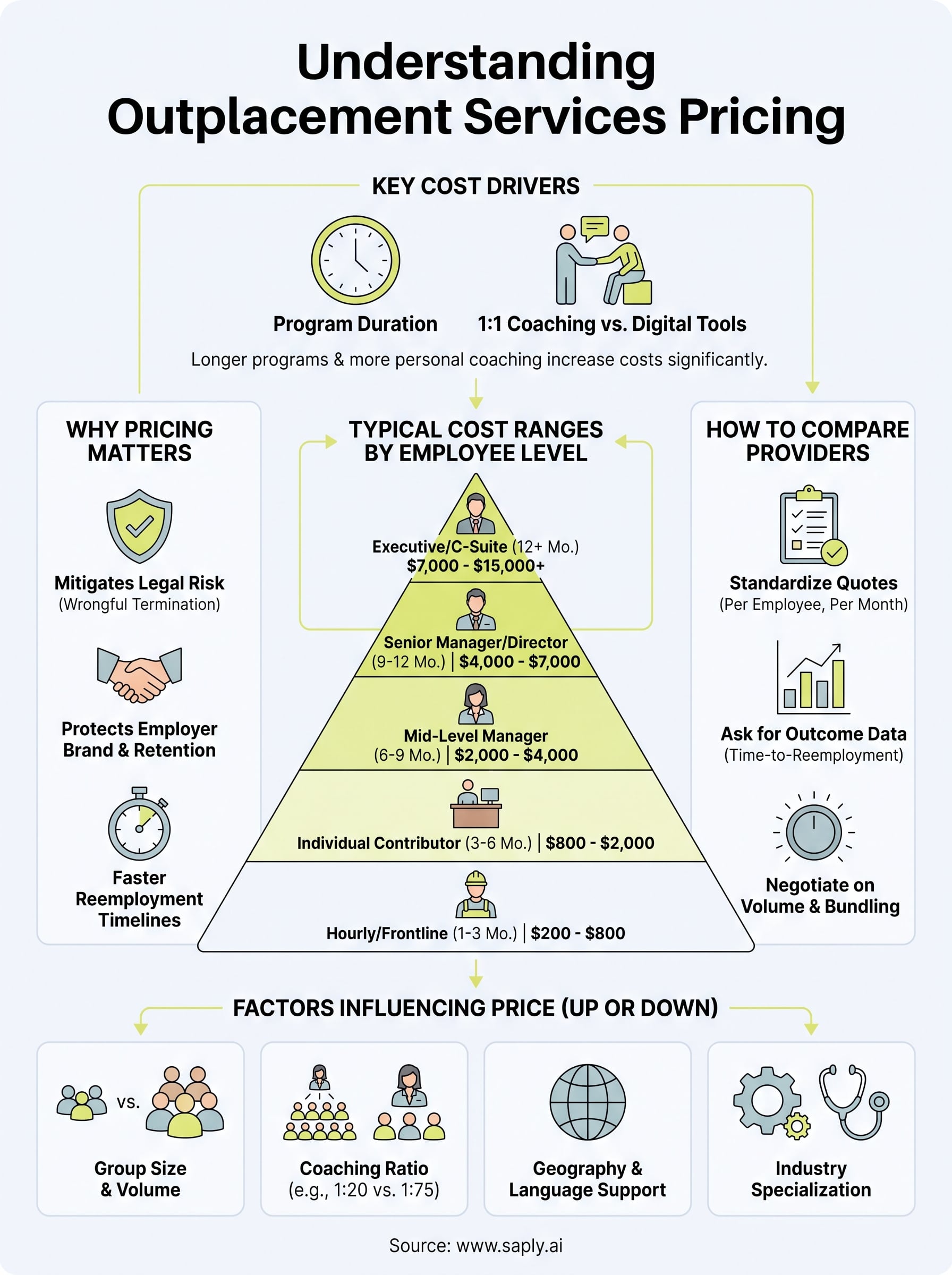
| Hourly / frontline | 1 to 3 months | $200 to $800 |
| Individual contributor | 3 to 6 months | $800 to $2,000 |
| Mid-level manager | 6 to 9 months | $2,000 to $4,000 |
| Senior manager / director | 9 to 12 months | $4,000 to $7,000 |
| Executive / C-suite | 12 months or more | $7,000 to $15,000+ |
The price gap between an hourly worker’s package and an executive’s package can be twenty times larger, and that gap tracks directly with how long and how personalized the support needs to be.
Why the jump between tiers is so steep
Executives don’t just need more coaching hours, they need a different kind of support entirely. Their job searches take longer because the pool of open roles is smaller, the interview process is more drawn out, and networking matters more than applying through job boards. Providers price this in by assigning senior coaches with executive placement experience, adding services like LinkedIn ghostwriting or interview media training, and extending the program timeline to match realistic search durations at that level.
Matching tier to actual need
Companies sometimes default to buying the same tier for everyone in a layoff to keep things simple, but that often means overpaying for frontline staff or underserving managers who need more than a basic package. Reviewing your workforce by role and tenure before setting a budget lets you allocate spend where it has the most impact, rather than applying a one-size-fits-all number across a group with very different reemployment challenges.
Key factors that drive outplacement pricing up or down
Beyond seniority tier, several variables push a quote higher or lower even for employees at the same level. Recognizing these factors before you negotiate lets you spot when a vendor is padding a quote versus pricing in something that genuinely matters for your workforce.
Group size and contract volume
Vendors reward volume. A company laying off 15 people pays a noticeably higher per-head rate than one running a 300-person RIF, because fixed setup costs like onboarding and account management get spread across more employees. Contract volume is usually the single biggest lever you have in negotiation, so always ask what the rate looks like at the next volume tier up, even if you don’t plan to hit it this round.
Delivery model and coaching ratio
A program built around dedicated 1:1 coaching costs more than one relying on group workshops and self-service tools, because human coaching hours don’t scale the way software does. Ask directly what the coaching ratio looks like, meaning how many employees share a single coach, since a 1:20 ratio delivers a very different experience than a 1:75 ratio at a similar price point.
A cheap quote built on a high coaching ratio isn’t a discount, it’s a different product wearing the same label.
Geography and language support
Outplacement providers price differently depending on whether they need to support employees across multiple countries, time zones, or languages. A domestic, English-only program costs less than one covering a global RIF with coaching available in six languages, since global reach requires a larger coach network and more infrastructure.

Industry specialization
Some providers specialize in tech layoffs, others in manufacturing or healthcare, and that specialization affects both price and quality. A coach who understands hiring trends in your specific industry gets employees reemployed faster than a generalist, which is worth paying for if your workforce is concentrated in one sector.
Contract length and renewal terms
Longer contracts lower the per-month cost but raise the total spend, while month-to-month or extension-based agreements offer flexibility at a premium. Ask whether unused coaching hours roll over or expire, since that clause alone can shift the real value of a quote by hundreds of dollars per employee.
Putting outplacement costs into perspective
Outplacement services pricing isn’t a number you can shop for in isolation. Program structure, seniority tier, and coaching ratio all shift the final invoice more than any single vendor’s base rate, so the real work is matching spend to what your departing employees actually need to land their next role quickly.
Budgeting well means asking the right questions upfront rather than comparing sticker prices after the fact. A standardized comparison sheet, clear outcome data, and honest volume negotiation will save you more than chasing the cheapest quote on the page.
Staffing agencies helping placed candidates land faster after a layoff know that speed matters just as much on the recruiting side. If your team is still formatting and tailoring CVs by hand, see how Saply speeds up submissions so your recruiters spend less time on paperwork and more time placing people.