
time-to-hire-vs-time-to-fill
Time To Hire vs Time To Fill: Definitions, Formulas & KPIs
Recruiters use "time to hire" and "time to fill" interchangeably all the time. They shouldn't. Each metric measures a different slice of your recruitment process, and confusing the...
Written by: Saply Team

Time To Hire vs Time To Fill: Definitions, Formulas & KPIs
Recruiters use “time to hire” and “time to fill” interchangeably all the time. They shouldn’t. Each metric measures a different slice of your recruitment process, and confusing the two leads to misleading reports and misaligned goals. Understanding the real distinction between time to hire vs time to fill is the first step toward accurate performance tracking.
Time to fill measures how long it takes to close a role from the moment it opens. Time to hire focuses on how quickly you move a specific candidate through your pipeline once they enter it. One reflects your overall recruitment capacity. The other reveals how efficient your evaluation and selection process actually is. Both matter, but they tell you very different things.
For staffing agencies juggling dozens of open positions, these metrics directly impact client satisfaction and placement revenue. The faster you format, tailor, and submit candidate CVs, a workflow Saply automates inside the tools recruiters already use, the more you compress both timelines. But before you can improve these numbers, you need to understand exactly what each one tracks and how to calculate it.
This article breaks down both metrics with clear definitions, formulas, and practical guidance on using them as recruitment KPIs. Whether you’re reporting to clients or optimizing your internal process, you’ll walk away knowing which metric to use, when, and why the difference matters for your agency’s bottom line.
Time to hire and time to fill definitions
Both metrics track time, but they start and stop at very different points in your recruitment process. Understanding that distinction separates accurate KPI reporting from misleading dashboards. When you look at time to hire vs time to fill side by side, you’re examining two measurements that serve different purposes and tell different stories about what’s happening inside your agency.
What time to fill measures
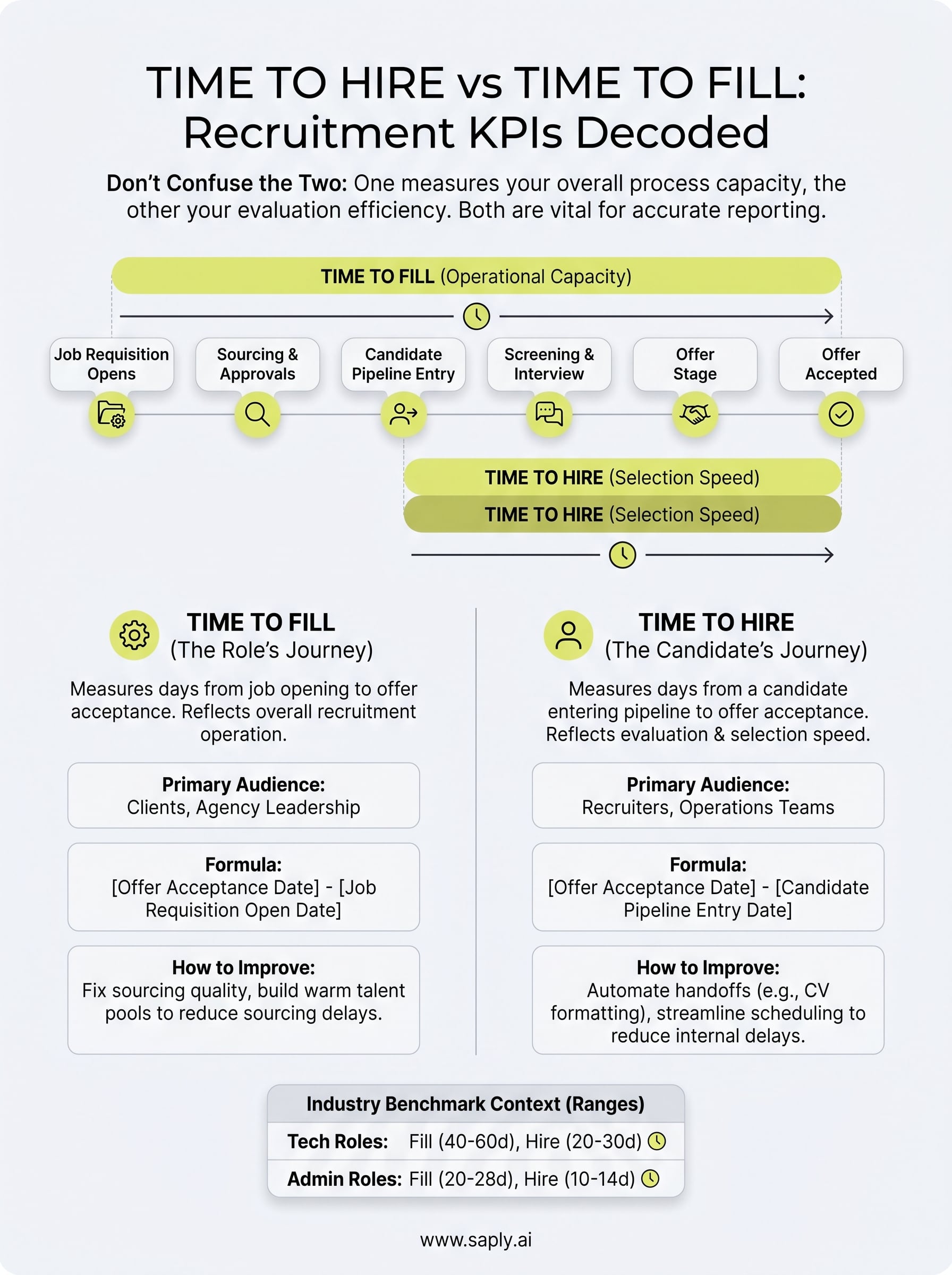
Time to fill tracks the total number of days between when a job requisition opens and when a candidate accepts an offer. It reflects how your entire recruitment operation performs: sourcing, job posting, application review, screening, interviewing, and offer. If a role opens on January 1 and a candidate signs an offer letter on February 15, your time to fill is 45 days.
Time to fill is primarily an operational metric. It tells you how quickly your agency can respond to a client’s staffing need from the moment the role is approved to the moment it’s closed.
This metric matters most to agency managers and clients who want to understand how fast your team can staff a position. It captures everything that happens before a specific candidate ever enters your pipeline, including time waiting for internal approvals, slow job board postings, or a thin talent pool in a specialized role. A high time to fill often signals a sourcing problem, a process bottleneck, or a position with requirements that are genuinely difficult to meet in the current market. Tracking it over time reveals whether your agency is getting faster or slower at standing up new searches.
What time to hire measures
Time to hire measures the number of days between when a specific candidate enters your pipeline and when they accept an offer. The clock starts the moment that person applies or gets sourced, not when the job originally opened. If a candidate applies on January 20 and accepts an offer on February 5, your time to hire for that candidate is 16 days, even if the role had been open since January 1.
This metric focuses on candidate experience and selection speed. It tells you how efficiently your team moves people through each pipeline stage, from initial screening to final decision. A high time to hire means candidates are sitting idle between touchpoints, which increases dropout risk and gives competing agencies a window to place the same person first.
For staffing agencies specifically, time to hire connects directly to CV submission speed. The faster you format a candidate’s resume to your agency template, tailor it to the job description, and get it in front of a client contact, the shorter your time to hire becomes. Delays in that formatting and tailoring step quietly stretch your time to hire without anyone flagging it as a process failure, because it looks like administrative overhead rather than a recruitment bottleneck. Recognizing it as a bottleneck is the first move toward fixing it.
Key differences and when to use each KPI
The simplest way to separate these two metrics is by asking who they describe. Time to fill describes your recruitment process as a whole, from open requisition to accepted offer. Time to hire describes a specific candidate’s journey through your pipeline. In the time to hire vs time to fill comparison, one is about the role and one is about the person. Treating them as the same number produces reports that hide where problems actually live.
How they differ in scope
Both metrics measure elapsed days, but they measure different things within that window. Time to fill includes everything: the delay before you sourced your first applicant, the time a role sat unfilled while approvals moved slowly, and the final negotiation period. Time to hire strips all of that away and focuses only on how efficiently you handled a candidate once they were in your hands.
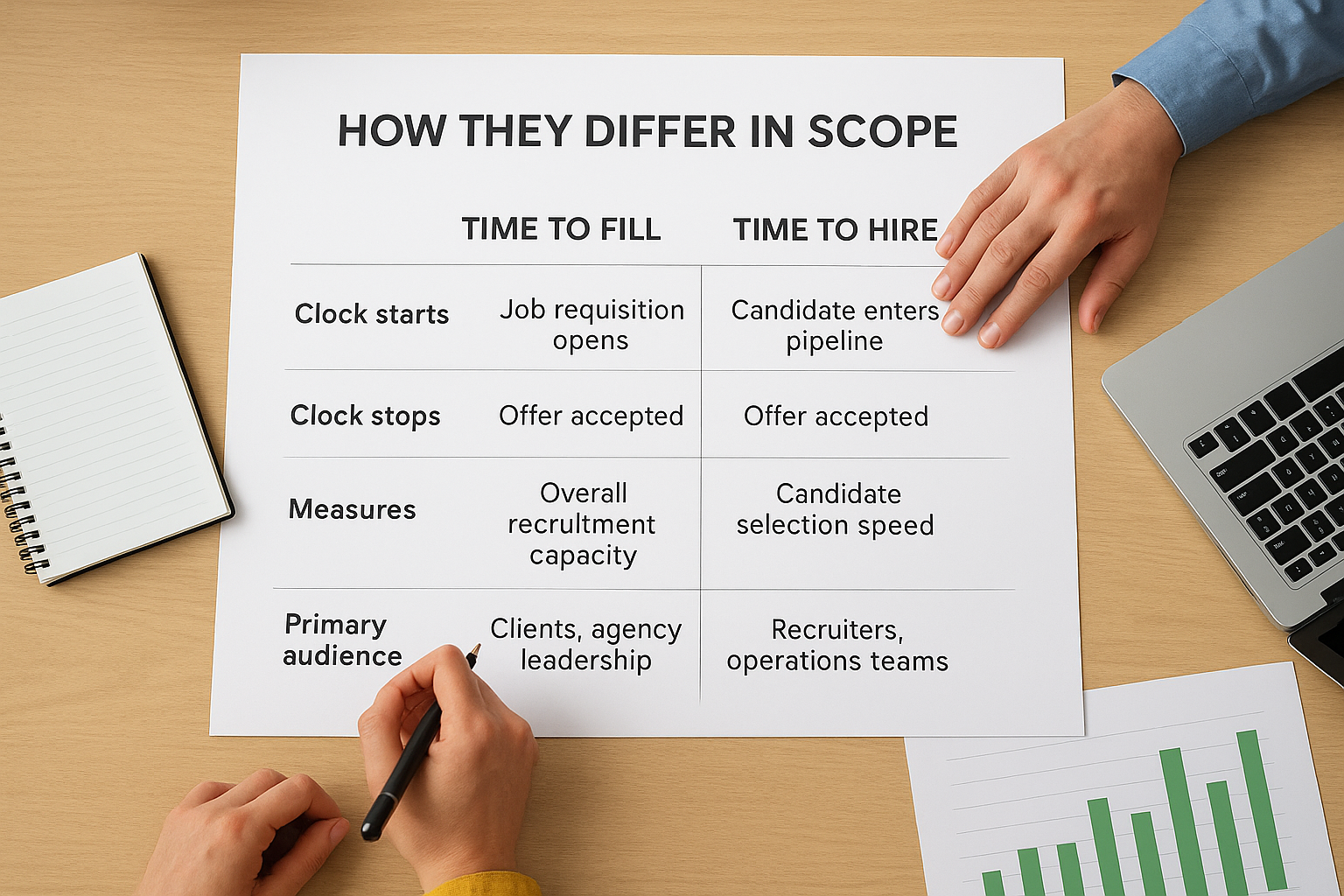
| Time to Fill | Time to Hire | |
|---|---|---|
| Clock starts | Job requisition opens | Candidate enters pipeline |
| Clock stops | Offer accepted | Offer accepted |
| Measures | Overall recruitment capacity | Candidate selection speed |
| Primary audience | Clients, agency leadership | Recruiters, operations teams |
When to use each metric
Use time to fill when you’re reporting to clients or agency leadership on overall staffing performance. It shows how fast your agency can stand up and close a search from start to finish. It’s the number clients care about because it directly reflects how quickly their open role gets filled.
Use time to hire when you want to find and fix internal process delays that hurt candidate experience and increase dropout risk.
Time to hire belongs in your internal performance reviews and pipeline audits. It tells you where candidates are waiting too long between stages, whether that’s a slow formatting step before submission, a delayed interview scheduling window, or a gap between assessment and offer. When you track it consistently, you can pinpoint exactly which stage is costing you placements.
How to calculate time to hire and time to fill
Both formulas are straightforward, but where you set your start date is what most agencies get wrong. Getting the inputs right matters more than the math itself. When you’re comparing time to hire vs time to fill across roles or reporting periods, inconsistent start dates make your numbers unreliable, so agree on definitions before you start tracking.
Time to fill formula
Time to fill is calculated by subtracting the job requisition open date from the offer acceptance date. Count only calendar days, not business days, unless your agency has a specific reason to exclude weekends.
Time to fill = Offer acceptance date - Job requisition open date
For example, if a client role opens on March 1 and a candidate accepts on March 29, your time to fill is 28 days. Track this number per role, then average it across all roles closed in a given month to get a meaningful baseline for your agency’s overall performance.
Time to hire formula
Time to hire starts from the moment a specific candidate enters your pipeline, whether they applied directly, were sourced by a recruiter, or were pulled from your internal database. The clock stops when they accept the offer.
Time to hire = Offer acceptance date - Candidate pipeline entry date
Using the same example: if that accepted candidate first appeared in your pipeline on March 15, your time to hire is 14 days, even though the role had been open for 28. That gap between 28 and 14 tells you your sourcing took two weeks before you found the right person.
Tracking both metrics consistently
Your ATS or CRM should log both dates automatically if it’s configured correctly. If you’re managing candidate data manually across spreadsheets or email, you’ll need to record pipeline entry dates the moment a candidate is added, not retrospectively. Retroactive date-setting introduces errors that skew your averages. Assign one person or one system to own this data entry step, and your numbers will reflect reality instead of guesswork.
Benchmarks and what affects your numbers
Knowing your formulas only helps if you have a reference point for what good looks like. Benchmarks give you context, but they vary significantly by industry, role type, and seniority level. When you track time to hire vs time to fill together, comparing your numbers against industry data helps you identify whether a slow metric reflects an internal process problem or a market-wide shortage.
Benchmarks are most useful for spotting outliers, not for setting rigid internal targets that ignore your specific role mix and market conditions.
Industry benchmark ranges
According to data from the Society for Human Resource Management (SHRM), the average time to fill across industries sits around 36 to 42 days. Time to hire tends to run shorter, typically landing in the 14 to 23 day range once a strong candidate enters the pipeline. Technology, healthcare, and engineering roles consistently sit at the higher end, while administrative and sales roles often close faster.

| Role Category | Avg. Time to Fill | Avg. Time to Hire |
|---|---|---|
| Administrative | 20-28 days | 10-14 days |
| Sales | 25-35 days | 12-18 days |
| Technology | 40-60 days | 20-30 days |
| Healthcare | 45-65 days | 22-35 days |
What drives your numbers up
Sourcing gaps and thin talent pools push time to fill higher before a single candidate touches your pipeline. If your job postings aren’t reaching the right candidates or your internal database is outdated, the role sits open longer regardless of how fast your evaluation process runs once someone applies.
Time to hire climbs when your internal handoffs are slow. Delays in scheduling interviews, waiting for client feedback, or spending hours manually formatting and tailoring CVs before submission all add days to a candidate’s pipeline journey. These administrative steps don’t feel like bottlenecks, but they accumulate quickly across a high-volume desk. Each unnecessary delay increases the chance that another agency or direct employer moves faster and closes the placement first.
How to improve both metrics without rushing
Improving time to hire vs time to fill doesn’t require cutting corners or pressuring candidates into faster decisions. The goal is removing friction from your process so that the time genuinely wasted on administrative delays, slow handoffs, and manual formatting tasks shrinks, while the time spent on real evaluation stays intact. Both metrics improve when you fix the right things, not when you rush the parts of recruitment that actually require careful judgment.
Fix your sourcing to compress time to fill
Sourcing quality matters more than sourcing volume. Posting to more job boards doesn’t help if you’re attracting applicants who don’t match the role. Instead, invest time in building and maintaining a warm candidate database so that when a requisition opens, you already have people to contact. Roles that open into an existing pipeline of pre-screened candidates close significantly faster, and your time to fill reflects that immediately.
A maintained internal talent pool cuts the dead time between requisition open and first qualified application. That early waiting period is where most of your time to fill quietly disappears before a single recruiter touchpoint occurs.
Proactive talent pooling often reduces time to fill more reliably than any change to your interview or offer process.
Speed up your pipeline handoffs to reduce time to hire
Administrative steps between pipeline stages are the most common source of wasted time in your time to hire numbers. Formatting a candidate’s CV to your agency template, tailoring it to a specific job description, and getting it submitted to a client contact can easily consume hours of recruiter time per candidate. Automating or streamlining that formatting and tailoring step shortens the gap between a candidate entering your pipeline and a client reviewing their resume, without removing any evaluation quality from the process.
Beyond CV submission, clear handoff ownership between team members keeps candidates moving forward. Assign specific people to own each stage transition, whether that’s scheduling interviews, collecting client feedback, or issuing offer letters. When no one owns a handoff, candidates sit idle. When someone does, your time to hire drops without sacrificing the rigor that protects your placement decisions.
What to do next
You now have a clear picture of time to hire vs time to fill: what each metric tracks, how to calculate it, what benchmarks to compare against, and where to focus your improvement efforts. The next step is putting this into practice inside your actual workflow, not just tracking the numbers but acting on them. Start by auditing where your candidates wait longest between pipeline stages. That gap is almost always where your time to hire bleeds unnecessarily.
For staffing agencies, CV formatting and tailoring is one of the most consistent sources of silent delay in the hiring pipeline. Every hour your recruiters spend manually reformatting resumes is time a qualified candidate sits idle before a client ever sees their name. Saply automates that step directly inside the tools your team already uses, so submissions move faster without adding complexity to your process. That’s a direct path to shorter time to hire and more placements closed.