
Resume Parsing
13 Best AI Resume Parsing Software Tools for Recruiters
Thirteen resume parsing tools compared: parsing APIs like Textkernel, DaXtra, RChilli and Affinda against in-workflow tools like Saply and small-team ATS options like 100Hires, with pricing models, GDPR and EU tender compliance, and the ROI math behind the category.
Written by: Saply Team

AI resume parsing software reads a CV in any file format and converts it into structured candidate data: contact details, work history, skills, education, and certifications. Recruitment teams use it to cut manual data entry, feed clean profiles into their ATS, and screen candidates faster. The catch is that “parsing” covers two very different product categories, and buying the wrong one leaves your real bottleneck untouched.
Saply product, pricing and data-handling details reviewed on 16 September 2026.
TL;DR
- For a raw parsing API to embed in your own systems: Affinda (accuracy on messy documents), RChilli (deep field extraction, 50+ languages), Textkernel (European, semantic enrichment, owned by Bullhorn), or HireAbility (throughput).
- For agencies that want parsing plus candidate-to-job matching at volume: DaXtra Parser.
- If you already run Bullhorn or Zoho Recruit, test the built-in parsing before buying anything.
- For a startup or small in-house team that wants an ATS with parsing out of the box and no enterprise contract: 100Hires, from USD 49 a month.
- If your recruiters turn CVs into branded, client-ready submissions, Saply is the in-workflow option: it parses, formats, and tailors inside Word, Google Docs, and Outlook, returning a finished CV in under 1 minute.
- For EU tender and public sector work, anonymization and mandated templates matter more than parse accuracy; Saply and Textkernel are the EU-focused options.
- Free entry points: OpenResume (open source), plus free tiers from Affinda, Zoho Recruit, and Parseur.
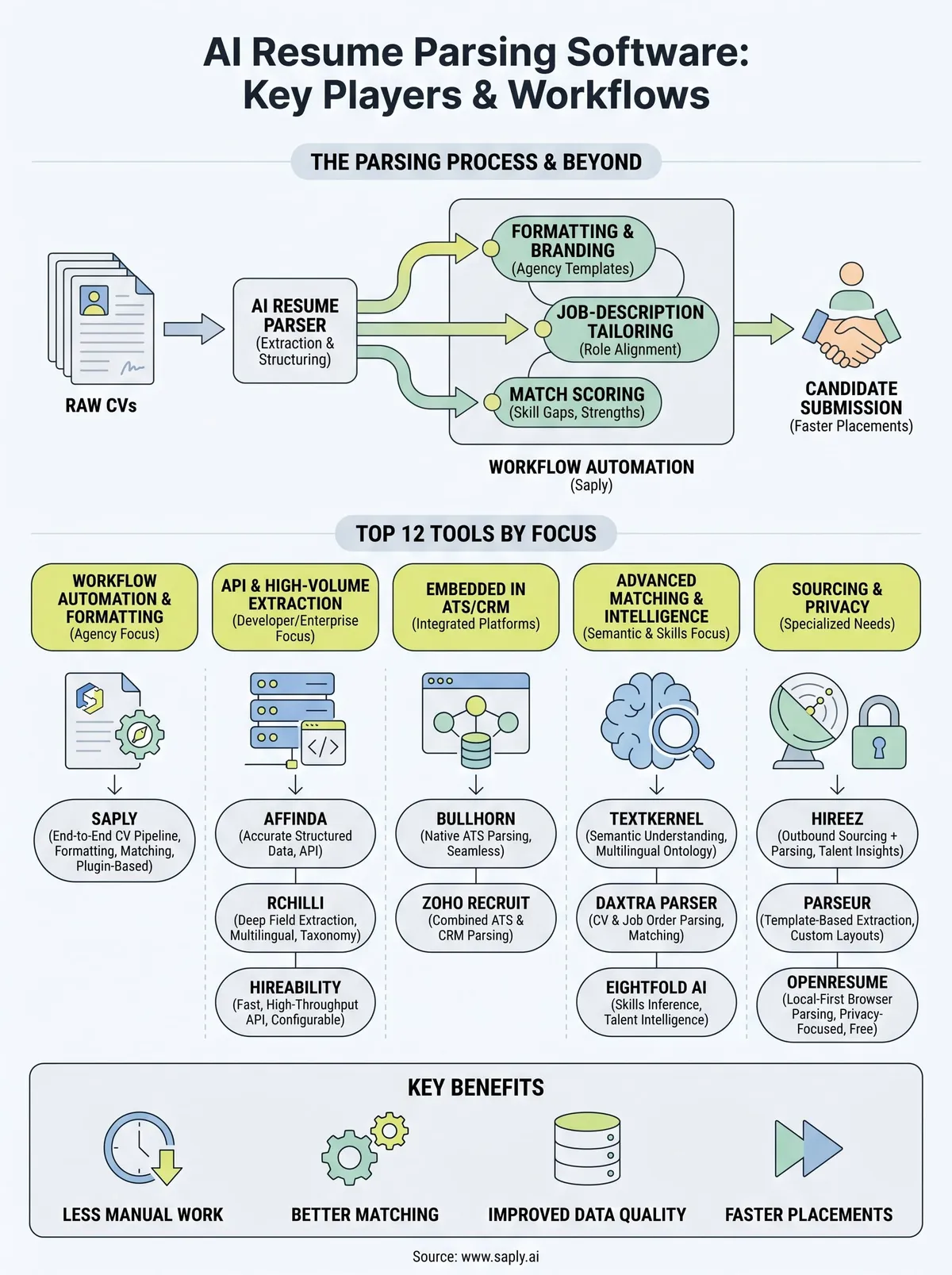
Parsing is only one piece of the puzzle. Once you’ve extracted the data, you still need to format, tailor, and match that resume to a specific role. That’s where tools like Saply come in, going beyond parsing to handle CV formatting, job-description tailoring, and match scoring, all inside the tools recruiters already use. Parsing gets you the data; what you do with it afterward determines how fast you fill the role.
This guide breaks down 13 of the best AI resume parsing tools available to recruiters right now. For each one, you’ll find what it does well, where it falls short, and who it’s built for, so you can pick the right fit for your agency’s workflow without wasting time on demos that go nowhere.
The 13 tools at a glance
| Tool | Category | Best for | Pricing model |
|---|---|---|---|
| Saply | In-workflow parsing, formatting, and matching | Staffing agencies and consultancies that turn raw CVs into branded, client-ready submissions | Volume-based Pro; Enterprise; free trial |
| Affinda | Parsing API | Technical teams embedding accurate extraction into custom pipelines | Per document, free tier |
| RChilli | Parsing API | Enterprise-scale extraction, 150+ fields, 50+ languages | Volume credits, enterprise |
| Textkernel | Parsing API with enrichment | European multilingual parsing feeding matching and ranking systems | Enterprise, by module |
| DaXtra Parser | Parsing plus matching | High-volume agencies ranking candidates against parsed job orders | Volume-based, quoted |
| HireAbility | Parsing API | Platform vendors that need high-throughput structured output | Per document, tiered |
| 100Hires | Small-team ATS with built-in AI parsing | Startups and small teams hiring 5 to 50 roles a quarter, with a native ChatGPT app | Flat plans from USD 49 a month |
| Bullhorn | ATS with built-in parsing | Agencies already running Bullhorn as their system of record | Enterprise contract |
| Zoho Recruit | ATS plus CRM with built-in parsing | Small agencies that want one budget-friendly platform | Per user, free plan |
| Parseur | Template-based document parsing | Standardized intake forms, not freeform CVs | Per document, free plan |
| hireEZ | Sourcing platform with profile parsing | Outbound sourcing teams working external candidate pools | Subscription, quoted |
| Eightfold AI | Enterprise talent intelligence | Global enterprises running skills inference at scale | Enterprise, custom |
| OpenResume | Open-source, in-browser parser | Individual recruiters who want free, local, privacy-first extraction | Free, open source |
Parsing APIs vs in-workflow CV tools: which do you actually need?
The fastest way to shortlist is to decide which of two categories you are buying. Standalone parsing APIs (Textkernel, Affinda, RChilli, HireAbility) take a document and return structured JSON or XML for your developers to route into an ATS or product. In-workflow CV tools (Saply) parse the same document but keep going: they rebuild it into your agency’s template, tailor it to a vacancy, and score the match, returning a finished document instead of raw data.
If you are building a product or a large ingestion pipeline, buy a parsing API and expect developer time to wire it in. If recruiters handle the CV after the parse, be honest about where the hours actually go: most agency time is lost reformatting and tailoring, not extracting, and a parser that only returns JSON leaves that step in place.
How we evaluated these 13 tools
This list is built from vendor documentation, published pricing pages, and hands-on experience running agency CV workflows, not from paid placements. We weighed each tool on six criteria:
- Parsing accuracy on real-world documents. Not clean test files: multi-column layouts, scanned PDFs, photos, skill bars, and non-English CVs, which is where parsers actually diverge.
- Bulk and scale handling. Whether throughput holds up at hundreds of CVs per week, and whether bulk intake needs developer work or works out of the box.
- ATS integration depth. A pre-built connector for Bullhorn or Carerix is a different purchase from a raw REST API that your team has to wire in and maintain.
- Compliance and data handling. Where documents are processed and stored, retention windows, anonymization support, and whether candidate data trains vendor models.
- Pricing transparency. Whether you can estimate cost from the website or only after a sales cycle.
- What happens after the parse. Structured data alone still leaves formatting and tailoring on a recruiter’s desk, so we credit tools that carry the CV further toward submission.
One of these criteria is self-serving and we say so where it applies: Saply is our product, and the last criterion is the reason it exists. The per-vendor entries flag where each tool genuinely beats it.
1. Saply
Disclosure: Saply is our own product, so read this entry with that in mind. The rest of this list gets the same honest treatment, so you can judge for yourself.
Saply sits at the intersection of CV parsing and full CV workflow automation. It doesn’t just extract candidate data from a resume, it takes that parsed content and immediately moves it through formatting, tailoring to a specific job description, and match scoring, all without making you switch applications. For staffing agencies that submit dozens of resumes per week, that end-to-end pipeline saves hours of manual work per recruiter.
What it does best
The core strength of Saply is what happens after the parse. Once it pulls structured data from a candidate’s CV, it applies your agency’s branded template automatically, aligns sections and typography with one click, and tailors the content to the role you’re filling. It also runs a match scoring analysis against the job description, flagging skill gaps, relevant certifications, and standout strengths so you know exactly how to pitch the candidate before you send anything to a client.
Saply combines ai resume parsing software capabilities with document formatting and job-matching in a single workflow, removing the copy-paste steps that slow most recruiters down.
How the parsing workflow fits into recruiter tools
Rather than pulling you into a separate dashboard, Saply operates as a plugin inside tools you already use, including Microsoft Word, Google Docs, and Outlook. The parsing, formatting, and tailoring happen inside your existing document editor, which cuts the learning curve to near zero and keeps your team’s daily rhythm intact. You don’t migrate to a new platform or retrain staff on unfamiliar software.

Best for
This tool is purpose-built for staffing agencies and recruitment consultancies that handle high submission volumes and need CVs formatted to a specific agency template before sending to clients. If your team spends significant time manually reformatting raw candidate CVs or copying content between systems, Saply directly targets that bottleneck. It’s less suited to in-house HR teams that process only a handful of applications per month and don’t need agency-style CV branding.
Integrations and setup
Saply offers ATS integrations including Bullhorn, Carerix, Spott and Loxo on Enterprise. Pro includes the Word and Google Docs plugins. For a custom CV template, send a filled-in Word document with sample or anonymized data. Saply sets up the template and tests it with CV inputs before adding it to your account. Confirm the setup scope and timing for your template, then review a generated document before using it for client submissions.
Pricing approach
Saply publishes Pro pricing and a 7-day free trial with no credit card required. Pro pricing depends on CV volume and includes office plugins; Enterprise adds ATS integrations, bulk processing and API access. Check the current pricing page for billing terms and the features your workflow needs.
2. Affinda
Affinda is a dedicated document AI company that builds parsing technology for HR and recruitment use cases. Its resume parser is one of the more mature options in the ai resume parsing software market, designed for teams that need structured, machine-readable candidate data delivered fast and accurately.
What it does best
Affinda’s parser extracts a wide range of resume fields, including contact details, work history, education, skills, certifications, and languages, with strong accuracy across a variety of CV formats. It handles unstructured and inconsistently formatted documents reasonably well, which matters when candidates submit resumes from different templates or regions.
Affinda’s core advantage is parsing accuracy across messy, real-world resumes rather than only clean, structured documents.
Parsing accuracy and output formats
The parsed output arrives as structured JSON or XML, making it straightforward for developers to pipe data into ATS platforms or internal databases. Affinda also returns confidence scores alongside extracted fields, so downstream systems can flag low-confidence extractions for human review rather than silently passing bad data into your workflow.
Best for
Affinda suits technical teams and larger recruitment operations that want a parsing API to embed into custom-built tools or automate large-scale CV processing pipelines. It works well for companies with developer resources who need raw structured output rather than a recruiter-facing interface with built-in formatting or tailoring capabilities.
Integrations and setup
Affinda provides a REST API as its primary integration method, with SDKs available for common languages. It connects to ATS platforms through custom API work rather than pre-built native plugins, so expect some development time before it fits into your recruiter workflow.
Pricing approach
Affinda prices on a volume-based model tied to the number of documents parsed. They offer a free tier for low-volume testing, with paid plans scaling based on monthly parse volume, which suits businesses with predictable, high-throughput document processing needs. As a market anchor, reseller listings such as Eden AI price its parser at $0.070 per file, though direct rates vary with volume.
3. RChilli
RChilli is a enterprise-grade parsing vendor that focuses on structured data extraction at scale. It’s been in the ai resume parsing software space for over a decade and has built a reputation for depth of field extraction and broad language coverage, which makes it a common choice for global recruitment operations.
What it does best
RChilli extracts over 150 data fields from a single resume, going well beyond basics like contact info and job titles. It pulls certifications, accomplishments, references, and detailed education breakdowns, which gives downstream systems more candidate context to work with before a recruiter reviews anything. The depth of extraction is the main reason enterprise teams choose it over lighter-weight parsers.
If your workflow depends on feeding rich, structured candidate data into multiple downstream systems, RChilli’s field coverage is difficult to match.
Language support and taxonomy features
The parser handles more than 50 languages, which matters for multinational staffing firms or agencies placing candidates across regions. Beyond language support, RChilli includes a built-in taxonomy layer that normalizes job titles, skills, and industries against standardized frameworks. That normalization step reduces the inconsistency that comes from candidates using different terms for the same role or skill.
Best for
RChilli fits large staffing operations and enterprise HR tech vendors that need high-volume parsing with normalized output across multiple languages. It works well for teams building or maintaining ATS platforms who want parsing as a core embedded service rather than an add-on.
Integrations and setup
RChilli connects via REST API and offers pre-built integrations with several major ATS platforms, and it is a common choice inside Oracle HCM and SAP SuccessFactors environments, where swapping parsing vendors later means substantial integration work. Setup typically requires developer involvement, especially when configuring custom taxonomies or field mappings to match your internal data structure.
Pricing approach
RChilli charges on a volume-based credit model, with enterprise contracts available for high-throughput needs. Custom pricing is standard for larger accounts.
4. Textkernel
Textkernel is a European AI company that specializes in labor market intelligence and semantic matching technology built specifically for recruitment. Its approach to resume parsing centers on deep natural language processing, meaning it reads the intent and context behind resume content rather than just lifting surface-level fields. Staffing firms across Europe rely on it heavily, though it also serves global markets. Textkernel is owned by Bullhorn, which is worth knowing if vendor consolidation matters to your procurement.
What it does best
Its standout capability is semantic understanding of resume content. Rather than treating a resume as a list of keywords, the system reads the meaning behind job titles, skills, and career progression. This matters when candidates describe the same role ten different ways, because Textkernel maps those variations back to standardized concepts rather than creating duplicate or conflicting data points inside your system.
Enrichment, normalization, and multilingual parsing
Beyond basic extraction, Textkernel enriches parsed data by linking it to external labor market datasets, giving you context about how a candidate’s experience maps to current market demand. It normalizes job titles and skills using its own ontology framework, which reduces inconsistencies across high-volume candidate pools. The parser also handles more than 30 European and global languages, making it a practical choice if your agency places candidates across regional markets.

Textkernel’s ontology layer is what separates it from basic parsers: it turns raw CV text into normalized, market-contextualized candidate profiles.
Best for
Textkernel suits European staffing agencies and multinational firms that need reliable multilingual parsing combined with labor market enrichment. It’s particularly strong for organizations feeding parsed data into matching or ranking systems, since the normalization layer makes those downstream processes significantly more accurate.
Integrations and setup
Textkernel connects via REST API, with partnerships across several major ATS vendors. Setup typically requires developer resources to configure field mappings and ontology customizations for your specific use case.
Pricing approach
Pricing operates on an enterprise model, negotiated based on volume and the specific modules you activate. There is no publicly listed self-serve pricing tier.
5. DaXtra Parser
DaXtra Parser is a long-established player in the ai resume parsing software market, with a specific focus on staffing and recruitment agency workflows. DaXtra says the parser extracts more than 150 fields across over 40 languages. The company built its parsing technology from the ground up for agency use cases, which shows in how the product handles the messy, high-volume document flows that staffing firms deal with every day.
What it does best
DaXtra Parser pulls structured candidate data from resumes and job orders simultaneously, which means it can extract information from both sides of a placement in a single processing step. That dual-parsing capability gives recruiters a direct data bridge between candidate profiles and open roles without requiring separate manual steps to process each document type.
DaXtra’s ability to parse job orders alongside resumes is a meaningful advantage for agencies that need candidate-to-role data alignment done at the point of ingestion.
Agency workflows and matching features
Beyond extraction, DaXtra includes built-in semantic matching that compares parsed candidate profiles against parsed job descriptions using its own relevance engine. This matching layer produces ranked candidate lists based on how closely a resume aligns with a role’s requirements, giving recruiters a prioritized shortlist rather than an unfiltered pile of profiles to review manually.
Best for
DaXtra fits staffing and recruitment agencies that process high volumes of both resumes and job descriptions and want matching logic baked into the same tool. It is particularly useful for agencies running high-throughput sourcing operations where speed of candidate ranking is a competitive factor.
Integrations and setup
DaXtra connects with a wide range of ATS platforms, including Bullhorn and several other recruitment-focused systems. Integration typically uses its API or pre-built ATS connectors, reducing setup time compared to building custom pipelines from scratch.
Pricing approach
DaXtra operates on a volume-based pricing model, with enterprise contracts available for larger agencies. Direct contact with their sales team is required to get a quote tailored to your processing volume.
6. HireAbility
HireAbility is a dedicated parsing API provider that has focused on resume and job order parsing since the early days of automated recruitment technology. Its product sits squarely in the ai resume parsing software category, built for technical teams and platform developers who need reliable, high-speed extraction at scale rather than a recruiter-facing interface with workflow tools layered on top.
What it does best
HireAbility specializes in fast, accurate extraction of structured data from resumes submitted in a wide range of file formats, including PDFs, Word documents, and plain text files. The parser returns clean, structured XML or JSON output that integrates directly into ATS platforms, job boards, and internal databases without requiring significant data transformation on the receiving end.
Speed, scale, and configurable parsing
One of HireAbility’s practical advantages is the ability to process high document volumes without meaningful degradation in extraction accuracy or response time. For organizations running large-scale candidate ingestion pipelines, that consistency matters. The parser also offers configurable output options, so you can specify which fields you need returned and trim the response to match your downstream data model rather than receiving a bloated payload you have to filter manually.
If your team processes hundreds of resumes daily and needs clean structured output delivered fast, HireAbility’s throughput focus is worth evaluating.
Best for
HireAbility fits recruitment technology vendors and enterprise HR teams that embed parsing into custom-built platforms. It is less suited for agencies that want a recruiter-facing tool with formatting or tailoring capabilities included.
Integrations and setup
The product delivers via a REST API, which requires developer resources to configure and connect to your existing systems. There are no pre-built recruiter plugins available out of the box.
Pricing approach
HireAbility uses a volume-based pricing model, with plans tiered around monthly parse counts. You contact their team directly to get a quote that matches your processing needs.
7. 100Hires
100Hires is an AI applicant tracking system built for startups and small hiring teams, and it is the only entry on this list aimed at companies that hire 5 to 50 roles a quarter rather than at agencies or enterprises. Its AI resume parser is included in every plan, so a two-person team gets structured candidate records from day one without buying a parsing API or signing an enterprise contract. It is rated 4.8 on G2 and 4.7 on Capterra, and the vendor cites a Forbes Advisor listing as a top ATS for startups and small businesses.
What it does best
Inbound applications from job boards land in 100Hires already parsed into contact details, work history, skills and education, and the same platform runs AI candidate screening, sourcing and outreach. For a small team, the value is that parsing, pipeline and communication sit in one low-cost tool instead of three subscriptions.
A native ChatGPT app on top of the ATS
100Hires ships a native ChatGPT app built on the OpenAI Apps SDK and an MCP server with more than 130 tools, listed in the ChatGPT App Directory. Recruiters can move candidates between stages, draft outreach and pull weekly pipeline updates from inside a chat, with answers drawn from live candidate records rather than pasted text. The same MCP server connects to Claude Code, Cursor and Codex.
100Hires is the budget answer to “we need an ATS that parses CVs” for teams too small for Bullhorn and too busy to wire in a parsing API.
Best for
100Hires fits startups, small businesses and small in-house recruiting teams that hire steadily but do not submit branded CVs to clients. It is not built for staffing agencies that need client-ready formatting, EU tender templates or anonymised submissions, so agencies should treat it as an intake system and handle document work elsewhere.
Integrations and setup
Setup is self-serve with a 14-day free trial. 100Hires posts to Indeed, LinkedIn, ZipRecruiter, Glassdoor, Monster and other boards, connects to Gmail, Outlook, Slack, Zoom and Twilio, and offers Zapier, webhooks and a REST API. There are no pre-built connectors to staffing ATS platforms, because it is the ATS.
Pricing approach
100Hires publishes flat plans priced by company size, starting at USD 49 a month for a single user with up to three jobs, USD 199 a month for unlimited jobs, candidates and users, and USD 399 a month for the Pro tier, with annual billing discounted and a custom enterprise quote above that. Parsing is included rather than billed per document.
8. Bullhorn
Bullhorn is one of the most widely used ATS platforms in the staffing industry, and its built-in resume parsing is a core reason agencies stay on it for years. Rather than a standalone ai resume parsing software tool, Bullhorn embeds parsing directly into the ATS workflow, so candidate data lands in structured fields the moment a resume enters the system.
What it does best
Bullhorn’s parsing capability works inside the ATS itself, pulling contact details, work history, skills, and education from incoming resumes and populating candidate records automatically. The main advantage here is that no separate parsing tool or API integration is required for teams already running Bullhorn as their primary recruitment platform, which lowers operational complexity for agencies that prefer a consolidated tech stack.
Built-in parsing inside a staffing ATS
Because parsing happens natively within the platform, your team never needs to move data between systems manually. Uploaded resumes convert into structured candidate profiles within seconds, ready for recruiter review and immediate action. That tight integration reduces data entry errors and keeps your candidate database consistent without requiring additional cleanup steps or third-party tools handling data in the middle.
For agencies already using Bullhorn as their ATS, its built-in parsing removes a significant layer of manual data entry from the daily workflow without adding another vendor to manage.
Best for
Bullhorn suits established staffing agencies that have already adopted it as their primary ATS and want parsing as part of that existing investment rather than a separate subscription with its own setup and maintenance overhead.
Integrations and setup
Bullhorn connects with a wide ecosystem of third-party tools, including sourcing platforms, job boards, and productivity apps. Setup happens inside your existing Bullhorn environment, with no separate parser to configure or credentials to manage independently.
Pricing approach
Bullhorn operates on an enterprise contract model, with pricing customized to agency size and the specific feature set your team activates. No self-serve pricing tiers are published publicly.
9. Zoho Recruit
Zoho Recruit is a cloud-based ATS with built-in CRM functionality, making it one of the few recruitment platforms that handles both candidate tracking and client relationship management inside a single product. Its native resume parsing sits within that broader system, giving smaller agencies and in-house teams a way to automate candidate data entry without adding a separate ai resume parsing software subscription to their stack.
What it does best
Zoho Recruit’s parser automatically extracts key resume fields, including contact information, work history, skills, and education, and maps them directly into candidate records within the ATS. Because the CRM layer sits alongside the ATS, the same platform also tracks client contacts, job openings, and hiring pipelines without requiring your team to jump between separate tools to manage both sides of a placement.
Built-in parsing inside an ATS plus CRM
The combined ATS and CRM structure means that parsed candidate data connects immediately to open requisitions and client accounts within the same environment. You can move from parsing a resume to associating that candidate with an active role and a client contact in a single platform session, which cuts down on context switching during busy sourcing periods.
For smaller agencies that want candidate and client management in one place without building a multi-tool stack, Zoho Recruit’s structure removes significant coordination overhead.
Best for
Zoho Recruit fits small to mid-sized staffing agencies and in-house HR teams that need a combined ATS and CRM with solid built-in parsing rather than best-in-class extraction depth. It works well when budget and simplicity take priority over enterprise-grade parsing accuracy or high-volume throughput.
Integrations and setup
Zoho Recruit connects with Zoho’s broader product suite, including Zoho CRM and Zoho People, alongside third-party tools through its marketplace and API access.
Pricing approach
Zoho Recruit offers tiered subscription plans based on the number of active users and job postings, with a free plan available for very small teams.
10. Parseur
Parseur is a document parsing platform that takes a different approach from most dedicated ai resume parsing software tools. Rather than applying a pre-trained AI model to every document, it lets you build custom parsing templates for specific document types, which gives you more control over exactly what gets extracted and how it maps to your downstream systems.
What it does best
Its core strength is structured data extraction from documents with consistent layouts, such as templated job applications, standardized HR forms, and email-based candidate submissions. You define the fields you want extracted using a visual editor, and the system pulls those fields reliably every time a matching document format comes through your pipeline. For recurring document types with predictable formatting, this approach delivers clean output with minimal cleanup required.
Template-based parsing versus AI parsing
The core tradeoff with Parseur is flexibility versus control. Traditional AI-driven parsers handle unpredictable, varied resume formats because they learn patterns across millions of documents. Parseur’s template model works differently: it performs reliably on documents you’ve trained it on, but struggles with resumes that deviate from your defined templates. That makes it a better fit for controlled intake processes than open-application pipelines where candidates submit CVs in dozens of different formats.
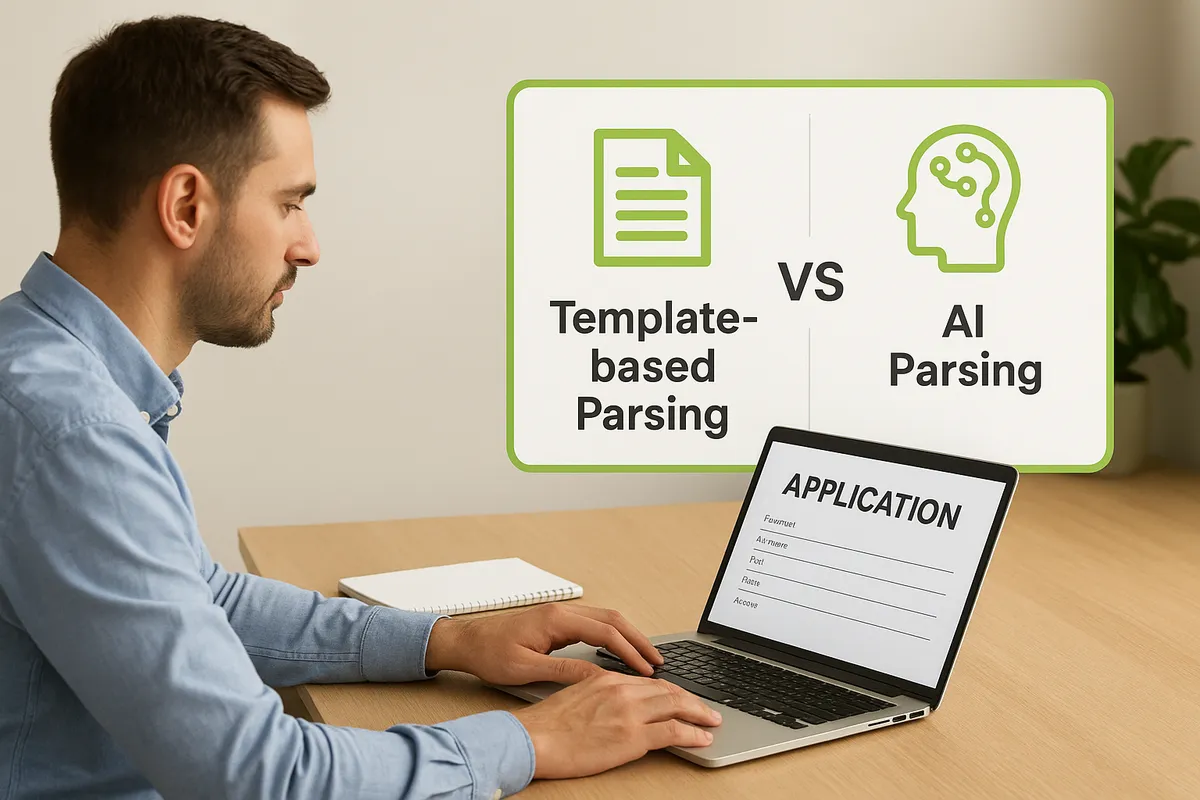
If your candidate intake process uses standardized submission forms or templated documents, Parseur’s template model will outperform general-purpose AI parsers on accuracy for those specific layouts.
Best for
Parseur suits operations teams and HR departments that process standardized document flows rather than open-format candidate CVs. It works well when your intake uses consistent application templates rather than freeform resumes from varied sources.
Integrations and setup
The platform connects to downstream tools through Zapier, Make, and direct API access, routing parsed data to CRMs, spreadsheets, or ATS platforms without requiring custom development work.
Pricing approach
Parseur offers tiered subscription plans based on monthly document volume, with a free plan available for low-throughput testing before committing to a paid tier.
11. hireEZ
hireEZ is an outbound recruitment platform that combines AI-powered candidate sourcing with built-in profile parsing, making it a distinct category from dedicated ai resume parsing software vendors. Rather than processing resumes your team receives directly, it focuses on finding and structuring candidate profiles pulled from external platforms and professional networks.
What it does best
hireEZ pulls candidate profiles from over 45 external data sources, including GitHub, Stack Overflow, and professional networks, and automatically structures that data into searchable candidate records. The platform’s AI applies relevance scoring on top of the parsed data, so you get a ranked shortlist rather than an unfiltered pile of profiles to work through manually.
Parsing plus sourcing and talent insights
Beyond profile extraction, hireEZ delivers talent market intelligence alongside the parsed data, giving you visibility into candidate availability, compensation benchmarks, and skill trends in specific hiring areas. That combination helps you advise clients with more precision and speed than working from a static internal database alone.
If your recruiting strategy depends on proactive outbound sourcing rather than waiting for inbound applications, hireEZ’s parsing and sourcing combination removes a significant manual research step.
Best for
hireEZ suits recruiting teams running high-volume outbound sourcing campaigns that want parsed, structured candidate data delivered with market context included. It fits less well for agencies whose primary need is processing inbound resumes submitted by candidates directly.
Integrations and setup
The platform connects with major ATS systems, including Bullhorn, Greenhouse, and Lever, through pre-built integrations that sync parsed candidate data directly into your existing workflow without custom development work.
Pricing approach
hireEZ operates on a subscription-based pricing model tiered by team size and feature access. You need to contact their sales team directly to receive a quote matched to your specific sourcing volume and workflow needs.
12. Eightfold AI
Eightfold AI is an enterprise talent intelligence platform that uses deep learning to go beyond standard ai resume parsing software capabilities. Rather than simply extracting fields from a resume, the platform builds a full picture of a candidate’s potential based on their career trajectory, skills progression, and role history, which gives larger organizations a richer data foundation for both hiring and internal mobility decisions.
What it does best
Eightfold’s core strength is skills inference, meaning it reads a candidate’s career history and predicts adjacent skills they likely hold even when those skills are not explicitly listed on the resume. This approach reduces the blind spots that come from keyword-dependent parsing, where a strong candidate gets filtered out simply because they used different terminology than the job description expected.
Eightfold’s ability to infer skills from career context, rather than relying only on stated keywords, makes it more effective at surfacing qualified candidates who write resumes inconsistently.
Skills-based matching and talent intelligence
Beyond individual candidate profiles, Eightfold delivers talent intelligence at scale, giving HR teams visibility into workforce skill gaps, succession risks, and hiring market trends. The platform applies its matching engine to both external candidates and internal employees, which makes it useful for organizations managing large headcounts and trying to reduce external hiring by redeploying existing talent into open roles.

Best for
Eightfold fits large enterprises and global corporations that run complex talent operations across multiple departments or geographies. It is not designed for small staffing agencies that need fast, lightweight parsing and CV formatting tools.
Integrations and setup
Eightfold connects with major HRIS and ATS platforms through enterprise-grade API integrations. Setup requires dedicated implementation support and is built around a structured onboarding process rather than a self-serve configuration model.
Pricing approach
Eightfold operates on a custom enterprise pricing model with no publicly listed tiers, requiring direct engagement with their sales team to receive a quote.
13. OpenResume
OpenResume is an open-source resume parser and builder that sits at the opposite end of the spectrum from enterprise ai resume parsing software platforms. It was built as a transparency-first tool, meaning the code is publicly available, there is no server-side data storage by default, and all processing happens locally in your browser. For recruiters or developers who handle sensitive candidate data and want simple extraction without sending documents to a third-party server, that architecture is a meaningful distinction.
What it does best
OpenResume focuses on parsing clean, structured resume data from well-formatted documents and presenting the output in a readable, editable format. The tool breaks down resumes into standard sections, including contact information, work experience, education, and skills, and displays them in a structured view that makes it easy to verify what was extracted before using it in any downstream process.
Privacy-first parsing for basic fields
Because OpenResume processes documents entirely within the browser, no candidate data travels to an external server during parsing. That local-first approach makes it one of the few parsing tools where you can point to a concrete technical reason why candidate information stays within your control from the moment you upload a document to the moment you use the output.
For teams operating under strict data handling policies or processing CVs in regulated industries, local browser-based parsing removes a layer of third-party data exposure entirely.
Best for
OpenResume suits individual recruiters, developers, and small teams that need basic field extraction from well-formatted resumes without paying for a subscription or sending candidate data to an external service.
Integrations and setup
There are no native ATS integrations built into OpenResume. Because it operates as an open-source browser tool, connecting it to your existing systems requires custom development work to build any kind of automated data pipeline.
Pricing approach
OpenResume is completely free to use, with the source code available publicly for teams that want to self-host or extend the tool’s functionality for their own workflows.
What resume parsing software costs in 2026
Published price lists across the market cluster into four models. The ranges below are what vendors typically publish or quote; treat them as orientation, not offers, since volume discounts and module bundles move the numbers.
| Pricing model | Typical published range | Common with | Watch out for |
|---|---|---|---|
| Per document or parse credits | EUR 0.01 to 0.15 per CV at volume | Affinda, RChilli, HireAbility | Monthly minimums; OCR, scans, and extra languages often billed as add-ons |
| Per user or per seat | EUR 30 to 150 per recruiter per month | ATS add-ons and recruiter-facing platforms | Paying for seats that rarely parse; per-seat volume caps |
| Subscription based on CV volume | Published starting price, quote for your volume | Saply | Billing period, included volume and which integrations require Enterprise |
| Enterprise or platform contract | Custom quotes only | Textkernel, DaXtra, Bullhorn, Eightfold | Long sales cycles; parsing bundled with modules you may not need |
What moves the price inside those ranges: OCR and photo support, multilingual coverage, skill and title normalization layers, security certifications, pre-built ATS connectors, and support SLAs. Independent vendor listings corroborate the per-document band; Valitract, for example, lists $0.05 to $0.10 per document on its paid plans. Small-team ATS pricing sits at the low end of the market: 100Hires publishes flat plans from USD 49 a month with parsing included. Free tiers (Affinda, Zoho Recruit, Parseur) and free trials (Saply’s is 7 days, no credit card) are common enough that you should never buy this category unseen.
Use cases and ROI: what parsing actually saves
The ROI case for this category is labor time, and it is worth doing the math on your own desk instead of trusting vendor claims. A recruiter who spends 20 minutes manually formatting each submission loses more than three hours a day to it, and a five-recruiter team loses over 75 hours of capacity per week to formatting alone.
The numbers from a real deployment: consultants at De Cronos Groep were spending 30 to 45 minutes formatting each CV before automating the workflow. Afterward, a branded, client-ready CV came back in under 1 minute, saving roughly 30 minutes per CV, and the group attributes 15% more placements to the faster turnaround. For a mid-sized agency, that recovered capacity compounds to roughly EUR 81,120 per year using the defaults in Saply’s ROI calculator, which you can rerun with your own team size and volumes.
Where the category earns its keep in practice:
- High-volume client submissions: parse, format, and tailor dozens of CVs per recruiter per week without the copy-paste tax.
- Tender and framework responses: extracting consultant data into mandated EU templates on deadline.
- Database migration and cleanup: parsing legacy CV files into structured ATS records instead of retyping them.
- Inbound application triage: structuring high applicant volumes so screening happens on data, not on stacks of PDFs.
The honest caveat: if your ATS already parses inbound CVs adequately and your clients accept unformatted resumes, a dedicated tool saves you little. Measure your real per-CV handling time first; the ROI lives in the formatting and tailoring steps, not in extraction itself.
Best CV parsing software for staffing agencies
The best CV parsing software for a staffing agency depends on where the hours actually go. If the bottleneck is raw extraction into your ATS at high volume, DaXtra Parser and Textkernel are the strongest agency-focused parsing engines, and Bullhorn’s built-in parsing covers the basics if you already run it as your system of record. If the bottleneck is what happens after the parse, turning raw CVs into branded, tailored, client-ready submissions, Saply handles parsing, formatting, and match scoring in one flow inside Word, Google Docs, Outlook, and your ATS, taking a submission from roughly 30 minutes of manual work to under 1 minute.
A quick way to place yourself:
- You are building software or a data pipeline: pick a parsing API (Affinda, RChilli, Textkernel, HireAbility) and budget developer time.
- You submit formatted CVs to clients every day: pick an in-workflow tool. Parsing accuracy matters less than what the tool does with the parsed data.
- You mostly need parsing inside the ATS you already pay for: test Bullhorn’s or Zoho Recruit’s built-in parser on your real CVs before adding a vendor.
- You are a startup or small in-house team without an ATS yet: 100Hires bundles parsing into a flat-price ATS, but plan separately for any client-facing document work.
GDPR compliance, anonymization, and EU tender formatting
For European agencies, parsing accuracy is only half the evaluation. Candidate CVs are personal data under the GDPR, so where a parser processes and stores documents matters as much as what it extracts. Most US-based parsing APIs will sign a data processing agreement, but few address the two requirements that public sector and EU institution work adds on top: anonymized submissions and strict template compliance.
Agencies bidding on EU framework contracts typically need consultant CVs delivered in mandated formats such as DIGIT TM 2/3, ITS19, or Europass, often with personal identifiers removed. Saply combines EU data residency and purpose-aligned retention with anonymization for blind submissions and EU framework templates. Check the generated CV against the tender requirements before submission. Among the parsing API vendors, Textkernel stands out as a European company with EU processing options, while OpenResume avoids the question entirely by parsing locally in the browser, at the cost of having no automation pipeline.
Frequently asked questions
Which resume parsing tools work with our existing ATS system?
Bullhorn, Zoho Recruit and 100Hires include parsing natively, so nothing extra is needed if you run one of them. DaXtra offers pre-built connectors for Bullhorn and other staffing ATS platforms, while Affinda, RChilli, Textkernel, and HireAbility connect to any ATS through their APIs with developer work. Saply integrates natively with Bullhorn, Carerix, and Spott and returns the finished document to the record, and hireEZ syncs parsed profiles into Bullhorn, Greenhouse, and Lever.
What AI CV parsing tools can automatically standardize documents and apply branded templates?
This is the dividing line between the two categories in this guide. Parsing APIs return structured data and leave document production to you. Saply is built for exactly this job: it parses the CV, rebuilds it in your agency’s branded template or a client-specific one, and returns a finished document in under 1 minute. If branded output is the requirement, evaluate in-workflow tools rather than raw parsers.
Do any parsers specialize in GDPR compliance and tender-specific formatting?
Saply supports EU-based processing, anonymization and EU tender templates, including DIGIT TM and Europass. Its security information describes retention aligned to the processing purpose and no use of customer data to train AI models. Template support does not by itself establish tender compliance. Your bid team should check required fields, evidence and the final document against the specific tender.
What resume parsing solutions can handle bulk uploads and extract candidate information into our existing ATS system?
For hundreds of CVs per month, HireAbility and RChilli are engineered for sustained high-throughput API parsing, and DaXtra handles bulk agency ingestion with matching included. Saply processes CVs in batches and by email forwarding, pushing results back to Bullhorn, Carerix, or Spott, which suits agencies whose volume peaks around submission deadlines rather than a constant firehose.
What tools have strong candidate-to-vacancy matching accuracy?
DaXtra ships a semantic relevance engine that ranks parsed candidates against parsed job orders, Textkernel’s ontology normalizes titles and skills so downstream matching is cleaner, and Eightfold infers adjacent skills for enterprise-scale matching. Saply scores each candidate against the specific vacancy with a breakdown of strengths and gaps at the moment the CV is formatted, which is the point where a recruiter decides whether to submit.
Is resume parsing GDPR compliant?
Parsing is neither compliant nor non-compliant by itself: a CV is personal data, so compliance depends on how the processor handles it. Ask any vendor three questions: where documents are processed and stored (EU or US), how long parsed data is retained, and whether candidate documents train their models. Certifications like SOC 2 signal mature controls but do not replace those answers. You also need a data processing agreement and a lawful basis for the processing. Saply documents EU data residency, purpose-aligned retention and no training on customer data, with a DPA available for customers. Confirm retention and deletion for the specific workflow you use.
How accurate is AI resume parsing in 2026?
On clean, text-based CVs, leading parsers extract standard fields like contact details, work history, and education reliably, and vendors commonly claim above 90% field-level accuracy. There is no standardized public benchmark behind those claims, so treat them as marketing until you test. Accuracy still drops on scanned documents, photos, multi-column and creative layouts, and mixed-language CVs. The practical check: run 20 of your own hardest real CVs through a trial and count the corrections; tools like Affinda return per-field confidence scores so low-confidence extractions can be routed to human review.
What is the difference between resume parsing and CV formatting?
Parsing converts CV content into structured fields such as skills, employment dates, and education. CV formatting does the opposite direction of work: it places candidate information into a readable, branded document, often reorganized for a specific role. Parsing APIs stop at the fields; formatting tools produce the document a client actually receives.
Can parsing software and Saply work together?
Yes, the two categories stack cleanly. A parsing API like DaXtra or Affinda can extract candidate data into your ATS at volume, while Saply takes the CV from there and produces the formatted, tailored, client-ready version inside Word or Google Docs. Engineering teams often keep a dedicated parser for ingestion and give recruiters Saply for the document work that follows.
Next steps
Choosing the right ai resume parsing software comes down to where the real bottleneck sits in your workflow. If you need raw extraction for a custom-built pipeline, tools like RChilli, Affinda, or HireAbility give you solid API-based options. If you want parsing embedded inside an ATS you already use, Bullhorn or Zoho Recruit handles that without adding another vendor to manage, and a small team starting from scratch gets the same from 100Hires at a flat monthly price.
But if you run a staffing agency and the problem is not just extracting data, it’s formatting, tailoring, and matching resumes to roles fast, that’s a different problem. Saply addresses that entire workflow in one place, working inside the tools your team already uses every day.
Your next move is simple: run a real submission through it and see how much time your team saves. Start your 7-day free trial of Saply and put actual candidate CVs through the process before you commit to anything.