
what-is-an-applicant-tracking-system
What Is an Applicant Tracking System (ATS)? How It Works
Every recruiter at a staffing agency interacts with one daily, but not everyone can explain what an applicant tracking system actually does under the hood. At its core, an ATS is the software that man...
Written by: Saply Team
What Is an Applicant Tracking System (ATS)? How It Works
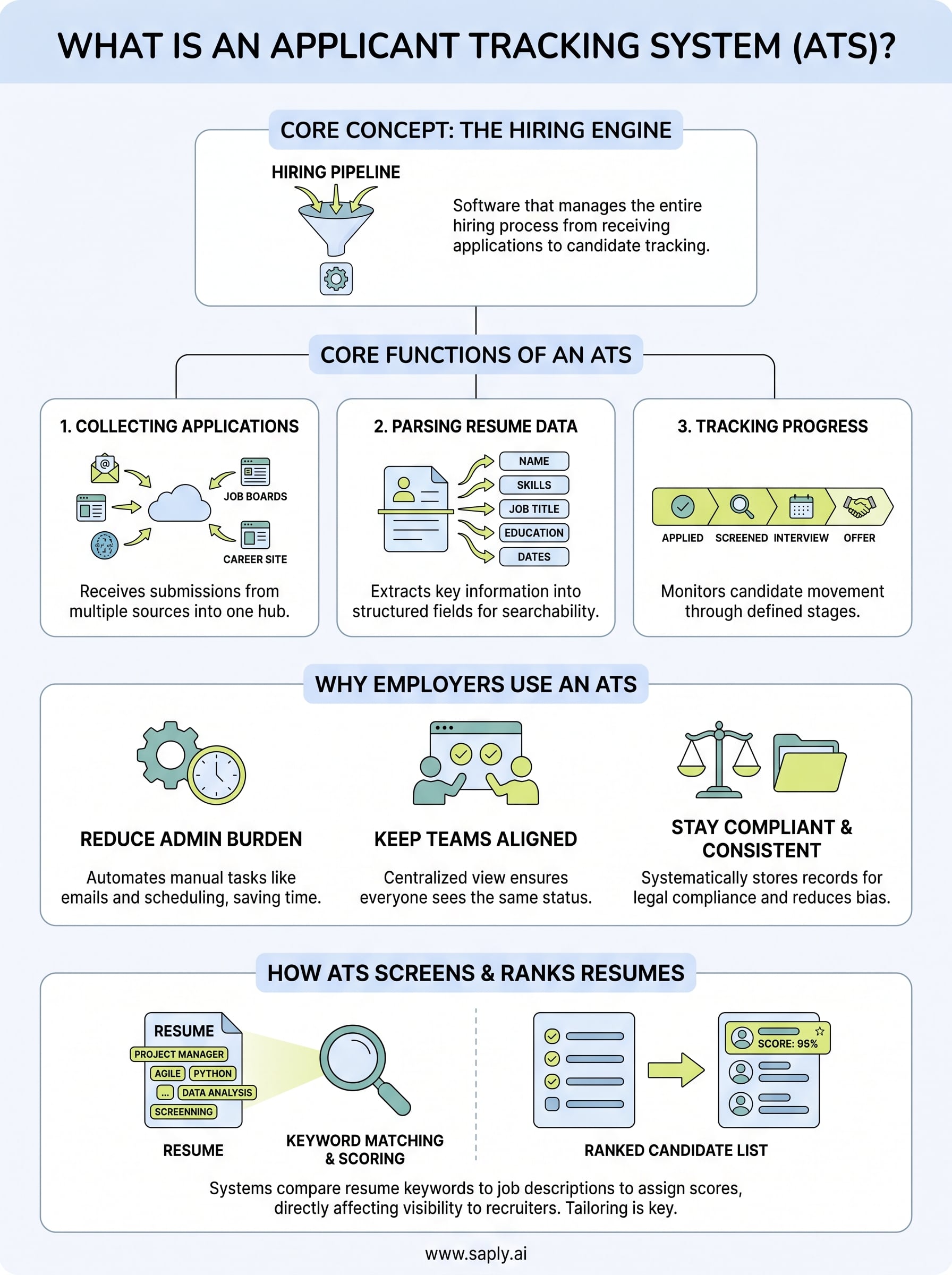
Every recruiter at a staffing agency interacts with one daily, but not everyone can explain what an applicant tracking system actually does under the hood. At its core, an ATS is the software that manages the entire hiring pipeline, from receiving applications to tracking candidates through every stage of the recruitment process. For employers, it’s the central hub. For candidates, it’s the gatekeeper that decides whether a resume gets seen by a human.
Understanding how these systems work matters whether you’re submitting candidates into one or trying to get past its filters. ATS platforms like Bullhorn, Carerix, and Spott each handle resume parsing, ranking, and workflow management differently, and those differences directly affect how quickly your submissions move forward. At Saply, we integrate with these systems so recruiters can format and tailor CVs before they ever hit the ATS, giving candidates the best possible shot at making it through.
This article breaks down how applicant tracking systems function, what they look for in a resume, and which providers dominate the market right now. Whether you’re a recruiter looking to speed up your submission workflow or simply want to understand the technology behind modern hiring, you’ll walk away with a clear, practical picture of the ATS and its role in recruitment.
What an ATS is and what it does
An applicant tracking system is software that companies use to receive, organize, and manage job applications from the moment a candidate submits their resume to the moment someone gets hired. If you’ve ever wondered what is an applicant tracking system at a technical level, think of it as a database with a workflow engine built on top. Every application gets stored, tagged, and moved through defined stages, so hiring teams can see exactly where each candidate stands without digging through email inboxes.
The core functions of an ATS
At its most basic level, an ATS handles three primary jobs: collecting applications, parsing resume data into structured fields, and tracking candidate progress through the hiring pipeline. When a candidate submits a resume, the system extracts information like job title, skills, education, and work history, then maps each piece to a corresponding field in the database. This parsing step determines whether a candidate’s profile gets surfaced in recruiter searches or disappears into the system.

The accuracy of resume parsing directly shapes whether a well-qualified candidate appears in results or gets buried entirely.
Workflow automation is the other major function most ATS platforms offer. Recruiters can set up pipeline stages, trigger automated candidate communications, assign tasks to team members, and log notes against each record, keeping the whole team aligned without anyone manually chasing status updates.
What an ATS stores and tracks
Beyond the resume itself, an ATS stores a wide range of candidate data: contact details, interview notes, feedback from hiring managers, communication history, and compliance documentation. For staffing agencies specifically, this creates a searchable talent pool that recruiters can query whenever a new position opens. Instead of starting from scratch with every job order, you can pull up candidates who already passed screening stages for similar roles.
Your ATS also tracks key recruitment metrics like time-to-fill, submission-to-interview ratios, and source effectiveness. These numbers give managers direct visibility into where the pipeline slows down and which sourcing channels consistently deliver the strongest candidates.
Why employers use an ATS
When you understand what is an applicant tracking system, the next logical question is why it’s become standard practice for employers of every size. Hiring teams deal with hundreds, sometimes thousands, of applications per open role. Without a system to organize and filter that volume, strong candidates slip through the cracks, and recruiters end up buried in spreadsheets instead of making placements.
A single corporate job posting can attract over 250 applications, making manual review impractical without automated support.
Reducing administrative burden
Manual hiring tasks, like reading every resume, sending status emails, and scheduling interviews, consume hours that hiring teams could spend on higher-value work. An ATS handles these repetitive steps automatically, freeing your team to focus on evaluating the strongest candidates rather than managing logistics.
Employers also use ATS platforms to keep hiring teams aligned. When multiple recruiters or hiring managers work the same role, a centralized system ensures everyone sees the same candidate status without duplicate outreach or missed follow-ups.
Staying compliant and consistent
Employment law requires companies to retain application records for a defined period depending on jurisdiction. An ATS stores this data systematically, reducing legal risk and simplifying audits. When every candidate moves through the same structured pipeline, you also reduce the chance of bias entering undocumented evaluation steps.
Most platforms log the following by default:
- Application dates and source channels
- Interview stage outcomes and decision notes
- Offer and rejection records
How an ATS works step by step
Understanding what is an applicant tracking system becomes clearer when you trace the steps a candidate’s application goes through from submission to final decision. Most ATS platforms follow the same predictable sequence, and knowing it helps you submit candidates who survive every stage without getting filtered out early.
From job posting to application intake
When a recruiter posts a role, the ATS generates a unique application link and distributes it across job boards, career pages, and sourcing channels simultaneously. Every submission that comes in gets pulled directly into the system, where the ATS creates a new candidate record without requiring any manual data entry on your end.
The system captures more than just the resume at this stage. It also logs the source channel, submission timestamp, and any screening question responses the candidate provided, giving you a complete intake record from the moment they apply.
From resume parsing to pipeline progression
Once the application lands, the ATS scans the resume and extracts key data points like job titles, skills, employment dates, and education credentials, then maps each element to a structured database field. This makes every candidate searchable and comparable against other applicants immediately.
Poorly formatted resumes often cause parsing errors that bury qualified candidates before a recruiter ever sees them.
After parsing, the ATS moves each candidate into the first stage of the hiring pipeline. Recruiters can advance them manually or let automated rules push them forward based on keyword matches or minimum experience thresholds, with every stage transition logged so the full team stays aligned in real time.
How ATS software screens and ranks resumes
Once you understand what is an applicant tracking system, the screening and ranking process is where it becomes most relevant to your submissions. When a resume enters the ATS, the system doesn’t just store it; it scores it against the job description and assigns a rank that determines whether a recruiter sees your candidate near the top of the queue or buried below dozens of others.
Keyword matching and scoring
The primary method most ATS platforms use is keyword matching. The system compares terms in the resume against the language in the job description, including job titles, required skills, certifications, and tools. If a resume uses different phrasing for the same skill, the parser may not recognize the match, which drops the candidate’s overall score even if they’re fully qualified for the role.

Resumes that mirror the exact language from a job description consistently score higher in ATS keyword matching algorithms.
How ranking affects your submissions
When recruiters search the candidate pool, the ATS surfaces the highest-ranked profiles first. Candidates who fall below a set threshold may never appear in standard search results, regardless of their actual fit. This is why tailoring a CV before submission is not optional; it directly determines visibility inside the system.
A well-formatted, accurately parsed resume with relevant keywords aligned to the role gives your candidate a measurably better chance of landing at the top of the ranked list where hiring decisions actually get made.
Popular ATS tools and what to look for
When you’re trying to understand what is an applicant tracking system in practice, it helps to look at the actual platforms running recruitment pipelines across the industry. Dozens of options exist, but a handful dominate the market, and they differ significantly in how they parse resumes, handle integrations, and structure candidate workflows.
The most widely used ATS platforms
Bullhorn is the go-to choice for staffing agencies managing high candidate volumes, with deep CRM functionality built directly alongside its ATS features. Greenhouse is widely used by mid-to-large companies that prioritize structured hiring and interviewer scorecards. Workday HCM suits enterprise organizations that need ATS capabilities embedded within a broader HR system. Lever combines ATS and CRM functions in a single interface, while iCIMS focuses on scalable enterprise hiring with strong compliance tools.
The right ATS for your operation depends more on workflow fit than on feature count.
What to evaluate before choosing one
Your primary filter should be integration capability. If the platform doesn’t connect cleanly with the document tools and sourcing channels your team already uses, adoption will stall fast. You also need to evaluate resume parsing accuracy, because a system that misreads candidate data creates downstream problems that cost time at every stage. Support quality, pricing structure, and the speed of onboarding new templates round out the practical checklist before you commit to any platform.
Final takeaways
Understanding what is an applicant tracking system comes down to recognizing it as the engine that controls candidate visibility throughout the entire hiring process. Every submission you make passes through parsing, keyword matching, and ranking before a human ever reviews it. How well your CVs are formatted and tailored to each role determines whether your candidates surface at the top of that ranked list or disappear into the system entirely.
The practical takeaway is straightforward: you cannot separate CV quality from ATS performance. Resumes that use job-description language, parse cleanly, and present structured data consistently outperform those that don’t, regardless of how strong the underlying candidate actually is. That’s the gap Saply closes. If your team submits into Bullhorn, Carerix, Spott, or any other ATS, formatting and tailoring every CV before submission gives your candidates a measurably stronger chance of reaching the interview stage faster.