
what-is-candidate-experience-in-recruitment
What Is Candidate Experience In Recruitment? Best Practices
Every interaction a candidate has with your agency shapes how they feel about working with you. From the first job listing they read to the final offer letter, those touchpoints add up. That's what ca...
Written by: Saply Team

What Is Candidate Experience In Recruitment? Best Practices
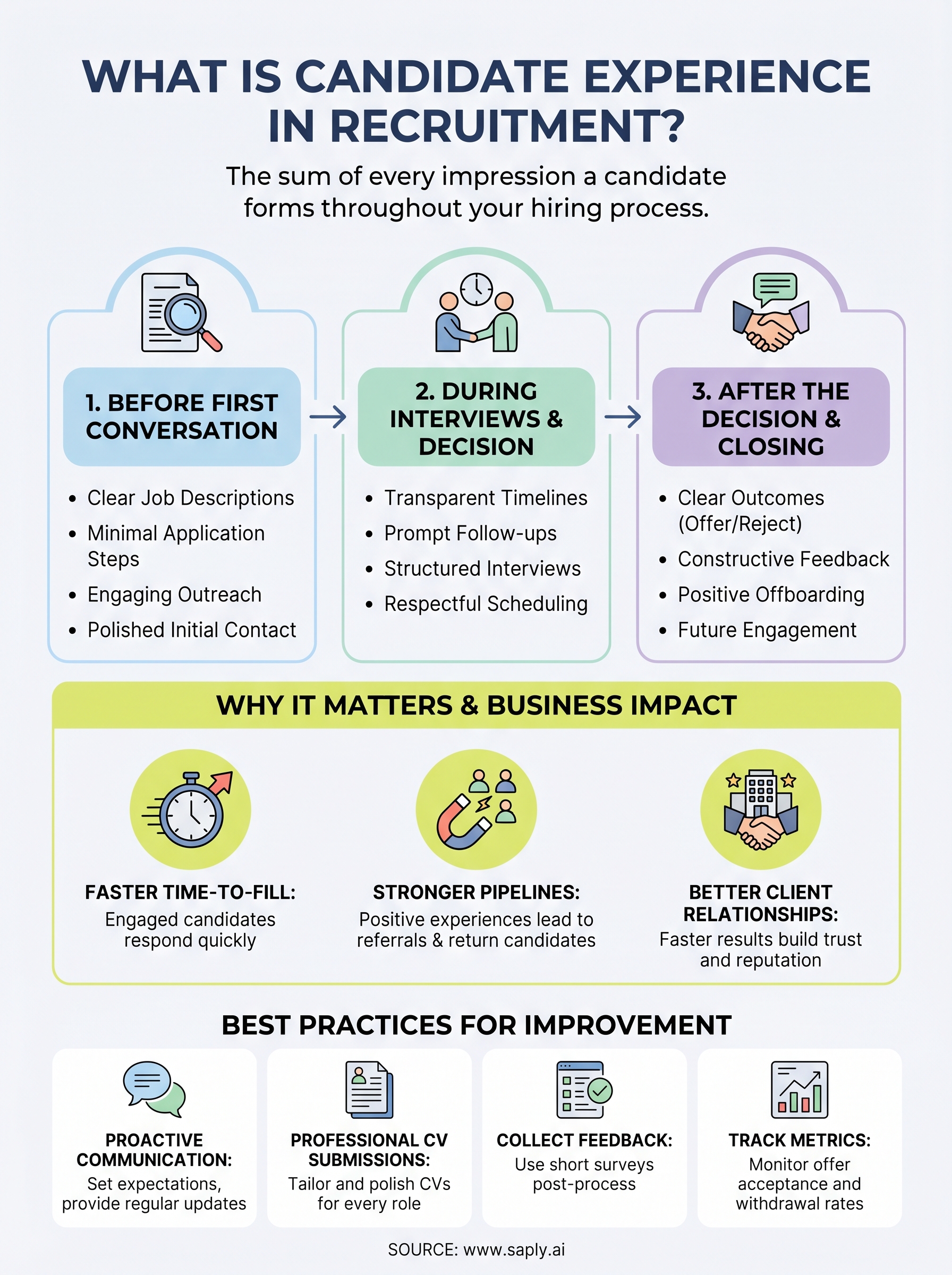
Every interaction a candidate has with your agency shapes how they feel about working with you. From the first job listing they read to the final offer letter, those touchpoints add up. That’s what candidate experience in recruitment really comes down to, the sum of every impression a candidate forms during your hiring process. And for staffing agencies handling dozens of roles at once, those impressions can make or break your ability to attract and retain top talent.
A poor candidate experience doesn’t just cost you one hire. It damages your reputation with candidates who talk to other candidates, and with clients who notice when their roles take too long to fill. On the flip side, agencies that prioritize the experience see faster placements, stronger candidate pipelines, and better client relationships. One often-overlooked piece of that experience? How you present their CV. A polished, tailored resume signals professionalism and care, which is exactly why we built Saply to handle CV formatting and tailoring automatically inside the tools recruiters already use.
This article breaks down what candidate experience means, why it matters for staffing agencies specifically, and practical steps you can take to improve it across your recruitment workflow. We’ll cover everything from communication best practices to the role technology plays in delivering a smoother process for every candidate you engage.
Why candidate experience matters in recruitment
When you ask what is candidate experience in recruitment, the follow-up question is always: why does it matter? The answer connects directly to your agency’s bottom line. Candidates who have a positive experience are more likely to accept offers, refer others to your agency, and return for future roles. Those who don’t will move to competitors and share their frustration with other candidates you may be counting on.
The business case for better candidate experience
Research consistently shows that candidate experience affects hiring outcomes in measurable ways. For staffing agencies, a stronger experience translates to faster time-to-fill and a more reliable talent pool. When candidates feel respected and informed, they stay engaged and respond quickly, making it far more likely they’ll accept the role you put them forward for. That responsiveness can be the difference between placing a candidate before a competitor does or losing them entirely mid-process.
A candidate who drops out isn’t just a missed placement. It’s a signal that something in your process needs attention.
Client relationships also depend on how you handle candidates. Clients notice when roles stay open longer than expected, and they will ask why. Drop-offs and rejected offers slow placements and erode trust. When you run a professional, consistent process, clients see results faster and bring you more roles as a direct result.
The ripple effect on your reputation
Candidates talk. They share experiences with peers, on professional networks, and through direct referrals. A single negative interaction can reach dozens of potential candidates before you hear about it. Staffing agencies that overlook candidate experience often find their talent pool shrinking quietly, not from one big mistake but from accumulated friction across hundreds of small moments.
Agencies known for treating candidates well attract stronger applicants, see higher offer acceptance rates, and build a reputation that makes sourcing less costly over time. That becomes a real competitive advantage in markets where top candidates have multiple options. Every email you send, every feedback call you make, and every CV you submit on their behalf is either building that reputation or slowly eroding it.
The stages that shape candidate experience
When you think about what is candidate experience in recruitment, breaking it into stages helps you pinpoint exactly where things go wrong. Each stage carries distinct touchpoints, and a weak link in any one of them colors how candidates judge the entire process. Your job is to build consistency across all of them, not just at the moments that feel most visible.

Before the first conversation
The experience starts before a candidate ever speaks with you. Job descriptions, outreach messages, and application steps all signal whether your agency is worth engaging with. If a posting is vague or the application process takes too long, strong candidates drop off before you ever assess them. Keep postings specific and application steps minimal to maximize the quality of applicants who make it through.
Your initial screening call also falls into this stage. How you introduce yourself, the client, and the role sets the tone for everything that follows. Candidates pick up quickly on whether a recruiter has actually read their background before reaching out.
During interviews and after the decision
How you manage the middle of the process shapes whether candidates stay engaged or start pursuing other options. Clear timelines, fast follow-ups, and structured interviews all signal respect for the candidate’s time. Disorganized scheduling or silence between stages is one of the fastest ways to lose a strong candidate to a competitor.
A prompt follow-up after an interview costs nothing and significantly increases the chance a candidate stays committed to your process.
The post-decision stage leaves the strongest lasting impression. Whether a candidate is hired, rejected, or chooses another role, how you close that interaction determines whether they return to you or recommend your agency to others.
Best practices to improve candidate experience
Understanding what is candidate experience in recruitment gives you the foundation. Acting on it is where agencies see real results. Most improvements don’t require new tools or major process overhauls. They require deliberate habits applied consistently across every candidate interaction your team handles.
Communicate proactively and consistently
Candidates don’t drop out because a process is slow. They drop out because nobody tells them what’s happening. Set clear expectations at each stage: when they’ll hear from you, what the next step looks like, and how long decisions typically take. A brief update email takes two minutes to write and keeps candidates engaged far longer than silence ever will.
Proactive communication is the single highest-impact change most staffing agencies can make without touching any existing technology.
Present candidates professionally at every submission
How a CV looks when it reaches a client signals the care you put into representing that candidate. A poorly formatted resume creates doubt before the client reads a single line. When you submit polished, role-tailored CVs, you strengthen the candidate’s confidence in your agency and increase client confidence in the submission at the same time.
Beyond formatting, tailoring a CV to the specific job description shows candidates you’ve read their background and taken the role seriously. That small signal carries real weight. Candidates who feel represented well are significantly more likely to stay committed to your process and accept offers when they come through.
How to measure candidate experience
Knowing what is candidate experience in recruitment is one thing. Knowing whether your process actually delivers a good one requires deliberate measurement. Without data, you’re guessing at what’s working and what needs fixing. The good news is that measuring candidate experience doesn’t require complex tools, just a few consistent habits applied across every placement cycle.
Collect feedback directly from candidates
Post-process surveys are the simplest and most reliable way to gather candidate feedback. Send a short survey after a placement closes, whether the candidate was placed or not. Ask three to five targeted questions about communication clarity, CV submission quality, and speed of feedback. Keep it brief so candidates actually complete it.
Candidates who weren’t placed are often more candid, which makes their responses especially valuable for identifying process gaps.
Response rates improve significantly when you send surveys within 48 hours of the process closing. Timing matters because candidates recall specific details accurately when the experience is still fresh in their minds.
Track the metrics that reveal drop-off
Quantitative data tells you where candidates exit before a process concludes. Track these key metrics by stage:

- Offer acceptance rate
- Interview-to-offer ratio
- Candidate withdrawal rate
A spike in withdrawals at a specific stage signals a friction point worth investigating. Pair these numbers with your survey responses to build a complete picture of where your process holds up and where it consistently loses people before a placement crosses the finish line.
Common mistakes and how to fix them
When you look at what is candidate experience in recruitment, most problems trace back to a handful of repeated mistakes. These aren’t complex failures. They’re predictable gaps that show up across agencies of all sizes, and each one has a straightforward fix.
Treating communication as optional
The most common mistake agencies make is going silent between process stages. Candidates interpret silence as disorganization or disinterest, and they respond by pursuing other options. The fix is straightforward: build update checkpoints into every stage of your workflow. Even a brief message confirming that feedback is still pending keeps candidates engaged and reduces drop-off significantly.
Candidates rarely withdraw because a process is slow. They withdraw because nobody told them what was happening.
Submitting CVs without tailoring them
Another major mistake is submitting the same generic CV to multiple roles without adjusting it to match the job description. This signals to both the client and the candidate that you haven’t engaged seriously with the position. Clients notice mismatched submissions, and candidates notice when their background isn’t represented accurately.
Fixing this means treating every submission as a deliberate act. Review the job description before submitting, identify the skills and experience that match, and adjust the CV accordingly. Tools like Saply automate this step directly inside Word, Google Docs, and your ATS, so tailoring no longer adds time to your workflow.
Final takeaways
Understanding what is candidate experience in recruitment gives you a clear framework for improving every stage of your process. From the first job posting a candidate reads to the final feedback call, each touchpoint either builds or weakens your agency’s reputation. Consistent communication, professional CV submissions, and structured feedback loops are what separate agencies that fill roles reliably from those that constantly lose candidates mid-process.
The fixes are within reach. Most of them require deliberate habits, not expensive technology. Start by auditing where candidates drop off, gather feedback after each placement cycle, and address the gaps that show up repeatedly. Tools like Saply can handle CV formatting and tailoring automatically, freeing your team to focus on the relationship-driven work that no software can replace. Better candidate experience starts with small, consistent improvements applied across every role you work on.