
what-is-high-volume-recruiting
What Is High Volume Recruiting? Definition & Benchmarks
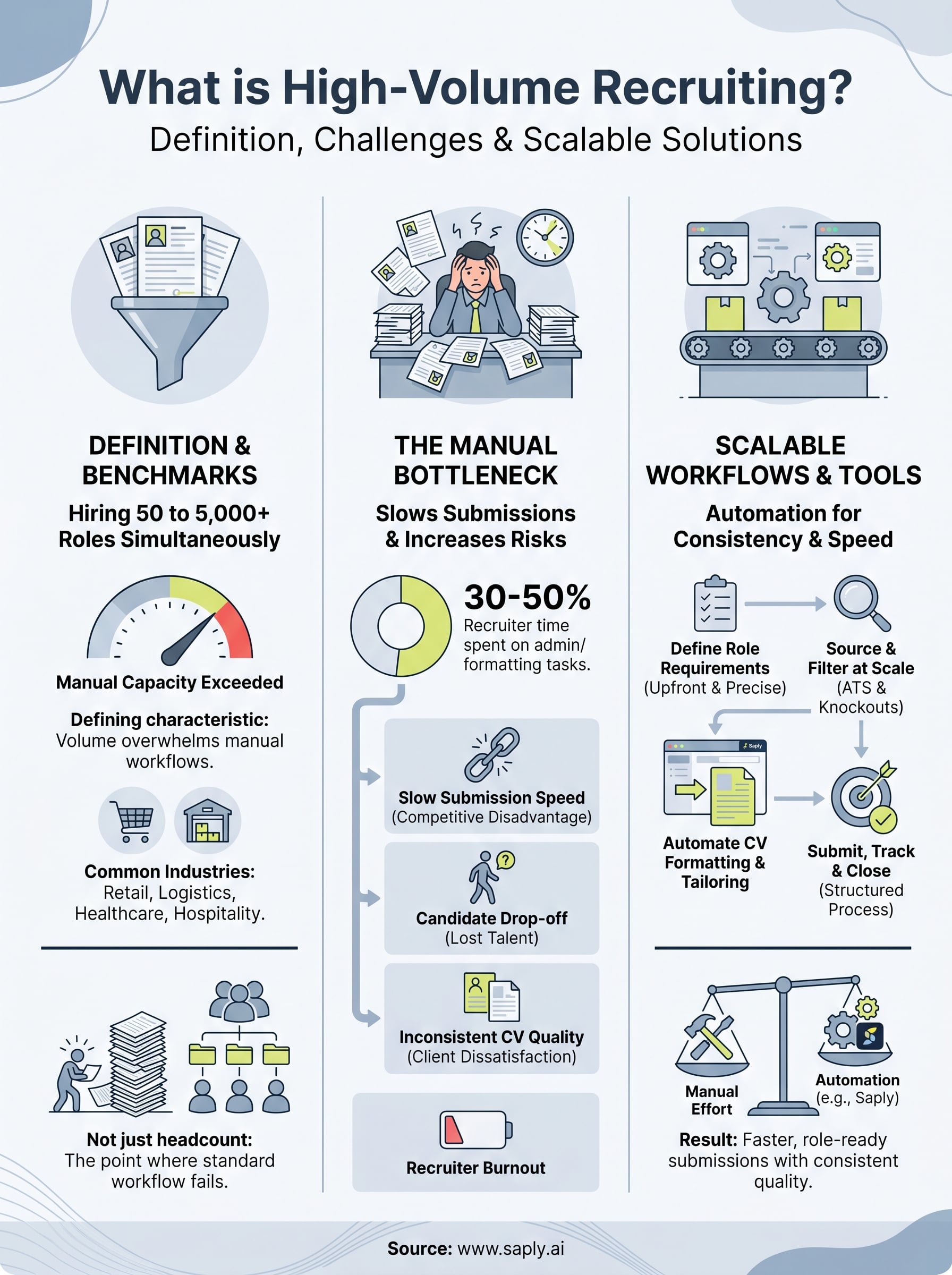
When a staffing agency needs to fill 50, 500, or 5,000 roles at once, the process stops being about individual placements and becomes an operational challenge. That's the core of what is high volume r...
Written by: Saply Team

What Is High Volume Recruiting? Definition & Benchmarks
When a staffing agency needs to fill 50, 500, or 5,000 roles at once, the process stops being about individual placements and becomes an operational challenge. That’s the core of what is high volume recruiting, a hiring approach where the sheer number of open positions demands a fundamentally different strategy than standard recruitment. The threshold varies by industry, but the defining characteristic stays the same: volume overwhelms manual workflows.
For recruiters managing these surges, the bottleneck often isn’t sourcing candidates. It’s everything that happens after, formatting CVs to client templates, tailoring them to specific job descriptions, and submitting them fast enough to stay competitive. At Saply, we built our AI-powered CV formatting and tailoring tools specifically for staffing teams dealing with this kind of pressure, so we’ve seen firsthand where high-volume processes break down.
This article breaks down what qualifies as high-volume recruiting, the benchmarks that separate it from standard hiring, and the strategies that keep large-scale pipelines moving without sacrificing candidate quality.
Why high volume recruiting matters
High volume recruiting isn’t a niche specialty reserved for large corporations or household-name brands. Staffing agencies and recruitment firms of all sizes encounter it when they win large client accounts, support seasonal hiring surges, or help a client scale a new business unit rapidly. When you understand what is high volume recruiting and why it operates differently from placing individual candidates, you stop treating large-scale hiring as “more of the same work” and start building systems that can absorb and convert high candidate flow consistently and profitably.
The agencies that win high-volume contracts aren’t necessarily the ones with the most candidates in their database. They’re the ones that can process and submit those candidates faster and more accurately than everyone else.
The competitive pressure of submission speed
In high-volume hiring, speed of submission is a direct competitive advantage. Clients running large hiring campaigns often work with multiple agencies at the same time, and the recruiter who submits a formatted, role-ready CV first gets the interview slot. That means your internal process, from receiving a raw CV to sending a polished submission, has to be measurably faster than what competing firms can produce.
The average recruiter spends 30 to 50 percent of their week on administrative formatting tasks when working at volume. That time doesn’t build client relationships, it doesn’t surface better candidates, and it doesn’t close placements. Across a team of five or ten recruiters, those hours erode your margin and slow the entire pipeline at exactly the moment when pace matters most.
What happens when volume processes break down
When high-volume pipelines lack structure, problems multiply fast across every submission. Inconsistent CV formatting confuses clients who expect a uniform presentation from your agency across every candidate. Tailoring errors, such as mismatched skills or missing certifications, damage your credibility with clients and reduce your interview conversion rates on campaigns where you need to maintain a strong batting average.
Candidate experience also takes a hit when internal processes slow down. Candidates sitting in limbo while your team manually reformats their documents lose interest and accept other offers. At volume, even a one-day processing delay can cost your agency multiple placements within a single client campaign.
The downstream effects on your business accumulate over time. You see lower placement rates, higher recruiter burnout, and client churn when delivery timelines slip. Staffing agencies that rely entirely on manual workflows for high-volume work typically hit an output ceiling they cannot break through without restructuring how they handle the administrative side of recruitment. Scaling headcount to match volume growth is expensive and slow. Building structured, automated processes is the more sustainable path.
What counts as high volume recruiting
There is no universal number that automatically puts a hiring campaign in the high-volume category, but most recruiting professionals and industry benchmarks draw the line somewhere between 50 and 250 open roles at any given time. What matters more than a specific headcount is whether your current process can absorb the load without breaking. If your team is manually formatting every CV, individually tailoring each document, and chasing submissions one by one, you are effectively operating in high-volume territory the moment your workload outpaces your manual capacity, regardless of the exact number on the board.
High volume is less about a fixed threshold and more about the point where your standard workflow stops being able to keep up.
The numbers that define high volume
Staffing agencies generally classify a campaign as high volume when they need to fill 50 or more roles within a defined timeframe, whether that is a 30-day sprint for a client launch or a seasonal ramp that runs quarterly. At the enterprise level, what is high volume recruiting often looks like managing thousands of applications per month across multiple client accounts simultaneously. Applicant-to-hire ratios in high-volume environments typically run between 150:1 and 500:1, meaning your team processes hundreds of candidate files for every placement that closes.

Smaller agencies working regional markets may hit the same operational strain at lower absolute numbers. A five-person recruitment team managing 80 open roles simultaneously faces the same workflow pressure as a larger firm running 400, because the constraint is recruiter capacity relative to submission volume, not total headcount alone.
When standard recruiting becomes high volume
The clearest signal that your operation has crossed into high-volume territory is when individual recruiters can no longer manage each candidate file with full attention. Formatting starts to slip. Tailoring becomes generic. Submission timelines stretch. These are process failures, not recruiter failures. They indicate that the tools and workflows supporting your team were built for lower throughput than what the business now demands.
Recognizing that shift early gives you time to build the right infrastructure before clients notice the drop in quality or speed.
Common examples and industries that use it
Understanding what is high volume recruiting in practice becomes much clearer when you look at which industries depend on it as a baseline, not just a temporary surge. Certain sectors require rapid, ongoing workforce replenishment as a core part of how they operate. If your staffing agency serves clients in any of these industries, speed and submission quality are not nice-to-haves; they are the main factors that determine whether you keep the account.
Agencies that work in even one of these sectors need to treat high-volume workflows as a core competency, not an occasional exception.
Retail and seasonal commerce
Retail is the most visible example of high-volume hiring in action. Large retailers open hundreds of positions simultaneously ahead of peak shopping periods, often with tight deadlines and standardized role requirements across dozens of locations. Your team may need to format and submit large batches of CVs within a single week to fill floor staff, supervisors, and distribution roles before the client’s window closes.
The pressure in retail isn’t just volume, it’s speed paired with consistency. Clients expect every submission to match their template and read cleanly, which means manual formatting workflows collapse fast when you are processing 80 or 100 candidate files at once.
Logistics, warehousing, and manufacturing
These sectors tie headcount directly to output and revenue, which creates frequent and often sudden hiring surges. Warehousing and manufacturing clients issue high-volume requests when they win new contracts, open new facilities, or cover fulfillment peaks driven by e-commerce demand.
Roles in these industries often share similar skill profiles, so your challenge shifts from deep tailoring to pure throughput. Your submission process needs to handle scale without slowing down or letting formatting quality slip across the batch.
Healthcare and hospitality
Healthcare staffing runs at high volume because turnover rates in nursing, care work, and allied health remain consistently elevated. Hospitals and care facilities need continuous candidate pipelines to maintain safe staffing ratios, and credential-heavy role requirements make each submission more intensive to prepare correctly.
Hospitality follows a similar pattern for different reasons. Hotels, restaurant groups, and event venues experience sharp, predictable staffing spikes tied to travel seasons and events, and clients in this space routinely give minimal advance notice before roles need to be filled.
The high volume recruiting process step by step
Understanding what is high volume recruiting conceptually is one thing; running it without losing control of quality is another. The process follows a predictable sequence, but each step carries operational weight that can slow your pipeline or stall it entirely if you don’t build the right structure in from the start.

Step 1: Define role requirements upfront
Before you source a single candidate, you need a precise, documented brief from your client covering required skills, certifications, experience levels, and any disqualifying criteria. Vague intake conversations produce mismatched submissions, and at volume, those mismatches waste hours your team cannot recover. Pin down the job description, the timeline, and the exact submission format your client expects before your recruiters touch any candidate files. Starting without this alignment turns every downstream step into guesswork.
Step 2: Source and filter at scale
Your sourcing strategy needs to cast a wide net quickly. Job boards, ATS databases, and referral networks all feed candidates into your pipeline simultaneously at high volume. The filtering stage is where you save time or lose it. Apply consistent screening criteria, such as pre-screening questions and automated knockout filters, so that only role-ready candidates advance to the formatting stage. Letting unqualified profiles through at this point multiplies wasted effort across your entire team.
The time you invest in tight filtering criteria at step two saves multiples of that time across every downstream step.
Step 3: Format and tailor every CV for submission
This is the step that breaks most manual high-volume workflows. Every candidate CV needs to match your agency’s template and reflect the specific requirements of the open role before your client sees it. Formatting errors and generic tailoring are the fastest ways to lose client confidence when you are submitting at volume, and they are entirely preventable with the right tools and process in place.
Step 4: Submit, track, and close the loop
Once your formatted CVs go out, you need a system to track submission status, client feedback, and interview outcomes across every open role simultaneously. Follow up on stalled submissions promptly, document what worked, and use that data to tighten your approach for the next campaign. Turning outcome data into process improvements is what separates agencies that scale high-volume work profitably from those that simply survive it.
Challenges you will hit and how to avoid them
Anyone working through what is high volume recruiting for the first time quickly discovers that the same scale creating opportunity also creates failure points. The problems are predictable, and that is actually useful, because you can build defenses against them before they cost you a client contract or a team member.
Candidate drop-off during long processes
High-volume pipelines attract a lot of candidates, but slow internal processing burns through that supply faster than you replace it. Candidates in active job searches move quickly. If your team takes three or four days to format and submit a CV because everything is done manually, that candidate has likely already accepted an interview elsewhere. The fix is shortening the gap between candidate intake and submission by automating the formatting and tailoring steps that sit between sourcing and delivery.
The candidates you lose to slow processing don’t show up in your placement data. They just disappear, and you never know how many you could have placed.
Inconsistent CV quality across the batch
When recruiters handle large batches manually, output quality varies from file to file based on how tired, rushed, or distracted the recruiter is at that moment. One submission looks polished and on-template; the next has mismatched formatting and a generic summary that ignores the job description entirely. Clients notice this inconsistency immediately, and it signals that your agency lacks process discipline at scale.
You avoid this by standardizing every formatting and tailoring step so the quality of a submission does not depend on who handled it or when. Template compliance and role-specific tailoring need to be enforced systematically, not left to individual judgment under time pressure.
Recruiter burnout from administrative overload
Repetitive, manual formatting tasks at high volume grind recruiters down fast. When your team spends the majority of their week reformatting documents instead of building candidate relationships or talking to clients, they burn out and your turnover climbs. This is a process design failure, not a staffing problem.
Protect your team by removing low-value administrative work from their plates through automation, so their time goes toward the decisions and conversations that actually require human judgment.
Tools and workflows that make volume hiring scalable
Once you understand what is high volume recruiting and the operational strain it creates, the logical next step is identifying what technology and process design actually solve those problems at scale. No single tool fixes a broken workflow on its own, but the right combination of platforms and structured processes can move your team from reactive and overwhelmed to consistent and fast without adding headcount.
ATS platforms and candidate tracking
An applicant tracking system is the foundation of any scalable high-volume operation. Your ATS handles candidate sourcing, pipeline visibility, and status tracking across every open role simultaneously, which means your team stops managing submissions through email threads and spreadsheets. Many agencies use ATS platforms that connect directly to client systems, reducing manual data entry and keeping submission records current without extra steps every time a candidate moves through the pipeline.
CV formatting and tailoring automation
The step that consumes the most recruiter time in high-volume work is preparing candidate CVs for submission. Manually formatting each document to your agency template and tailoring the content to match the job description is repeatable, time-consuming work that automation handles far more consistently than any recruiter working under deadline pressure.
Tools that embed directly into software your team already uses, such as Microsoft Word, Google Docs, or your ATS, eliminate the application-switching that fragments focus and slows throughput.
Saply integrates CV formatting and tailoring directly into the tools your recruiters already use daily, so your team can apply your agency template, match candidates to job descriptions, and generate role-ready submissions without leaving the applications your workflow already runs through.
Building a repeatable submission workflow
Technology only delivers results when your team applies it consistently. Map out every step from candidate intake to final submission and assign clear ownership at each stage so nothing stalls between handoffs. Standardize the sequence of operations so any recruiter can pick up a file mid-process and know exactly what has been done and what comes next.
Documented, repeatable workflows also accelerate onboarding for new recruiters, which matters directly when your agency wins a large contract and needs to scale quickly to match the demand without losing submission quality or speed.
Final takeaways
What is high volume recruiting comes down to one operational reality: the moment candidate volume outpaces your manual capacity, your standard process stops working. Speed, consistency, and structured workflows are what separate agencies that win large contracts and keep them from those that deliver inconsistent results and lose the account. You don’t solve volume problems by working harder. You solve them by removing the bottlenecks that slow every submission down, starting with CV formatting and tailoring.
The agencies that scale high-volume work profitably invest in automation that fits inside the tools their recruiters already use, so the process speeds up without adding complexity or friction. Your team’s time belongs on decisions and relationships, not on reformatting documents under deadline pressure. If you want to see what that looks like in practice, explore how Saply handles CV formatting and tailoring at scale and start a free 14-day trial with no credit card required.