



Technical Recruiting: What It Is And How It Works
If a hiring manager hands you a job req for a senior Kubernetes engineer and you've never touched container orchestration yourself, you already know recruiting for tech roles isn't like filling a sale...

If a hiring manager hands you a job req for a senior Kubernetes engineer and you’ve never touched container orchestration yourself, you already know recruiting for tech roles isn’t like filling a sales or admin position. What is technical recruiting, exactly, and why does it demand a different playbook? It’s the practice of sourcing, screening, and placing candidates for engineering, IT, and data roles, where you need to understand skill stacks, certifications, and role requirements well enough to judge fit before a hiring manager ever sees a resume.
Technical recruiters spend their days decoding job descriptions full of frameworks and acronyms, then matching that language to what a candidate has actually built. That’s the core difference from general recruiting: you’re not just assessing soft skills and culture fit, you’re evaluating technical competency against a moving target of tools and languages.
This article breaks down what technical recruiters actually do day to day, how the role diverges from generalist recruiting, and where the biggest bottlenecks show up, particularly around CV tailoring for niche technical positions. If you’re placing candidates for staffing clients, that last part matters more than most people admit.
Why technical recruiting matters for hiring success
Getting technical recruiting right shapes whether a company ships products on time or watches deadlines slip because a critical seat sits empty. Bad technical hires cost more than a wasted salary; they cost sprints, morale, and client trust when a staffing firm places someone who can’t actually deliver. When you understand what technical recruiting demands, you stop treating engineering reqs like every other opening and start protecting the placements that matter most to your business.
The real cost of a mismatched hire
Understanding the stakes starts with the numbers. The U.S. Bureau of Labor Statistics projects that computer and IT occupations will grow much faster than the average for all occupations through the decade, which means competition for qualified candidates keeps intensifying (BLS Occupational Outlook Handbook). Every week a technical role stays open, a client loses ground on that competitive curve, and a staffing agency risks losing the account altogether.
A mismatched technical hire doesn’t just cost a salary, it costs the project timeline built around them.
What poor technical screening actually looks like
Vague screening shows up in predictable ways, and each one erodes your credibility with clients:
- Keyword matching instead of verifying actual hands-on experience with a tool or language
- Skipping technical vetting and relying only on a phone screen for soft skills
- Submitting CVs that don’t map candidate experience to the specific job description
- Missing certifications or version-specific skills that a hiring manager explicitly listed as required
Recruiters who skip these checks end up submitting candidates who look good on paper but stall in technical interviews, wasting everyone’s time.
Why speed and accuracy both matter
Speed matters just as much as accuracy in this equation. Clients expect fast turnaround on technical reqs, but rushing a submission without verifying skill alignment backfires quickly. Balancing both is what separates agencies that keep repeat clients from ones that lose accounts after one bad placement.
How technical recruiting works, step by step
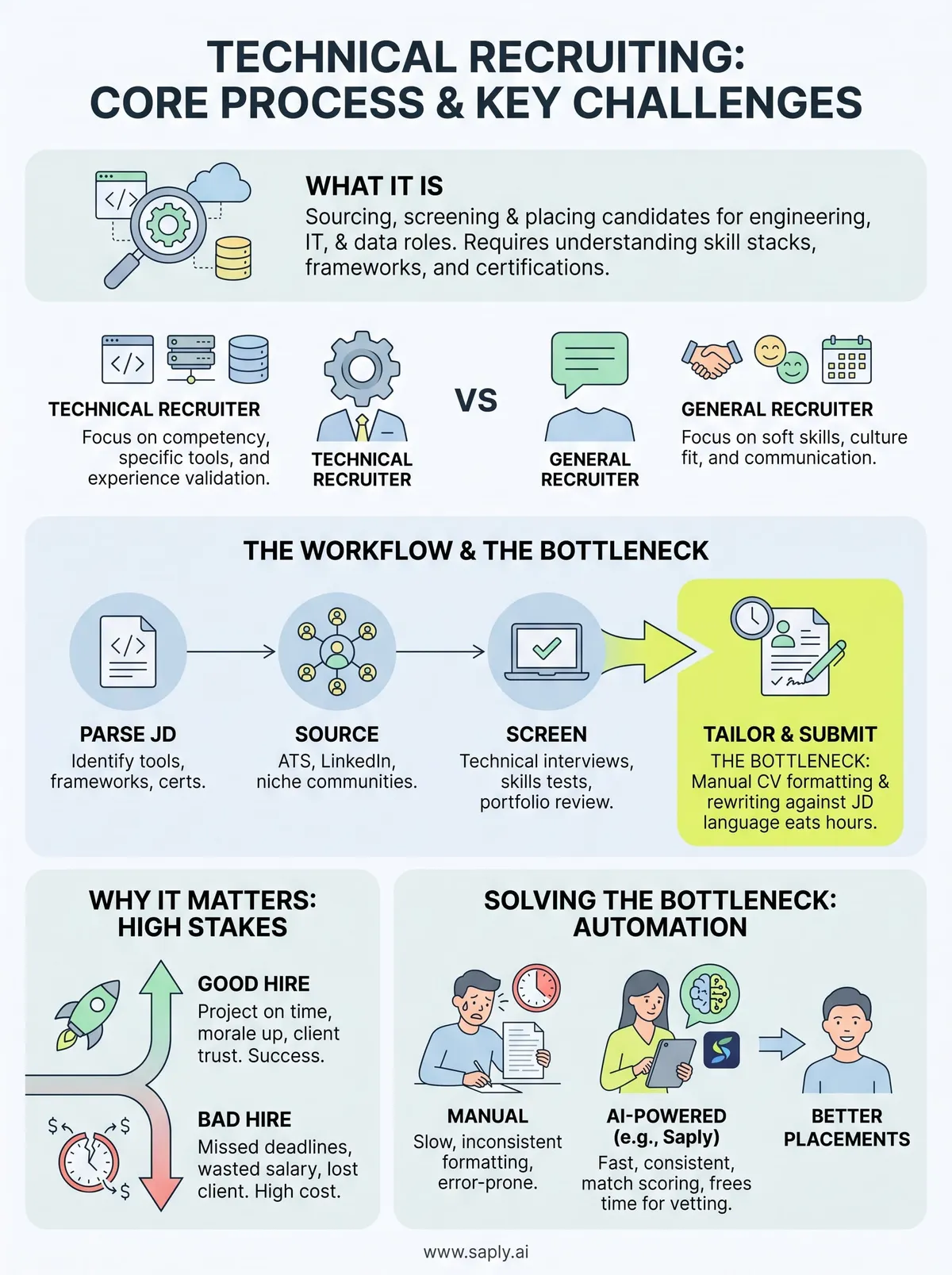
Technical recruiting follows a recognizable sequence, even though the tools and vocabulary shift with every job req. You start with a job description, translate it into a candidate profile, then work through sourcing, screening, and submission before a hiring manager ever sees a name.

The core workflow
Most technical recruiters move through the same core steps on every search, regardless of the tech stack involved:
- Parse the job description for required tools, frameworks, certifications, and years of experience
- Source candidates through ATS databases, referrals, or platforms like LinkedIn
- Screen resumes against the specific skill requirements, not just job titles
- Conduct technical screens or coordinate with a hiring manager for skills assessments
- Format and tailor the CV to match the client’s template and highlight relevant experience
- Submit the candidate with notes on fit, gaps, and expected salary range
Every step depends on the one before it, so a sloppy job description parse creates weak sourcing, which cascades into wasted screening time later.
Where the bottleneck usually sits
Formatting and tailoring eat more hours than any other step in this list, especially at agencies handling high submission volumes. Recruiters copy-paste content between raw resumes and client templates by hand, then manually rewrite bullet points to mirror the job description’s language.
The steps in technical recruiting are simple to list but slow to execute by hand, and that gap is where most agencies lose time.
Speeding up that middle stretch, without cutting corners on accuracy, is where the real competitive advantage lives.
Technical recruiting vs. general recruiting
General recruiting and technical recruiting share a process, but the judgment calls inside that process differ sharply. A generalist recruiter can usually assess communication skills and culture fit within a single conversation. A technical recruiter has to verify claims about frameworks, certifications, and hands-on project work that they may never have personally used, which raises the bar for research and vetting before any candidate reaches a client.

Where the two roles diverge
Looking at the differences side by side makes the gap concrete:
| Factor | General Recruiting | Technical Recruiting |
|---|---|---|
| Screening focus | Soft skills, culture fit | Skill stack, tool proficiency, certifications |
| Job description complexity | Broad, role-based | Dense, framework and version specific |
| Vetting method | Interview and reference checks | Technical screens, coding tests, portfolio review |
| Sourcing channels | Job boards, referrals | Niche communities, GitHub, specialized platforms |
| Turnover risk | Moderate | High if skills are misrepresented |
General recruiting checks if someone fits the team; technical recruiting checks if someone can actually do the job.
Why the distinction matters for staffing agencies
Misapplying general recruiting habits to technical roles creates the exact mismatches covered earlier, where a candidate clears a phone screen but fails the first real assignment. Staffing agencies that treat every req the same way lose credibility fast with technical clients, since those clients expect recruiters to speak the language of their stack. Recognizing this split early lets you build separate workflows, screening questions, and even CV formatting standards for technical submissions instead of forcing every candidate through a generic process built for non-technical roles.
Core skills and tools every technical recruiter needs
Succeeding at technical recruiting takes more than a sharp eye for resumes. You need a working vocabulary for the roles you fill, comfort with the platforms recruiters rely on daily, and enough process discipline to keep high volumes moving without sacrificing accuracy.
Skills that separate strong technical recruiters
Knowing what to look for matters as much as knowing where to look. The strongest technical recruiters build these habits over time:
- Reading job descriptions like an engineer, spotting which frameworks or certifications are non-negotiable versus nice-to-have
- Asking pointed technical questions during screens instead of relying on résumé keywords alone
- Tracking market rates and skill scarcity so pitches to clients stay realistic
- Recognizing red flags like inflated titles or vague project descriptions
A technical recruiter’s real skill isn’t knowing code, it’s knowing enough to ask the right questions.
Tools that keep the workflow moving
Process only scales with the right stack behind it. Most technical recruiters lean on an ATS like Bullhorn or Carerix for candidate tracking, sourcing platforms such as LinkedIn Recruiter and niche developer communities, and standard document tools like Microsoft Word or Google Docs for formatting submissions. Gaps show up fastest in that last category, since manual formatting and tailoring rarely scale alongside sourcing volume.
Quality assurance closes the loop. Reviewing every submission against the original job description before it reaches a client catches the mismatches that damage trust, and it’s a habit worth building into every stage of the process, not just the final check.
How staffing agencies can speed up technical recruiting
Speed wins accounts in technical staffing, but only when it doesn’t come at the cost of accuracy. Agencies that scale technical recruiting successfully usually attack the same bottleneck: the manual work of formatting and tailoring CVs before submission. That’s the stage where recruiters lose hours copy-pasting content into templates and rewriting bullet points to mirror a job description, and it’s also the stage most ripe for automation.
Where automation fits without cutting corners
AI-powered formatting tools now handle the repetitive parts of this workflow, applying a client’s template automatically and tailoring content against a job description in under 1 minute instead of hours. Saply, for example, plugs directly into Microsoft Word, Google Docs, and Outlook, along with ATS systems like Bullhorn, Carerix, and Spott, so recruiters never leave the tools they already use daily. It also runs a match analysis that flags skill gaps and certification mismatches before a CV ever reaches a hiring manager, which protects the quality checks covered earlier in this article.
Automating the formatting step doesn’t replace a recruiter’s judgment, it gives that judgment more hours to work with.
What agencies gain from cutting formatting time
The payoff shows up directly in submission volume and client trust:
- Faster turnaround on job reqs without sacrificing tailoring quality
- Consistent formatting across every recruiter on the team
- Built-in gap analysis that catches mismatches before clients do
- More time for sourcing and screening, the parts of the job that actually require human judgment
Agencies that solve the formatting bottleneck free up recruiters to focus on the technical vetting that clients are actually paying for.
Bringing it all together
Technical recruiting comes down to one thing general recruiting doesn’t demand: proving a candidate can actually do the job, not just talk about it. You now know the workflow, the skills, and the tools that separate agencies who win repeat technical clients from those who lose accounts after one bad placement. The gap almost always sits in the same place, the hours lost formatting and tailoring CVs by hand while sourcing and screening wait.
Closing that gap is the fastest way to protect the credibility you’ve built with technical clients. Automating CV formatting frees up the hours you need for the vetting that actually catches skill mismatches, and pairing that automation with match scoring means fewer surprises after submission. If you’re ready to stop losing hours to manual formatting, try Saply free for 7 days and see how much faster your submissions move.