ai-resume-parsing-software
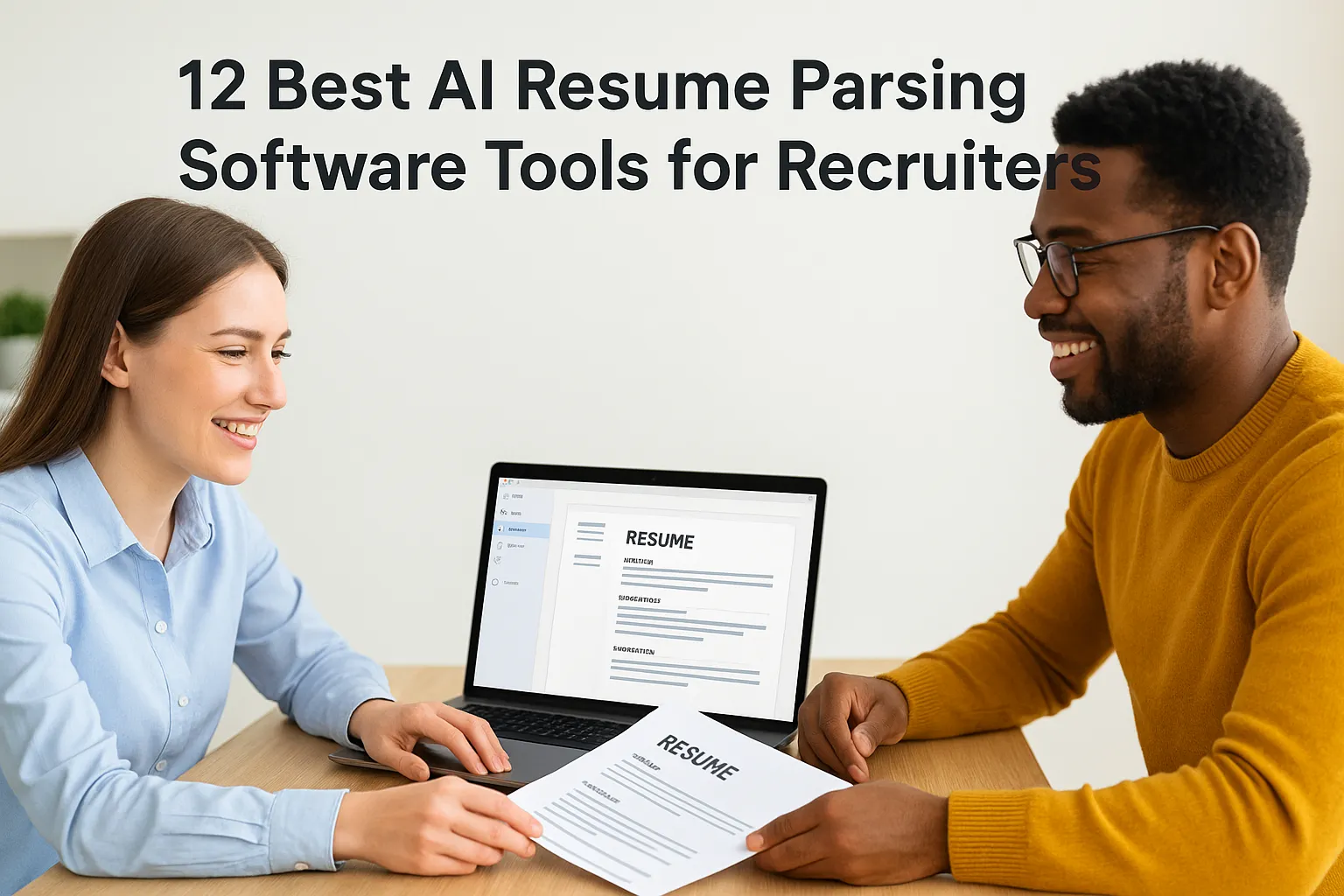
12 Best AI Resume Parsing Software Tools for Recruiters
Every recruiter knows the drill: a pile of resumes comes in, and someone has to pull out names, job titles, skills, and work history before any real evaluation can happen. Done manually, that process...
Written by: Saply Team
12 Best AI Resume Parsing Software Tools for Recruiters
Every recruiter knows the drill: a pile of resumes comes in, and someone has to pull out names, job titles, skills, and work history before any real evaluation can happen. Done manually, that process eats hours. Done poorly, it means missed candidates and slow submissions. That’s exactly why ai resume parsing software has become a core part of modern recruitment stacks, it automates the extraction and structuring of candidate data so recruiters can focus on placing people, not reformatting documents.
But parsing is only one piece of the puzzle. Once you’ve extracted the data, you still need to format, tailor, and match that resume to a specific role. That’s where tools like Saply come in, going beyond parsing to handle CV formatting, job-description tailoring, and match scoring, all inside the tools recruiters already use. Parsing gets you the data; what you do with it afterward determines how fast you fill the role.
This guide breaks down 12 of the best AI resume parsing tools available to recruiters right now. For each one, you’ll find what it does well, where it falls short, and who it’s built for, so you can pick the right fit for your agency’s workflow without wasting time on demos that go nowhere.
1. Saply
Saply sits at the intersection of CV parsing and full CV workflow automation. It doesn’t just extract candidate data from a resume, it takes that parsed content and immediately moves it through formatting, tailoring to a specific job description, and match scoring, all without making you switch applications. For staffing agencies that submit dozens of resumes per week, that end-to-end pipeline saves hours of manual work per recruiter.
What it does best
The core strength of Saply is what happens after the parse. Once it pulls structured data from a candidate’s CV, it applies your agency’s branded template automatically, aligns sections and typography with one click, and tailors the content to the role you’re filling. It also runs a match scoring analysis against the job description, flagging skill gaps, relevant certifications, and standout strengths so you know exactly how to pitch the candidate before you send anything to a client.
Saply combines ai resume parsing software capabilities with document formatting and job-matching in a single workflow, removing the copy-paste steps that slow most recruiters down.
How the parsing workflow fits into recruiter tools
Rather than pulling you into a separate dashboard, Saply operates as a plugin inside tools you already use, including Microsoft Word, Google Docs, and Outlook. The parsing, formatting, and tailoring happen inside your existing document editor, which cuts the learning curve to near zero and keeps your team’s daily rhythm intact. You don’t migrate to a new platform or retrain staff on unfamiliar software.

Best for
This tool is purpose-built for staffing agencies and recruitment consultancies that handle high submission volumes and need CVs formatted to a specific agency template before sending to clients. If your team spends significant time manually reformatting raw candidate CVs or copying content between systems, Saply directly targets that bottleneck. It’s less suited to in-house HR teams that process only a handful of applications per month and don’t need agency-style CV branding.
Integrations and setup
Saply connects natively with Bullhorn, Carerix, and Spott, with additional ATS systems available on request. Custom CV templates are built into the platform within 48 hours of submission, so your agency’s formatting standards are ready to apply from day one. Because it runs as a plugin inside Word, Google Docs, and Outlook, there’s no infrastructure change required to get your team started.
Pricing approach
Saply runs on a CV credit system billed monthly or yearly, so you pay based on actual usage rather than a flat seat fee that doesn’t reflect your team’s real volume. A 14-day free trial is available with no credit card required, giving your team room to run real submissions through the tool before committing to a plan.
2. Affinda
Affinda is a dedicated document AI company that builds parsing technology for HR and recruitment use cases. Its resume parser is one of the more mature options in the ai resume parsing software market, designed for teams that need structured, machine-readable candidate data delivered fast and accurately.
What it does best
Affinda’s parser extracts a wide range of resume fields, including contact details, work history, education, skills, certifications, and languages, with strong accuracy across a variety of CV formats. It handles unstructured and inconsistently formatted documents reasonably well, which matters when candidates submit resumes from different templates or regions.
Affinda’s core advantage is parsing accuracy across messy, real-world resumes rather than only clean, structured documents.
Parsing accuracy and output formats
The parsed output arrives as structured JSON or XML, making it straightforward for developers to pipe data into ATS platforms or internal databases. Affinda also returns confidence scores alongside extracted fields, so downstream systems can flag low-confidence extractions for human review rather than silently passing bad data into your workflow.
Best for
Affinda suits technical teams and larger recruitment operations that want a parsing API to embed into custom-built tools or automate large-scale CV processing pipelines. It works well for companies with developer resources who need raw structured output rather than a recruiter-facing interface with built-in formatting or tailoring capabilities.
Integrations and setup
Affinda provides a REST API as its primary integration method, with SDKs available for common languages. It connects to ATS platforms through custom API work rather than pre-built native plugins, so expect some development time before it fits into your recruiter workflow.
Pricing approach
Affinda prices on a volume-based model tied to the number of documents parsed. They offer a free tier for low-volume testing, with paid plans scaling based on monthly parse volume, which suits businesses with predictable, high-throughput document processing needs.
3. RChilli
RChilli is a enterprise-grade parsing vendor that focuses on structured data extraction at scale. It’s been in the ai resume parsing software space for over a decade and has built a reputation for depth of field extraction and broad language coverage, which makes it a common choice for global recruitment operations.
What it does best
RChilli extracts over 150 data fields from a single resume, going well beyond basics like contact info and job titles. It pulls certifications, accomplishments, references, and detailed education breakdowns, which gives downstream systems more candidate context to work with before a recruiter reviews anything. The depth of extraction is the main reason enterprise teams choose it over lighter-weight parsers.
If your workflow depends on feeding rich, structured candidate data into multiple downstream systems, RChilli’s field coverage is difficult to match.
Language support and taxonomy features
The parser handles more than 50 languages, which matters for multinational staffing firms or agencies placing candidates across regions. Beyond language support, RChilli includes a built-in taxonomy layer that normalizes job titles, skills, and industries against standardized frameworks. That normalization step reduces the inconsistency that comes from candidates using different terms for the same role or skill.
Best for
RChilli fits large staffing operations and enterprise HR tech vendors that need high-volume parsing with normalized output across multiple languages. It works well for teams building or maintaining ATS platforms who want parsing as a core embedded service rather than an add-on.
Integrations and setup
RChilli connects via REST API and offers pre-built integrations with several major ATS platforms. Setup typically requires developer involvement, especially when configuring custom taxonomies or field mappings to match your internal data structure.
Pricing approach
RChilli charges on a volume-based credit model, with enterprise contracts available for high-throughput needs. Custom pricing is standard for larger accounts.
4. Textkernel
Textkernel is a European AI company that specializes in labor market intelligence and semantic matching technology built specifically for recruitment. Its approach to ai resume parsing software centers on deep natural language processing, meaning it reads the intent and context behind resume content rather than just lifting surface-level fields. Staffing firms across Europe rely on it heavily, though it also serves global markets.
What it does best
Its standout capability is semantic understanding of resume content. Rather than treating a resume as a list of keywords, the system reads the meaning behind job titles, skills, and career progression. This matters when candidates describe the same role ten different ways, because Textkernel maps those variations back to standardized concepts rather than creating duplicate or conflicting data points inside your system.
Enrichment, normalization, and multilingual parsing
Beyond basic extraction, Textkernel enriches parsed data by linking it to external labor market datasets, giving you context about how a candidate’s experience maps to current market demand. It normalizes job titles and skills using its own ontology framework, which reduces inconsistencies across high-volume candidate pools. The parser also handles more than 30 European and global languages, making it a practical choice if your agency places candidates across regional markets.

Textkernel’s ontology layer is what separates it from basic parsers: it turns raw CV text into normalized, market-contextualized candidate profiles.
Best for
Textkernel suits European staffing agencies and multinational firms that need reliable multilingual parsing combined with labor market enrichment. It’s particularly strong for organizations feeding parsed data into matching or ranking systems, since the normalization layer makes those downstream processes significantly more accurate.
Integrations and setup
Textkernel connects via REST API, with partnerships across several major ATS vendors. Setup typically requires developer resources to configure field mappings and ontology customizations for your specific use case.
Pricing approach
Pricing operates on an enterprise model, negotiated based on volume and the specific modules you activate. There is no publicly listed self-serve pricing tier.
5. DaXtra Parser
DaXtra Parser is a long-established player in the ai resume parsing software market, with a specific focus on staffing and recruitment agency workflows. The company built its parsing technology from the ground up for agency use cases, which shows in how the product handles the messy, high-volume document flows that staffing firms deal with every day.
What it does best
DaXtra Parser pulls structured candidate data from resumes and job orders simultaneously, which means it can extract information from both sides of a placement in a single processing step. That dual-parsing capability gives recruiters a direct data bridge between candidate profiles and open roles without requiring separate manual steps to process each document type.
DaXtra’s ability to parse job orders alongside resumes is a meaningful advantage for agencies that need candidate-to-role data alignment done at the point of ingestion.
Agency workflows and matching features
Beyond extraction, DaXtra includes built-in semantic matching that compares parsed candidate profiles against parsed job descriptions using its own relevance engine. This matching layer produces ranked candidate lists based on how closely a resume aligns with a role’s requirements, giving recruiters a prioritized shortlist rather than an unfiltered pile of profiles to review manually.
Best for
DaXtra fits staffing and recruitment agencies that process high volumes of both resumes and job descriptions and want matching logic baked into the same tool. It is particularly useful for agencies running high-throughput sourcing operations where speed of candidate ranking is a competitive factor.
Integrations and setup
DaXtra connects with a wide range of ATS platforms, including Bullhorn and several other recruitment-focused systems. Integration typically uses its API or pre-built ATS connectors, reducing setup time compared to building custom pipelines from scratch.
Pricing approach
DaXtra operates on a volume-based pricing model, with enterprise contracts available for larger agencies. Direct contact with their sales team is required to get a quote tailored to your processing volume.
6. HireAbility
HireAbility is a dedicated parsing API provider that has focused on resume and job order parsing since the early days of automated recruitment technology. Its product sits squarely in the ai resume parsing software category, built for technical teams and platform developers who need reliable, high-speed extraction at scale rather than a recruiter-facing interface with workflow tools layered on top.
What it does best
HireAbility specializes in fast, accurate extraction of structured data from resumes submitted in a wide range of file formats, including PDFs, Word documents, and plain text files. The parser returns clean, structured XML or JSON output that integrates directly into ATS platforms, job boards, and internal databases without requiring significant data transformation on the receiving end.
Speed, scale, and configurable parsing
One of HireAbility’s practical advantages is the ability to process high document volumes without meaningful degradation in extraction accuracy or response time. For organizations running large-scale candidate ingestion pipelines, that consistency matters. The parser also offers configurable output options, so you can specify which fields you need returned and trim the response to match your downstream data model rather than receiving a bloated payload you have to filter manually.
If your team processes hundreds of resumes daily and needs clean structured output delivered fast, HireAbility’s throughput focus is worth evaluating.
Best for
HireAbility fits recruitment technology vendors and enterprise HR teams that embed parsing into custom-built platforms. It is less suited for agencies that want a recruiter-facing tool with formatting or tailoring capabilities included.
Integrations and setup
The product delivers via a REST API, which requires developer resources to configure and connect to your existing systems. There are no pre-built recruiter plugins available out of the box.
Pricing approach
HireAbility uses a volume-based pricing model, with plans tiered around monthly parse counts. You contact their team directly to get a quote that matches your processing needs.
7. Bullhorn
Bullhorn is one of the most widely used ATS platforms in the staffing industry, and its built-in resume parsing is a core reason agencies stay on it for years. Rather than a standalone ai resume parsing software tool, Bullhorn embeds parsing directly into the ATS workflow, so candidate data lands in structured fields the moment a resume enters the system.
What it does best
Bullhorn’s parsing capability works inside the ATS itself, pulling contact details, work history, skills, and education from incoming resumes and populating candidate records automatically. The main advantage here is that no separate parsing tool or API integration is required for teams already running Bullhorn as their primary recruitment platform, which lowers operational complexity for agencies that prefer a consolidated tech stack.
Built-in parsing inside a staffing ATS
Because parsing happens natively within the platform, your team never needs to move data between systems manually. Uploaded resumes convert into structured candidate profiles within seconds, ready for recruiter review and immediate action. That tight integration reduces data entry errors and keeps your candidate database consistent without requiring additional cleanup steps or third-party tools handling data in the middle.
For agencies already using Bullhorn as their ATS, its built-in parsing removes a significant layer of manual data entry from the daily workflow without adding another vendor to manage.
Best for
Bullhorn suits established staffing agencies that have already adopted it as their primary ATS and want parsing as part of that existing investment rather than a separate subscription with its own setup and maintenance overhead.
Integrations and setup
Bullhorn connects with a wide ecosystem of third-party tools, including sourcing platforms, job boards, and productivity apps. Setup happens inside your existing Bullhorn environment, with no separate parser to configure or credentials to manage independently.
Pricing approach
Bullhorn operates on an enterprise contract model, with pricing customized to agency size and the specific feature set your team activates. No self-serve pricing tiers are published publicly.
8. Zoho Recruit
Zoho Recruit is a cloud-based ATS with built-in CRM functionality, making it one of the few recruitment platforms that handles both candidate tracking and client relationship management inside a single product. Its native resume parsing sits within that broader system, giving smaller agencies and in-house teams a way to automate candidate data entry without adding a separate ai resume parsing software subscription to their stack.
What it does best
Zoho Recruit’s parser automatically extracts key resume fields, including contact information, work history, skills, and education, and maps them directly into candidate records within the ATS. Because the CRM layer sits alongside the ATS, the same platform also tracks client contacts, job openings, and hiring pipelines without requiring your team to jump between separate tools to manage both sides of a placement.
Built-in parsing inside an ATS plus CRM
The combined ATS and CRM structure means that parsed candidate data connects immediately to open requisitions and client accounts within the same environment. You can move from parsing a resume to associating that candidate with an active role and a client contact in a single platform session, which cuts down on context switching during busy sourcing periods.
For smaller agencies that want candidate and client management in one place without building a multi-tool stack, Zoho Recruit’s structure removes significant coordination overhead.
Best for
Zoho Recruit fits small to mid-sized staffing agencies and in-house HR teams that need a combined ATS and CRM with solid built-in parsing rather than best-in-class extraction depth. It works well when budget and simplicity take priority over enterprise-grade parsing accuracy or high-volume throughput.
Integrations and setup
Zoho Recruit connects with Zoho’s broader product suite, including Zoho CRM and Zoho People, alongside third-party tools through its marketplace and API access.
Pricing approach
Zoho Recruit offers tiered subscription plans based on the number of active users and job postings, with a free plan available for very small teams.
9. Parseur
Parseur is a document parsing platform that takes a different approach from most dedicated ai resume parsing software tools. Rather than applying a pre-trained AI model to every document, it lets you build custom parsing templates for specific document types, which gives you more control over exactly what gets extracted and how it maps to your downstream systems.
What it does best
Its core strength is structured data extraction from documents with consistent layouts, such as templated job applications, standardized HR forms, and email-based candidate submissions. You define the fields you want extracted using a visual editor, and the system pulls those fields reliably every time a matching document format comes through your pipeline. For recurring document types with predictable formatting, this approach delivers clean output with minimal cleanup required.
Template-based parsing versus AI parsing
The core tradeoff with Parseur is flexibility versus control. Traditional AI-driven parsers handle unpredictable, varied resume formats because they learn patterns across millions of documents. Parseur’s template model works differently: it performs reliably on documents you’ve trained it on, but struggles with resumes that deviate from your defined templates. That makes it a better fit for controlled intake processes than open-application pipelines where candidates submit CVs in dozens of different formats.
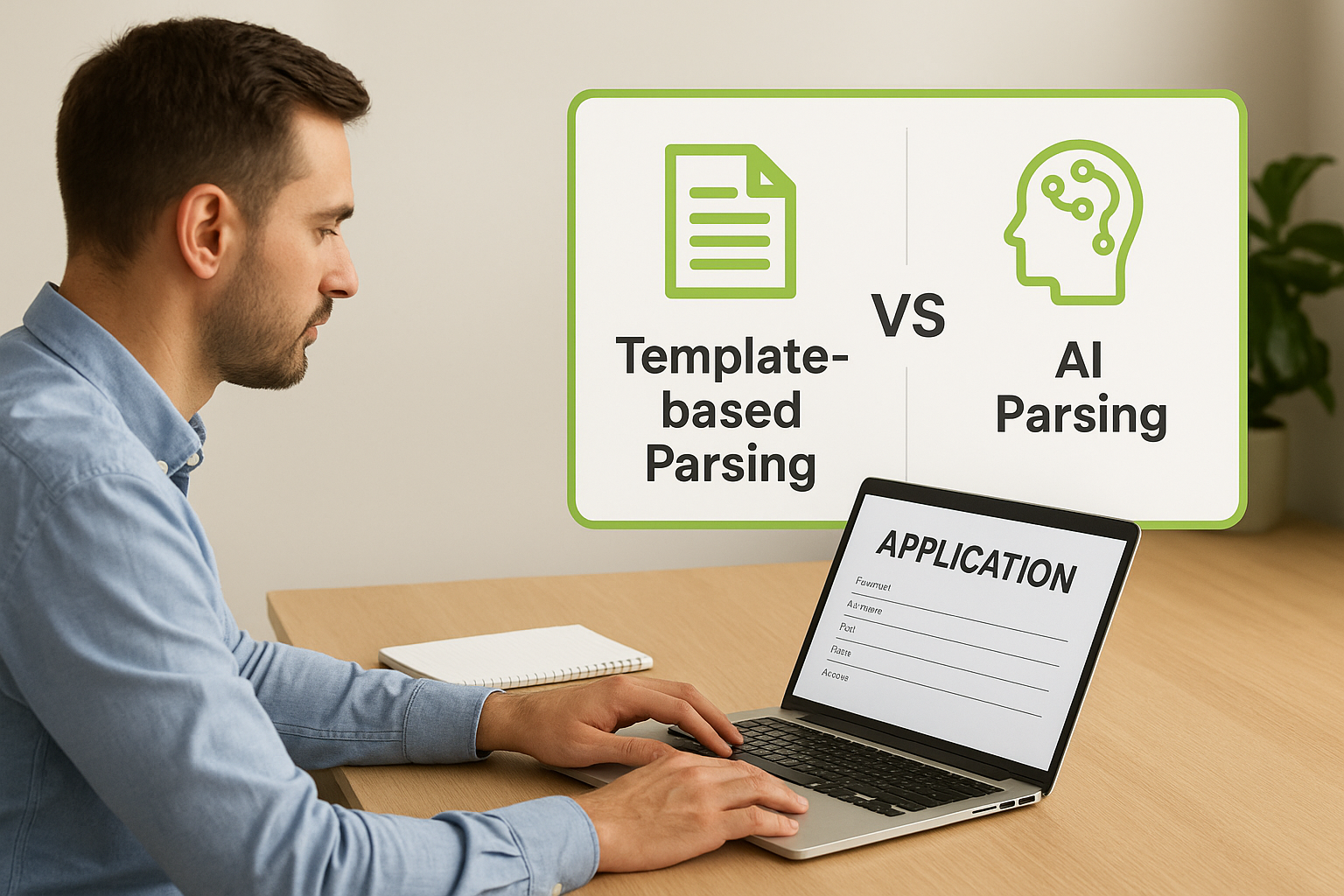
If your candidate intake process uses standardized submission forms or templated documents, Parseur’s template model will outperform general-purpose AI parsers on accuracy for those specific layouts.
Best for
Parseur suits operations teams and HR departments that process standardized document flows rather than open-format candidate CVs. It works well when your intake uses consistent application templates rather than freeform resumes from varied sources.
Integrations and setup
The platform connects to downstream tools through Zapier, Make, and direct API access, routing parsed data to CRMs, spreadsheets, or ATS platforms without requiring custom development work.
Pricing approach
Parseur offers tiered subscription plans based on monthly document volume, with a free plan available for low-throughput testing before committing to a paid tier.
10. hireEZ
hireEZ is an outbound recruitment platform that combines AI-powered candidate sourcing with built-in profile parsing, making it a distinct category from dedicated ai resume parsing software vendors. Rather than processing resumes your team receives directly, it focuses on finding and structuring candidate profiles pulled from external platforms and professional networks.
What it does best
hireEZ pulls candidate profiles from over 45 external data sources, including GitHub, Stack Overflow, and professional networks, and automatically structures that data into searchable candidate records. The platform’s AI applies relevance scoring on top of the parsed data, so you get a ranked shortlist rather than an unfiltered pile of profiles to work through manually.
Parsing plus sourcing and talent insights
Beyond profile extraction, hireEZ delivers talent market intelligence alongside the parsed data, giving you visibility into candidate availability, compensation benchmarks, and skill trends in specific hiring areas. That combination helps you advise clients with more precision and speed than working from a static internal database alone.
If your recruiting strategy depends on proactive outbound sourcing rather than waiting for inbound applications, hireEZ’s parsing and sourcing combination removes a significant manual research step.
Best for
hireEZ suits recruiting teams running high-volume outbound sourcing campaigns that want parsed, structured candidate data delivered with market context included. It fits less well for agencies whose primary need is processing inbound resumes submitted by candidates directly.
Integrations and setup
The platform connects with major ATS systems, including Bullhorn, Greenhouse, and Lever, through pre-built integrations that sync parsed candidate data directly into your existing workflow without custom development work.
Pricing approach
hireEZ operates on a subscription-based pricing model tiered by team size and feature access. You need to contact their sales team directly to receive a quote matched to your specific sourcing volume and workflow needs.
11. Eightfold AI
Eightfold AI is an enterprise talent intelligence platform that uses deep learning to go beyond standard ai resume parsing software capabilities. Rather than simply extracting fields from a resume, the platform builds a full picture of a candidate’s potential based on their career trajectory, skills progression, and role history, which gives larger organizations a richer data foundation for both hiring and internal mobility decisions.
What it does best
Eightfold’s core strength is skills inference, meaning it reads a candidate’s career history and predicts adjacent skills they likely hold even when those skills are not explicitly listed on the resume. This approach reduces the blind spots that come from keyword-dependent parsing, where a strong candidate gets filtered out simply because they used different terminology than the job description expected.
Eightfold’s ability to infer skills from career context, rather than relying only on stated keywords, makes it more effective at surfacing qualified candidates who write resumes inconsistently.
Skills-based matching and talent intelligence
Beyond individual candidate profiles, Eightfold delivers talent intelligence at scale, giving HR teams visibility into workforce skill gaps, succession risks, and hiring market trends. The platform applies its matching engine to both external candidates and internal employees, which makes it useful for organizations managing large headcounts and trying to reduce external hiring by redeploying existing talent into open roles.

Best for
Eightfold fits large enterprises and global corporations that run complex talent operations across multiple departments or geographies. It is not designed for small staffing agencies that need fast, lightweight parsing and CV formatting tools.
Integrations and setup
Eightfold connects with major HRIS and ATS platforms through enterprise-grade API integrations. Setup requires dedicated implementation support and is built around a structured onboarding process rather than a self-serve configuration model.
Pricing approach
Eightfold operates on a custom enterprise pricing model with no publicly listed tiers, requiring direct engagement with their sales team to receive a quote.
12. OpenResume
OpenResume is an open-source resume parser and builder that sits at the opposite end of the spectrum from enterprise ai resume parsing software platforms. It was built as a transparency-first tool, meaning the code is publicly available, there is no server-side data storage by default, and all processing happens locally in your browser. For recruiters or developers who handle sensitive candidate data and want simple extraction without sending documents to a third-party server, that architecture is a meaningful distinction.
What it does best
OpenResume focuses on parsing clean, structured resume data from well-formatted documents and presenting the output in a readable, editable format. The tool breaks down resumes into standard sections, including contact information, work experience, education, and skills, and displays them in a structured view that makes it easy to verify what was extracted before using it in any downstream process.
Privacy-first parsing for basic fields
Because OpenResume processes documents entirely within the browser, no candidate data travels to an external server during parsing. That local-first approach makes it one of the few parsing tools where you can point to a concrete technical reason why candidate information stays within your control from the moment you upload a document to the moment you use the output.
For teams operating under strict data handling policies or processing CVs in regulated industries, local browser-based parsing removes a layer of third-party data exposure entirely.
Best for
OpenResume suits individual recruiters, developers, and small teams that need basic field extraction from well-formatted resumes without paying for a subscription or sending candidate data to an external service.
Integrations and setup
There are no native ATS integrations built into OpenResume. Because it operates as an open-source browser tool, connecting it to your existing systems requires custom development work to build any kind of automated data pipeline.
Pricing approach
OpenResume is completely free to use, with the source code available publicly for teams that want to self-host or extend the tool’s functionality for their own workflows.
Next steps
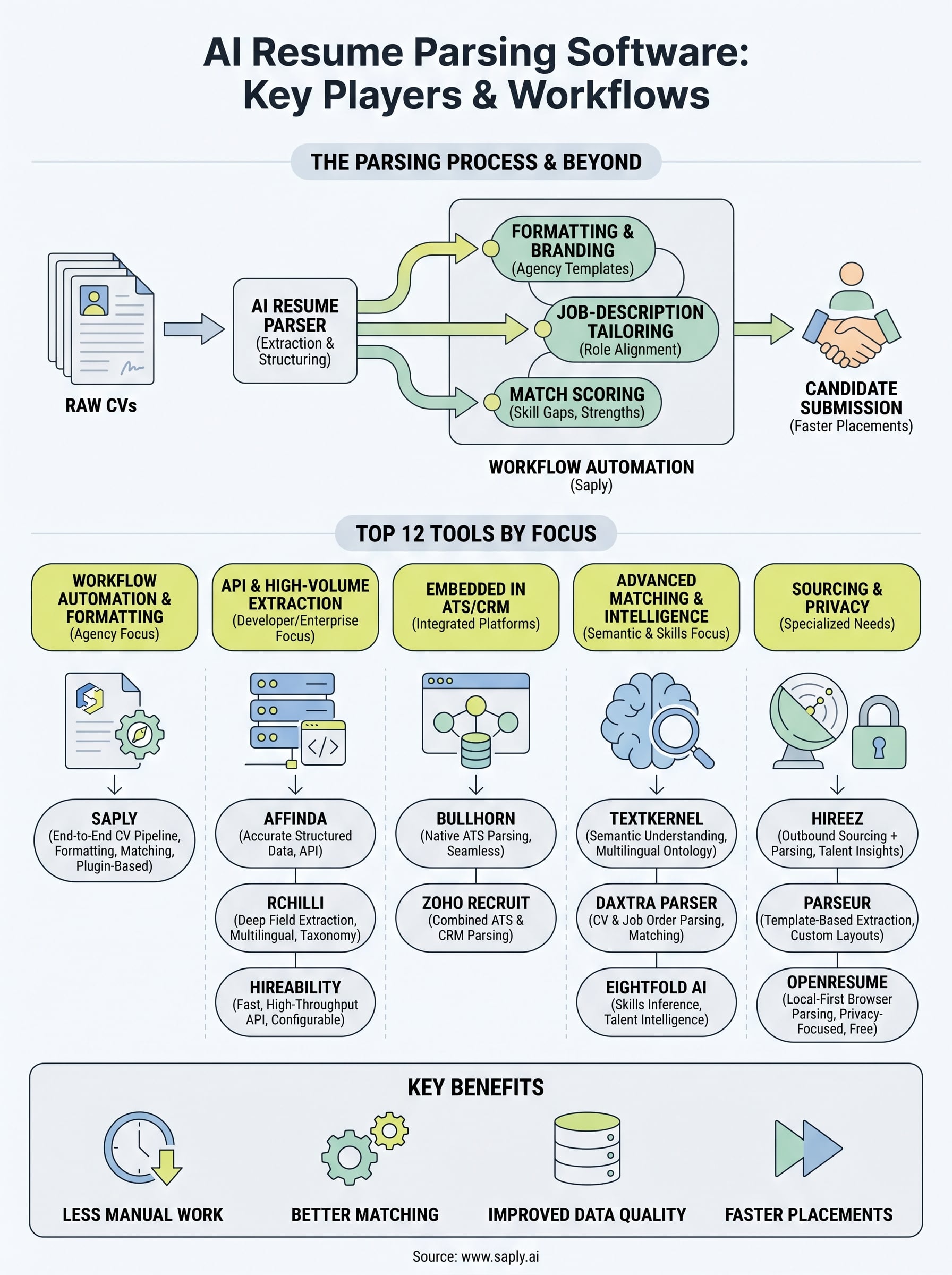
Choosing the right ai resume parsing software comes down to where the real bottleneck sits in your workflow. If you need raw extraction for a custom-built pipeline, tools like RChilli, Affinda, or HireAbility give you solid API-based options. If you want parsing embedded inside an ATS you already use, Bullhorn or Zoho Recruit handles that without adding another vendor to manage.
But if you run a staffing agency and the problem is not just extracting data, it’s formatting, tailoring, and matching resumes to roles fast, that’s a different problem. Saply addresses that entire workflow in one place, working inside the tools your team already uses every day.
Your next move is simple: run a real submission through it and see how much time your team saves. Start your 14-day free trial of Saply and put actual candidate CVs through the process before you commit to anything.