best-employer-branding-examples
9 Best Employer Branding Examples To Inspire Your Strategy
Candidates check out a company's reputation long before they accept an interview, and if what they find looks generic or outdated, your best prospects walk away. That's why studying best employer bran...
Written by: Saply Team

9 Best Employer Branding Examples To Inspire Your Strategy
Candidates check out a company’s reputation long before they accept an interview, and if what they find looks generic or outdated, your best prospects walk away. That’s why studying best employer branding examples matters: they show you what actually makes a candidate stop scrolling and pay attention, instead of relying on guesswork or a template nobody updates. For recruiters juggling dozens of open roles, strong employer branding directly translates into faster yeses and fewer ghosted offers.
This article answers that search directly. You’ll see nine companies that built a recognizable employer brand through specific, repeatable tactics, not vague mission statements. Each example breaks down the exact move you can borrow, whether it’s how they talk about culture, how they showcase employees, or how they position roles to attract the right candidates fast.
We’ll walk through each case, pull out the practical lessons behind it, and connect them to what staffing consultants and recruiters can act on this week. If you’re pitching candidates or clients on why a role matters, these examples give you real talking points grounded in what’s worked for other companies, not theory.
1. HubSpot
HubSpot built its employer brand around one document: the Culture Code, a public slide deck that lays out how the company actually operates, not how it wants to look on a careers page. Millions of people have viewed it, and that transparency became the company’s calling card long before “culture deck” was a common term in HR circles. The Culture Code works because it reads like an internal memo that leaked on purpose, full of specific commitments like flexible time off and radical transparency around pay bands, rather than corporate platitudes.

Signature branding strategy
HubSpot’s core move is treating employer branding as a product, complete with versioning and public updates. The company revises its Culture Code every few years and announces the changes the same way it would announce a software release. That approach signals to candidates that culture isn’t static marketing copy, it’s something the company actively manages and improves.
A culture document only builds trust if candidates can tell it gets updated, not just published once and forgotten.
Channels and content they use
HubSpot spreads this message across a few consistent channels instead of chasing every platform trend:
- Public SlideShare and website hub hosting the Culture Code itself, kept easy to skim and share
- Employee-run blog content where HubSpotters write about their own career paths, not just recruiters
- LinkedIn Life pages that mix product news with behind-the-scenes team photos and promotions
- Glassdoor engagement, where the company responds to reviews instead of ignoring critical feedback
This mix keeps the message consistent whether a candidate finds HubSpot through a Google search, a LinkedIn scroll, or a Glassdoor deep-dive before an interview.
Lesson you can apply
Staffing consultants rarely have the resources to build a slide deck seen by millions, but the underlying lesson scales down easily. Write down your agency’s actual working norms, things like how fast you respond to candidates or how you handle feedback after a rejected submission, and put that somewhere a candidate can find it before they ever talk to you. Specificity beats polish here. A candidate deciding between two similar staffing firms will remember the one that told them exactly what to expect, not the one with the nicest logo.
For recruiters using Saply, this same principle applies to how you present candidates to clients. A tailored CV that clearly shows relevant experience against a job description works the same way HubSpot’s Culture Code does: it replaces vague claims with specific, checkable facts that build trust fast.
2. Salesforce
Salesforce built its employer brand on a single word: Ohana, the Hawaiian concept of extended family that the company uses to describe how it treats employees, customers, and partners alike. Instead of treating this as a slogan, Salesforce backs it with concrete programs like paid volunteer time and equal pay audits, which gives candidates something tangible to check against the marketing. That gap between stated values and verifiable practice is exactly where most employer brands fall apart, and it’s the gap Salesforce works hardest to close.
Signature branding strategy
Salesforce’s approach centers on proving its values through public commitments rather than just describing them. The company publishes its philanthropic 1-1-1 model (donating equity, product, and employee time) and ties recruiting messaging directly to it, so candidates see the company’s stated priorities backed by numbers they can look up.
Values only function as employer branding when a candidate can verify them with a quick search.
Channels and content they use
Salesforce spreads the Ohana message through a focused set of channels:
- Dedicated careers site sections covering equality, sustainability, and volunteering separately from job listings
- Trailhead, its free learning platform, doubling as a recruiting funnel by letting candidates build skills before applying
- Executive social posts from leadership reinforcing the same values candidates read about on the careers site
Lesson you can apply
Recruiters can’t launch a philanthropic program overnight, but you can pick one value you already practice and back it with a number. If your agency guarantees a callback within 48 hours, say that explicitly instead of promising “great communication.” Candidates and clients trust specifics over adjectives, and that trust shortens the distance between a first conversation and a signed offer.
3. Airbnb
Airbnb turned its own product philosophy into its employer brand: belonging. The company built its hiring message around the same idea that powers its guest experience, that people should feel at home wherever they are, and applied it internally through office design, employee resource groups, and a famous “Belong Anywhere” mission statement that recruiters actually reference in interviews. Job seekers researching employer branding examples often point to Airbnb because the brand message matches what employees report experiencing day to day, not just what marketing publishes.
Signature branding strategy
Airbnb’s strategy rests on narrative consistency between the customer brand and the employee brand. Instead of running separate campaigns for guests and candidates, the company folds its hiring pitch into the same storytelling it uses for hosts and travelers, so a candidate researching the company sees one coherent identity rather than two disconnected messages.
When your customer story and your hiring story sound like they came from two different companies, candidates notice the mismatch immediately.
Channels and content they use
Airbnb keeps its channel mix tight and story-driven:
- Airbnb Careers blog featuring employee travel stories tied directly to company values
- Instagram takeovers from employees showcasing global offices and remote work setups
- Internal mobility features on the careers site, showing real examples of employees switching teams
Lesson you can apply
Staffing recruiters can borrow this by making sure the pitch to a candidate matches the pitch to the client. If you tell a client the candidate is a strong culture fit, make sure the candidate’s own words during screening back that up, and use them directly in your submission notes. Consistency between what you promise and what you deliver is what separates a memorable placement from a forgettable one, and it’s far cheaper to build than a full campaign.
4. Patagonia
Patagonia built its employer brand on a cause bigger than the company itself: environmental activism. The outdoor retailer hires people who already care about conservation, then gives them tools to act on it, like paid time off for environmental activism and on-site support for employees who get arrested during peaceful protests. That last policy sounds extreme until you realize it’s exactly the kind of detail that makes Patagonia one of the most cited employer branding examples in recruiting circles, because it proves the company’s mission isn’t just a tagline.

Signature branding strategy
Patagonia’s core move is hiring for shared purpose before hiring for skill. Job postings lead with the company’s environmental mission, not the role’s responsibilities, which filters candidates before they even apply. This front-loads culture fit into the funnel instead of testing for it late in the interview process, saving everyone time.
When your mission filters candidates before the first interview, you spend less time screening for fit later.
Channels and content they use
Patagonia keeps its channels aligned tightly with its activism:
- Patagonia Action Works, a platform connecting employees and customers to grassroots environmental groups
- Films and documentaries produced in-house that double as recruiting content by showing employees living the mission
- Retail store events where local staff host environmental campaigns, reinforcing the brand at a community level
Lesson you can apply
Recruiters can apply this by naming the specific cause or standard your agency actually holds, rather than a generic value like “integrity.” If you specialize in placing candidates fairly regardless of background, say that outright in your job postings and client pitches. A clear filter attracts candidates who already align with it, which means fewer mismatched submissions and faster placements down the line.
5. Hilton
Hilton built its employer brand around hospitality itself, treating employees the same way it wants guests treated. The company’s “Thrive at Hilton” initiative bundles flexible scheduling, mental health support, and free hotel stays for staff worldwide, which gives recruiters something concrete to point to instead of abstract talk about “work-life balance.” Hilton consistently ranks near the top of Great Place to Work lists, and that recognition feeds directly back into its employer branding examples because candidates trust third-party validation more than self-published claims.
Signature branding strategy
Hilton’s approach centers on team member perks that mirror the guest experience. Every employee gets discounted room rates at Hilton properties globally, turning a workplace benefit into a lived example of the brand promise. This closes the gap between what the company sells to customers and what it offers staff, which is rare in hospitality.
When employees get to experience the exact perk your brand sells, the pitch writes itself.
Channels and content they use
Hilton spreads this message through a focused set of touchpoints:
- Thrive at Hilton hub on the corporate site detailing benefits by region and role
- Employee testimonial videos featuring frontline staff, not just corporate leadership
- Great Place to Work certification badges displayed prominently across job postings
Lesson you can apply
Recruiters can copy this by identifying one perk your agency offers that candidates can actually experience firsthand, not just read about. If you offer flexible submission timelines or direct access to hiring managers, describe the exact mechanics rather than calling it “great support.” Third-party recognition also carries weight, so if your agency has any verified rating or award, feature it where candidates and clients will actually see it before they decide to work with you.
6. Cisco
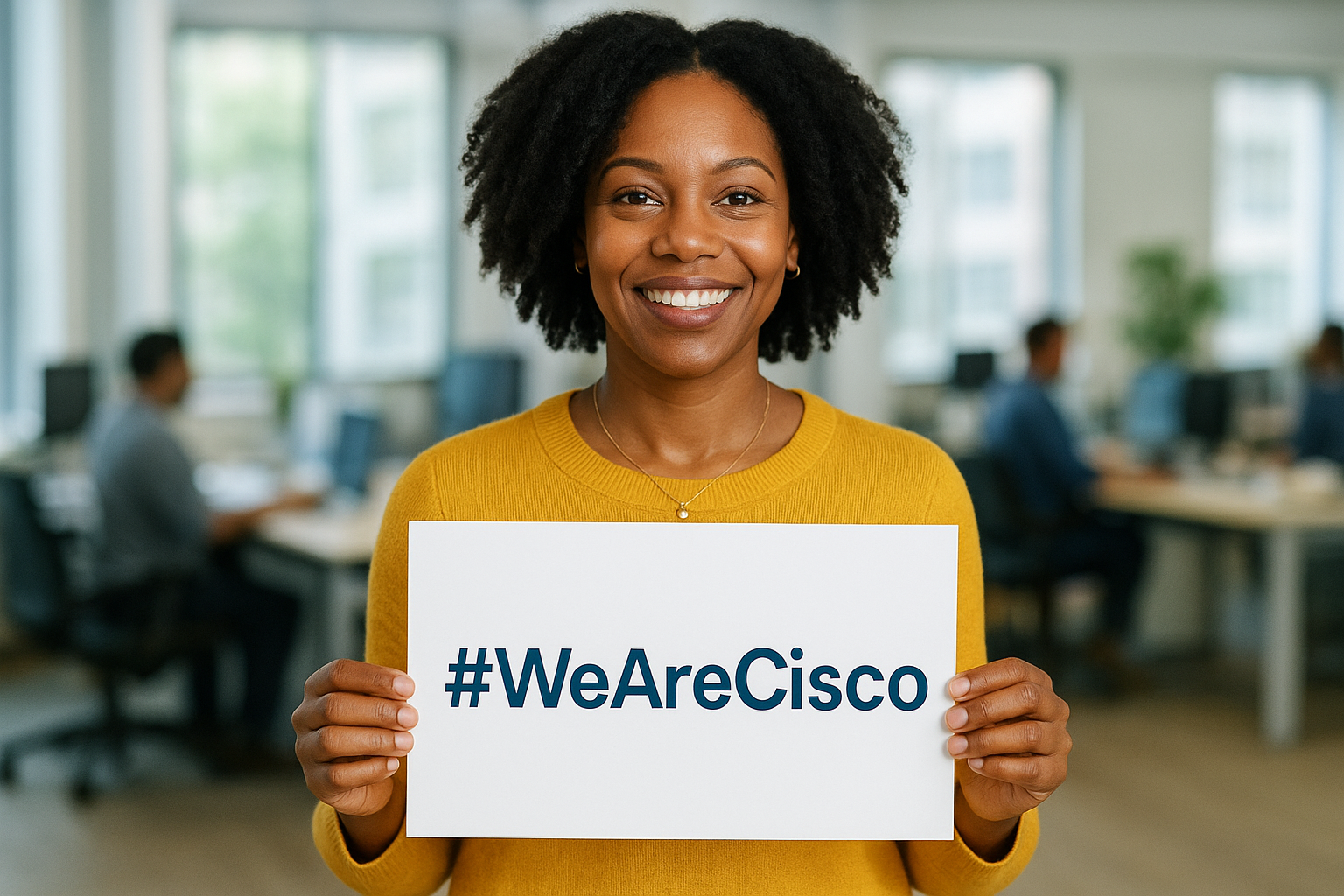
Cisco turned its employees into its main marketing channel through the #WeAreCisco campaign, a company-wide effort that puts real staff stories front and center instead of polished corporate messaging. The tech giant has topped Fortune’s “100 Best Companies to Work For” list multiple times, and it credits much of that reputation to letting employees speak in their own words rather than scripting every testimonial through a communications team. This grassroots approach makes Cisco one of the more studied employer branding examples because it proves authenticity scales even at a company with over 80,000 employees worldwide.
Signature branding strategy
Cisco’s core strategy is employee-generated storytelling built around a single unifying hashtag that any staff member can use. Rather than centralizing every piece of content through HR, the company trains and encourages employees across departments to post their own career stories, which multiplies the volume of authentic content without multiplying the marketing budget.
A hashtag only works as employer branding when employees actually want to use it without being told to.
Channels and content they use
Cisco keeps its content spread across channels employees already use daily:
- #WeAreCisco hashtag active across Instagram, LinkedIn, and Twitter/X, populated mostly by employees, not marketing
- Internal storytelling program that trains staff to write and film their own short career updates
- Diversity and inclusion microsites highlighting specific employee resource groups by name, not just in aggregate stats
Lesson you can apply
Agencies can borrow this by inviting satisfied candidates and placed hires to share their own placement story on LinkedIn, tagging your agency directly. Real, first-person accounts from people you’ve placed carry more weight with future candidates than any recruiter-written case study, and they cost almost nothing to collect.
7. LinkedIn
LinkedIn practices what it sells, and that’s the whole point of its employer brand. As the platform every other company on this list uses to recruit, LinkedIn faces extra scrutiny when it tells clients how to build a strong employer brand, so it treats its own careers presence as a live demo of the product. That self-referential pressure makes LinkedIn one of the more instructive employer branding examples, because you can watch the company apply its own advice in real time.
Signature branding strategy
LinkedIn’s core move is turning its own employees into product proof. Instead of separating marketing from recruiting, the company shows staff using LinkedIn features to build their own visibility, network, and career paths, which doubles as an implicit testimonial for the platform itself. This blurs the line between customer content and employer content on purpose.
If your product and your workplace tell the same story, candidates trust both more.
Channels and content they use
LinkedIn concentrates almost entirely on its own platform, with a few consistent formats:
- Employee-authored LinkedIn posts about internal projects, promotions, and lessons learned
- #LifeAtLinkedIn hashtag aggregating staff content into one searchable feed
- LinkedIn Learning courses built by internal experts, doubling as recruiting signals of expertise
Lesson you can apply
Recruiters can copy this by treating their own LinkedIn activity as recruiting collateral instead of an afterthought. Post about a placement that went well, explain what made the match work, and tag the candidate if they’re comfortable with it. Genuine posts from a recruiter who clearly knows their niche build more trust with future candidates than a polished company page ever will, and they cost you fifteen minutes, not a campaign budget.
8. Deloitte
Deloitte built its employer brand around career flexibility, betting that professionals stay longer when they can shape their own path instead of climbing a fixed ladder. The firm’s “Deloitte University” campus and its internal mobility programs let employees switch practice areas, industries, and even countries without leaving the company, which matters in professional services where burnout drives constant turnover. This focus on internal movement makes Deloitte a frequently cited name among employer branding examples, because it addresses the exact reason ambitious people quit: feeling stuck.
Signature branding strategy
Deloitte’s core move is reframing retention as flexibility rather than loyalty perks. Instead of promising long tenure, the firm markets the ability to reinvent your career every few years without changing employers, which appeals directly to candidates who fear getting boxed into one specialty too early.
Candidates stay longer when the pitch is freedom to change roles, not pressure to stay in one.
Channels and content they use
Deloitte spreads this message through a mix built for professionals researching long-term career paths:
- Deloitte University content hub showcasing training programs and leadership development in detail
- Alumni network communications, keeping former employees engaged as referral sources and boomerang hires
- Glassdoor and LinkedIn thought leadership posts from partners discussing internal career pivots by name
Lesson you can apply
Staffing recruiters can apply this by tracking and sharing what happens to candidates after placement, not just the placement itself. If a candidate you placed got promoted or switched teams within a client company, mention that pattern to future candidates considering similar roles. Showing a realistic path forward, not just the first job, gives candidates a reason to trust your pitch over a competing agency’s generic listing.
9. Spotify
Spotify built its employer brand around autonomy, structuring teams as independent “squads” that operate almost like small startups inside a larger company. Each squad picks its own tools, sets its own sprint pace, and answers directly to a mission rather than a rigid hierarchy, which gives candidates a concrete reason to believe the company’s talk about trust isn’t just recruiting copy. This model, often called the “Spotify Engineering Culture,” gets referenced constantly among employer branding examples because Spotify published the actual framework instead of keeping it internal.
Signature branding strategy
Spotify’s core move is open-sourcing its own management model. The company released detailed videos and documents explaining exactly how squads, tribes, and guilds function, turning an internal org chart into public recruiting material. Competitors and candidates alike study the model, which means Spotify gets recognized as an innovator every time another company references the framework.
Publishing how your teams actually work turns an internal process into free recruiting content.
Channels and content they use
Spotify keeps its message focused on a few high-impact formats:
- “Spotify Engineering Culture” videos, animated explainers that have been viewed and cited across the tech industry for years
- Life at Spotify blog, covering squad structure, remote work policy, and employee spotlights
- Work From Anywhere policy pages, detailing exactly how location flexibility works instead of leaving it vague
Lesson you can apply
Recruiters can borrow this by documenting how your own team actually works, not how it looks on an org chart. If your agency lets consultants choose their own client accounts or manage their own pipeline, explain that structure plainly to candidates considering a recruiting career with you. A specific workflow description signals autonomy far more convincingly than a job posting that just says “collaborative environment.”
What these employer brands have in common
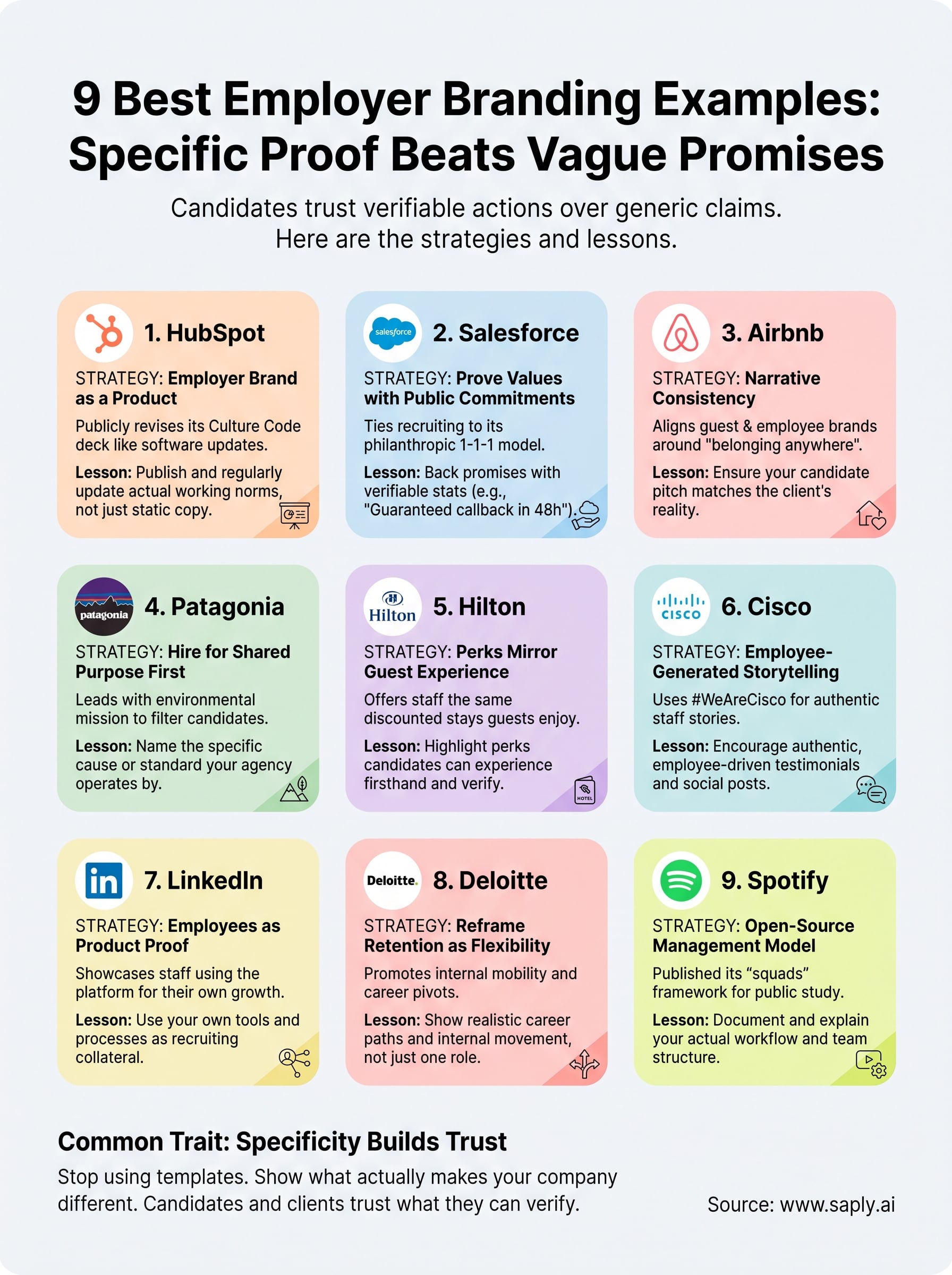
Every example here shares one trait: specific proof beats vague promises. HubSpot published its actual norms, Hilton let employees use the exact perk it sells, and Spotify open-sourced its own management model instead of describing it in adjectives. None of them relied on a slogan alone, and that’s the real lesson behind these employer branding examples. Candidates and clients trust what they can verify, not what sounds nice in a job posting.
Getting to that level of detail takes time most recruiters don’t have, especially when you’re formatting and tailoring CVs for every new role. That’s exactly the gap Saply closes. It turns raw candidate CVs into polished, job-matched documents inside the tools you already use, so you spend less time on formatting and more time building the kind of specific, trustworthy pitch these brands are known for. Try Saply’s free 14-day trial and see how much faster your submissions can move.