



Contingent Workforce Management Strategy: A Practical Guide
Non-permanent workers, freelancers, contractors, temps, and gig workers, now make up a significant share of the workforce at many organizations. Yet most companies still manage them through a patchwor...

Non-permanent workers, freelancers, contractors, temps, and gig workers, now make up a significant share of the workforce at many organizations. Yet most companies still manage them through a patchwork of spreadsheets, disconnected vendor relationships, and ad hoc hiring decisions. A well-defined contingent workforce management strategy changes that by giving organizations a structured framework for sourcing, engaging, and managing non-permanent talent. Without one, costs balloon, compliance risks multiply, and the speed advantage that contingent labor is supposed to provide disappears.
This guide breaks down what a contingent workforce management strategy actually involves, why it matters, and how to build one that works in practice. You’ll find concrete steps for aligning stakeholder interests, setting governance standards, selecting the right technology, and measuring performance, so your organization can use contingent talent as a genuine competitive lever rather than a reactive stopgap. For staffing agencies, the strategy conversation hits especially close to home: you’re the ones supplying these workers, formatting and tailoring CVs at volume, and racing to get candidates submitted before competitors do. That’s where tools like Saply fit into the picture, helping recruitment teams automate CV formatting and tailoring so they can keep up with the velocity a strong contingent workforce program demands.
Whether you’re an HR leader designing a program from scratch or a staffing firm looking to better serve enterprise clients, this guide gives you a practical, start-to-finish blueprint.
Why contingent workforce strategy matters in 2026
The contingent workforce has crossed a threshold where treating it as an afterthought carries measurable consequences. Workforce composition data from enterprises across sectors shows that contingent workers represent between 30 and 50 percent of total headcount at many large organizations, and the share keeps growing. Without a deliberate contingent workforce management strategy, you manage a significant portion of your human capital with no formal structure, which creates real financial and operational exposure.
Workforce composition has shifted permanently
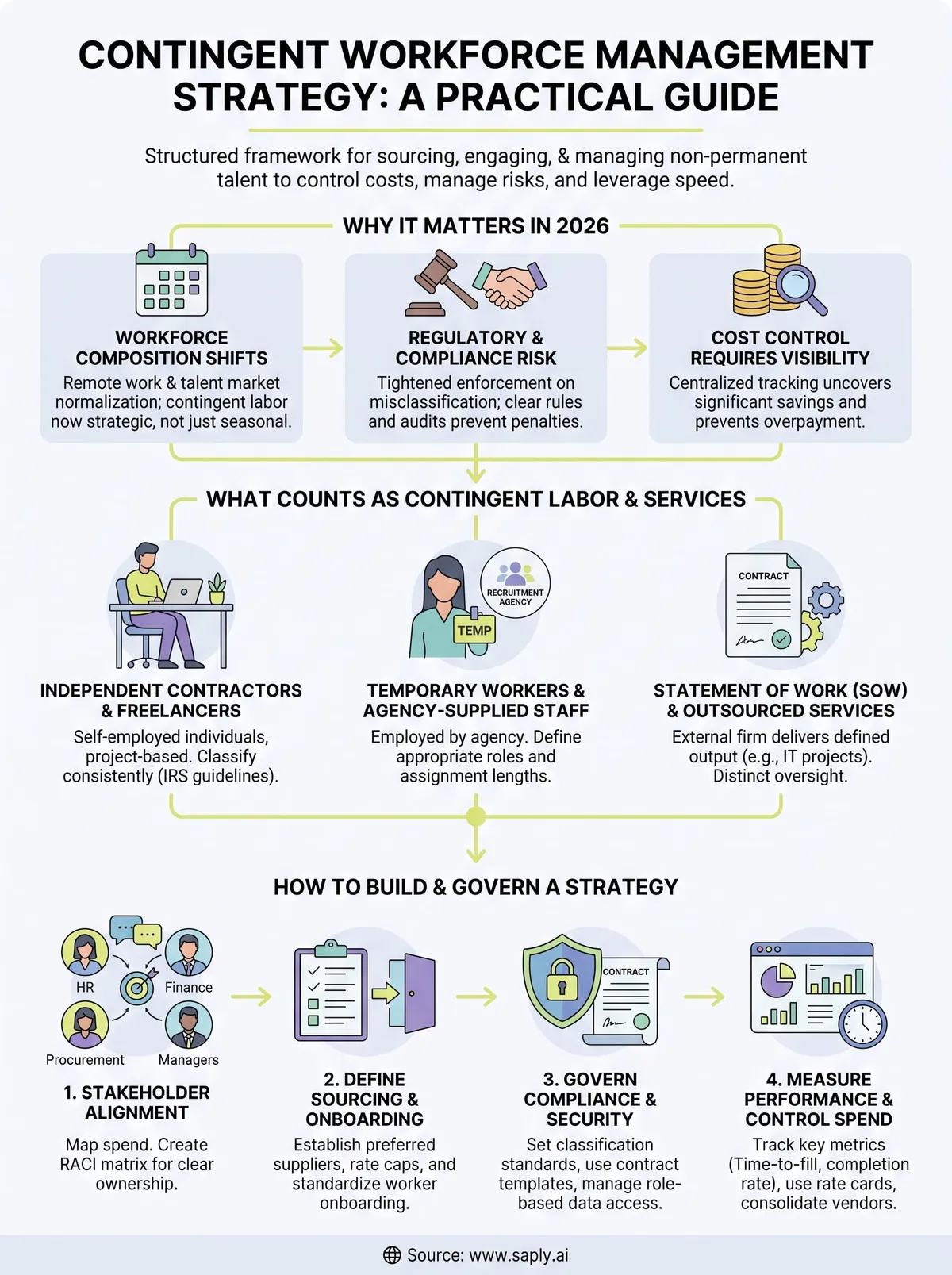
The days of contingent labor being a niche staffing solution are gone. Remote work normalization, combined with a global talent market, has made it far easier for skilled professionals to work as independent contractors rather than accept permanent roles. Organizations that once used temps purely for seasonal demand fluctuations now use contractors and freelancers to staff entire product lines and critical functions year-round.
A formal strategy gives you a repeatable system for finding, vetting, and deploying non-permanent workers rather than scrambling each time a need surfaces.
Your competitors are adapting to this shift by building deliberate programs around contingent talent. Organizations that do the same will attract better workers faster, while those that rely on ad hoc decisions will keep paying a coordination premium with nothing to show for it structurally.
Regulatory and compliance risk has grown
Misclassifying a worker as an independent contractor when they legally qualify as an employee is an increasingly costly mistake. Labor regulators in the US, UK, and EU have tightened enforcement in recent years, and penalties for misclassification include back taxes, fines, and significant legal exposure. Your contingent workforce strategy needs to include clear classification criteria, consistent contract standards, and regular compliance audits.
- Define classification rules based on control, integration, and financial dependence
- Standardize contract templates for each worker category
- Schedule quarterly audits to catch classification drift before regulators do
Cost control requires centralized visibility
Contingent labor spend is often fragmented across departments, with different managers engaging vendors and agencies independently and without coordination. That fragmentation makes it nearly impossible to negotiate volume pricing, track total spend, or identify redundant suppliers. Building a strategy forces you to centralize visibility first, and that step alone uncovers significant savings.
Organizations that consolidate oversight consistently discover they were significantly overpaying before they started tracking it systematically. Centralized visibility is not optional; it is the foundation that every other cost-control effort depends on.
What counts as contingent labor and services
Before you can build a contingent workforce management strategy, you need a shared definition of what falls inside its scope. Organizations often define this too narrowly, covering only temporary workers from staffing agencies while ignoring the freelancers, project-based contractors, and outsourced service providers that quietly accumulate across departments. A clear taxonomy prevents gaps in governance and gives every stakeholder the same starting point.
Independent contractors and freelancers
Independent contractors and freelancers are self-employed individuals who work on a project or retainer basis without an employment relationship with your organization. They set their own schedules, use their own tools, and typically work for multiple clients simultaneously. Your strategy needs to classify these workers consistently using IRS guidelines on behavioral control, financial control, and relationship type to avoid misclassification liability.
Getting classification right at the point of engagement is far easier than correcting it after a tax audit or worker complaint.
Temporary workers and agency-supplied staff
Temporary workers come through staffing agencies or recruitment firms and are employed by the agency rather than your organization directly. The agency handles payroll, benefits, and employer tax obligations. Your contingent workforce strategy should define which roles are appropriate for agency-supplied temp placements and set standards for how long those assignments can run before they trigger reclassification concerns.
Statement of work and outsourced services
Statement of work (SOW) engagements cover situations where you contract an external firm or vendor to deliver a defined output rather than supply individual workers. IT projects, marketing campaigns, and logistics support often fall into this category. These arrangements carry different compliance and cost-control requirements than individual worker engagements, so your strategy needs to treat them as a distinct labor category with their own oversight processes.
How to build a contingent workforce strategy
Building a strategy starts with understanding what you actually need from contingent labor before you write a single policy. Map your current contingent spend by department, worker type, and vendor to get a baseline picture. Without that baseline, any plan you create is built on assumptions rather than real data, and those assumptions will cost you.
Start with stakeholder alignment
HR, procurement, finance, and line managers all interact with contingent workers differently, and each group has competing priorities. HR focuses on compliance and worker experience, procurement focuses on vendor cost and contracts, and managers focus on speed and output. Your contingent workforce management strategy needs to bridge those interests with a shared governance model that assigns clear ownership of each decision point before hiring begins.

Getting alignment on roles and responsibilities upfront prevents the disputes that derail programs when a compliance issue or cost overrun surfaces later.
A simple RACI matrix that maps each stakeholder to sourcing, classification, contract approval, and performance review decisions is enough to start. Clear accountability reduces delays and prevents duplicate effort across teams.
Define your sourcing and onboarding model
Once stakeholders are aligned, establish a preferred supplier list that defines which agencies and platforms you use for each worker category. Tie each supplier to specific roles, rate caps, and contract terms. Your onboarding process should also standardize every step a contingent worker goes through, from background checks and system access to role briefings, so managers do not make ad hoc decisions that create compliance gaps down the line.
How to govern compliance, risk, and security
Governance is the part of a contingent workforce management strategy that most organizations delay until a problem forces their hand. That is a costly approach. Setting clear compliance and security rules before you scale your contingent program is far cheaper than correcting violations, resolving disputes, or recovering from a data breach after the fact.
Establish classification and contract standards
Worker misclassification sits at the center of most contingent workforce compliance failures. The IRS Common Law Rules provide three criteria for determining worker status: behavioral control, financial control, and the type of relationship. Apply those criteria consistently at the point of engagement, not after the fact. Use standardized contract templates for each worker category, with clear terms around deliverables, payment structure, and termination conditions.
Reviewing classification decisions on a quarterly basis prevents gradual drift, where a contractor’s day-to-day role quietly starts to resemble an employee’s without anyone catching it.
Build a simple review checklist your managers complete before any new contingent engagement starts. That checkpoint alone eliminates most misclassification risk before it accumulates.
Manage data access and security exposure
Contingent workers often receive system access that is broader than their role requires, and that access frequently persists after their assignment ends. Your governance model should define role-based access levels for each contingent worker category and require a formal offboarding step that revokes credentials the day an assignment closes.
Tracking access grants in a central log gives you a clear audit trail and reduces exposure if a security incident occurs. Treat contingent worker access with the same rigor you apply to permanent employees.
How to measure performance and control spend
Measurement turns your contingent workforce management strategy from a policy document into a living program. Without tracking outcomes, you have no way to know whether your sourcing decisions are working, your vendors are performing, or your costs are drifting upward. Establish your core metrics before you start scaling, because retrofitting measurement onto an existing program is significantly harder than building it in from the beginning.
Track the metrics that reflect real program health
Most organizations track total contingent spend but stop there, which misses most of what matters. Supplement spend data with metrics that tell you whether the program is actually delivering value:
- Time-to-fill by worker category and supplier
- Assignment completion rate, meaning the percentage of engagements that reach their planned end date
- Cost per engagement compared to your internal rate benchmarks
- Compliance audit pass rate across classification reviews
Tracking time-to-fill by supplier quickly reveals which agencies consistently deliver and which ones slow your hiring down despite competitive rates.
Review these metrics on a monthly cadence with procurement and HR together, not separately, so decisions reflect the full picture.
Control spend through rate cards and vendor consolidation
Rate cards set the ceiling for what you pay by worker type, skill level, and geography, and they give your procurement team a non-negotiable anchor in every supplier conversation. Consolidating to a preferred vendor list reduces fragmentation, unlocks volume pricing, and gives you the leverage to hold suppliers accountable to performance standards. Fewer vendors managed well outperforms many vendors managed inconsistently every time.
Next steps
A strong contingent workforce management strategy does not require a complete overhaul of how your organization operates. Start with the baseline: map your current spend by worker type and department, identify your top three compliance gaps, and get HR, procurement, and finance aligned on a shared governance model. Those three steps alone will put you ahead of most organizations still managing contingent labor reactively.
From there, build out your rate cards, consolidate your vendor list, and set up a monthly review cadence that tracks time-to-fill, cost per engagement, and compliance audit results. Progress compounds quickly once you have visibility and accountability in place.
For staffing agencies supplying contingent workers into these programs, submission speed is a direct competitive advantage. The faster your team formats and tailors CVs to specific roles, the more placements you win. See how Saply helps recruitment teams cut CV prep time and keep pace with high-volume contingent programs.