



Contingent Workforce Risk Management: Risks, Controls, KPIs
Every contractor, freelancer, or temp worker your agency places carries risk. Misclassification penalties, compliance gaps, co-employment disputes, these aren't abstract legal concepts. They're the ki...

Every contractor, freelancer, or temp worker your agency places carries risk. Misclassification penalties, compliance gaps, co-employment disputes, these aren’t abstract legal concepts. They’re the kind of problems that shut staffing firms down. Contingent workforce risk management is the discipline of identifying those risks before they become liabilities, and building repeatable controls to keep your operations clean. If your agency places non-permanent workers at scale, this matters more than almost anything else on your priority list.
The challenge is that risk doesn’t sit in one place. It spans legal classifications, onboarding documentation, client contracts, and even how you represent candidates during the submission process. A CV that overstates qualifications or misaligns a candidate’s experience with a role’s actual requirements can create downstream compliance headaches, one reason tools like Saply exist, helping staffing teams format and tailor CVs accurately to match specific job descriptions and reduce misrepresentation risk at the point of submission.
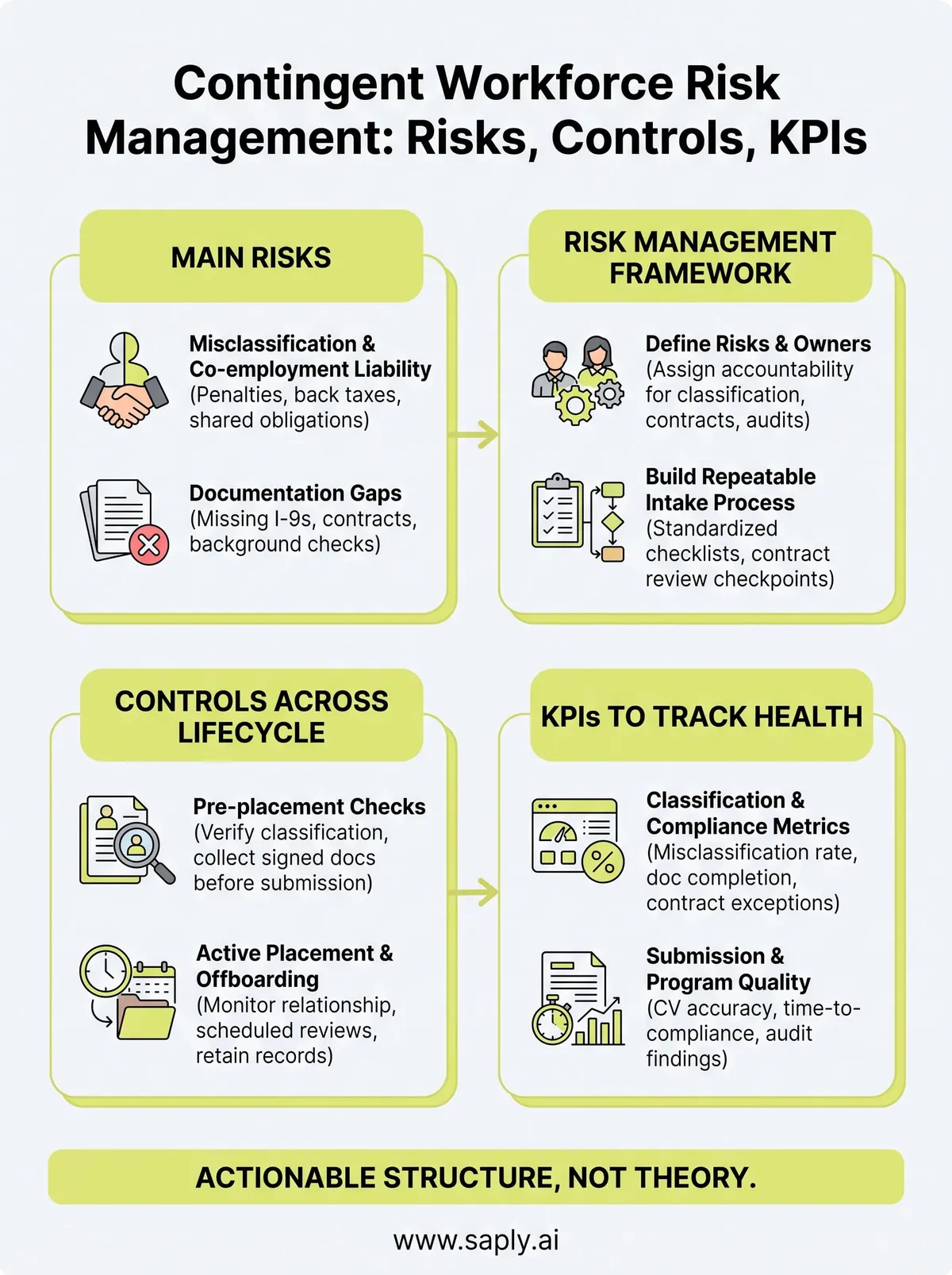
This guide breaks down the core risk categories tied to contingent workforce management, walks through practical controls you can implement, and identifies the KPIs worth tracking. Whether you’re building a risk framework from scratch or tightening an existing one, you’ll find actionable structure here, not theory.
Why contingent workforce risk management matters
The contingent workforce has grown significantly over the last decade. More companies rely on contractors, temps, and freelancers to fill critical gaps quickly, and staffing agencies are the engine placing those workers. But every placement your agency makes is also a legal and financial exposure point. Without a structured approach to contingent workforce risk management, you’re operating reactively, addressing problems only after they’ve already cost you money and credibility.
Penalties for worker misclassification can stack across the IRS, the Department of Labor, and state agencies simultaneously, meaning a single classification error can trigger multiple enforcement actions at once.
The scale of contingent work raises the stakes
The numbers behind contingent work aren’t small. According to the U.S. Bureau of Labor Statistics, alternative work arrangements account for a meaningful share of total employment. When your agency places workers at volume, even a single misclassified contractor can trigger back taxes, benefit liability, and legal fees that far exceed the revenue you earned on that placement. Your exposure grows in direct proportion to your placement volume.
Clients are raising expectations too. Many enterprise clients now require staffing vendors to demonstrate documented compliance controls before they’ll sign a master services agreement. Your risk posture directly affects your ability to win and keep business, not just your ability to avoid fines.
Regulatory pressure keeps increasing
Federal and state agencies have intensified enforcement around worker classification and labor standards. The IRS, the Department of Labor, and state regulators all carry overlapping jurisdiction. A single misclassification can draw scrutiny from several directions at once. Staying ahead of that requires a repeatable compliance framework your full team understands and follows, not just a policy document that sits in a shared drive.
The main risks you need to control
Contingent workforce risk management involves four risk categories that staffing agencies consistently encounter. Each one can generate financial penalties, client relationship damage, or both. Understanding where your exposure actually sits is the first step toward building controls that work.
Worker misclassification and co-employment liability
Misclassifying a contractor as an independent worker when they legally qualify as an employee is the most common and costly risk staffing agencies face. The IRS and Department of Labor both enforce classification rules, and penalties can include back taxes, unpaid benefits, and fines that accumulate per worker.
Co-employment liability adds another layer: if your client exercises too much direct control over a worker you placed, both you and the client may share employer obligations.
Documentation gaps during onboarding compound these risks. Missing I-9 forms, unsigned contracts, or incomplete background checks create compliance exposure that regulators can exploit during an audit. Your agency needs airtight documentation standards at every stage of the worker lifecycle, starting before a contractor sets foot on a client site.
How to set up a risk management framework
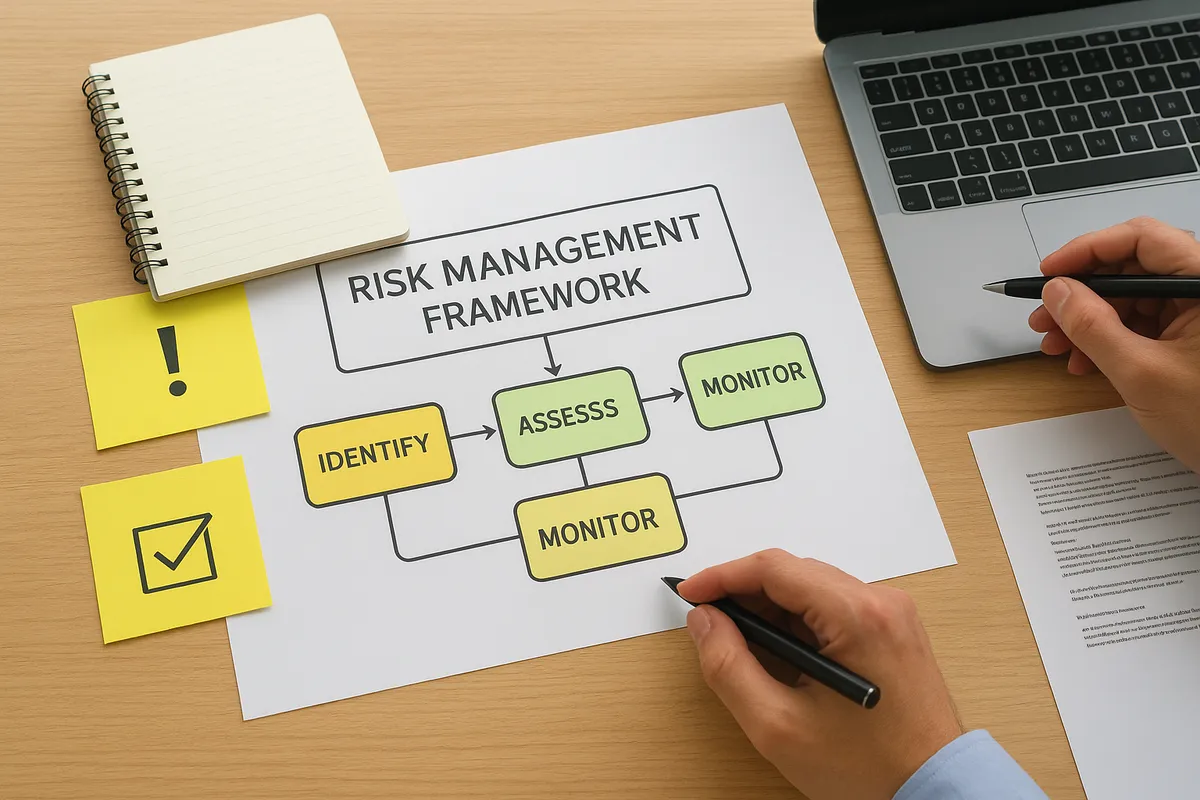
A risk management framework gives your agency a structured way to identify, assess, and respond to exposure points before they become liabilities. Without one, contingent workforce risk management becomes reactive rather than preventive. Start by mapping every stage where a contingent worker touches your agency, from first contact through offboarding, and note where compliance failures are most likely to occur in your current process.
Define your risk categories and owners
Assign ownership to each risk category before you build any controls. Clear accountability is what keeps compliance from falling through the cracks when placement volume increases. At a minimum, assign owners for:
- Worker classification reviews
- Contract and MSA compliance
- Onboarding documentation audits
Without named owners for each risk area, accountability disperses and controls break down fast.
Build a repeatable intake and review process
Your intake process needs standardized checklists that every recruiter follows before a candidate reaches a client. Include classification criteria, required documents, and a contract review checkpoint at minimum.
Consistency across your team’s workflow is what turns a framework into an operational habit. When your pipeline gets busy, that standardized process is what keeps compliance from slipping.
Controls across the worker lifecycle
Effective contingent workforce risk management requires controls at every stage, not just at onboarding. Each phase of the worker lifecycle carries its own exposure points, and a gap at any stage can undermine the controls you’ve built everywhere else.
Pre-placement checks
Before a candidate reaches a client, verify classification criteria and collect all required documentation: signed contracts, background check results, and any role-specific certifications. Build a standardized checklist your recruiters complete for every placement before submission, not after. Missing paperwork at this stage creates compliance exposure that regulators can exploit during an audit.
A single missing document at pre-placement can create liability that outlasts the entire engagement.
Active placement and offboarding
Monitor the working relationship between your placed worker and the client throughout the engagement to catch co-employment risk before it escalates. Scheduled check-ins and contract renewal reviews keep your team aware of changes in real time.
When the placement ends, collect signed offboarding documentation and confirm client system access is revoked. Retain all worker records per IRS and Department of Labor guidelines. Proper record retention protects your agency during audits and signals the compliance standards clients now expect.
KPIs to track risk and program health
Tracking the right metrics turns contingent workforce risk management from a policy exercise into a measurable program. Without data, you won’t know where your controls are holding and where they’re breaking down under placement volume.

What you measure consistently is what your team actually manages.
Classification and compliance metrics
Start with the metrics that reflect your legal exposure directly. These numbers tell you how clean your operations are before a regulator asks the same question.
| KPI | What it signals |
|---|---|
| Misclassification incident rate | How often placements require reclassification after review |
| Onboarding documentation completion rate | Whether intake controls are holding across your team |
| Contract exception rate | How frequently standard terms get altered under client pressure |
Submission and program quality indicators
Beyond compliance, track submission-level data that reveals where risk enters your pipeline early. Your CV accuracy rate, meaning how often a submitted candidate’s documented experience actually matches the role requirements, is one indicator that flags misrepresentation risk before a placement is made. Also monitor time-to-compliance completion per placement and audit finding frequency per quarter. These metrics give leadership a real picture of program health and highlight where your team needs additional process support.
What to do next
Contingent workforce risk management is not a one-time project. It’s a repeatable system you build, measure, and tighten over time as your agency grows and regulations shift. Start by auditing your current intake process against the controls outlined here. Identify the two or three gaps that create the most exposure right now, whether that’s incomplete onboarding documentation, inconsistent classification reviews, or missing offboarding records, and close those first before expanding your framework.
From there, assign ownership to each risk category, implement the KPIs that match your current volume, and schedule a quarterly review so your program stays calibrated. Small, consistent improvements compound fast when your whole team follows the same process. One area worth reviewing early is your submission workflow. Candidates who reach clients with inaccurate or misaligned CVs create downstream risk before the engagement even starts. Saply’s AI-powered CV formatting and tailoring tools help your team submit candidates with accuracy and confidence, reducing misrepresentation risk at the source.