
future-of-staffing-agencies
Future Of Staffing Agencies: 9 Trends For 2026 And Beyond
The staffing industry is shifting under recruiters' feet. Economic uncertainty, evolving client expectations, and rapid AI adoption are reshaping the future of staffing agencies in ways that demand at...
Written by: Saply Team
Future Of Staffing Agencies: 9 Trends For 2026 And Beyond
The staffing industry is shifting under recruiters’ feet. Economic uncertainty, evolving client expectations, and rapid AI adoption are reshaping the future of staffing agencies in ways that demand attention right now. Firms that recognize these shifts early will gain a serious competitive edge, those that don’t risk falling behind.
What’s driving the change? Clients want faster submissions, better-matched candidates, and leaner processes. Recruiters are drowning in manual work like CV formatting and tailoring, tasks that eat hours but add little strategic value. That’s exactly why we built Saply, an AI-powered plugin that handles CV formatting, tailoring, and job matching directly inside the tools recruiters already use. It’s one example of how automation is becoming table stakes, not a nice-to-have.
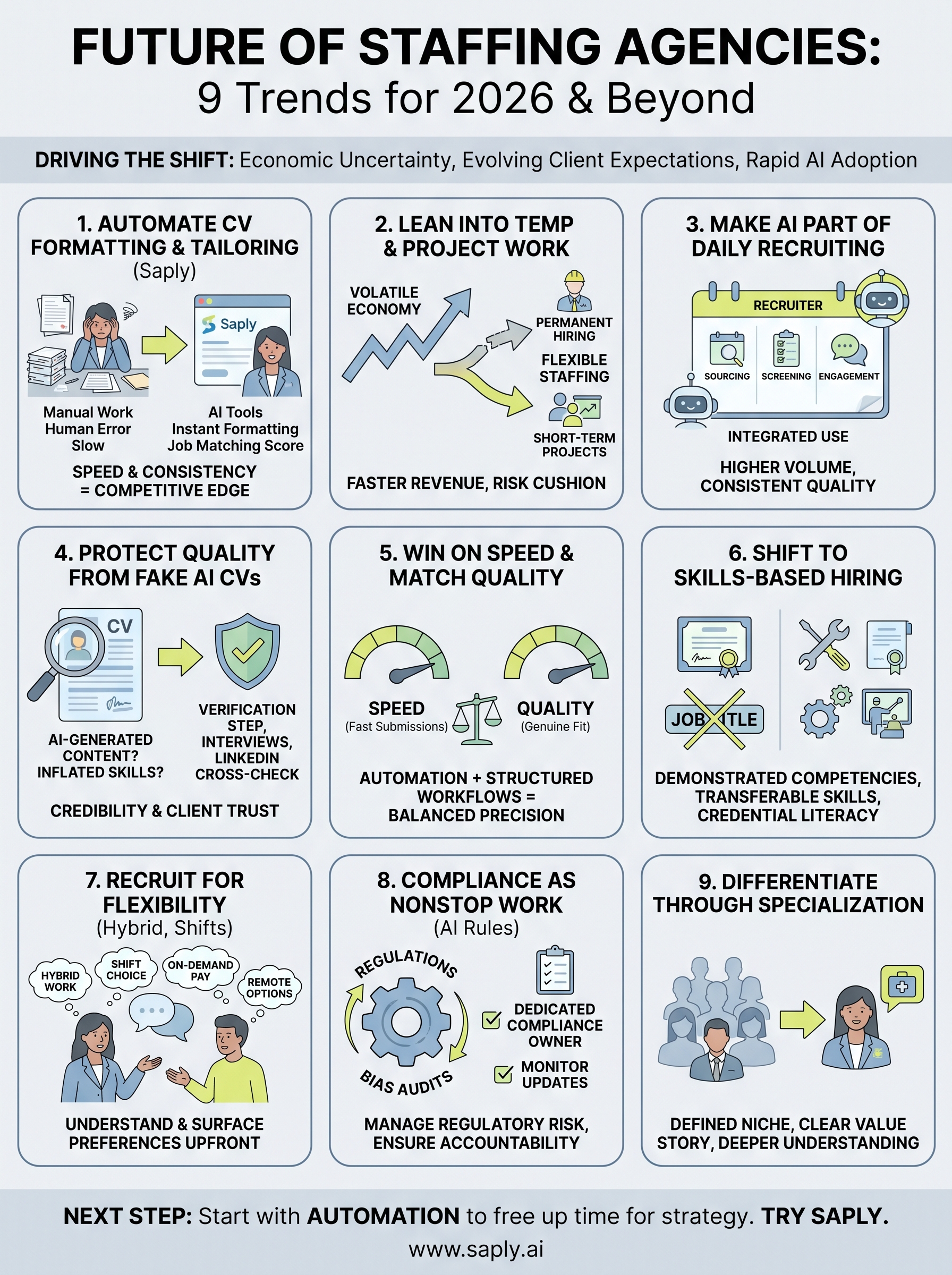
This article breaks down nine trends shaping staffing agencies in 2026 and beyond, from AI and automation to workforce shifts and new revenue models. Each one points to where the industry is headed and what your agency can do to stay ahead.
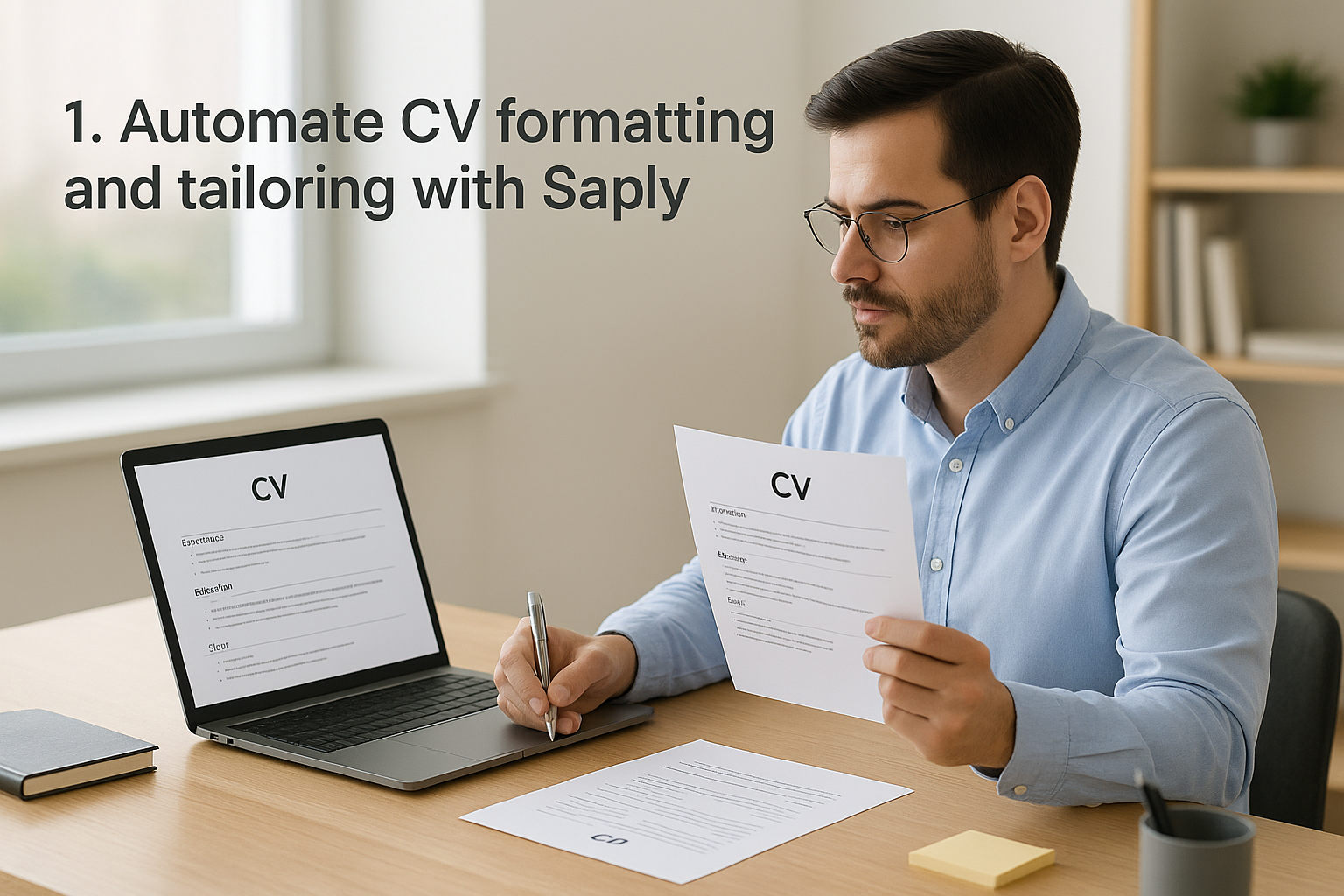
1. Automate CV formatting and tailoring with Saply
CV formatting and tailoring has always been one of the most time-consuming tasks in a recruiter’s workflow. In 2026, the trend is clear: agencies that automate this process are outpacing those that still do it by hand, and the gap keeps growing.
What the trend looks like
Recruiters used to spend hours per week copy-pasting candidate information, adjusting layouts, and rewriting bullet points to match job descriptions. Today, AI tools handle all of that in seconds. Platforms like Saply plug directly into Microsoft Word, Google Docs, Outlook, and major ATS systems like Bullhorn and Carerix, so there is no new software to learn. You apply your agency’s template, tailor the CV to the role, and get a match score before you even hit send.
The future of staffing agencies belongs to teams that eliminate repetitive admin work and redirect that time toward relationships and strategy.
Why it matters for agencies
Speed is a direct competitive advantage in staffing. When two agencies submit to the same client, the one that arrives first with a well-matched candidate wins the placement. Manual CV work slows that cycle at every step. Automating formatting and tailoring removes the bottleneck without sacrificing quality, and it scales with your team’s volume so busy periods do not create a backlog.
Beyond speed, automation reduces human error and inconsistency in how CVs get presented. Every candidate goes out in your agency’s template with the relevant experience highlighted for that specific role, which builds client trust over time.
What to do next
Start by identifying how many hours per week your team currently spends formatting and tailoring CVs. Then test Saply’s 14-day free trial, no credit card required, to measure the time saved on your actual workload. Map the integration with your existing ATS or document tools so the new workflow fits without disruption.
KPIs to track
Measuring the impact of CV automation requires the right benchmarks. Track these metrics before and after you implement automation to see real productivity gains and identify where further process improvements are possible:
- Average time per CV submission before and after automation
- Submission volume per recruiter per week
- Client feedback scores on CV quality and relevance
- Time-to-submit from candidate intake to client delivery
2. Lean into temp and project work in a choppy economy
When economic conditions turn unpredictable, companies pause permanent hiring and shift toward flexible staffing arrangements instead. That pattern is driving one of the most significant changes in the future of staffing agencies: a sustained rise in demand for temp and project-based placements.
What the trend looks like
Businesses are increasingly filling critical roles with contract workers and project specialists rather than committing to full-time headcount. This covers everything from short-term production surges to multi-month project teams hired for specific deliverables. Clients want the option to scale up or down quickly without the risk attached to permanent employment costs.
Agencies that build a strong temp and contract book create predictable recurring revenue that cushions them against the volatility of permanent placement cycles.
Why it matters for agencies
Temp and contract placements generate faster revenue cycles and spread risk across a broader client and candidate base. If a client freezes permanent hiring, your agency still has an active relationship and a way to deliver value. Diversifying your placement mix between permanent and flexible roles protects your business when one segment slows.
What to do next
Audit your current placement split between permanent and flexible contract roles. If temp and project work accounts for less than 30% of your revenue, start building that pipeline deliberately. Develop a roster of candidates who specifically want flexible or short-term work so you can respond to client requests without long lead times.
KPIs to track
- Ratio of temp to permanent placements by quarter
- Fill rate on short-notice contract requests
- Average contract length and renewal rate
- Revenue from flexible placements as a percentage of total billings
3. Make AI part of daily recruiting, not a side tool
The future of staffing agencies depends on more than adopting AI for one or two tasks. Recruiters who use AI selectively miss most of the benefit. Consistent, integrated use across sourcing, screening, and communication is what separates high-output teams from everyone else.
What the trend looks like
AI tools are moving from experimental add-ons to core parts of the recruiting workflow. Agencies now use AI for candidate sourcing, screening, engagement follow-ups, and reporting. Daily users of AI tools are processing significantly more candidates than those relying on manual processes, and clients notice the difference in both speed and quality.
Adoption is also spreading beyond early adopters. Mid-size staffing firms are standardizing AI use across entire teams rather than leaving it to individual recruiters, which creates more consistent output at scale.
Why it matters for agencies
When AI stays on the sidelines, your team produces inconsistent results. Some recruiters use it regularly, others avoid it, and quality and speed vary across every submission. Building AI into standard daily workflows removes that inconsistency.
Agencies that treat AI as a daily work tool rather than an optional extra will consistently outperform those that don’t.
What to do next
Audit which AI tools your team currently uses and how often. Then identify the two or three highest-volume daily tasks where AI saves the most time and build those tools into your standard process. Add brief team training sessions to reduce friction and build consistent habits before introducing anything new.
KPIs to track
Track these metrics to measure how well AI is embedded in your team’s daily work:
- AI tool adoption rate across your recruiting team
- Tasks completed per recruiter per day
- Time saved per week across sourcing, screening, and admin
- Candidate pipeline throughput month over month
4. Protect quality as fake and AI-written CVs surge
Fake CVs have always existed, but AI-generated content has made it dramatically easier to produce polished, convincing resumes that misrepresent a candidate’s actual experience and skills. Your screening process needs to account for this now.

What the trend looks like
Recruiters are seeing a growing volume of CVs where skills, job titles, and even employment dates appear inflated or entirely fabricated. AI tools let candidates generate highly formatted, keyword-rich resumes in minutes, which means a CV that looks strong on paper may not reflect the person behind it. The future of staffing agencies depends on building screening processes that catch these discrepancies before they reach your clients.
Submitting a candidate who misrepresented their background is one of the fastest ways to damage a client relationship you spent months building.
Why it matters for agencies
A single bad placement costs your agency credibility far beyond the placement fee. Clients remember when a candidate falls short of what the CV promised, and they take that to the next agency conversation. Verification and quality control are now a competitive differentiator, not just a compliance checkbox.
What to do next
Add a structured verification step into your intake process. Ask candidates to walk you through specific projects or responsibilities verbally. Cross-check employment dates and job titles against LinkedIn profiles and reference calls before the CV goes anywhere near a client.
KPIs to track
- Verification pass rate on new candidate intakes
- Placement fallthrough rate tied to candidate misrepresentation
- Client satisfaction scores per submitted candidate
- Average screening time per candidate
5. Win on speed to submit without tanking match quality
Speed and quality feel like they pull in opposite directions, but the future of staffing agencies requires you to deliver both at once. Clients expect fast submissions, and they also expect every candidate to be a genuine fit for the role.
What the trend looks like
Recruiting teams are under pressure to submit candidates faster than ever, sometimes within hours of a job order coming in. At the same time, clients are getting more selective. They do not want a stack of CVs to sort through; they want two or three strong matches they can move forward with immediately. The agencies winning this game are using structured workflows and automation to cut time on admin without cutting corners on candidate relevance.
Speed without match quality is not a competitive advantage. It is just a faster way to frustrate your clients.
Why it matters for agencies
Every hour your team spends manually formatting and tailoring CVs is an hour a competitor could use to get in front of your client first. But sending misaligned candidates to hit a faster submission time costs you the client relationship over the long run. Balancing throughput with precision is what separates agencies with strong repeat business from those constantly chasing new clients.
What to do next
Build a submission checklist that takes under five minutes to complete and confirms role alignment before anything goes to a client. Use tools that score CV-to-job match quality automatically so you get speed and accuracy without adding extra review steps.
KPIs to track
- Time from job order to first submission
- Submission-to-interview conversion rate
- Client reuse rate per recruiter
- Average CVs submitted per placement
6. Shift to skills-based hiring and credential literacy
The hiring conversation is moving away from job titles and degree requirements toward what a candidate can actually do. For the future of staffing agencies, this shift means your team needs to understand and communicate skills with far more precision than before.
What the trend looks like
Employers are dropping rigid degree requirements and focusing instead on demonstrated competencies and transferable skills. A candidate without a four-year degree but with hands-on experience in a specific tool or process is increasingly more attractive than a credentialed candidate who lacks that direct ability. LinkedIn’s research consistently shows that skills-based job postings are growing year over year across nearly every sector.
Agencies that can translate a candidate’s actual capabilities into language that matches client needs will win more placements than those still leaning on credentials alone.
Why it matters for agencies
When clients define roles by skills rather than titles or degrees, your screening criteria and intake questions need to match. If your team is still filtering candidates by educational background first, you are eliminating strong matches before the conversation even starts. Building credential literacy across your recruiting team means everyone can assess what a candidate knows and can do, not just what their CV says they studied.
What to do next
Rewrite your candidate intake templates to capture specific skills, tools, and demonstrated outputs rather than just job titles and tenure. Train your team to ask targeted questions that surface real competency during screening calls.
KPIs to track
- Skills match rate between submitted candidates and job requirements
- Placement success rate for candidates without traditional degree credentials
- Client acceptance rate on skills-based candidate profiles
- Screening time per candidate after intake template updates
7. Recruit for flexibility: hybrid, shifts, and pay options
Candidates are choosing employers based on how work is structured, not just what the work pays. Understanding what workers actually want from a role is becoming a core recruiting skill, and the future of staffing agencies runs through this shift.

What the trend looks like
Flexible work goes beyond remote options now. Candidates are asking about shift choices, compressed schedules, on-demand pay access, and hybrid arrangements before they even discuss compensation packages. Employers who offer these structures attract more applicants and retain workers longer, which means your agency needs to surface this information upfront when pitching roles to candidates.
Agencies that collect and communicate flexibility details alongside salary data will consistently attract stronger candidate interest than those posting bare-bones job summaries.
Why it matters for agencies
When you match candidates to roles that align with their scheduling needs and pay preferences, you reduce early dropouts and fallthrough placements. A candidate who accepts a role that does not fit their life pulls out within weeks, which costs your agency the fee and the client relationship. Qualifying candidates on flexibility requirements early in the screening process protects your placement success rate.
What to do next
Add specific flexibility questions to your intake process: preferred schedule structure, commute tolerance, interest in on-demand pay, and remote work expectations. Share that information with clients when presenting candidates so both sides are aligned before an offer goes out.
KPIs to track
- Candidate dropout rate before placement start date
- Placement retention rate at 30, 60, and 90 days
- Fill rate on roles with flexible arrangements versus standard roles
- Candidate satisfaction score at intake and post-placement
8. Treat AI hiring rules and labor compliance as nonstop work
Regulations governing AI in hiring and labor compliance are not settling into a stable state. New rules are appearing at the city, state, and federal level on a rolling basis, and agencies that treat compliance as a one-time audit will get caught off guard.
What the trend looks like
Governments are moving fast to regulate how AI tools are used in candidate screening, ranking, and selection. New York City’s Local Law 144 was an early example, requiring bias audits for automated employment decision tools. More jurisdictions are following with disclosure requirements and algorithmic accountability rules that apply directly to staffing firms and their clients. The future of staffing agencies includes managing this compliance layer as an ongoing operational responsibility.
Agencies that stay ahead of AI hiring regulations protect their clients and their own liability exposure at the same time.
Why it matters for agencies
Your agency sits between the employer and the candidate, which means regulatory risk lands on both sides of your relationship. If you use AI tools in your screening process and those tools face a compliance challenge, you need to demonstrate that your process meets current requirements. Clients increasingly ask agencies to confirm compliance as part of the vendor relationship.
What to do next
Assign a dedicated compliance owner on your team who monitors regulatory updates across the states and cities where you place workers. Review your AI tool vendors’ bias audit documentation and update your intake disclosures when new rules apply.
KPIs to track
- Compliance review frequency per quarter
- Vendor audit documentation currency rate
- Client compliance inquiries resolved within 48 hours
- Staff training completion rate on updated hiring regulations
9. Differentiate through specialization and a clearer value story
Generalist staffing agencies are competing on price by default, and that is a race nobody wins long-term. The future of staffing agencies that grow consistently belongs to firms with a defined niche and a clear story about why they are the right partner for a specific type of client or candidate.
What the trend looks like
Clients are moving their business toward agencies that deeply understand their industry, its terminology, its hiring cycles, and the specific skills that separate good candidates from great ones. Agencies focused on sectors like healthcare technology, skilled trades, or financial services are winning larger retainers and longer relationships than broad generalists competing across every vertical.
Specialization is not a limitation. It is the clearest signal to a client that you understand their world.
Why it matters for agencies
When you position your agency around a specific sector, your candidate quality improves because your screening criteria match what clients actually need. Your sales conversations become shorter because clients do not need to educate you on the basics of their roles. Referrals also increase because a specialized agency is easier for a satisfied client to recommend to peers in the same industry.
What to do next
Audit your current placement history by sector and identify where your success rate is highest. Build your outbound messaging, website copy, and candidate intake process around that vertical rather than presenting your agency as capable of everything.
KPIs to track
- Revenue concentration by sector per quarter
- Client retention rate within your target vertical
- Placement success rate compared to your generalist baseline
- Inbound referral rate from existing clients
Next steps for agency leaders
The nine trends above map out a clear direction for the future of staffing agencies. Acting on all of them at once is not realistic, so start by identifying where your agency loses the most time and where client relationships feel most at risk. Those two pressure points tell you where to focus first.
Automation is the fastest lever most teams can pull. Every hour your recruiters spend reformatting CVs or manually tailoring content to job descriptions is an hour not spent on relationships, strategy, or new business. Reducing that admin load directly increases your submission speed and placement volume without adding headcount.
If you want to see what that looks like in practice, start your free trial with Saply and measure the time your team saves in the first two weeks. No credit card required, and your custom template can be live within 48 hours.