
high-volume-recruiting-strategies
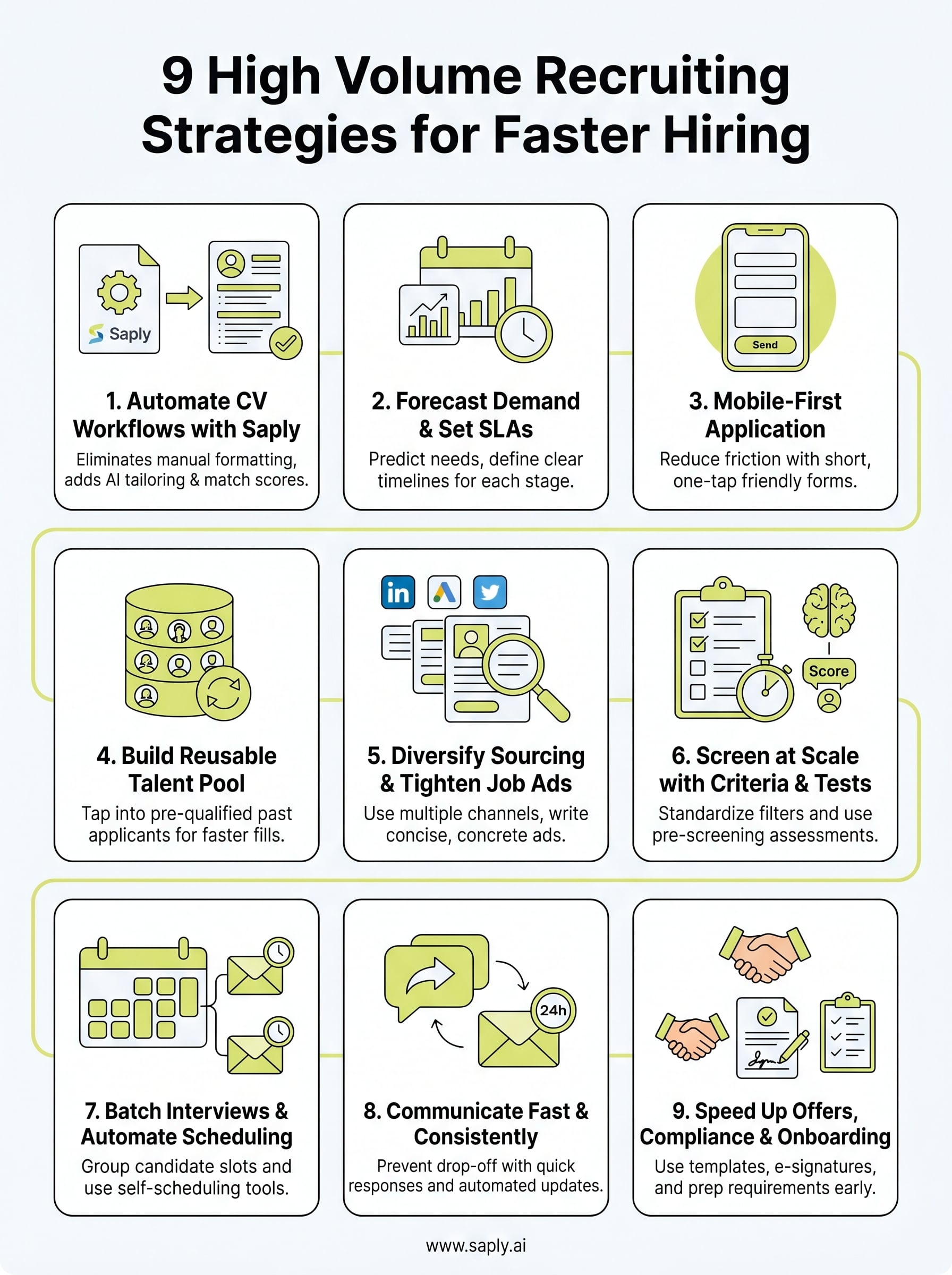
9 High Volume Recruiting Strategies For Faster Hiring
When a client drops 50 open roles on your desk with a two-week deadline, your usual workflow breaks down. Sourcing, screening, formatting, and submitting candidates at that scale requires a fundamenta...
Written by: Saply Team
9 High Volume Recruiting Strategies For Faster Hiring
When a client drops 50 open roles on your desk with a two-week deadline, your usual workflow breaks down. Sourcing, screening, formatting, and submitting candidates at that scale requires a fundamentally different approach. That’s where high volume recruiting strategies come in, they give staffing teams a repeatable system for filling large numbers of positions without sacrificing candidate quality or burning out your recruiters.
The biggest bottleneck in high volume hiring isn’t finding candidates. Most staffing agencies already have access to deep talent pools. The real problem is processing speed: getting CVs formatted, tailored to job descriptions, matched to roles, and submitted to clients before a competitor does. Every manual step, reformatting a resume, rewriting a summary, cross-checking qualifications, adds up fast when you’re doing it hundreds of times a week.
This guide breaks down nine proven strategies that staffing agencies and recruitment firms use to hire faster at scale. From smarter screening workflows to automating CV preparation with tools like Saply, each strategy focuses on cutting the busywork out of your process so your team can spend less time on admin and more time placing candidates.
1. Automate CV workflows with Saply
CV preparation is one of the biggest time drains in high volume recruiting strategies. A single recruiter can spend two to three hours a day just reformatting CVs, rewriting summaries, and aligning content to templates before a single submission goes out.
What it solves
Saply eliminates the manual back-and-forth of CV formatting and tailoring by working directly inside the tools you already use: Microsoft Word, Google Docs, and Outlook. Instead of copy-pasting content between applications, you apply your agency’s branded template with one click, let the AI tailor the CV to the job description, and get a match score with risk assessment before you pitch the candidate to a client.
When your team stops formatting CVs by hand, they can process significantly more submissions per day without adding headcount.
How to implement it
Start by connecting Saply to your existing ATS, whether that’s Bullhorn, Carerix, or Spott. Your custom CV template gets integrated within 48 hours. From there, your recruiters pull a candidate CV, paste in or sync the job description, and Saply returns a formatted, tailored resume with a skill-gap analysis attached.
Set a team-wide rule that no CV goes to a client without running through the Saply workflow first. This consistency gives you a repeatable benchmark you can measure against over time.
Common mistakes to avoid
The most common mistake is treating Saply as a formatting tool only. Recruiters who skip the AI tailoring step miss the bigger time savings, because the match scoring feature tells you exactly where a candidate is strong and where the gaps are before you submit.
Uploading poorly structured raw CVs without any cleanup is another problem. A quick two-minute review of the source document before processing saves significant follow-up time later. Garbage in, garbage out still applies here.
KPIs to track
Once the workflow is live, track these four core metrics to measure impact and hold your team accountable to outcomes:
- CV submissions per recruiter per day (baseline vs. post-implementation)
- Average CV prep time in minutes per submission
- Client rejection rate on submitted CVs
- Time-to-submission from candidate intake to client delivery
2. Forecast hiring demand and set hiring SLAs
Reactive recruiting kills speed. When your team only responds to open roles as they land, you start every engagement behind. Forecasting demand and defining service level agreements (SLAs) for each hiring stage gives your recruiters a structured framework to hit predictable turnaround times, even when client needs spike without warning.
What it solves
Without forecasts, your team plans nothing in advance, so talent pools run dry exactly when you need them most. High volume recruiting strategies only work when there’s a clear agreement on how fast each step must move. SLAs create accountability and let you spot bottlenecks before they stall an entire campaign.
Setting SLAs forces every recruiter on your team to treat speed as a measurable output, not just an intention.
How to implement it
Pull historical placement data from your ATS to identify when your highest-volume periods hit throughout the year. Map those peaks to your clients’ business cycles and project staffing needs two to four weeks out. Then document time targets for each stage, such as 24 hours from intake to first submission and 48 hours from interview to offer.
Share these SLAs with your full team and review them weekly during a short stand-up. Adjust targets based on role complexity and client priority.
Common mistakes to avoid
Setting SLAs without baseline data leads to unrealistic targets that your team ignores after week one. Start with what your current data actually shows, then tighten the numbers gradually as your process improves.
KPIs to track
- SLA adherence rate per recruiter per week
- Average time per hiring stage across active roles
- Forecast accuracy measured against actual placement volume
3. Cut friction with a mobile-first application
Candidates abandon applications that take too long to complete on a phone. In high volume recruiting strategies, where you need a steady flow of applicants to keep submissions moving, a clunky desktop-only application form is a silent conversion killer that costs you qualified candidates before they even get to your recruiters.
What it solves
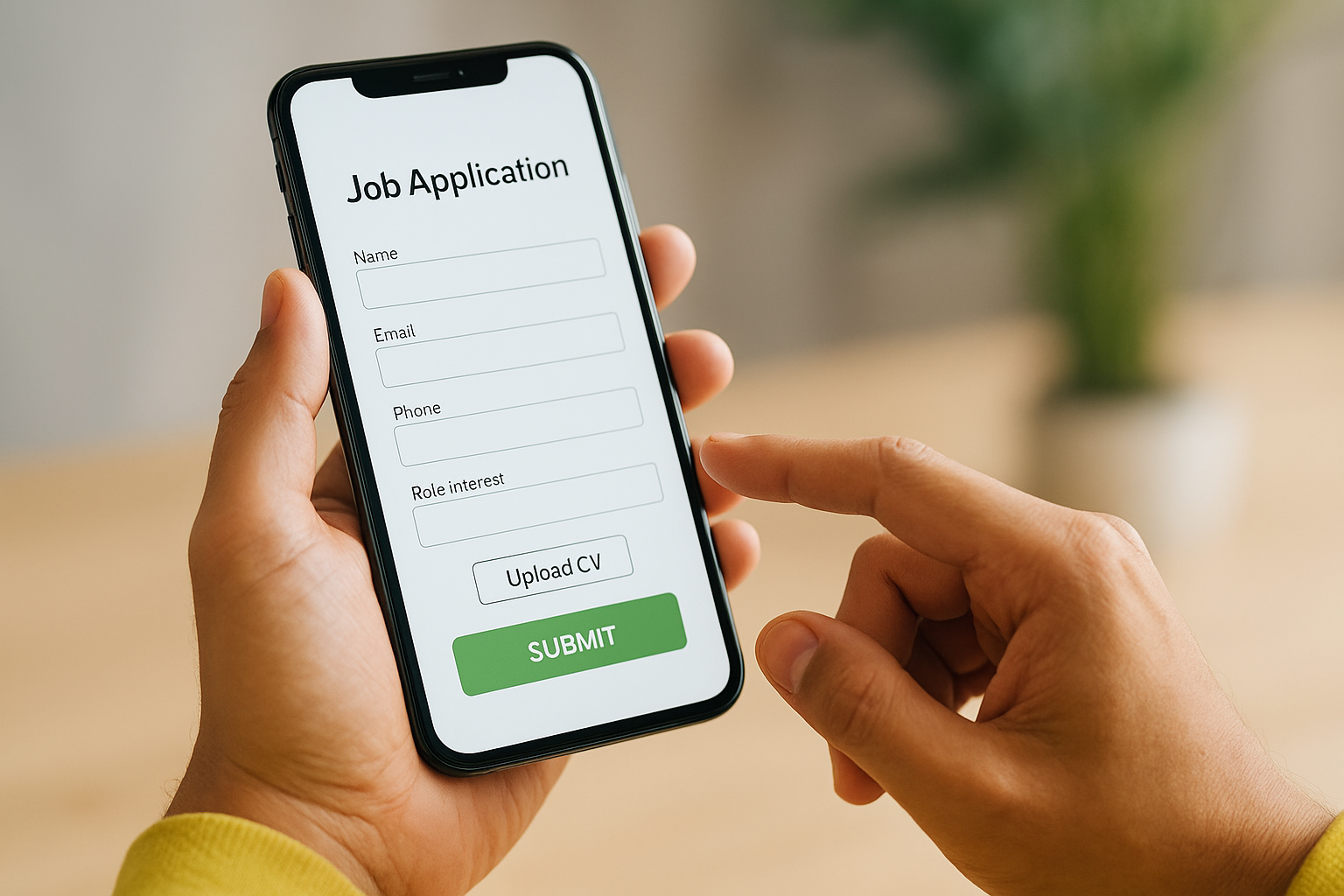
A mobile-first application reduces the drop-off rate between a candidate seeing your job posting and actually submitting their information. Most job seekers browse and apply on their phones, so a form that requires uploading documents through a desktop browser or filling out 15 fields up front will lose candidates at the first point of friction.
Cutting your application to five fields or fewer on mobile can double your completed submission rate without changing your sourcing spend.
How to implement it
Audit your current application flow by completing it yourself on a phone. Time how long it takes and count every required field. Then strip it back to the minimum: name, contact details, role interest, and a CV upload. Use tools that support one-tap LinkedIn or Google profile imports to remove the need for manual data entry entirely. Test across both iOS and Android before going live.
Common mistakes to avoid
Keeping optional fields that feel mandatory is a common issue. Candidates who see a long form assume it is all required and leave. Avoid requiring cover letters at the initial stage for high-volume roles.
KPIs to track
- Application completion rate by device type
- Time to complete the application on mobile
- Drop-off point in the application funnel
4. Build a reusable talent pool from past applicants
Most staffing agencies re-source the same roles repeatedly when they already have qualified candidates sitting in their database from previous campaigns. Building a reusable talent pool turns those past applicants into a ready-to-deploy asset that cuts your sourcing time significantly.
What it solves
Starting from scratch on every new job order wastes time you do not have in high volume recruiting strategies. A structured talent pool gives your team pre-qualified candidates who already know your agency, reducing the time it takes to move from intake to first submission.
Recruiters who tap existing talent pools fill roles two to three times faster than those who rely solely on fresh sourcing.
How to implement it
Tag every applicant in your ATS by skill category, availability status, and last contacted date immediately after each campaign closes. Create a simple re-engagement workflow: send a short check-in message every 60 to 90 days to candidates who were not placed. Keep their CV and preferences current so you can act fast when a matching role opens.
Common mistakes to avoid
The biggest error is letting your talent pool go stale without re-engagement. Candidates change roles, relocate, or lose interest if they hear nothing for months. Avoid tagging candidates with generic labels like “good candidate” that give your team no actionable information when a new role lands.
KPIs to track
Once your talent pool is running, these three metrics tell you whether re-engagement is actually reducing sourcing time and improving placement speed.
- Percentage of roles filled from existing talent pool vs. new sourcing
- Time-to-first-submission for pool candidates vs. fresh applicants
- Re-engagement response rate per outreach campaign
5. Diversify sourcing and tighten your job ads
Relying on one or two job boards puts your entire pipeline at risk when those channels slow down. In high volume recruiting strategies, your sourcing mix needs to be wide enough that a dip in one channel does not stall submissions across your entire client roster. Tighter, more specific job ads also mean fewer unqualified applications to sift through.
What it solves
A single-channel sourcing strategy creates artificial bottlenecks because you compete with every other agency posting to the same platform. Spreading across multiple sourcing channels, including niche job boards, employee referral programs, social sourcing, and direct database outreach, keeps your applicant flow consistent even when one source underperforms.
Agencies that source from four or more active channels fill high-volume roles 40% faster than those that rely on one primary job board.
How to implement it
Run a quick audit of your last 30 placements and note which sourcing channel each candidate came from. Identify your two weakest channels and invest time in building them up. At the same time, rewrite your job ads to lead with specific role requirements and compensation range rather than a company overview. Concrete details filter out poor-fit applicants before they reach your inbox.
Common mistakes to avoid
Posting identical job ads across every channel without adjusting tone or format wastes the opportunity each platform offers. LinkedIn audiences respond differently than niche industry boards. Avoid listing every possible qualification as a hard requirement, because that narrows your pool faster than the role actually demands.
KPIs to track
- Application volume by sourcing channel per active campaign
- Qualified applicant rate per channel
- Cost per qualified applicant across all active sources
6. Screen at scale with structured criteria and tests
Unstructured screening in high volume recruiting strategies creates inconsistency. Different recruiters use different standards, which means similar candidates get different outcomes based on who reviews them rather than how qualified they actually are.
What it solves
Without a defined screening framework, your team wastes time evaluating candidates against shifting or subjective criteria. Structured criteria and pre-screening assessments give every recruiter the same filters to work from, so you move faster and make more consistent decisions across hundreds of applicants.
Standardizing your screening criteria cuts average review time per candidate by up to 50% while reducing the risk of missing qualified applicants.
How to implement it
Define three to five non-negotiable criteria for each role type before the campaign launches. These can include minimum experience level, specific certifications, location constraints, or availability windows. Build a short pre-screening assessment of four to six questions that candidates complete before a recruiter reviews their CV. Tools inside your ATS can auto-score responses and surface only those who meet your threshold.
Common mistakes to avoid
Setting too many screening criteria is a common trap. When your filters are overly strict, you eliminate strong candidates who could be coached on minor gaps. Avoid using the same assessment for every role without adjusting questions to match what that specific position actually requires.
KPIs to track
- Screening-to-interview conversion rate per campaign
- Average time spent reviewing a single candidate profile
- Assessment pass rate by sourcing channel
7. Batch interviews and automate scheduling
Coordinating individual interviews across a high-volume campaign is one of the fastest ways to lose momentum. When each candidate requires a separate scheduling thread with your client and multiple back-and-forth emails, your team burns hours on logistics that add zero value to the placement itself.
What it solves
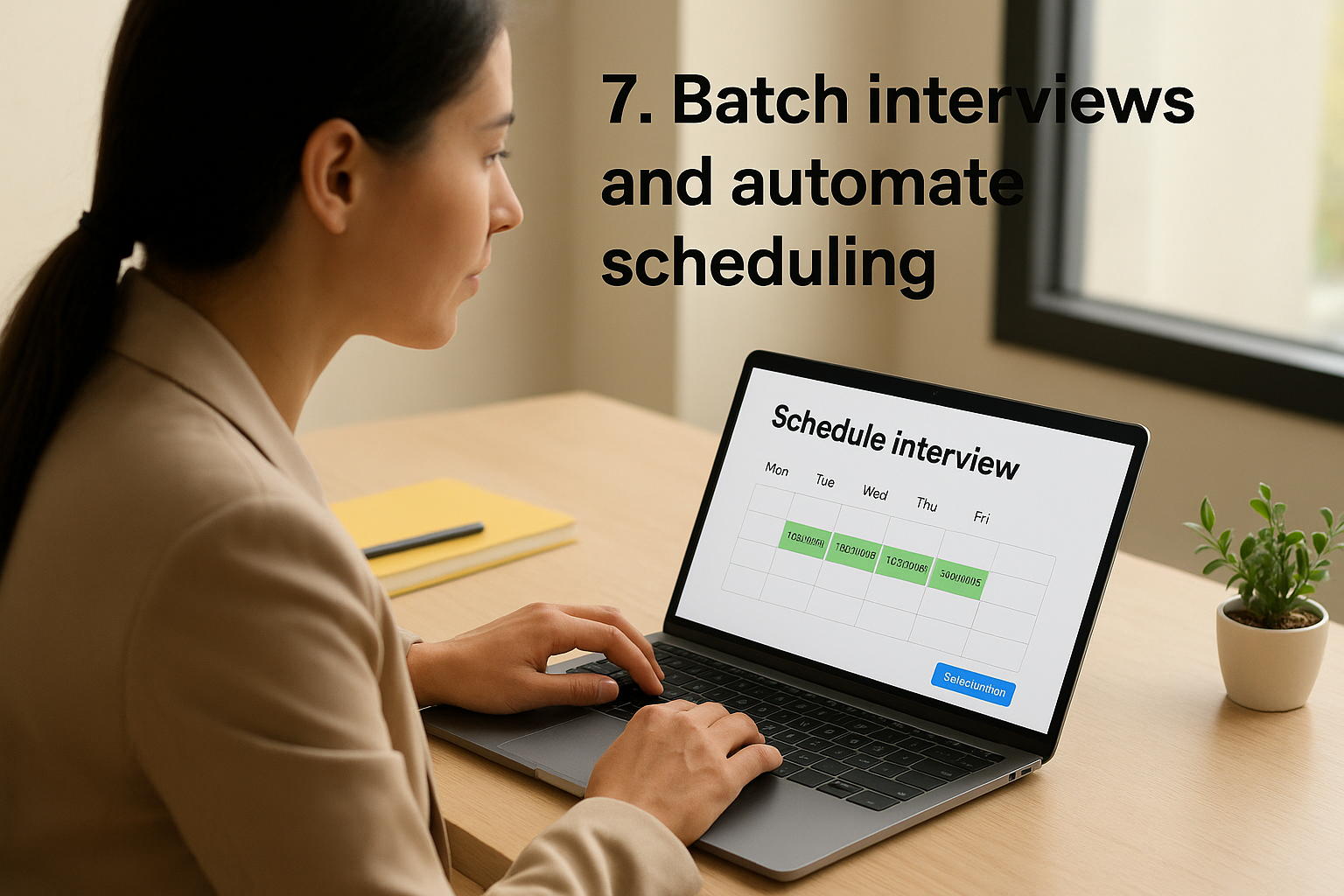
Batching interviews and automating scheduling removes the manual coordination bottleneck that slows down your pipeline when you’re processing dozens of candidates at once. In high volume recruiting strategies, every hour spent chasing calendar availability is an hour not spent sourcing or submitting the next candidate.
Agencies that batch interviews into structured time blocks can process three times the candidates in the same calendar window as those scheduling individually.
How to implement it
Group similar-role candidates into dedicated interview blocks, such as two-hour windows where your client sees four to six candidates back to back. Use scheduling tools that allow candidates to self-select available slots from a shared calendar link, eliminating the email ping-pong entirely. Set up automated confirmation and reminder messages so no-show rates drop without any manual follow-up from your team.
Common mistakes to avoid
Batching too many candidates into a single session leads to interviewer fatigue and inconsistent evaluation quality by the final slot. Keep each block to six candidates maximum. Avoid giving clients open-ended scheduling windows without setting a firm deadline for when all interviews must be completed.
KPIs to track
Track these metrics to confirm your batching and scheduling setup is actually reducing time and improving throughput across active campaigns.
- Interview-to-offer conversion rate per batch session
- Average scheduling time per candidate in minutes
- No-show rate before and after automation
8. Communicate fast and consistently to prevent drop-off
Candidate drop-off is one of the quietest but most damaging problems in high volume recruiting strategies. You spend time sourcing, screening, and submitting candidates, then lose them mid-process because your team did not follow up quickly enough. Slow or inconsistent communication signals to candidates that the opportunity is not worth waiting for, so they accept the next offer that comes their way.
What it solves
Poor communication creates drop-off at every stage of the funnel, from the moment a candidate applies to the point where they are waiting on an offer. When candidates hear nothing for days, they assume the role is filled or that you are not serious. Consistent, timely outreach keeps candidates engaged and committed to your process rather than shopping elsewhere.
A 24-hour response window from application to first contact can reduce candidate drop-off by more than 40% compared to teams that respond within three to five days.
How to implement it
Set up automated status updates inside your ATS that trigger at key transitions, such as application received, CV submitted to client, and interview confirmed. Write five to seven template messages for the most common communication points so recruiters spend seconds personalizing rather than minutes drafting. Aim for a maximum 24-hour response time at every stage.
Common mistakes to avoid
Sending generic messages that give candidates no useful information about next steps frustrates rather than reassures. Avoid going silent after an interview without a clear timeline for the decision.
KPIs to track
- Average response time from candidate action to recruiter reply
- Drop-off rate between each pipeline stage
- Candidate satisfaction score collected post-placement
9. Speed up offers, compliance, and onboarding
The final stretch of high volume recruiting strategies is where placements fall apart most often. A slow offer process, incomplete compliance checks, or a disorganized onboarding sequence gives candidates time to accept a competing offer, and all your sourcing and screening work disappears with them.
What it solves
Delays between interview and offer create a window of uncertainty that candidates fill by entertaining other options. Compliance bottlenecks, such as missing documents or unsigned agreements, then slow down start dates even after a candidate accepts. Fixing this stage locks in placements that your team has already earned.
Cutting your offer-to-acceptance window to 24 hours reduces candidate withdrawal rates significantly compared to a standard three to five day turnaround.
How to implement it
Build a pre-populated offer template that your team can send within hours of a client decision, not days. Use e-signature tools to collect compliance documents digitally so candidates never need to print, scan, or visit an office. Create a checklist of onboarding requirements for each client and attach it to every active role before the campaign even starts.
Common mistakes to avoid
Waiting for a client to draft their own offer language from scratch on every hire adds unnecessary days to your timeline. Prepare standard templates in advance with the client and get their approval upfront. Avoid treating compliance as a post-offer activity when most document collection can start at the interview confirmation stage.
KPIs to track
- Offer-to-acceptance rate and average time to accept
- Compliance completion rate before the candidate start date
- Onboarding no-show rate on day one
Next steps
The nine high volume recruiting strategies in this guide work because they target specific bottlenecks rather than trying to fix everything at once. You do not need to implement all nine simultaneously. Start with the stages where your team loses the most time right now, whether that is CV prep, scheduling, or candidate drop-off, and build from there.
The fastest wins come from automating the manual work that eats up recruiter hours without adding placement value. CV formatting and tailoring is the clearest example. Every hour your team spends reformatting documents is an hour they are not sourcing or submitting candidates. Fixing that single step compounds across your entire workflow.
If you want to see what faster CV processing looks like in practice, start a free trial of Saply and run your next campaign with the manual formatting work removed from your team’s plate entirely.