
how-to-build-a-candidate-pipeline
How To Build A Candidate Pipeline For Faster, Better Hires
Most recruiters know the drill: a new role lands on your desk, and suddenly you're scrambling to source candidates from scratch. That reactive cycle burns time, delays submissions, and puts you behind...
Written by: Saply Team

How To Build A Candidate Pipeline For Faster, Better Hires
Most recruiters know the drill: a new role lands on your desk, and suddenly you’re scrambling to source candidates from scratch. That reactive cycle burns time, delays submissions, and puts you behind competitors who already have qualified talent ready to go. Learning how to build a candidate pipeline is what separates agencies that consistently fill roles fast from those stuck in a constant sourcing loop.
A strong pipeline means you’re not starting from zero every time a client calls. You’ve already identified, engaged, and organized candidates who match the types of roles you regularly fill. But building one takes more than just hoarding resumes in a database, it requires a repeatable process for sourcing, nurturing, and keeping candidates warm over time. And when those candidates are ready to submit, tools like Saply help you format and tailor their CVs in seconds, so you move from pipeline to placement without the manual bottleneck.
This guide breaks down a step-by-step approach to building a candidate pipeline that actually works. You’ll learn how to define your pipeline strategy, source candidates proactively, keep them engaged between opportunities, and maintain a talent pool that drives faster, better hires on repeat.
What a candidate pipeline is and when to use it
A candidate pipeline is a structured, staged system for identifying and managing potential hires before a specific role opens. Unlike a passive resume database, a pipeline is active. You continuously source candidates, sort them by readiness and fit, and keep them engaged so that when a client calls with an urgent need, you already have qualified people at different stages of your process. Think of it less like a filing cabinet and more like a live sales funnel built entirely around talent.
A pipeline only works if you treat it as a living system, not a storage folder you revisit when things get desperate.
How a pipeline differs from a talent database
Many agencies already have a large database in their ATS. That database becomes a pipeline the moment you actively segment, prioritize, and communicate with the people in it. A raw database is static. Candidates sit in it with outdated contact details, stale CVs, and no recent engagement. A pipeline, by contrast, has defined stages, a clear owner for each candidate, and a cadence of touchpoints that keeps your relationships current.
Here is a simple example of how the two compare:
| Feature | Talent Database | Candidate Pipeline |
|---|---|---|
| Candidate status | Stored, rarely reviewed | Actively tracked by stage |
| Contact recency | Often outdated | Refreshed on a set schedule |
| Engagement | Reactive (search when needed) | Proactive (regular touchpoints) |
| Submission speed | Slow, starts from scratch | Fast, candidates are pre-qualified |
| CV readiness | Raw, inconsistent formats | Formatted and ready to submit |
When building a pipeline is worth it
Building a pipeline makes the most sense when you regularly fill the same types of roles for similar clients. If you place IT contractors, logistics managers, or healthcare professionals on repeat, you already know the profile you’re looking for. Investing time in sourcing and nurturing those profiles proactively saves you hours each time a vacancy comes in. You spend less time scrambling and more time pitching the right candidates quickly.
Pipelines also matter more as competition increases. When multiple agencies are pitching candidates for the same role, the one who submits first with the best-prepared CV often wins. That speed advantage only comes from having a warm pipeline ready to activate. If your current process looks like: receive job brief, search database, find cold leads, send outreach, wait, format CV, and then submit then you are already losing time at every stage.
The roles a pipeline works best for
Not every role justifies a dedicated pipeline. Focus your effort on positions that meet at least two of these criteria:
- High fill frequency – you place this type of role at least once a month
- Predictable skill set – the requirements stay consistent across clients
- Competitive market – candidates get multiple offers and move quickly
- Long lead time – sourcing from zero takes more than two weeks
When you understand how to build a candidate pipeline around these specific role types, you stop wasting pipeline effort on one-off searches and focus your energy where it pays off most. The following steps walk you through exactly how to set that up, starting with identifying which roles deserve your pipeline investment first.
Step 1. Pick priority roles and hiring signals
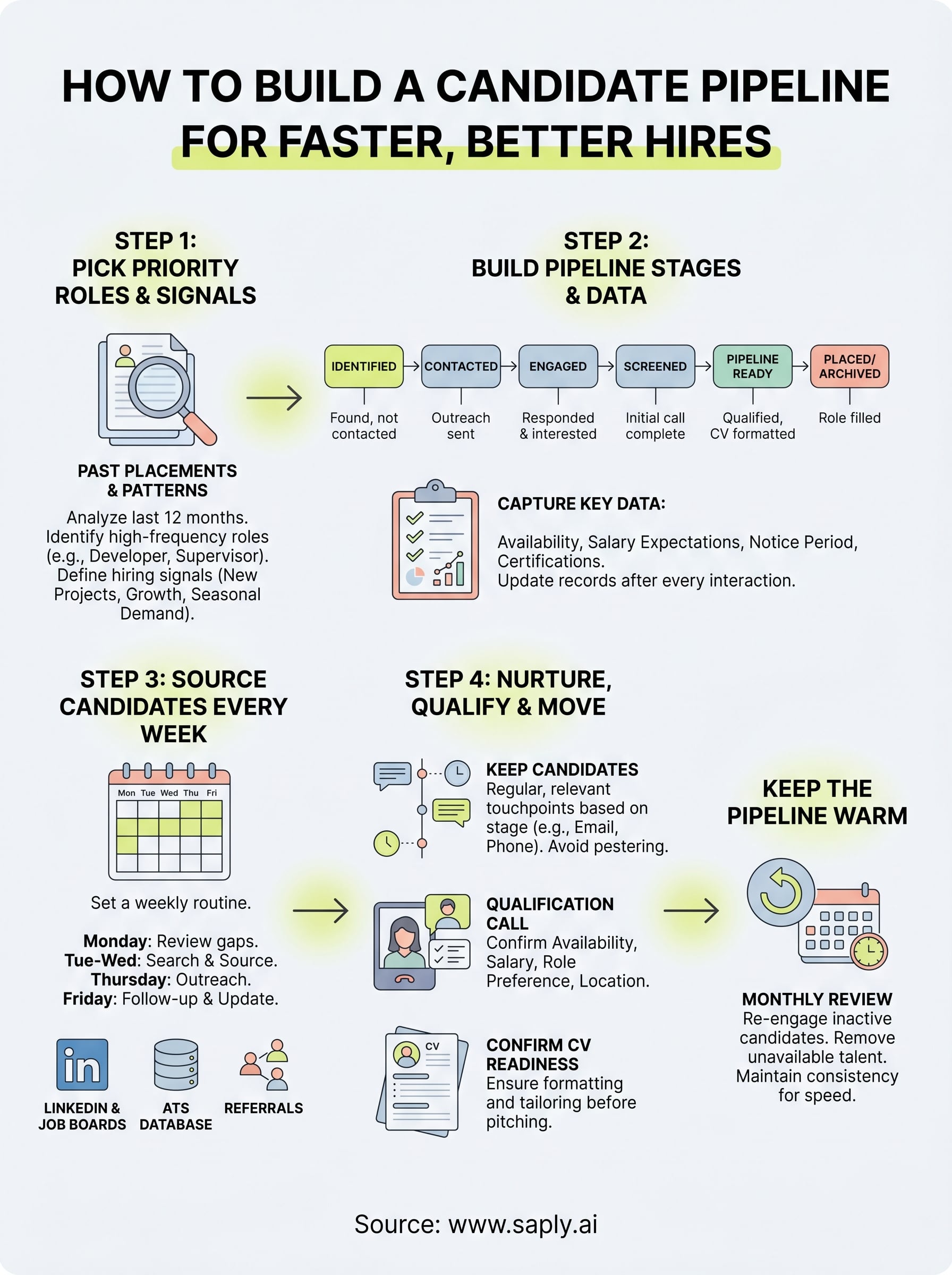
Before you source a single candidate, you need to decide which roles deserve a pipeline. Trying to build pipelines for every position you fill spreads your effort thin and produces nothing useful. Start by pulling your last 12 months of placements and looking for patterns. The roles that appear most often, move fastest, or cause the most last-minute scrambling are exactly where a proactive pipeline pays off the most.
Identify your highest-frequency roles
Open your ATS or placement records and list every role type you filled in the past year. Count how many times each appeared, how long it took to fill on average, and whether you lost any submissions to a competitor. This simple audit tells you where your pipeline effort belongs. If you placed software developers, warehouse supervisors, or finance contractors three or more times in a single quarter, those are your pipeline priorities.
Your pipeline should reflect where your revenue actually comes from, not the roles you hope to fill someday.
Once you have your top three to five role types, write a one-paragraph profile for each. Include the must-have skills, typical experience level, common certifications, and the red flags that disqualify candidates quickly. This profile becomes the filter you use when sourcing and screening, so you never waste time building a pipeline around the wrong people.
Define the hiring signals to watch
Hiring signals are early indicators that a client will need candidates before they officially brief you. Recognizing these patterns lets you warm up your pipeline weeks ahead of a formal request. Common signals include:
- A client expands into a new location or department
- A contract renewal period is approaching for contingent staff
- A client wins a new project or announces public growth
- Seasonal demand cycles you already know from past placements
- A candidate in an active placement signals they plan to move on soon
Set up a simple tracking system in your ATS notes or a shared spreadsheet to log these signals by client. When two or more signals overlap for the same client, activate your pipeline for that role type immediately. This habit is what turns knowing how to build a candidate pipeline from a concept into a daily practice. You stop reacting to briefs and start predicting them.
Step 2. Build your pipeline stages and data
Once you know which roles to prioritize, you need a clear structure to manage the candidates you source. Without defined stages, your pipeline becomes a flat list with no way to tell who is ready to submit, who needs a follow-up, and who dropped off months ago. A staged pipeline gives every candidate a specific position in your process so you always know what action to take next.
Define your pipeline stages
Most recruitment pipelines work best with five to six stages. Keep them simple enough to maintain consistently and specific enough to drive action. Here is a template you can apply directly in your ATS or a shared spreadsheet:
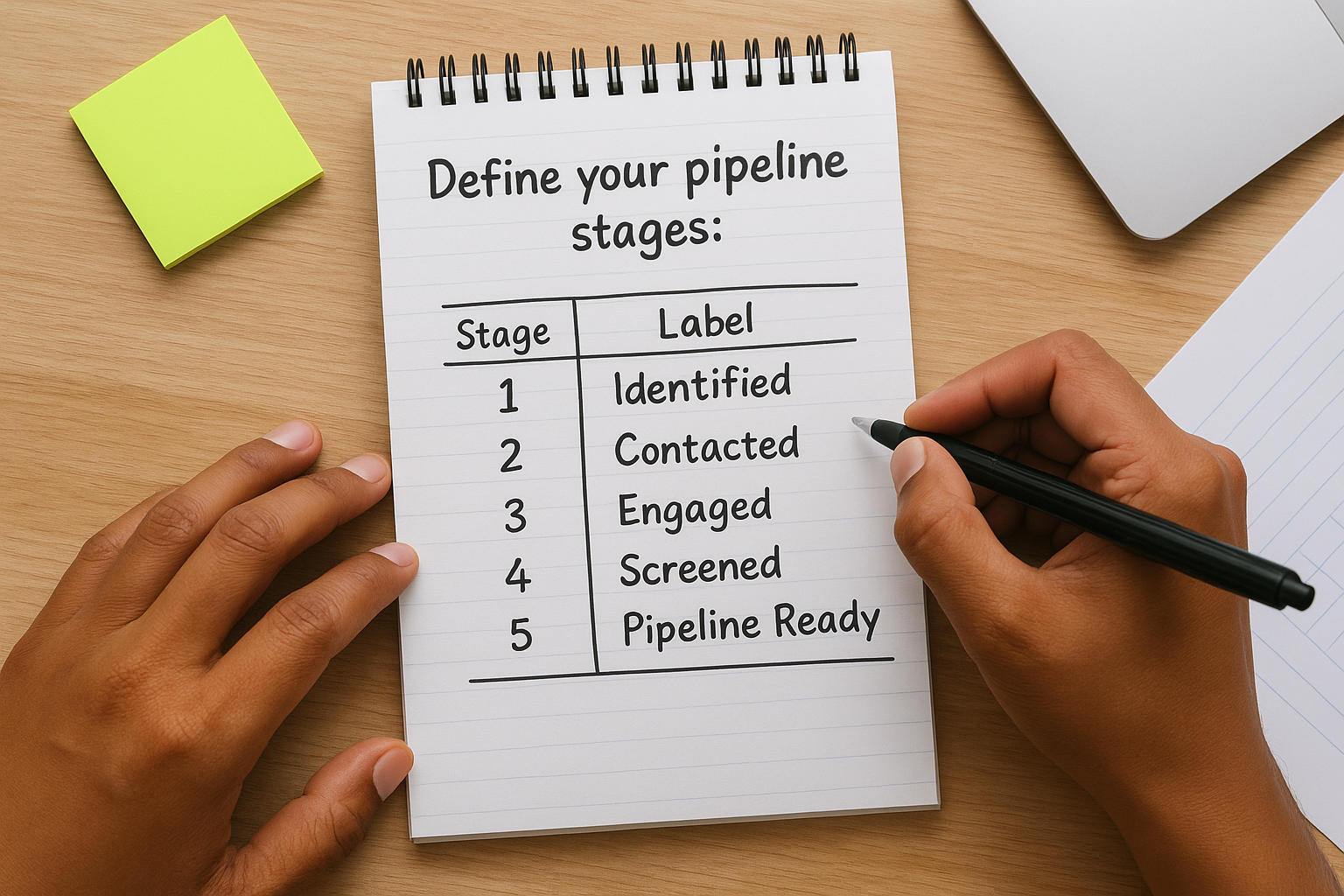
| Stage | Label | What it means |
|---|---|---|
| 1 | Identified | Found but not yet contacted |
| 2 | Contacted | Outreach sent, no response yet |
| 3 | Engaged | Responded and expressed interest |
| 4 | Screened | Initial call or assessment complete |
| 5 | Pipeline Ready | Qualified, CV formatted, ready to submit |
| 6 | Placed or Archived | Filled the role or no longer available |
The stage a candidate sits in should always tell you the next action to take, nothing more.
Move candidates between stages based on specific trigger events, not gut feel. A reply to your outreach moves someone from Contacted to Engaged. A completed screening call with a strong fit moves them to Screened. This discipline keeps the pipeline clean and immediately usable when a client brief lands.
Capture the right data for each candidate
Understanding how to build a candidate pipeline means nothing if your records are incomplete. For each candidate, capture a minimum set of data points that make future action fast and reliable. At the screening stage, log availability window, salary expectations, notice period, and any role-specific certifications. These details let you filter and pitch the right person without re-screening from scratch every time a role opens.
Update each record after every interaction, even a brief one. A short note like “available from August, open to contract work, prefers remote” saves you significant time when an urgent brief arrives. Treat your pipeline data as a living document you maintain actively, not a one-time entry task you complete once and forget.
Step 3. Source candidates every week
Building a pipeline is not a one-time activity. You need to add new candidates consistently each week to keep it healthy. A pipeline that stops receiving fresh talent stales quickly, and you end up back where you started: sourcing from zero when a client calls. Treat sourcing as a non-negotiable weekly task, not something you squeeze in when work slows down. The volume does not have to be large, but it does have to be regular.
Where to find pipeline candidates
Your sourcing channels should match where your target candidates actually spend their time. For most role types, a combination of LinkedIn, your existing ATS database, and direct referrals covers the majority of your pipeline needs. Go deeper by checking industry-specific job boards, professional associations, and alumni networks tied to the certifications your target candidates typically hold.
Here are the most reliable sourcing channels by candidate type:
| Candidate Type | Primary Channels |
|---|---|
| Tech and IT | LinkedIn, GitHub profiles, Stack Overflow |
| Finance and Accounting | LinkedIn, professional association directories |
| Logistics and Operations | Indeed, trade group forums, referrals |
| Healthcare | Specialty job boards, licensing databases, referrals |
| General Professional | LinkedIn, ATS re-engagement, candidate referrals |
Set a weekly sourcing routine
Consistency is what separates recruiters who understand how to build a candidate pipeline from those who source in bursts and then disappear for weeks. Block two to three focused hours each week dedicated to sourcing alone. Split that time between finding new candidates and re-engaging people already sitting in your pipeline who have gone quiet.
A short weekly sourcing block does more for your pipeline than a long monthly push you never repeat.
Use this simple weekly template to stay on track without overcomplicating the process:
- Monday: Review pipeline gaps by role type and note how many candidates you need at each stage
- Tuesday to Wednesday: Run targeted searches on LinkedIn or your ATS for new candidates matching your priority profiles
- Thursday: Send outreach to three to five new candidates per priority role
- Friday: Follow up on open responses and update candidate records with fresh notes from any conversations
This routine keeps your sourcing output steady and your pipeline full without demanding hours in a single sitting. Even on a slow week, you make measurable progress toward a pipeline that is ready to activate when the next brief arrives.
Step 4. Nurture, qualify, and move candidates
Sourcing candidates gets them into your pipeline, but nurturing and qualifying them is what turns a list of names into a real talent bench. Most pipelines stall here because recruiters get busy and stop communicating with candidates who are not yet attached to an active role. When a brief finally lands, those candidates have gone cold, taken another position, or forgotten who you are entirely.
Keep candidates engaged between opportunities
Your goal is to stay on a candidate’s radar without pestering them. A simple touchpoint schedule keeps relationships warm without requiring long conversations. Use this template to plan contact frequency by pipeline stage:

| Stage | Contact Frequency | Channel |
|---|---|---|
| Identified | None yet | N/A |
| Contacted | Once per week for 2 weeks | Email or LinkedIn |
| Engaged | Once every 3 weeks | Email or phone |
| Screened | Once per month | Phone or email |
| Pipeline Ready | Once every 2 weeks | Phone preferred |
Your messages do not need to be elaborate. A quick note sharing a relevant industry update, a new role type you are working on, or a check-in on their situation keeps the conversation going without demanding anything from them. Short, specific messages consistently outperform long, generic ones.
The candidates who respond best to outreach are the ones who feel like you remember them, not like they are on a mass contact list.
Run a structured qualification call
Before you move anyone to Pipeline Ready status, run a 15-minute qualification call to confirm the details you need to pitch them confidently. Cover these points in every call without exception:
- Current availability and notice period – confirm the exact date they can start
- Salary or rate expectations – get a specific number, not a range
- Role type preference – permanent, contract, or open to both
- Location and remote flexibility – note any hard limits upfront
- Relevant certifications or recent projects – capture anything new since you last spoke
Confirm CV readiness before you pitch
Understanding how to build a candidate pipeline also means knowing that a great candidate with a poorly formatted CV costs you placements. Before you mark anyone as Pipeline Ready, confirm their CV is current, formatted to your agency template, and tailored to the role types you plan to pitch them for. Tools like Saply let you handle CV formatting and tailoring directly in Word or Google Docs, so you clear this step fast without creating extra work for yourself.
Keep the pipeline warm
A candidate pipeline only delivers results if you maintain it consistently. Set a monthly calendar reminder to review every stage, remove candidates who are no longer available, and re-engage anyone you have not spoken to in 60 days or more. That single habit prevents your pipeline from turning into the static database you were trying to move away from in the first place.
The full process of knowing how to build a candidate pipeline comes down to three ongoing commitments: source candidates every week, qualify and update their records after each interaction, and keep their CVs formatted and ready to submit at any moment. When a client brief lands, your response time drops from days to hours because the hard work is already done. Try Saply free for 14 days and see how much faster you can move from a warm pipeline to a placed candidate.