
how-to-build-a-candidate-profile
Ideal Hiring Blueprint: How To Build A Candidate Profile
Every recruiter has submitted a candidate they felt confident about, only to get radio silence from the client. Often, the issue isn't the candidate, it's a mismatch between what the role actually req...
Written by: Saply Team
Ideal Hiring Blueprint: How To Build A Candidate Profile
Every recruiter has submitted a candidate they felt confident about, only to get radio silence from the client. Often, the issue isn’t the candidate, it’s a mismatch between what the role actually requires and what the recruiter prioritized during sourcing. Knowing how to build a candidate profile before you start searching gives your team a concrete framework to evaluate fit, spot gaps early, and pitch candidates with real conviction.
A candidate profile goes beyond a job description. It defines the skills, experience, certifications, and soft traits that make someone genuinely right for a specific position, not just qualified on paper. For staffing agencies handling dozens of open roles simultaneously, this kind of clarity is the difference between fast placements and wasted submissions. It also makes downstream tasks like CV tailoring and formatting far more efficient, because you already know what to emphasize for each role.
This guide walks you through the full process of creating a candidate profile from scratch, covering research, structure, templates, and practical examples. We’ll also show how tools like Saply can accelerate the steps that follow, using AI to match, tailor, and format CVs against the candidate profile you’ve defined, so your team spends less time on admin and more time closing placements.
What a candidate profile is and when to use it
A candidate profile is a structured document that describes the ideal person for a specific role, going well beyond what a job description covers. Where a job description tells candidates what the position involves, a candidate profile tells your recruitment team what a successful hire actually looks like. It captures skills, experience levels, certifications, behavioral traits, and work style preferences in one place, so everyone evaluating candidates is working from the same benchmark.
How a candidate profile differs from a job description
A job description is written for the candidate. A candidate profile is written for the recruiter. That distinction matters because the two documents serve completely different purposes. A job description lists duties and responsibilities to attract applicants. A candidate profile defines the criteria your team uses to evaluate and compare those applicants with precision.
A candidate profile answers one question a job description never does: what does “good” actually look like for this specific role, in this specific company, right now?
For example, a job description might say “3+ years of B2B sales experience required.” Your candidate profile goes further: it specifies whether those years should come from outbound hunting or account management, which industries translate well, and whether the hiring manager values deal volume over deal size. That level of detail changes how you source, how you screen, and how you pitch.
The core components of a candidate profile
Knowing how to build a candidate profile starts with understanding what belongs in it. The document typically covers four areas:
- Hard requirements: Qualifications, certifications, years of experience, technical skills, and any non-negotiables the client has set
- Soft requirements: Communication style, leadership approach, collaboration preferences, and personality traits that fit the team dynamic
- Cultural signals: Values alignment, attitude toward feedback, pace preference (startup vs. structured environment), and management style compatibility
- Motivational drivers: What the candidate needs to stay engaged, such as career growth, compensation structure, autonomy, or mission alignment
When to build a candidate profile
Build one before you source, not after. Many teams treat the candidate profile as something you fill in retrospectively once a few candidates have already been screened. That approach wastes time and creates inconsistency across the team. You need a shared definition of fit before anyone opens a resume.
Use a candidate profile for every new role you open, every time a client renews a position with changed requirements, and any time your team disagrees on whether a candidate is worth submitting. That last scenario is a clear signal that your criteria were never defined clearly enough. A completed profile eliminates the back-and-forth and gives your whole team a single source of truth to work from.
Step 1. Define success in the role
Before you can build a candidate profile that actually works, you need a clear answer to one question: what does success look like in this role at 90 days, six months, and one year? Most recruiters skip this conversation and jump straight to matching job descriptions against resumes. That creates a gap between what the client actually needs and what you end up submitting. Close that gap before you source a single candidate.
Talk to the hiring manager before you open a search
Scheduling a 20-minute intake call with the hiring manager is one of the highest-leverage actions you can take at this stage. This conversation surfaces the real requirements that never make it into the written job description, including team dynamics, past hiring failures, and the specific challenges the new hire will face on day one. Come prepared with a standard set of questions:
- What did the last person in this role do well, and where did they fall short?
- What will this person need to accomplish in their first 90 days to be considered successful?
- Who will they work with most closely, and what does that team dynamic look like?
- What has made previous hires fail in similar roles at your company?
- Are there any non-negotiable requirements that aren’t listed in the job description?
The answers to these questions often reveal criteria that matter more to the client than anything written in the official posting.
Translate success into measurable outcomes
Once you have that intake conversation, convert the answers into specific, measurable outcomes rather than vague trait descriptions. “Strong communicator” is not a useful criterion. “Presents weekly pipeline updates to a VP-level audience and adjusts messaging based on live questions” gives your team something concrete to screen against.
Knowing how to build a candidate profile means defining what winning looks like, not just what the role involves. Write two or three outcome statements for each major responsibility before you move to the next step.
Step 2. Turn job work into must-haves and nice-to-haves
Once you have your success outcomes from Step 1, your next task is to convert the job’s actual work into a tiered list of candidate requirements. Not every requirement carries the same weight, and treating them equally leads to rejecting strong candidates over minor gaps or accepting weak ones because they checked the most boxes. Sorting requirements into must-haves and nice-to-haves is one of the most practical parts of how to build a candidate profile that your whole team can use consistently.
Mixing non-negotiables with preferences in a single list is one of the fastest ways to create inconsistent screening decisions across your team.
Identifying true non-negotiables
A must-have is a requirement where the absence of it makes the candidate unsuitable, regardless of everything else they bring. These are hard skills, certifications, or experience thresholds that the role genuinely cannot function without. To identify them, go back to your intake conversation and ask: if a candidate has everything else but lacks this one thing, would the client still consider them? If the answer is no, it’s a must-have.
Common must-haves include:
- Specific licenses or certifications (e.g., CPA, PMP, registered nurse credentials)
- Minimum years of experience in a directly relevant role
- Technical skills tied to the core job function (e.g., proficiency in a required platform)
- Legal or compliance requirements like security clearance or right to work
Building the tiered criteria template
Nice-to-haves are qualifiers that strengthen a candidate’s fit but don’t disqualify them if absent. Use this simple template to document both tiers for each role:
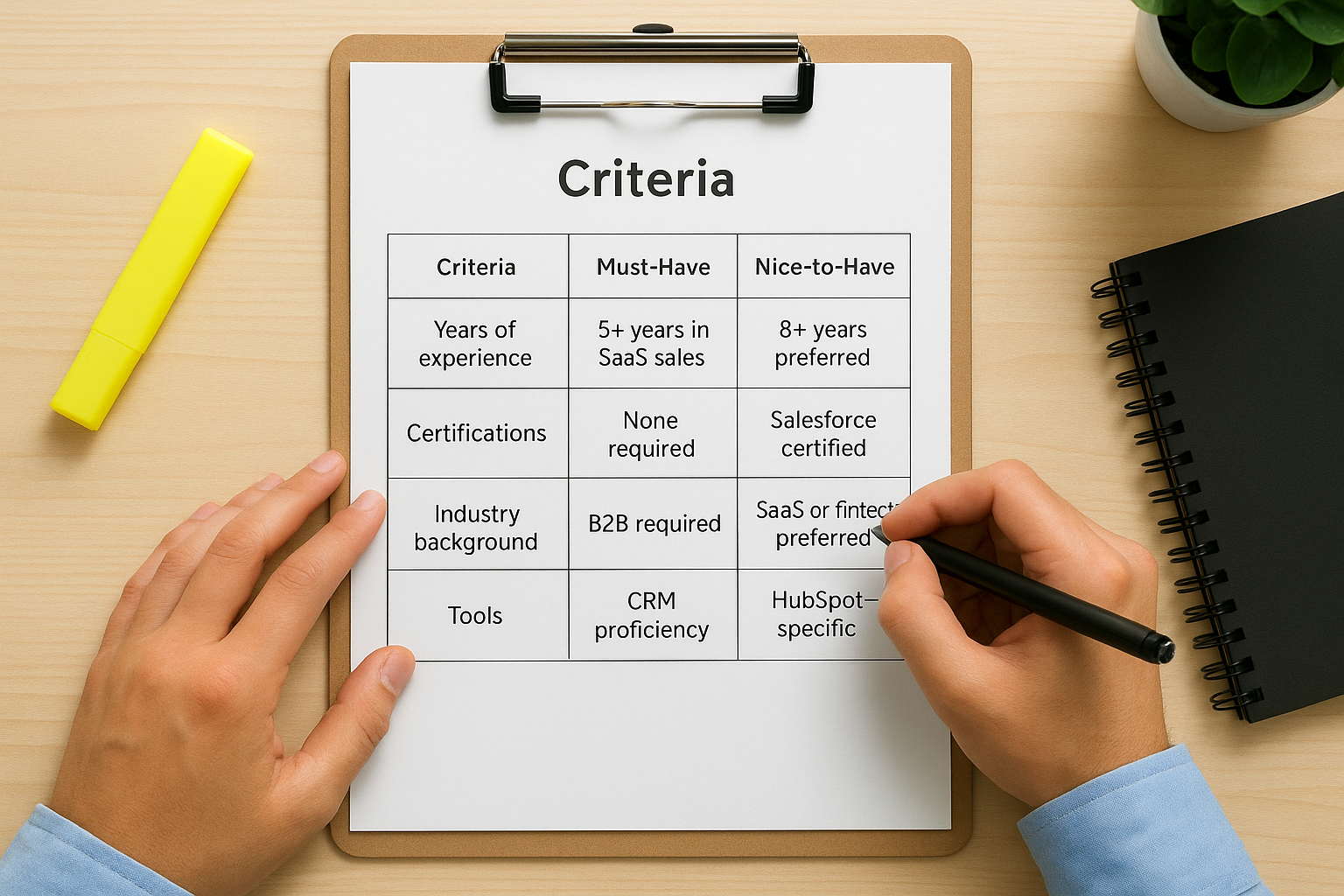
| Criteria | Must-Have | Nice-to-Have |
|---|---|---|
| Years of experience | 5+ years in SaaS sales | 8+ years preferred |
| Certifications | None required | Salesforce certified |
| Industry background | B2B required | SaaS or fintech preferred |
| Tools | CRM proficiency | HubSpot-specific experience |
Fill this table during your intake process, then share it with every team member screening for the role.
Step 3. Add culture, motivation, and work style signals
Skills and experience tell you whether a candidate can do the job. Culture, motivation, and work style signals tell you whether they’ll actually stay, perform, and contribute. When you know how to build a candidate profile that captures these factors, you give your team a way to screen beyond the resume and reduce the risk of placements that look strong on paper but fall apart within six months.
Capturing cultural fit without vague language
“Culture fit” is one of the most overused terms in recruitment, and it’s useless unless you define it precisely for each role. Ask your hiring manager what specific behaviors and working norms the team operates by, then translate those into signals you can actually look for during screening. Is the team highly autonomous, or do they meet daily and collaborate closely? Is the leadership style directive or consultative?
Vague culture criteria lead to subjective screening decisions that vary by recruiter. Specific behavioral signals keep your whole team aligned.
Use these questions to extract concrete culture signals during your intake call:
- How does the team handle disagreement or conflicting priorities?
- What does a typical week look like for someone in this role?
- What behaviors have caused friction with past hires in similar positions?
Mapping motivation and work style
Motivation and work style affect retention as much as they affect day-to-day performance. A candidate driven by public recognition will disengage in a company that rewards quietly. Someone who needs deep focus blocks will struggle in a high-interruption environment. Your candidate profile should document both dimensions so your whole team screens for them consistently.
Add a short section to your profile template with these fields:
| Signal | Detail |
|---|---|
| Motivation driver | Growth, compensation, autonomy, mission |
| Preferred work pace | Fast and reactive vs. structured and deliberate |
| Feedback style | Frequent check-ins vs. quarterly reviews |
| Work environment | Remote, hybrid, or on-site preference |
Step 4. Write the profile and build a simple scorecard
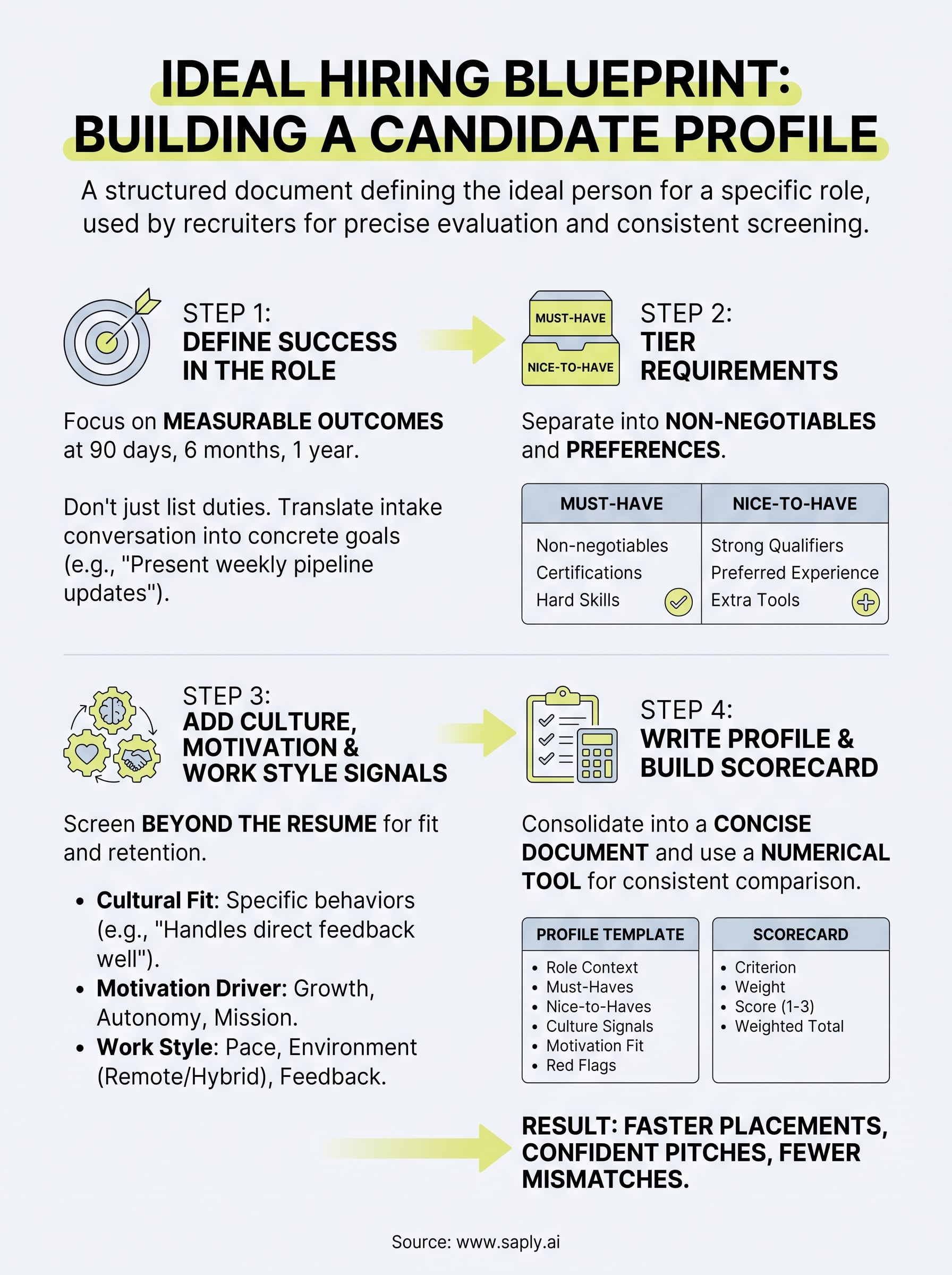
With your success outcomes, tiered requirements, and cultural signals documented, you’re ready to consolidate everything into a single, shareable profile. The final document is what your team will actually use during sourcing and screening, so clarity and brevity matter more than length. A candidate profile that runs five pages rarely gets read. Keep yours to one focused page that any recruiter on your team can absorb in under two minutes.
The profile only works if your team actually uses it. A concise, well-organized document gets referenced. A sprawling one gets ignored.
Assembling the full profile template
Knowing how to build a candidate profile means knowing how to structure it so the most critical information is visible immediately. Use this template as your starting point:

Candidate Profile: [Role Title]
- Role context: One to two sentences on why this position exists and what success looks like at 90 days
- Must-have requirements: Bullet list of non-negotiables from Step 2
- Nice-to-have requirements: Bullet list of strong preferences
- Culture and work style signals: Two to three specific behavioral markers from Step 3
- Motivation fit: Primary driver (growth, compensation, autonomy, mission)
- Red flags to screen for: Patterns from past failed hires the client shared during intake
Fill every field before the search opens. Leave nothing blank.
Creating a scorecard to rank candidates consistently
A scorecard translates your profile into a numerical evaluation tool that removes guesswork when comparing multiple candidates. Assign each criterion a weight based on its importance to the role, then score each candidate on a 1-to-3 scale. Multiply score by weight to get a weighted total for each person.
| Criterion | Weight | Candidate Score (1-3) | Weighted Score |
|---|---|---|---|
| Must-have skills met | 5 | 3 | 15 |
| Relevant industry experience | 3 | 2 | 6 |
| Culture signal alignment | 3 | 3 | 9 |
| Motivation fit | 2 | 2 | 4 |
| Total | 34 |
Use the same scorecard for every candidate on the same role. This gives you a defensible, consistent basis for deciding who to submit.
Wrap it up and put it to work
Building a candidate profile is a one-time investment that pays off across every step of the placement process. When you define success outcomes, sort requirements into clear tiers, and document culture signals before sourcing begins, your team screens faster, submits stronger candidates, and reduces the risk of mismatches that waste everyone’s time. The scorecard gives you a consistent, defensible way to decide who makes the cut and eliminates disagreements between team members about whether a candidate is worth submitting.
Once your profile is ready, apply it directly when reviewing CVs. Saply lets you match candidates against specific role requirements and tailor CVs to those criteria automatically, so the work you put into knowing how to build a candidate profile translates into faster, more confident submissions. Your profile defines who you are looking for. Saply handles the formatting and tailoring to get the right people in front of clients without the manual overhead holding your team back.