
how-to-grow-a-staffing-agency
How To Grow A Staffing Agency: A Practical 8-Step Plan
Most staffing agency owners hit a ceiling. You've got a solid client or two, a small team that works hard, and a process that mostly functions. But how to grow a staffing agency beyond that initial fo...
Written by: Saply Team
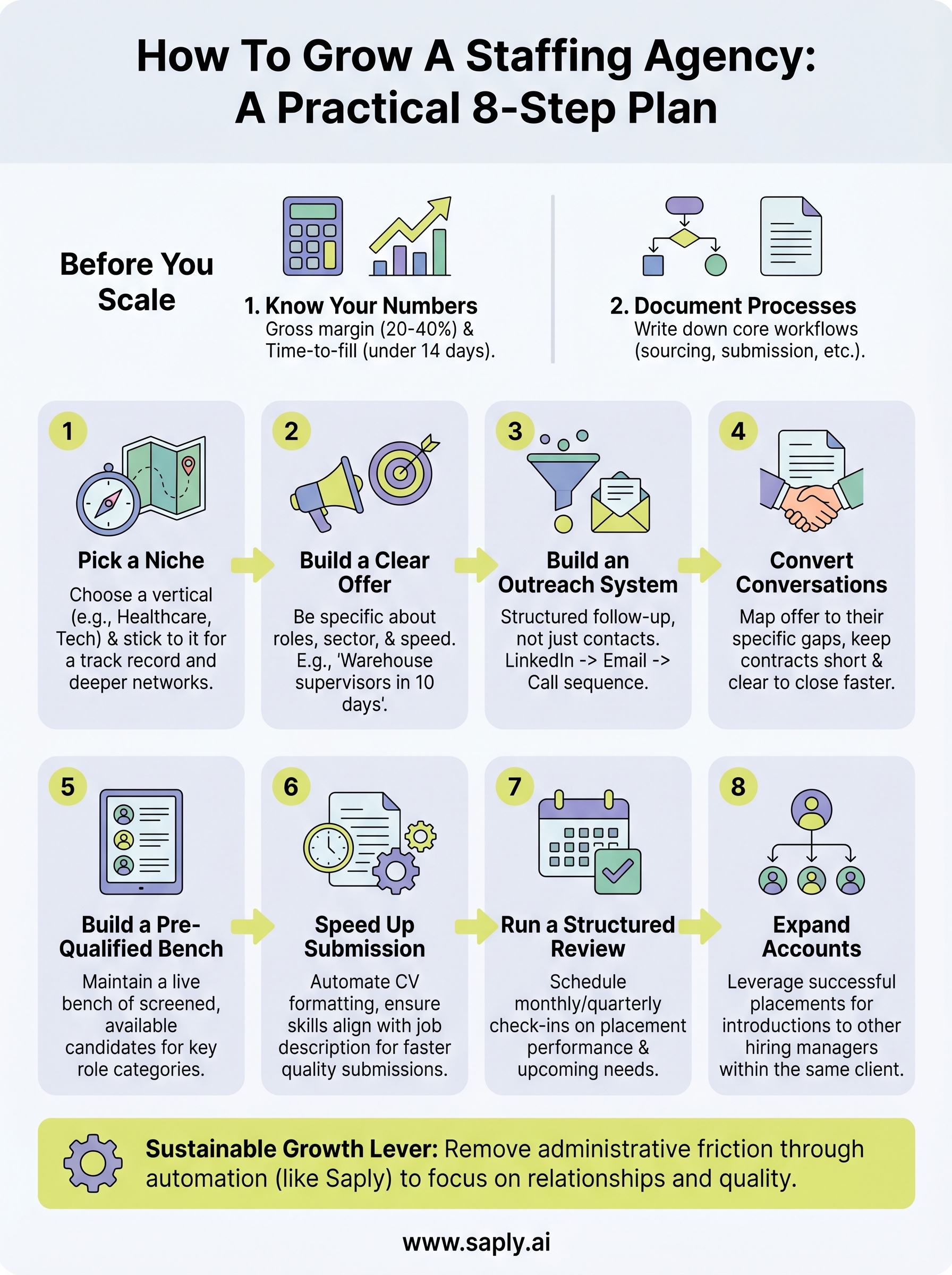
How To Grow A Staffing Agency: A Practical 8-Step Plan
Most staffing agency owners hit a ceiling. You’ve got a solid client or two, a small team that works hard, and a process that mostly functions. But how to grow a staffing agency beyond that initial foundation, how to actually scale revenue, win bigger accounts, and build something durable, is a different challenge entirely. It requires more than just hiring more recruiters and hoping for the best.
The agencies that grow consistently do a few things differently. They systemize what works, cut what doesn’t, and invest in the operational areas that directly impact speed and placement quality. That means rethinking everything from client acquisition to how your team handles something as fundamental as CV formatting and submission. It’s often the mundane, repetitive work, not the strategy, that bottlenecks growth the most.
That’s exactly why we built Saply: to eliminate the manual CV formatting and tailoring work that eats into recruiter productivity. But tools alone don’t grow an agency. Strategy does. In this guide, we’ll walk through eight practical steps to scale your staffing agency, covering client development, niche positioning, operational efficiency, and the hiring decisions that actually move the needle. No theory-heavy fluff, just a concrete plan you can start executing this week.
What to set up before you scale
Scaling before your foundation is solid is one of the fastest ways to break an agency. Growth amplifies everything that already exists in your business, so if your processes are inefficient or your financials are unclear, adding more clients and recruiters just creates bigger problems. Before you focus on how to grow a staffing agency, spend time diagnosing where you actually stand today.
Agencies that scale without chaos build their systems first, then add volume.
Know your numbers
You need a clear picture of your gross margin per placement and average time-to-fill before you invest in growth activities. If you don’t know these numbers, you’re making pricing and hiring decisions based on guesswork. Pull your last 12 months of placements and calculate revenue minus recruiter time cost minus candidate acquisition cost. Most agencies should target gross margins between 20% and 40%, depending on whether you run temp or permanent placements. If you’re below that range, scaling volume will not fix the margin problem.
| Metric | What to calculate | Healthy benchmark |
|---|---|---|
| Gross margin per placement | Revenue minus direct costs | 20–40% |
| Average time-to-fill | Days from job intake to placement | Under 14 days for high-volume roles |
| Recruiter productivity | Placements per recruiter per month | 3–6 perm, 15+ temp |
| Client retention rate | % of clients returning within 12 months | Above 60% |
Document your core processes
Undocumented processes do not scale. If your best recruiter is the only person who knows how to handle a client intake call or prepare a candidate submission, your growth is capped at whatever that one person can manage. Before you add headcount or take on new accounts, write down exactly how your team handles the key workflows: candidate sourcing, CV formatting and tailoring, client communication, and placement confirmation.
Starting simple works fine here. A shared document with step-by-step instructions and clear ownership assigned to each task is enough to get moving. Once these steps are written down, you can train new hires faster, spot bottlenecks early, and hand off work without quality dropping. This groundwork is what separates agencies that grow cleanly from those that spend all their time fixing preventable mistakes.
Steps 1–2. Pick a niche and a clear offer
Generalist agencies fight for every piece of business on price alone. The agencies that figure out how to grow a staffing agency past the plateau almost always specialize. A niche gives you a faster sales cycle, stronger candidate pools, and a reputation that attracts inbound work over time.
Step 1: Choose a vertical and stick to it
Pick one industry or job function where you already have some track record or can build one quickly. Healthcare, logistics, light industrial, finance, and technology are all viable verticals with steady demand. Your choice should be based on where your existing placements cluster and where local or national hiring activity is strong.
The tighter your niche, the easier it is to become the go-to agency in that space rather than one of dozens competing on the same roles.
Start with one vertical before expanding. A clear focus lets your recruiters build deeper candidate networks, speak the client’s language, and fill roles faster.
Step 2: Build a clear, specific offer
Vague positioning loses deals. Instead of “we provide staffing solutions,” your offer should state exactly what roles you fill, in which sector, and how fast. For example: “We place qualified warehouse supervisors and floor leads for mid-size logistics firms within 10 business days, or we keep searching at no additional cost.”
That kind of specificity signals confidence and gives clients a concrete reason to choose you over a generalist competitor. Write your offer in one or two sentences and test it in every client conversation until it lands consistently.
Steps 3–4. Build a predictable client pipeline
A strong niche and offer only work if you’re putting them in front of the right people consistently. Most agencies rely on referrals and warm relationships, which is fine early on, but referrals alone will not scale your agency. To grow, you need a repeatable outreach system that generates new client conversations every week, regardless of how busy your team gets.
Step 3: Build an outreach system, not a contact list
Collecting contacts means nothing without a structured follow-up process behind them. Start by building a target account list of 50 to 100 companies in your chosen vertical that match your ideal client profile: company size, hiring volume, and location. Then assign each account a simple outreach sequence: one LinkedIn connection request, followed by two personalized emails spaced five days apart, then a phone call.

The agencies that crack how to grow a staffing agency past seven figures treat outreach as a process, not a task.
Here is a simple three-touch sequence you can adapt immediately:
- Touch 1 (Day 1): LinkedIn connection with a one-line note referencing a shared industry topic
- Touch 2 (Day 6): Short email introducing your specific offer and one relevant placement result
- Touch 3 (Day 11): Follow-up call or email requesting a 15-minute conversation about their current hiring gaps
Step 4: Convert conversations into signed contracts
Getting a call booked is not a win until it becomes a signed agreement. When you speak with a prospect, ask direct questions about their current hiring bottlenecks, typical time-to-fill, and what their last staffing provider failed to deliver. Then map your offer to those specific gaps before you send any paperwork. Keep your contract to one page covering scope, fees, and a replacement guarantee. Shorter, clearer terms close faster and cut out the back-and-forth that stalls deals.
Steps 5–6. Win faster with a stronger candidate engine
Client acquisition gets you in the door, but your candidate delivery speed is what keeps you there. The fastest way to understand how to grow a staffing agency is to recognize that clients judge you on one thing above all else: how quickly you put the right person in front of them. Steps five and six are about building the supply side of your business so you can respond faster and submit stronger.
Step 5: Build a pre-qualified candidate bench
Waiting until a job order arrives to start sourcing is a growth killer. Instead, maintain a live bench of pre-screened candidates organized by role type and availability. For each major role category you fill, keep a shortlist of five to ten candidates you have already spoken with, verified, and confirmed are open to new opportunities within the next 30 days.

Agencies that consistently submit within 48 hours win the placement before slower competitors even open the brief.
Use a simple tracking template like this inside your ATS or a shared spreadsheet:
| Candidate name | Role type | Availability date | Last contacted | Status |
|---|---|---|---|---|
| [Name] | Warehouse supervisor | 2 weeks | [Date] | Ready to pitch |
| [Name] | Logistics coordinator | Immediate | [Date] | Needs refresh call |
Step 6: Speed up CV submission without cutting quality
Submitting a poorly formatted CV damages your credibility with the client and reflects badly on the candidate. Your team should follow a consistent submission checklist for every role: format matches your agency template, skills align with the job description, and any gaps are addressed in the cover note. Automating the formatting step alone cuts submission time significantly and lets your recruiters focus on the tailoring judgment calls that actually require human input.
Steps 7–8. Retain clients and expand accounts
Winning a new client costs far more time and money than keeping one. The most sustainable answer to how to grow a staffing agency is not constant new business acquisition but turning existing clients into long-term accounts that expand over time. Steps seven and eight focus on the relationship side of growth, where the real compounding happens.
Step 7: Run a structured client review process
Most agencies only talk to clients when a job order comes in or something goes wrong. That reactive pattern keeps you stuck at the transactional level. Instead, schedule a brief monthly or quarterly check-in with every active client to review placement performance, upcoming hiring needs, and any friction in the process. Use this call template to keep it consistent:
- Placement review: Which recent hires are performing well, and were there any misses?
- Pipeline preview: What roles do they anticipate filling in the next 60 to 90 days?
- Process feedback: What could your submission or onboarding process improve?
Clients who feel genuinely supported refer more business and rarely switch providers, even when a competitor undercuts your fees.
Step 8: Expand accounts by mapping the full org
A single hiring manager is not an account ceiling. Every client contact has colleagues in other departments or locations who also hire. After completing three or more successful placements with one contact, ask directly: “Who else on your team manages hiring for other functions?” Then treat that warm introduction the same way you would a new inbound lead, with a specific offer relevant to that department’s needs.
A simple way to keep growing
Every step in this guide compounds when your team spends less time on repetitive administrative work and more time on client relationships and candidate quality. That is the real lever behind how to grow a staffing agency sustainably. You can have a strong niche, a sharp offer, and a full client pipeline, but if your recruiters spend hours each week manually formatting and reformatting CVs, that bottleneck quietly limits everything else.
Removing that friction is straightforward. Automating your CV formatting and tailoring process through a tool like Saply lets your team submit faster, maintain consistent quality across every submission, and focus on the judgment calls that actually win placements. Your recruiters stay in the tools they already use, and the manual copy-paste work disappears. If you want to put this into practice, start a free 14-day trial with Saply’s AI-powered CV formatting platform and see how much time your team gets back in the first week.