
what-is-talent-acquisition-strategy
What Is Talent Acquisition Strategy? Definition & Framework
A talent acquisition strategy is a long-term plan that defines how an organization attracts, evaluates, and hires the right people for the right roles. It goes beyond filling open positions reactively...
Written by: Saply Team

What Is Talent Acquisition Strategy? Definition & Framework
A talent acquisition strategy is a long-term plan that defines how an organization attracts, evaluates, and hires the right people for the right roles. It goes beyond filling open positions reactively. Instead, it aligns hiring efforts with business goals, workforce planning, and employer branding to build a pipeline of qualified candidates before the need becomes urgent.
For staffing agencies and recruitment firms, understanding talent acquisition strategy matters on two levels. First, you’re often the ones executing it on behalf of your clients. Second, the speed and quality of your candidate submissions directly shape whether those strategies succeed or fall flat. A strong strategy depends on efficient processes, from sourcing and screening to formatting and presenting candidates in a way that matches the role. That’s exactly where tools like Saply fit in, removing the manual grind of CV formatting and tailoring so recruiters can focus on the strategic work that actually moves the needle.
This article breaks down what a talent acquisition strategy includes, why it matters more than standard recruiting, and gives you a practical framework to build or refine one. Whether you’re advising clients on their hiring approach or tightening your own agency’s operations, you’ll walk away with a clear structure you can put to work immediately.
What a talent acquisition strategy is
When people ask what is talent acquisition strategy, the simplest answer is this: it’s a deliberate, forward-looking plan that guides how an organization finds, attracts, and brings on the talent it needs to grow. Unlike a reactive hiring process that kicks off only when a seat opens up, a talent acquisition strategy runs continuously. It accounts for where the business is headed, what skills will matter in the next one to three years, and how to position the organization as a place top candidates actually want to work.
A talent acquisition strategy treats hiring as an ongoing business function, not a one-time response to an empty desk.
Think of it as the difference between farming and hunting. Reactive hiring is hunting - you scramble when there’s a need, take what you can get, and repeat the cycle. Strategic talent acquisition is farming - you build and tend a pipeline over time so that when a role opens, you already have strong candidates ready to move.
The core components
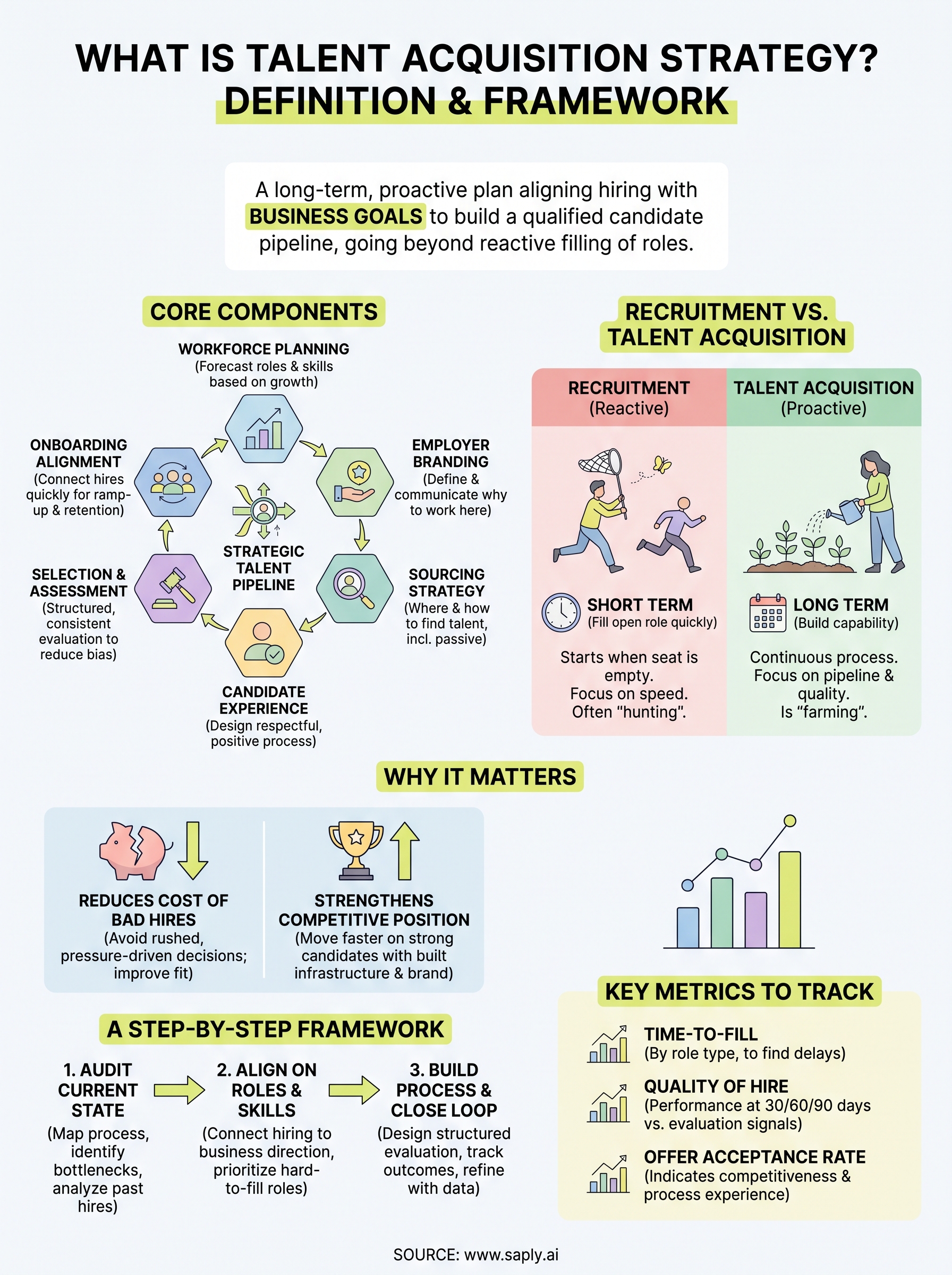
A talent acquisition strategy is not a single document or a checklist. It’s a system built from several interconnected parts that work together to fill roles faster and with better candidates. Understanding each component helps you see where your own process may have gaps.

The main components include:
- Workforce planning: Identifying what roles and skills the business will need based on growth projections, attrition rates, and market shifts
- Employer branding: Defining and communicating why someone would choose to work at the organization over a competitor
- Sourcing strategy: Deciding where and how to find candidates, whether through job boards, referrals, social platforms, or recruitment partnerships
- Candidate experience: Designing a hiring process that respects candidate time and reflects well on the organization from first contact through offer
- Selection and assessment: Building structured, consistent evaluation methods that reduce bias and improve hiring decisions
- Onboarding alignment: Connecting the hire to the role fast, so new employees ramp up quickly and stay longer
Each of these components feeds the others. Weak employer branding makes sourcing harder. A poor candidate experience undermines even the best sourcing efforts. When any piece is missing or inconsistent, the whole strategy underperforms.
How it connects to business goals
A talent acquisition strategy only works when it’s built around what the business actually needs, not just what HR or recruiters find convenient. That means starting with business priorities, not job descriptions. If the company plans to expand into a new market, the strategy needs to account for the skills and roles that expansion requires, often six to twelve months before those roles are posted publicly.
This connection to business goals is what separates strategic talent acquisition from transactional recruiting. When you understand the business direction, you can build talent pipelines proactively, advise hiring managers on realistic timelines, and make smarter decisions about where to invest sourcing effort. For staffing agencies, this means asking your clients the right questions upfront, not just collecting a job brief and pushing out CVs.
Practically speaking, aligning to business goals also means tracking outcomes beyond time-to-fill. You’re looking at quality of hire, retention at 90 days and one year, and whether the roles you filled actually moved the business forward. That’s how talent acquisition becomes a strategic asset rather than a support function.
Talent acquisition vs recruitment
Recruitment and talent acquisition are often used interchangeably, but they describe fundamentally different approaches to hiring. Recruitment focuses on filling a specific open role as quickly as possible. It starts when a vacancy appears and ends when someone accepts an offer. Talent acquisition is broader and continuous, encompassing recruitment but also including employer branding, workforce planning, pipeline building, and the long-term relationship management that makes future hiring faster and more targeted.

The core differences
The clearest way to understand the gap is to look at timeframe and intent. Recruitment operates in the short term: you have a need, you source candidates, you fill the role. Talent acquisition operates across months and years, building the infrastructure that makes each individual hire better than the last. When you only recruit reactively, every new opening feels like starting from scratch. When you invest in talent acquisition, you already know where strong candidates come from, what makes them stay, and how to reach them before they’re actively looking.
Recruitment fills seats. Talent acquisition builds the capability to fill the right seats faster, every time.
When each approach makes sense
Both approaches have legitimate uses, and the distinction matters when you’re advising clients or reviewing your own agency’s model. For high-volume, lower-skill roles with predictable turnover, a straightforward recruitment process often covers the need. Speed matters more than pipeline depth in those situations, and a structured sourcing and screening workflow handles it well without requiring a long-term strategy layer on top.
For specialized, senior, or hard-to-fill roles, the talent acquisition mindset pays off significantly. These are the positions where reactive hiring creates the most damage: long vacancy windows, inflated offers, and compromised hiring standards because the clock is running. A talent acquisition strategy addresses this by building relationships with passive candidates long before the role exists on paper. Understanding what is talent acquisition strategy at this level means recognizing that the investment made upfront consistently reduces both cost and friction when the need finally arrives.
For recruiters and staffing agencies, the practical takeaway is this: know which mode your client actually needs and structure your engagement accordingly. Treating every search as a pure recruitment sprint, regardless of role complexity, leaves meaningful long-term value on the table for both your clients and your own business.
Why a talent acquisition strategy matters
Understanding what is talent acquisition strategy matters because the difference between organizations that hire well and those that struggle often comes down to whether they’ve built a deliberate system or are simply reacting to each open seat as it appears. A reactive approach works until it doesn’t, and when it fails, the costs appear fast: unfilled roles slow down project delivery, rushed hires raise turnover, and client confidence in your agency drops. Building a strategy changes that equation entirely by giving every hiring decision a clear foundation to stand on.
It reduces the cost of a bad hire
Bad hires are expensive. Research from the U.S. Department of Labor estimates that a single bad hire can cost up to 30% of that employee’s first-year earnings. For specialized or senior roles, that number climbs considerably higher. A structured talent acquisition strategy reduces this risk by ensuring consistent evaluation criteria, better candidate fit, and stronger onboarding alignment from the start rather than patching gaps after the fact.
When you invest in building pipelines and refining your selection process, you stop making hiring decisions under pressure. Pressure-driven decisions are where most bad hires happen: a role has been open too long, the hiring manager is frustrated, and the next available candidate gets the offer regardless of fit. A strategy gives you the breathing room to avoid that trap and hold out for the right match.
It strengthens your position in competitive markets
In competitive hiring markets, the organizations with a strategy in place move faster and win more of the talent they actually want.
Speed matters in recruitment, but speed without structure just means filling seats faster with the wrong people. A talent acquisition strategy builds the infrastructure so you can act quickly on strong candidates without cutting corners on quality. When your sourcing channels are established, your employer brand is clear, and your evaluation process is consistent, time-to-fill drops without sacrificing the standard of who gets through.
For staffing agencies specifically, this is where your value compounds over time. Clients who see you placing well-matched candidates consistently will bring you more mandates and longer partnerships. That outcome doesn’t happen through effort alone. It happens because you’ve built a deliberate, repeatable system that performs reliably across different roles and hiring cycles.
The building blocks of a strong strategy
Before you can answer “what is talent acquisition strategy” for your own organization or your clients, you need to understand what actually holds one together. A strategy without strong foundational elements is just a plan on paper. The three core building blocks below are what separate a talent acquisition approach that delivers consistent results from one that relies on luck and timing.
Your employer brand and sourcing channels
Employer brand is how candidates perceive you or your client as an employer before they ever speak to a recruiter. It shapes whether strong candidates apply, respond to outreach, or refer others. If the employer brand is weak or undefined, every sourcing effort works harder than it needs to. You can post on every job board available and still lose top candidates to competitors who communicate their culture, values, and growth opportunities more clearly.
A strong employer brand doesn’t just attract more candidates. It attracts the right ones and reduces the time you spend screening out poor fits.
Sourcing channels are the specific places and methods you use to find candidates. The right mix depends on the roles you’re filling: job boards, employee referrals, LinkedIn, niche communities, or direct outreach to passive candidates. Knowing which channels consistently produce quality hires versus which drain time without results is something you can only learn by tracking your data over time.
Structured evaluation and a feedback loop
Structured evaluation means every candidate for a given role goes through the same assessment process, measured against the same criteria. This removes inconsistency from hiring decisions and gives you something to analyze when a hire doesn’t work out. Without structure, interviews become conversations and selection becomes guesswork, which makes it impossible to improve over time.
A feedback loop closes the circle between what you hire for and what actually produces strong performance on the job. This means collecting data on new hire performance at 30, 60, and 90 days and comparing it against the signals that predicted success in your evaluation process. When you find gaps, you adjust your criteria. When something predicts retention reliably, you weight it more heavily. Over time, your hiring process gets sharper and more accurate without adding complexity.
A step-by-step framework to build yours
Building a talent acquisition strategy doesn’t require starting from scratch. Most organizations already have parts of the puzzle in place and the goal is to connect those parts into a coherent system that runs consistently. The framework below gives you a practical sequence to follow, whether you’re building from the ground up or refining what already exists.
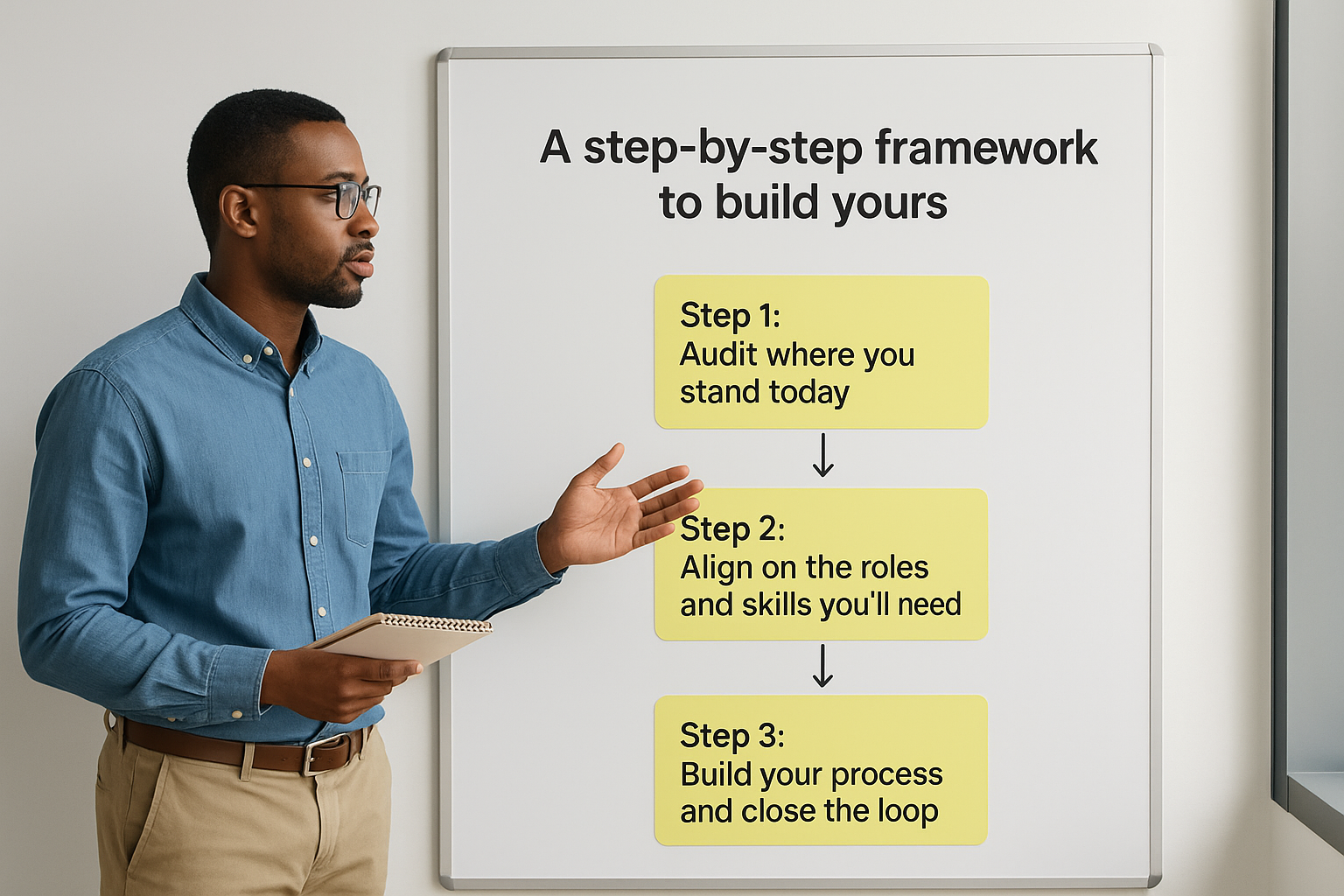
Step 1: Audit where you stand today
Before you can improve anything, you need an honest picture of how your hiring process currently works. Map out where candidates come from, how long each stage takes, and where strong candidates drop out. Look at your last 10 to 20 hires and identify which ones performed well and what those candidates had in common. This audit surfaces which parts of your process are working and which are creating friction before you invest effort in the wrong areas.
Pay attention to the stages where delays consistently occur. These bottlenecks are usually where your strategy needs the most attention first.
Step 2: Align on the roles and skills you’ll need
Once you understand where you stand, connect your hiring plan to the business direction, whether that’s your agency’s own growth or your client’s roadmap. Identify what roles will open in the next six to twelve months and which skill sets are hardest to source. This is workforce planning, and understanding what is talent acquisition strategy at its core means recognizing that this step is what separates proactive hiring from reactive scrambling.
Start sourcing before the pressure hits and you’ll consistently see better candidate quality and shorter time-to-fill.
Prioritize roles by business impact and difficulty to fill, not just by which ones have an open position today. Hard-to-fill roles need pipeline investment now, even if the hire is months away.
Step 3: Build your process and close the loop
With your priorities clear, design the evaluation and sourcing structure that every hire will move through. Define criteria for each role type, assign ownership for each stage, and identify which sourcing channels fit which position types. Then build a simple system for tracking outcomes after the hire. A 30/60/90-day check-in process gives you the data you need to refine your criteria over time without significant overhead.
Two hires into this system, the gains feel modest. Ten hires in, the pattern becomes clear: your screening sharpens, your sourcing mix improves, and your time-to-fill drops without any single dramatic change. That compounding improvement is what makes the framework worth building in the first place.
Metrics to track and how to improve
Knowing what is talent acquisition strategy means knowing how to measure whether yours is actually working. Tracking the right metrics gives you a clear signal on where your process is performing and where it’s quietly losing you time or quality. Without measurement, you’re making adjustments based on gut feel instead of data, and that’s the fastest way to build in blind spots that compound over time.
The metrics that matter most
Time-to-fill is the most commonly tracked metric, and for good reason. It tells you how long it takes from when a role is opened to when an offer is accepted. A rising time-to-fill signals a sourcing problem, a bottleneck in your evaluation stages, or a mismatch between your candidate pool and what the role actually requires. Track it by role type, not just as a single average across all positions, so you can see where the real delays live.
Quality of hire is harder to measure but far more valuable. Define it by setting specific performance criteria at 30, 60, and 90 days post-hire, then score new employees consistently against those benchmarks. When you connect quality of hire back to where a candidate came from and what signals they showed during evaluation, you start building a predictive model that improves every future hire.
The metrics you track define the decisions you make, so choose ones that connect directly to hiring outcomes, not just hiring activity.
How to use data to improve over time
Offer acceptance rate tells you whether your process is competitive at the final stage. A low acceptance rate often points to a compensation gap, a slow decision timeline, or a candidate experience that created doubt before the offer even landed. Each of these has a different fix, but you only find the right one by looking at the data alongside candidate feedback from declined offers.
Pipeline conversion rate by stage shows you exactly where candidates exit your process. If a high percentage of candidates drop off after the first interview, the problem is likely in how the role is being positioned or how the interview experience is structured. Review each exit point systematically and test one change at a time. Small, deliberate adjustments to specific stages produce cleaner insight than overhauling the entire process at once.
Next steps
Understanding what is talent acquisition strategy is the first step. Putting it into practice is where results actually happen. Start with the audit from Step 1, map your current process honestly, and identify the single biggest bottleneck in your pipeline. Fix that first before building anything else. Small, deliberate improvements compound faster than sweeping overhauls that never fully take hold.
For recruiters and staffing agencies, one of the fastest wins you can make right now is cutting the time spent on manual CV formatting and tailoring. Every hour your team spends reformatting documents is an hour taken away from sourcing, relationship-building, and the strategic work that actually closes placements. That’s exactly the problem Saply solves: it automates CV formatting and tailoring directly inside the tools you already use, so your team submits better candidates faster without adding steps to their workflow. Try it and see where your time goes instead.