
high-volume-recruiting-challenges
12 High Volume Recruiting Challenges And How To Solve Them
When your team needs to fill 50, 100, or 500 roles at once, every bottleneck in the process multiplies. Staffing agencies dealing with high volume recruiting challenges know this firsthand: a slow CV...
Written by: Saply Team
12 High Volume Recruiting Challenges And How To Solve Them
When your team needs to fill 50, 100, or 500 roles at once, every bottleneck in the process multiplies. Staffing agencies dealing with high volume recruiting challenges know this firsthand: a slow CV formatting step that costs five minutes per candidate suddenly eats up entire days. A weak screening process means hundreds of mismatched submissions clogging your pipeline. The margin for inefficiency shrinks fast when the volume goes up.
Most of these challenges aren’t new. Recruiters have wrestled with candidate quality, time-to-fill pressure, and inconsistent submissions for years. But scale changes the math. What works when you’re placing ten candidates a month breaks down completely at higher volumes, and the agencies that figure out how to streamline operations are the ones that win more client business. That’s exactly why we built Saply, to eliminate the manual CV formatting and tailoring bottleneck so recruiters can submit candidates faster without sacrificing quality.
This article breaks down 12 of the most common obstacles staffing teams face when recruiting at scale, along with practical solutions for each one. Whether you’re struggling with candidate drop-off, slow turnaround times, or inconsistent resume quality, you’ll find strategies you can put to work right away.
1. Manual CV formatting and tailoring slows submissions
Manual CV formatting is one of the most underestimated drains in high volume recruiting challenges. When you’re placing one or two candidates a week, spending 20 minutes reformatting a resume feels manageable. When that same process applies to 50 candidates, it stops being a minor inconvenience and becomes a serious operational bottleneck.

Why it happens in high-volume agency recruiting
Most staffing agencies receive CVs in every format imaginable: inconsistent fonts, missing sections, strange layouts, and outdated templates. Your clients expect a clean, branded document that matches your agency’s standard, so every raw CV needs to go through a manual transformation before it’s client-ready. That process typically involves copying content into a Word template, fixing spacing and headers, adjusting bullet points, and then tailoring the language to match the job description. Multiply that by dozens of candidates per day and you’re looking at a workflow that consumes hours of recruiter time that could go toward finding better talent or closing more placements.
What it costs in speed and quality
Speed is a competitive advantage in agency recruiting. When a client sends a job order, the first agency to submit a qualified, well-formatted candidate often wins the placement. Manual formatting slows that submission window, and it introduces inconsistency too. When different recruiters handle the same process differently, the output varies. One CV might be polished and tailored precisely to the job description while another is a loose reformatting job that doesn’t highlight the right skills. Inconsistent quality hurts your agency’s reputation with clients over time, even if individual submissions look acceptable in isolation.
The longer your formatting process takes, the more your submission speed suffers, and in a competitive market, slow submissions lose placements.
How to fix it with Saply inside existing tools
Saply integrates directly into Microsoft Word, Google Docs, and Outlook, so your recruiters don’t need to switch between applications or learn new software. With one click, Saply applies your agency’s custom CV template, aligns sections, and fixes typography automatically. The AI then tailors the CV to a specific job description, whether you paste it in manually or pull it from your ATS like Bullhorn or Carerix. Your recruiters spend their time reviewing and submitting, not reformatting from scratch.
Metrics to track after you streamline
Once you cut manual formatting out of the workflow, you need a few numbers to confirm the improvement is holding.
- Average CV preparation time per candidate (target: under 5 minutes from raw CV to client-ready)
- Submissions per recruiter per day (should increase measurably within the first two weeks)
- Client feedback scores on CV quality (track whether clients flag formatting issues less frequently)
- Time from job order received to first submission (a direct measure of your competitive submission speed)
2. Too many applicants and not enough recruiter hours
High volume recruiting challenges don’t stop at CV formatting. When a single job posting pulls in 300 to 500 applications overnight, your team faces a different problem entirely: there simply aren’t enough hours to give every applicant proper attention.
Why volume overload hits so fast
Modern job boards and ATS integrations make it easy to apply to dozens of roles with a single click. That low friction is great for candidates but brutal for recruiters. A well-distributed job posting can generate more applications in 48 hours than your team can realistically review in a week, and that backlog compounds fast when multiple roles are open simultaneously.
Where recruiters lose the most time
Most recruiters spend the bulk of their review time on applications that should have been filtered out automatically. Reading through unqualified submissions, cross-referencing requirements manually, and triaging by gut feel rather than structured criteria drains the hours that should go toward engaging top candidates. That means your best applicants often wait the longest for a response, which increases drop-off before you ever get them into the pipeline.
The candidates you most want to hire are also the ones with the most options, so slow follow-up costs you real placements.
How to triage the funnel without missing great talent
Set knockout questions at the application stage to remove clear mismatches before they hit a recruiter’s queue. Use your ATS to score and sort applicants by must-have criteria like availability, location, or specific certifications. Then assign reviewers to batches rather than letting the full queue pile up in one inbox. This keeps the process moving without forcing individual recruiters to carry the entire load.
Metrics to track after you streamline
- Application-to-review time (target: under 24 hours for initial triage)
- Qualified candidate rate (percentage of reviewed applicants who meet minimum criteria)
- Recruiter review capacity per day (number of applications each recruiter can process without quality dropping)
3. Screening breaks when you rely on resumes alone
Resumes give you a snapshot, not a full picture. When you’re working through high volume recruiting challenges, that snapshot becomes dangerously misleading at scale because candidates self-report their experience, skills, and achievements without any verification layer built into the document itself.
Why resume-only screening fails at scale
At low volume, a recruiter can compensate for resume gaps by asking the right questions during a quick call. At high volume, there isn’t time for exploratory conversations with every applicant, so decisions get made based on formatting, keywords, and gut feel. That approach lets underqualified candidates through while filtering out strong candidates who simply don’t know how to write a polished resume.
Resumes tell you what candidates want you to believe, not necessarily what they can deliver on day one.
What to screen for first in volume roles
Prioritize hard requirements that can be verified quickly: current right-to-work status, location relative to the role, specific certifications or licenses, and minimum years of relevant experience. These criteria either eliminate a candidate immediately or confirm they’re worth deeper review. Soft skills and cultural fit matter, but they belong later in the process when your pool is already narrowed.
How to standardize screening with knockout rules
Build knockout questions directly into your application form so your ATS removes clear mismatches before they reach a recruiter’s queue. Questions should be binary where possible: yes or no, pass or fail. Define the exact threshold for each role upfront with the hiring manager so your team applies consistent criteria across every applicant, not individual judgment calls that vary recruiter by recruiter.

Metrics to track after you streamline
- Knockout filter accuracy (percentage of filtered-out candidates who were genuinely unqualified)
- Screen-to-interview conversion rate (should rise when criteria are applied consistently)
- Average time spent per application review (target: under three minutes for initial pass/fail)
4. Low-quality applicants flood the top of the funnel
One of the most frustrating high volume recruiting challenges is opening your ATS each morning to find hundreds of new applications, most of which have no realistic chance of moving forward. The pipeline looks full on paper, but the actual work of finding qualified candidates hasn’t gotten any easier.
Why you attract the wrong applicants
Broad job postings attract broad audiences. When your job title is generic, your requirements are vague, or your listing appears on every aggregator by default, you pull in applicants who are spraying applications across dozens of roles without reading the details. Vague language in job descriptions is the single biggest driver of irrelevant applications, because it leaves candidates to self-qualify against criteria they can’t clearly see.
A job posting that tries to appeal to everyone ends up attracting the wrong people and buries the right ones.
How low-quality volume hides good candidates
When your queue fills with unqualified submissions, reviewers burn through energy and attention on candidates who should never have applied. By the time a strong candidate’s application appears, the recruiter reviewing it has already spent an hour on mismatches and is more likely to make a rushed or inconsistent decision. Volume without quality actively degrades the process rather than just adding work to it.
How to tighten targeting without shrinking pipeline
Rewrite job descriptions with specific, verifiable requirements upfront: exact experience levels, required certifications, location or travel expectations, and compensation range where possible. Use targeted job boards for specialized roles instead of defaulting to the broadest distribution options. Adding a short, role-specific screening question to the application form also filters out low-effort applicants who won’t complete even one extra step.
Metrics to track after you streamline
- Application-to-qualified-candidate ratio (a lower ratio signals better targeting)
- Source quality score (track which boards deliver the highest percentage of qualified applicants)
- Time-to-first-qualified-submission (tighter targeting should reduce this measurably)
5. Hiring manager bottlenecks stall decisions
Hiring manager delays are one of the most persistent high volume recruiting challenges agencies face, and they’re also one of the hardest to control because the bottleneck sits outside your team. When decision-makers are slow to review CVs, give feedback, or approve submissions, your carefully built pipeline stalls regardless of how efficiently your recruiters work.
Why feedback and approvals slow down
Hiring managers are typically juggling their core job responsibilities alongside the recruitment process. They didn’t sign up to be full-time reviewers, and when volume spikes, their response times drop accordingly. Without a defined SLA or deadline, feedback on submitted candidates often slips to the bottom of their priority list.
The faster your recruiters move, the more visible the hiring manager delay becomes, and that gap is where placements are lost.
Where handoffs break most often
Most breakdowns happen at two specific points: the moment you send a CV shortlist and the moment you wait for post-interview feedback. Without a structured handoff, submissions land in an inbox and sit there. No clear owner, no deadline, no follow-up trigger means the process stalls silently until your candidate accepts an offer elsewhere.
How to set service levels and decision rules
Define a response SLA upfront with every hiring manager before submissions begin. A 24 to 48-hour feedback window is a reasonable standard for high-volume roles. Set an automatic follow-up prompt in your ATS so nothing slips past the deadline without a nudge. When you agree on decision criteria in advance, like a defined shortlist size and a pass/fail scoring system, managers can review faster because they’re not deliberating from scratch on each candidate.
Metrics to track after you streamline
- Hiring manager response time (target: under 48 hours from submission)
- Feedback completion rate (percentage of submitted CVs that receive structured feedback)
- Decision-to-offer cycle time (measures how long approvals take once a finalist is identified)
6. Interview scheduling becomes a full-time job
Interview scheduling sounds like a minor logistical task until you’re coordinating 30 candidates across multiple hiring managers for the same role. At that scale, back-and-forth emails and calendar conflicts turn a simple step into one of the biggest high volume recruiting challenges your team faces.
Why back-and-forth scheduling kills momentum
Every exchange in a scheduling thread adds hours to your time-to-interview. A recruiter sends three available time slots, a candidate responds with a conflict, a new set of options goes out, and a day disappears before anyone sits down together. When you multiply that cycle across dozens of open roles, scheduling overhead compounds quickly and pulls recruiters away from work that actually moves placements forward.
The more rounds it takes to confirm an interview, the more likely a strong candidate accepts a competing offer before you get them in the room.
How delays increase ghosting and drop-off
Candidates in active job searches lose enthusiasm fast. When interview confirmation takes three or four days, their attention shifts to employers who moved faster. High-intent candidates interpret slow scheduling as a signal about how the organization operates, and many disengage before the conversation even starts.
Drop-off rates spike at the scheduling stage precisely when candidates are closest to a decision, which means slow scheduling doesn’t just cost time, it costs real placements.
How to move to self-scheduling and group slots
Self-scheduling tools let candidates book directly into pre-approved calendar slots without recruiter involvement. For high-volume roles, group interview slots or structured assessment days let you process multiple candidates in a single block, reducing total scheduling overhead without reducing interview quality.

- Send scheduling links in the initial outreach, not after a separate confirmation step
- Build recurring calendar blocks so hiring managers stay consistently available
- Use real-time calendar sync to prevent double-booking across your team
Metrics to track after you streamline
- Time-to-interview (from application to first interview date)
- Scheduling confirmation rate within 24 hours
- Interview drop-off rate (percentage of candidates who don’t show after confirming)
7. Candidate ghosting spikes during fast hiring cycles
Ghosting turns invested recruiter time into wasted effort. Fast hiring cycles push this risk higher because candidates in active searches apply to multiple roles simultaneously and commit to whoever responds fastest. Every hour your process stalls is an hour a competitor uses to close that candidate instead.
Why candidates disappear in volume hiring
When communication drops off for even a day, a competing offer fills the space. Most candidates won’t hold out for a process that feels slow or disorganized when another employer is already moving them toward an offer.
Your silence signals uncertainty on the candidate’s side. Parallel applications mean their commitment is conditional until someone gives them a clear, specific reason to stop looking elsewhere.
The faster your market moves, the shorter your window to keep a candidate engaged before they accept something else.
What signals predict a ghost
Watch for slow replies, vague confirmations like “I think so”, and multiple reschedule requests. These behaviors tell you the candidate is treating your process as a backup option while waiting for something better to close.
No-show rates spike sharply when candidates feel no urgency to commit. Spotting these signals early lets you prioritize re-engagement before they disappear entirely from your pipeline.
How to build confirmation and re-engagement loops
Send a clear confirmation message immediately after every stage transition, including a specific next step and a firm deadline. If a candidate doesn’t reply within 24 hours, trigger an automatic follow-up so nothing falls through without a nudge.
Short, direct communication between stages reduces the mental space candidates need to drift toward competing offers. Consistency in your messaging signals that your process is organized and worth their continued time and attention.
Metrics to track after you streamline
- Ghost rate by stage (identifies where drop-off concentrates in your funnel)
- Confirmation response time (target: under 24 hours from your outreach)
- Re-engagement recovery rate (percentage of non-responsive candidates you successfully bring back)
8. Candidate experience turns impersonal and inconsistent
Scaling your recruitment operation introduces one of the more subtle high volume recruiting challenges: candidates start to feel like ticket numbers rather than people. When your team processes hundreds of applications at once, individual communication quality drops, and candidates notice faster than you expect.
Why high volume feels transactional to candidates
When recruiters send the same generic status emails to every applicant, the process starts to feel like an automated assembly line. Candidates don’t expect a hand-written letter, but they do expect to know where they stand and what happens next. When that clarity disappears, they assume disorganization and start looking elsewhere.
A candidate who feels ignored doesn’t wait around, they move to the employer who made them feel like a priority.
Where experience breaks across channels
Most breakdowns happen at transition points between stages: after application submission, after interview, and after offer. These gaps are where communication goes silent, different recruiters send conflicting messages, and candidates receive inconsistent information about timelines and expectations. The experience fractures not because your team is careless but because there’s no structured handoff linking each stage together.
How to keep communication clear, fast, and human
Build templated but specific message sequences for each stage transition so every candidate receives consistent, timely updates regardless of which recruiter handles their file. Add the candidate’s name, the role title, and the next concrete step to every message. Brief and specific communication outperforms lengthy generic updates every time, and it takes no additional effort once the templates are built correctly.
Metrics to track after you streamline
- Candidate satisfaction score (collect via a short post-process survey)
- Communication gap rate (percentage of candidates who go more than 48 hours without an update)
- Stage-to-stage drop-off rate (identifies where experience failures cause candidates to disengage)
9. Offer and pay alignment issues derail close rates
Late-stage offer failures are one of the most demoralizing high volume recruiting challenges your team can face. You’ve invested time screening, formatting CVs, scheduling interviews, and managing communication, and then the deal collapses because the salary expectation was never confirmed with the client upfront.
Why offers fall apart late in the funnel
Candidates drop out at the offer stage when the number on the table doesn’t match what they were led to expect. This disconnect happens most often when compensation details stay vague through the early funnel stages. Recruiters sometimes avoid locking in specifics to keep candidates moving forward, but that approach creates a gap that closes against you at the worst possible moment.
The further a misaligned offer travels through your funnel, the more recruiter time it wastes when it finally falls apart.
How misalignment shows up in agency submissions
In agency recruiting, pay rate disagreements surface between three parties: the candidate, your agency, and the client. Clients sometimes shift their budget expectations after the search has started, or candidates revise their requirements once they receive a formal offer. Neither scenario is rare, and both are significantly easier to prevent than to recover from once an offer is declined.
How to lock requirements and ranges early
Confirm the exact pay range and key offer terms with your client before your first submission goes out. On the candidate side, get a confirmed number in writing during the initial screening call, not just a rough range. Revisit both figures before you submit a finalist to make sure nothing has shifted since your first conversation.
Metrics to track after you streamline
- Offer acceptance rate (a consistent drop signals misalignment happening earlier in the process)
- Offer-to-decline reason tracking (flag how often pay is cited as the reason)
- Salary confirmation completion rate (percentage of candidates with a locked rate before submission)
10. Compliance and documentation risks increase at scale
Compliance is easy to overlook when you’re focused on filling roles fast, but high volume recruiting challenges include a legal and operational layer that gets harder to manage as submission counts rise. The faster your team moves, the more gaps appear in your documentation trail.
Why volume hiring creates audit gaps
When recruiters process hundreds of candidates at pace, critical documentation steps get skipped or delayed. Equal opportunity records, consent forms, right-to-work checks, and rejection rationale often live in individual inboxes rather than centralized systems. Without a structured process, your agency can fail an audit not because you did anything wrong but because you can’t prove you did anything right.
The documentation gaps that seem minor during a busy hiring sprint become major liabilities if a candidate files a complaint or a client demands a compliance review.
What to document for a defensible process
Every candidate record should capture the same core information regardless of who handles it. The following items belong in every file before a candidate is closed out:
- Screening decision and the specific criteria applied
- Right-to-work verification with date and document type
- Consent to store and share personal data
- Interview notes tied to role-specific competencies, not personal characteristics
- Rejection reason mapped to job requirements, not subjective preference
How to build lightweight compliance into workflows
The most effective compliance systems don’t add separate steps, they embed checkpoints inside the steps your team already takes. Use ATS fields to make documentation mandatory before a candidate moves to the next stage. Assign a single owner for compliance spot checks each week, not quarterly, so gaps surface while the work is still fresh and correctable.
Metrics to track after you streamline
- Documentation completion rate (percentage of closed candidates with full records)
- Compliance audit score (internal or external review pass rate)
- Time to remediate flagged records (how quickly your team corrects gaps when identified)
11. Data gets messy and you lose source and funnel clarity
Tracking breaks quietly in high volume recruiting challenges. When your team is moving fast across multiple roles and platforms, data entry becomes inconsistent, source attribution disappears, and your funnel reports stop reflecting what’s actually happening in your pipeline.
Why recruiting data breaks in high-volume workflows
Most data problems start with inconsistent input at the recruiter level. When team members log candidates differently, skip source fields, or create duplicate records under separate contact entries, your reporting becomes unreliable almost immediately. By the time you try to analyze what’s working, the underlying data is too messy to trust.
Clean data doesn’t happen by accident at scale. It requires structure at the point of entry, not a cleanup effort weeks later.
Which dashboards matter most for volume recruiting
You don’t need a complex analytics setup to make better decisions. Focus on three core views: source performance by qualified candidate rate, funnel conversion at each stage, and time-in-stage by role. These three data points tell you where good candidates come from, where they’re falling out of your process, and which stages are creating the most delay.

How to clean tracking and make decisions faster
Standardize your ATS fields so that source, stage, and rejection reason are required entries before a candidate record advances. Assign one person to run a weekly data audit rather than waiting for quarterly reviews when fixing gaps becomes far harder. Reducing the number of open-text fields in favor of dropdown selections removes the variability that corrupts your reporting over time.
Metrics to track after you streamline
- Source-to-hire rate (which channels produce candidates who actually get placed)
- Funnel conversion rate by stage (where volume drops most sharply)
- Data completeness score (percentage of records with all required fields filled)
12. Onboarding gaps cause early churn and rework
Filling a role quickly is only half the job. When onboarding fails, placements fall apart within the first few weeks, and your team absorbs the full cost of starting over. This is one of the most overlooked high volume recruiting challenges because the damage shows up after the placement closes, not during the process itself.
Why fast hires quit fast without support
Candidates placed through fast-moving cycles often arrive on day one without clear expectations, proper introductions, or a structured first week. Unclear role expectations and the absence of early manager contact are the two most common reasons new hires disengage before they’ve had a chance to settle in. When your placement walks out, the client calls you to refill the role at your agency’s expense.
A placement that quits in week two costs your agency far more than a slower but better-supported hire would have.
What a minimum viable onboarding should include
You don’t need an elaborate program to reduce early churn. A structured first-week checklist shared between your agency and the client covers most of the risk. That checklist should confirm role clarity, assign a day-one point of contact, and schedule a 30-day check-in between the placed candidate and their manager.
- Confirmed start date, location, and reporting line sent before day one
- Designated contact person for the candidate’s first week
- Scheduled 30-day review to surface issues before they become exits
How agencies and clients can reduce day-one fallout
Your agency can reduce fallout by staying in contact with the placed candidate during the first two weeks rather than closing the file on offer acceptance. A brief check-in call at day three and day fourteen gives you early warning before a candidate decides to leave quietly.
Metrics to track after you streamline
Track these numbers to confirm your onboarding improvements are holding across all active placements.
- 30-day retention rate (percentage of placements still in role after one month)
- Early exit rate (placements who leave within the first 30 days)
- Client satisfaction score post-placement (tracks whether onboarding quality reflects on your agency’s reputation)
What to do next
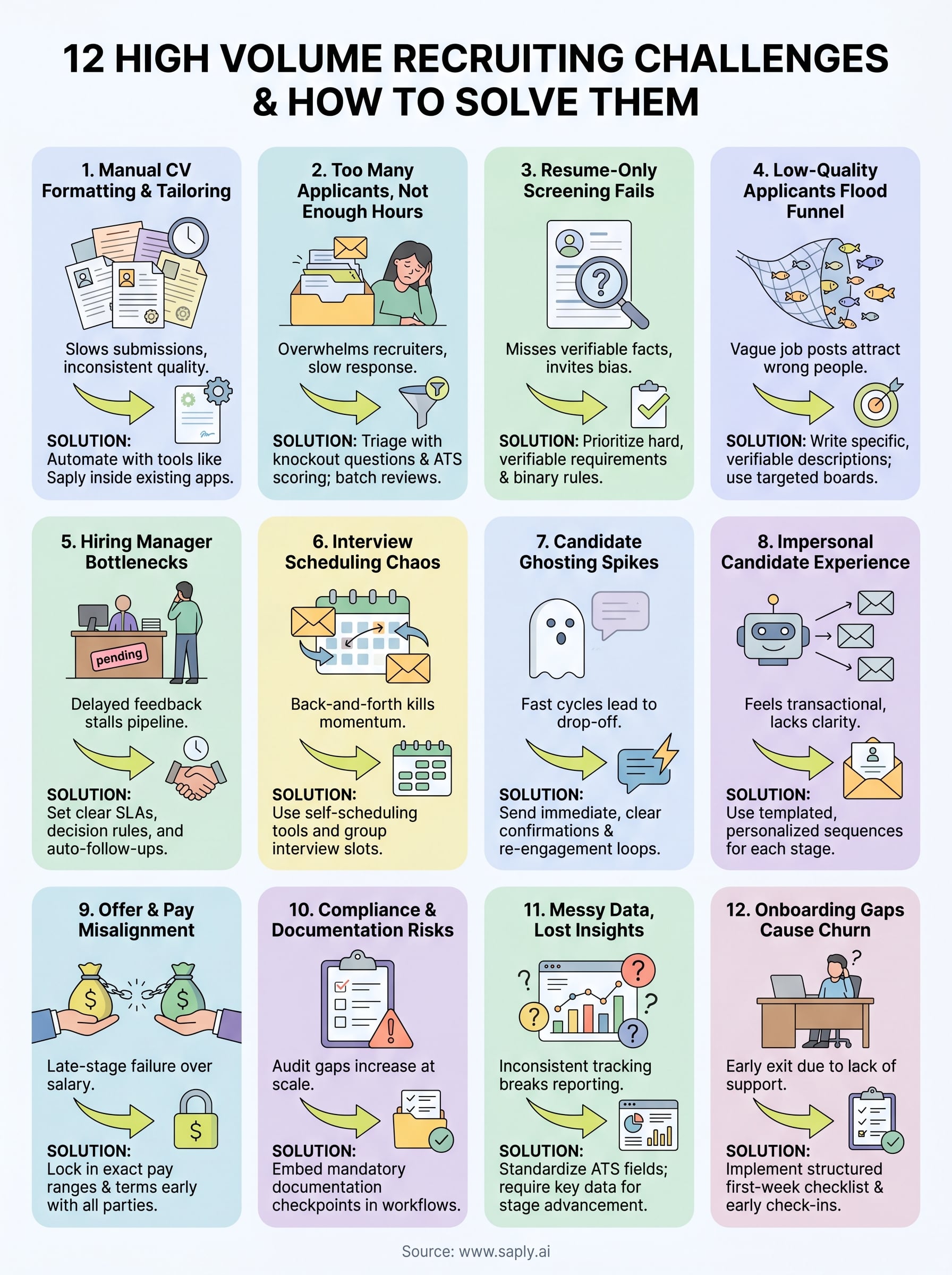
The 12 high volume recruiting challenges covered in this article each have a specific fix, but they all share a common thread: the more manual your process, the more it breaks under pressure. Fixing one bottleneck helps, but addressing the full stack from CV preparation to onboarding follow-up is what separates agencies that scale cleanly from those that stay stuck in reactive mode.
Start with the challenge that costs your team the most time right now. For most staffing agencies, that’s CV formatting and tailoring, the step that slows every submission before a candidate even reaches the client. Removing that bottleneck creates immediate capacity your recruiters can redirect toward higher-value work.
If you want to see how automation handles that specific problem inside the tools your team already uses, explore how Saply works and start a free 14-day trial with no credit card required.