
how-to-handle-high-volume-recruiting
How To Handle High-Volume Recruiting: 10 Ways That Scale
When your agency has 200 open roles and a dozen recruiters juggling candidates across all of them, figuring out how to handle high volume recruiting becomes less of a nice-to-know and more of a surviv...
Written by: Saply Team

How To Handle High-Volume Recruiting: 10 Ways That Scale
When your agency has 200 open roles and a dozen recruiters juggling candidates across all of them, figuring out how to handle high volume recruiting becomes less of a nice-to-know and more of a survival skill. The difference between agencies that scale and those that stall usually comes down to one thing: how much of the repetitive work they’ve managed to eliminate.
The bottlenecks are predictable. Formatting CVs to client templates, tailoring resumes to job descriptions, screening candidates against requirements, these tasks eat hours every week and multiply fast when req counts climb. Left unchecked, they slow down submissions, burn out recruiters, and cost you placements. The agencies winning at volume aren’t just working harder; they’re building systems that remove friction from every stage of the pipeline.
That’s exactly the problem we solve at Saply. Our AI-powered CV formatting and tailoring plugin sits inside the tools recruiters already use, Word, Google Docs, Outlook, and major ATS platforms, so your team can prepare and submit candidates faster without switching between apps or doing manual copy-paste work. Below, we’re sharing 10 proven strategies to help your agency handle high-volume recruiting without sacrificing speed or candidate quality.
1. Use Saply to format and tailor CVs fast
When you’re working through how to handle high volume recruiting, CV preparation is the first place to look for wasted time. Formatting and tailoring are two of the most repetitive tasks in any recruiter’s day, and at scale, they compound into dozens of hours lost every week. Saply removes that bottleneck by automating both tasks directly inside the tools your team already uses.
What it solves at scale
Manual CV formatting is a hidden productivity killer. Every time a recruiter copies a candidate’s resume into a company template, adjusts fonts, fixes sections, and rewrites bullets to match a job description, they’re spending 20 to 45 minutes on a single document. Multiply that by 15 to 20 submissions a week per recruiter, and the math gets painful fast.
At scale, CV prep alone can account for 30% or more of a recruiter’s weekly working hours before they’ve made a single client call.
Saply’s AI analyzes the job description and tailors the candidate’s CV to match it, surfacing relevant experience, adjusting language, and flagging skill gaps in one click. Your recruiters spend that saved time building relationships instead.
Steps to put it in place
Start by connecting Saply to your existing tools. The plugin integrates directly with Microsoft Word, Google Docs, Outlook, Bullhorn, Carerix, and Spott, so your team doesn’t need to log into a new platform or change how they work. Setup takes minutes, not days.
Then upload your agency’s CV template and Saply will replicate it exactly within 48 hours. From that point, every CV your team formats aligns to your brand automatically. You can also pull job descriptions directly from your ATS, so tailoring triggers without any manual input from your recruiters.
Metrics to watch
Track time-per-CV as your primary benchmark. If your team averages 30 minutes per document before Saply, you should see that number drop within the first two weeks. Also monitor submission volume per recruiter week over week, since more formatted CVs per day means more candidates in front of clients.
Your placement conversion rate is the longer-term signal to watch. Tailored CVs that precisely match job requirements give hiring managers fewer reasons to pass, and that improvement shows up in your conversion data within a billing cycle.
2. Start with a hiring plan you can execute
Jumping into high-volume hiring without a clear plan means your team spends time reacting instead of executing. A structured hiring plan defines how many roles you need to fill, which timelines are realistic, and who owns each stage of the process before the first application arrives.

What it solves at scale
When you’re working through how to handle high volume recruiting, chaos usually starts at the planning stage. Without defined targets and ownership, recruiters pull in different directions, duplicating effort on some roles while neglecting others entirely. A clear hiring plan gives every person on your team a shared reference point and stops those gaps from forming before they cost you placements.
Agencies that define hiring targets and role priorities before sourcing begins consistently close positions faster than those that plan reactively.
Steps to put it in place
Map your open roles by priority and deadline before your team starts sourcing. Assign each role a hiring manager, a target fill date, and a recruiter owner so accountability is clear from day one. Then set weekly submission targets per recruiter based on realistic capacity rather than aspirational numbers, so your pipeline keeps moving without burning people out.
Review your plan weekly during high-volume periods and adjust targets if role complexity or candidate availability shifts. A plan that adapts is far more useful than one that becomes outdated after the first week.
Metrics to watch
Track time-to-fill per role against the targets you set during planning. If a specific role consistently misses its deadline, that signals the plan needs adjustment. Also monitor recruiter workload distribution to keep capacity balanced across your team.
3. Standardize roles, requirements, and job titles
Inconsistent job titles and shifting requirements create invisible drag across your entire pipeline. When each recruiter writes their own version of the same role, you end up with duplicate sourcing efforts, inconsistent screening, and candidates who don’t match what your client actually needs. Standardization removes that friction before it starts.
What it solves at scale
One of the core challenges in how to handle high volume recruiting is keeping everyone aligned on what a role actually requires. When requirements drift between recruiters or postings, your screening criteria become unreliable, and you waste time reviewing candidates who were never a real fit in the first place.
Agencies with standardized role libraries fill positions faster because every recruiter starts from the same baseline rather than rebuilding requirements from scratch each time.
Steps to put it in place
Build a role library that captures approved job titles, core requirements, and must-have qualifications for every position type your agency fills regularly. Lock down the titles so they match what candidates search for, which keeps your pipeline relevant. Then review and update the library quarterly so requirements reflect current market conditions rather than outdated expectations.
Pair each role definition with a knockout criteria list so screening decisions stay consistent regardless of which recruiter handles the role.
Metrics to watch
Track screening pass rates by role to spot inconsistencies. If one recruiter advances 60% of applicants for a role and another advances 15%, your standards are drifting. Also watch time-to-shortlist, since standardized requirements should compress that number noticeably.
4. Make the application fast, mobile, and accessible
A long, clunky application process quietly kills your candidate pool before sourcing even has a chance to work. When you’re figuring out how to handle high volume recruiting, friction at the application stage is one of the fastest ways to shrink the top of your funnel and lose candidates you never even knew you had.

What it solves at scale
Most candidates today apply on mobile devices, often during a commute or a lunch break. If your application requires desktop access or takes more than five minutes to complete, a large portion of your potential pool never makes it through. At scale, that drop-off translates directly into fewer qualified candidates and slower fills.
Reducing your application to only the fields you need at the screening stage can meaningfully increase completion rates across your entire candidate pool.
Steps to put it in place
Trim your application to essential fields only and save the deeper qualification questions for the screening call. Then test the entire flow on a mobile device yourself to catch friction points before candidates do. A few targeted changes make a measurable difference:
- Remove any field that isn’t needed before initial screening
- Enable CV upload or LinkedIn import to cut manual data entry
- Check load time on mobile before launching any new posting
Metrics to watch
Track application completion rate as your primary signal. If candidates start but don’t finish, something in the form is creating friction worth removing.
Also monitor application source by device to confirm your mobile experience converts as well as desktop. A visible gap between the two rates points directly to a formatting or load-time issue worth fixing before it costs you placements.
5. Build a sourcing mix that keeps quality high
Relying on a single sourcing channel is one of the fastest ways to hit a quality ceiling when volume climbs. A diversified sourcing mix keeps your pipeline full without sacrificing the candidate standard your clients expect, which is exactly what makes it a key part of how to handle high volume recruiting at scale.
What it solves at scale
Leaning too heavily on one job board or referral source creates real concentration risk. When that channel dries up or gets flooded with low-fit applicants, your entire pipeline stalls. Spreading sourcing across multiple channels gives you consistent inflow and lets you cut underperforming sources without losing momentum.
Agencies with three or more active sourcing channels fill high-volume roles faster and with fewer rescreens than those that rely on a single pipeline.
Steps to put it in place
Start by auditing where your best recent hires actually came from rather than where you post most often. Those two answers are rarely the same. Then build a sourcing plan that balances passive channels like LinkedIn with active outreach to your existing candidate database, referrals, and niche boards relevant to the roles you fill most often.
- Track source by role type, not just overall volume
- Set a minimum of three active channels per role category
- Review channel performance monthly and reallocate effort accordingly
Metrics to watch
Watch source-to-hire rate for each channel you use. This tells you which sources consistently produce candidates who make it through to placement rather than dropping out mid-funnel.
Also track cost-per-quality-applicant so you can justify where to invest sourcing budget each quarter and cut channels that generate noise without results.
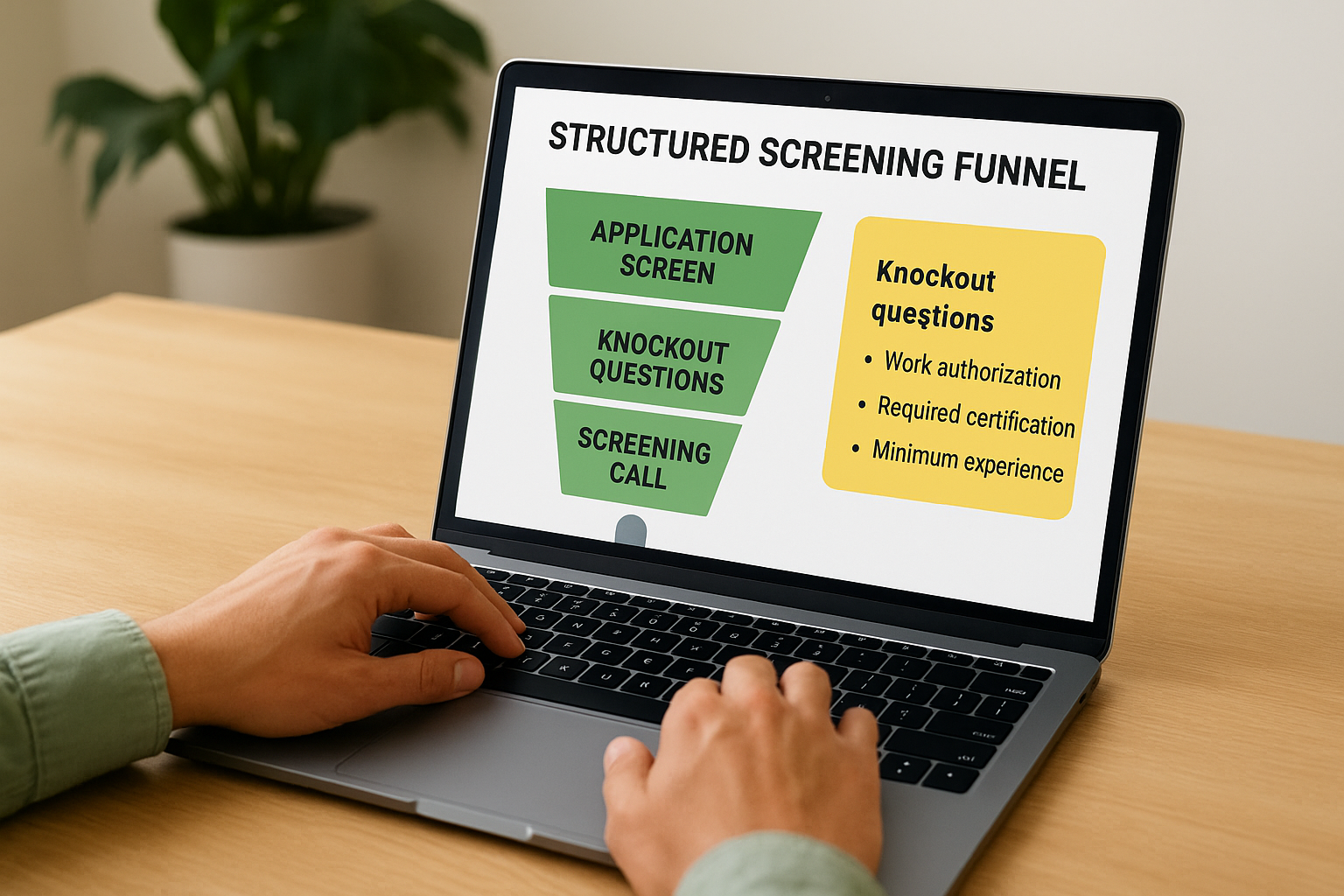
6. Screen with a structured funnel and knockouts
Unstructured screening is one of the most common reasons high-volume pipelines collapse under their own weight. When each recruiter decides what good looks like on the fly, your team wastes time reviewing candidates who should have been filtered out at the first step, which is a core problem in how to handle high volume recruiting efficiently.
What it solves at scale
Knockout questions at the top of your funnel do the sorting work before any recruiter has to read a single CV. When you define clear disqualifying criteria upfront, whether that is work authorization, required certifications, or minimum experience, candidates who don’t meet the floor exit the process automatically rather than clogging your pipeline.
A structured screening funnel cuts the time your team spends on unqualified applicants and sharpens the quality of every shortlist you deliver to a client.
Steps to put it in place
Set two to four knockout criteria for each role before sourcing opens. These should reflect genuine dealbreakers, not preferences. Then build a consistent screening scorecard so every recruiter evaluates the same dimensions in the same order. Pair the scorecard with a brief screening call template to keep conversations focused and time-bounded across your team.
Metrics to watch
Track your screen-to-shortlist ratio to confirm your knockouts are removing the right candidates rather than cutting too deep or too shallow. Also monitor time-per-screen per recruiter, since a well-designed funnel should compress that number as the team builds familiarity with the criteria.
7. Automate scheduling and high-volume interviews
Manual scheduling is one of the most time-consuming parts of high-volume recruiting that most agencies address last. When your team is coordinating dozens of interviews per week, back-and-forth emails and calendar conflicts become a serious drag that slows your entire pipeline.
What it solves at scale
Scheduling manually at volume means each recruiter loses significant time on calendar coordination that adds no strategic value. When a candidate waits two days for a confirmed interview slot, drop-off rates climb and your time-to-fill extends unnecessarily.
Automating interview scheduling alone can recover several hours per recruiter each week, time that goes directly back into sourcing and relationship-building.
Steps to put it in place
Connect a scheduling tool that lets candidates self-book into available slots without back-and-forth communication. For roles with high applicant volumes, consider pre-recorded video screening as a first-round filter before any live interview takes place, which keeps your team focused on candidates who already meet baseline criteria.
- Send automated calendar invites with all relevant details included
- Use structured interview templates so every interviewer covers the same ground
- Set automated reminders 24 hours before each scheduled interview to reduce no-shows
Metrics to watch
Track scheduling-to-interview time as your core benchmark, meaning the gap between a recruiter confirming a candidate and the interview actually taking place. This number tells you exactly how much friction your current process still carries when figuring out how to handle high volume recruiting at speed. Also watch no-show rates to confirm your reminder cadence is working as intended.
8. Run a communication cadence that prevents drop-off
Candidate drop-off is one of the most preventable problems in how to handle high volume recruiting, yet most agencies only notice it after a strong candidate has already gone silent. Proactive communication keeps candidates engaged and reduces the gap between screening and placement.
What it solves at scale
When candidates don’t hear back after an interview or application, they move on. At high volume, silent gaps in your pipeline cost you candidates who were genuinely interested but received a faster response from a competitor. A consistent communication cadence removes that uncertainty and keeps your agency top of mind throughout the process.
Agencies that send structured status updates at every stage of the hiring process report significantly lower candidate withdrawal rates than those that communicate only when a decision is made.
Steps to put it in place
Map every touchpoint in your hiring funnel and assign a communication trigger to each one, from application confirmation to post-interview follow-up. Then build simple templates for each stage so your recruiters send consistent messages without drafting from scratch every time. A few steps worth prioritizing:
- Send an automated confirmation within minutes of receiving an application
- Follow up within 24 hours after any interview to confirm next steps
- Set a weekly check-in for candidates in active pipelines lasting longer than two weeks
Metrics to watch
Track candidate withdrawal rate by stage to identify exactly where drop-off happens most. Also monitor average response time between recruiter and candidate touchpoints, since faster responses directly correlate with lower withdrawal rates across your pipeline.
9. Protect quality and fairness with standard scoring
Speed is only valuable in how to handle high volume recruiting if the candidates you move forward are actually the right fit. Without a consistent scoring framework, quality decisions become subjective and inconsistent, and your clients notice the difference quickly.
What it solves at scale
When different recruiters apply different personal standards to the same role, your shortlists become unreliable. Unconscious bias and individual preferences creep into decisions that should be based on clearly defined criteria. At volume, those inconsistencies multiply across hundreds of evaluations and produce shortlists that vary wildly in quality depending on who handled the screen.
Standardized scoring removes the guesswork and ensures every candidate gets evaluated against the same criteria, regardless of which recruiter owns the role.
Steps to put it in place
Build a scoring rubric for each role category that assigns weighted values to the criteria that matter most, such as relevant experience, required certifications, and communication quality. Share the rubric with every recruiter before sourcing opens and require them to complete it for each candidate they advance. A few steps that reinforce consistency:
- Calibrate scores weekly during ramp-up so recruiters align on what a 3 versus a 5 looks like in practice
- Require two reviewers for borderline candidates to reduce single-point bias
- Document score rationale for every candidate who advances or exits the funnel
Metrics to watch
Track inter-rater reliability between recruiters scoring the same candidate pool. A significant gap in scores points to a calibration problem worth addressing. Also watch offer acceptance rates by recruiter to surface any patterns in shortlist quality over time.
10. Tighten offers, onboarding, and early retention
The final stage of how to handle high volume recruiting is where agencies lose placements they already earned. A slow offer process or a disorganized onboarding experience tells a candidate everything they need to know about what working through your agency feels like, and many will walk away before they ever start.
What it solves at scale
Offer delays and clunky onboarding paperwork are two of the most common reasons placed candidates withdraw or churn within the first 30 days. At high volume, even a 5% early attrition rate translates into dozens of lost placements per quarter and damaged client relationships that take much longer to repair.
Agencies that move from verbal offer to signed agreement within 24 hours consistently see lower candidate withdrawal rates than those that allow that window to stretch beyond 48 hours.
Steps to put it in place
Prepare your offer documentation before you reach the verbal stage so nothing slows the close once a client approves a candidate. Digitize all onboarding paperwork so candidates can complete it from any device without waiting for physical forms. A few steps worth locking in:
- Set a 24-hour target for moving from verbal offer to written confirmation
- Send a pre-start welcome message with first-day logistics at least 48 hours before the start date
- Schedule a 30-day check-in with every placed candidate to surface issues early
Metrics to watch
Track offer-to-acceptance time and early attrition rate within the first 90 days. Both numbers tell you where your post-placement process still has gaps worth closing.
Final takeaways
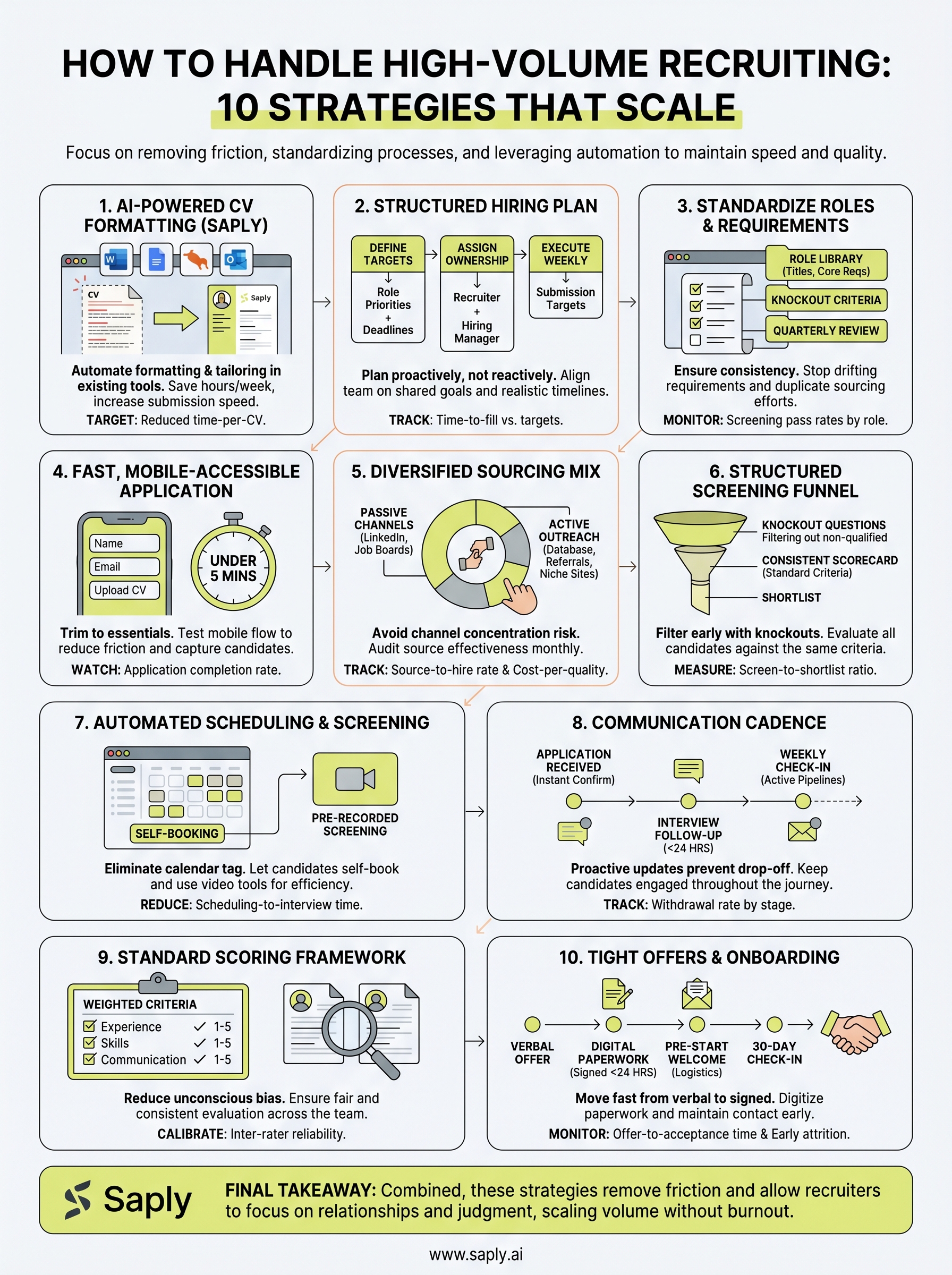
Knowing how to handle high volume recruiting comes down to removing friction at every stage, not just one or two. Each strategy in this list targets a specific point where time gets lost, candidates drop off, or quality slips under pressure. Apply them together and the compounding effect is significant: faster submissions, stronger shortlists, and fewer placements lost at the finish line.
Your recruiters are most valuable when they focus on relationships and judgment, not on reformatting CVs or chasing calendar slots. The agencies that scale without burning out their teams are the ones that automate the repetitive work and protect their people’s time for the decisions that actually require human judgment.
If CV formatting and tailoring is where your team loses the most time, start a free 14-day trial with Saply and see how much capacity you recover in the first week alone.