
how-to-run-a-staffing-agency
How To Run A Staffing Agency: Operations, Sales & Scaling
Knowing how to run a staffing agency goes beyond placing candidates in open roles. It means building a business that can win clients, move faster than competitors, and scale without drowning in admin...
Written by: Saply Team
How To Run A Staffing Agency: Operations, Sales & Scaling
Knowing how to run a staffing agency goes beyond placing candidates in open roles. It means building a business that can win clients, move faster than competitors, and scale without drowning in admin work. Whether you’re launching from scratch or tightening up an agency that’s already in motion, the operational details are what separate firms that grow from firms that stall.
The staffing industry rewards speed and consistency. Clients expect formatted, role-ready candidate submissions within hours, not days. Recruiters juggle sourcing, outreach, interviews, and compliance, all while manually reformatting CVs and tailoring them to each job description. That grind eats into the hours you need for revenue-generating activities like sales calls and client relationship building.
This guide breaks down the core pillars of running a staffing agency: operations, sales strategy, and scaling. You’ll get practical steps for each stage, from choosing your niche and setting up legal structures to building repeatable processes that hold up under volume. We’ll also cover where tools like Saply fit in, automating CV formatting and tailoring directly inside the tools recruiters already use, so your team spends less time on document prep and more time closing placements.
What a staffing agency needs to run well
Running a staffing agency well comes down to three interconnected elements: a clear service model, reliable operational systems, and a team that knows exactly how work moves from intake to placement. When any one of these breaks down, you see it immediately in submission quality, placement speed, and client retention. Before you can scale, you need to get these foundations right.
A defined niche and service model
Your niche determines everything downstream, from the candidates you recruit to the clients you pitch and the contracts you write. Generalist agencies face brutal competition and thin margins because they cannot build deep expertise in any one sector. Agencies that specialize in healthcare, IT, logistics, or light industrial work can charge higher margins, source faster, and build reputations that drive inbound referrals.
Specializing in one vertical does not limit your growth; it focuses your energy where you can win consistently.
Decide early whether you operate on contingency, retained search, or contract staffing because each model carries different cash flow timing, compliance requirements, and client relationship structures. A contract staffing model, for example, requires you to handle payroll, benefits, and workers’ compensation for placed candidates, which demands more infrastructure but generates recurring revenue.
Operational systems that scale with volume
Understanding how to run a staffing agency at volume means your systems need to handle a high number of job orders without creating bottlenecks. Your applicant tracking system (ATS) sits at the center of this: it tracks candidates, logs client communication, manages job orders, and stores placement history. The right choice depends on your volume, team size, and integration needs.
Equally important is how your team handles CV preparation and submission. Most recruiters spend significant time manually reformatting candidate documents to match agency templates and then tailoring each CV to the specific job description. Tools like Saply integrate directly into Word, Google Docs, and Outlook to automate that process, cutting document prep time and freeing recruiters to focus on sourcing and client calls.
A team built around clear responsibilities
Your recruiters, account managers, and coordinators each need to know where their responsibilities begin and end. Overlap and ambiguity slow placements down and frustrate clients. Map out your core workflow explicitly: who owns candidate sourcing, who manages client communication, and who handles compliance and onboarding paperwork.
Building standard operating procedures (SOPs) for each stage lets new hires ramp up quickly without relying entirely on senior staff to explain every step. Document these in a shared location your whole team can access and update as your processes evolve.
Set up the business, compliance, and cash flow
Before you place a single candidate, you need the right legal and financial foundation in place. Skipping this step creates liability exposure and cash flow problems that can end your business before it gains traction. Knowing how to run a staffing agency sustainably starts here.
Choose the right legal structure
Your business entity affects your taxes, personal liability, and ability to bring on investors. Most staffing agencies incorporate as an LLC or S-Corp because both structures limit personal liability while offering tax flexibility. Register your business with your state’s Secretary of State office and obtain a federal Employer Identification Number (EIN) through the IRS before opening a business bank account.
You will also need general liability insurance and, if you place contract workers, workers’ compensation insurance in every state where you operate. Requirements vary by state, so confirm coverage rules directly with your state’s labor department.
Understand staffing-specific compliance requirements
Staffing agencies carry employment law obligations that standard businesses do not. When you place contract workers, you act as their employer of record, which means you handle payroll taxes, withholding, and compliance with federal and state wage laws. The Department of Labor provides current guidance on worker classification rules you must follow.
Misclassifying a placed worker as an independent contractor instead of an employee is one of the most common and costly compliance mistakes in the staffing industry.
Solve the cash flow gap before it hits you
Your clients pay invoices on 30- to 60-day net terms, but your contractors expect weekly payroll. That gap will strangle your agency if you do not plan for it. Most staffing agencies use invoice factoring or a payroll funding line to bridge that gap. Factoring companies advance 80 to 90 percent of invoice value immediately, then collect directly from your client and remit the remainder minus a fee.
Build the core workflow from job order to redeploy
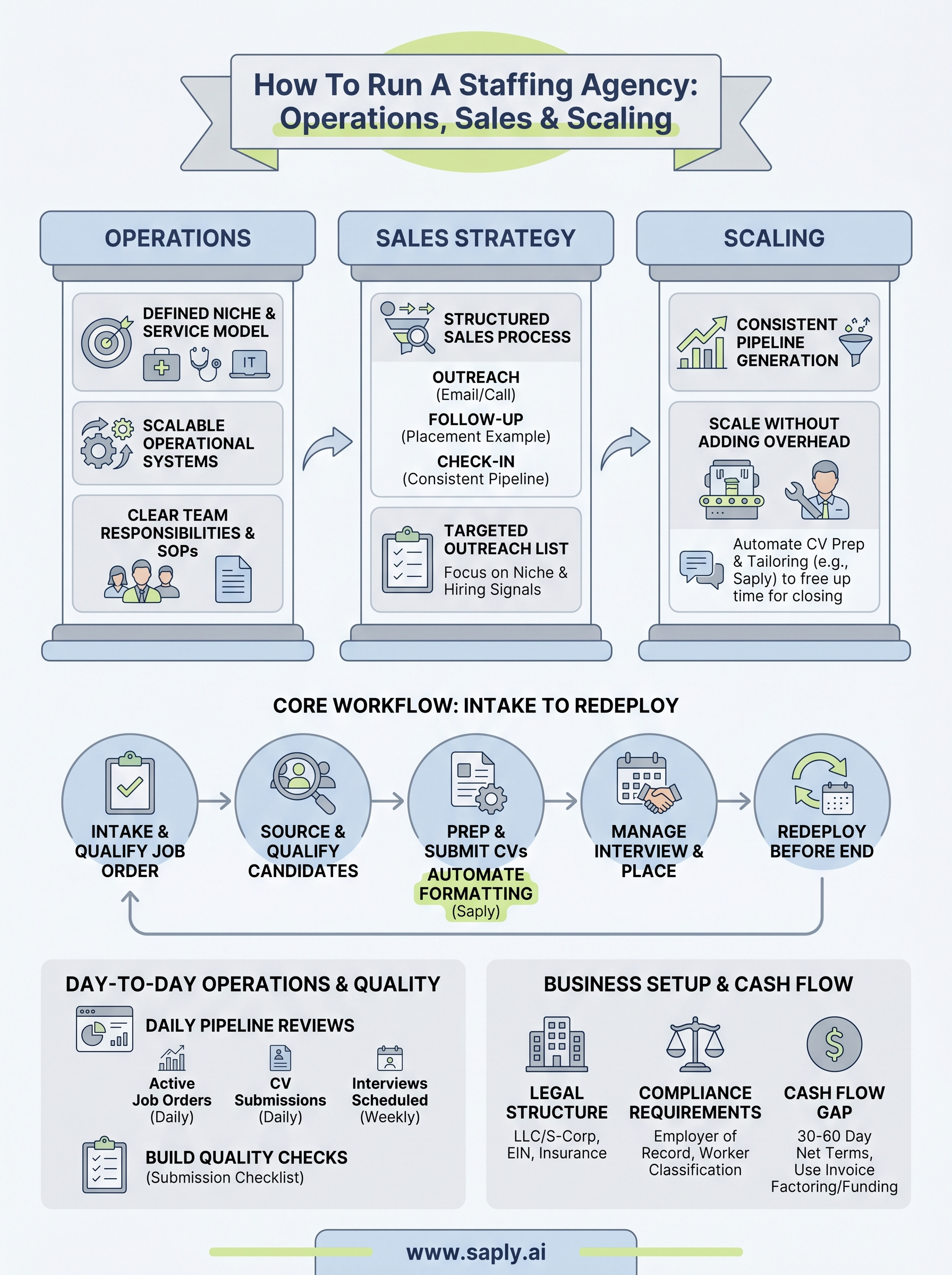
A repeatable workflow is what separates a staffing agency that scales from one that scrambles. Every placement should follow the same path: intake a job order, source and qualify candidates, prep and submit CVs, manage the interview cycle, place the candidate, and then re-engage them before the assignment ends. When your team executes this consistently, you reduce errors, speed up placements, and give clients a predictable experience.

Take the job order and qualify it immediately
When a client sends a job order, your first step is to qualify it before sourcing begins. Confirm the budget, start date, duration, required certifications, deal-breaker skills, and the hiring manager’s decision timeline. A job order missing this detail will send your team in the wrong direction and waste sourcing hours. Log everything in your ATS at intake so the full picture is visible to whoever touches the role.
A poorly qualified job order is one of the most common reasons a placement falls through at the offer stage.
Move candidates through intake, prep, and submission
Once you have qualified candidates, CV preparation becomes the next bottleneck in how to run a staffing agency efficiently. Recruiters manually formatting and tailoring documents to match agency templates and job descriptions burns time that should go toward sourcing and client calls. Saply integrates directly into Word, Google Docs, and Outlook to automate formatting and tailoring in one step, so your team submits polished, role-ready CVs faster without switching tools.
Close the loop with redeployment
Redeployment is revenue you already earned but often leave on the table. Set a calendar reminder 30 days before each contract ends to start a redeployment conversation with the placed candidate. Your CRM or ATS can trigger this automatically if you configure it correctly. Redeploying an existing contractor costs a fraction of sourcing a new one and keeps your placement volume high without additional recruiting effort.
Run day-to-day operations and quality control
The day-to-day work of running a staffing agency lives in pipeline visibility and submission quality. If you cannot see where every active job order stands and how your team performs against key targets, problems compound quietly until a client notices before you do. Consistent operational discipline closes that gap before it becomes a pattern.
Track the right metrics daily
Daily pipeline reviews keep your team focused on the right priorities. Check three numbers every morning: active job orders, submissions in the last 24 hours, and interviews scheduled for the next five business days. If any number looks low, you know where to redirect effort before the week slips. A shared dashboard in your ATS handles this without requiring separate reporting tools.
A breakdown of the core metrics to monitor and how often to review them:
| Metric | Review Frequency |
|---|---|
| Active job orders | Daily |
| CV submissions per recruiter | Daily |
| Interview-to-submission ratio | Weekly |
| Time to fill per role | Weekly |
| Placement-to-interview ratio | Monthly |
| Client satisfaction score | Monthly |
Build quality checks into every submission
Quality control is one of the most overlooked parts of how to run a staffing agency at a high standard. Before any CV leaves your team, a second reviewer should confirm the document matches your agency template, addresses the job description requirements, and contains no factual errors. That step takes under two minutes but prevents client complaints that damage long-term relationships.
One rejected submission due to a formatting error does more damage to client trust than ten strong submissions do to rebuild it.
Set a written submission checklist your recruiters complete before sending any candidate package. Include fields for template compliance, keyword alignment with the job description, and verification of claimed certifications. This adds seconds per submission and keeps your quality consistent even as your team grows.
Win clients and scale without chaos
Growth in a staffing agency does not happen by accident. You need a structured sales process and operational systems that hold up when client volume increases. The agencies that scale without losing quality treat business development as a repeatable discipline, not something that happens between placements.
Build a sales process that generates consistent pipeline
Start with a targeted outreach list built around your niche. If you specialize in IT staffing, your prospecting should focus on companies hiring developers and infrastructure engineers, not general HR contacts. Research hiring signals like job boards, LinkedIn posts, and funding announcements to find companies that are actively growing their headcount.

The best time to call a prospect is when they already have a problem you can solve, so monitor their hiring activity before you reach out.
Use a simple cadence to structure your outreach: an initial email, a follow-up call within three business days, a second email with a relevant case study or placement metric, and a final check-in two weeks later. Track every touchpoint in your CRM so nothing falls through the gaps. Here is a basic outreach sequence template:
| Step | Action | Timing |
|---|---|---|
| 1 | Personalized intro email | Day 1 |
| 2 | Follow-up call | Day 3 |
| 3 | Email with placement example | Day 7 |
| 4 | Final check-in email | Day 14 |
Scale operations without adding proportional overhead
Understanding how to run a staffing agency at scale means identifying which tasks consume recruiter time without directly contributing to placements. CV formatting and tailoring are the most common culprits. Automating those steps with tools integrated directly into your existing workflow, like Saply inside Word or Google Docs, keeps your submission volume high as client demand grows without requiring you to hire additional coordinators to keep up.
Next steps
Running a staffing agency well requires discipline across every layer of the business: niche selection, legal structure, repeatable workflows, daily metrics, and a sales process that generates consistent pipeline. Each of these areas compounds over time, so the sooner you build them correctly, the faster your agency can grow without breaking under its own volume.
Start with the areas that create the most friction in your current workflow. If CV prep and tailoring eat the most recruiter hours each week, that is the right place to act first. Knowing how to run a staffing agency at scale means removing the manual work that slows placements down, and that starts with the tools your team uses every day.
Try Saply free for 14 days and see how automated CV formatting and tailoring inside Word, Google Docs, and Outlook cuts document prep time so your recruiters can submit more polished candidates, faster, without switching between tools.