recruitment-crm-software-comparison
15 Recruitment CRM Software Comparison: Features & Pricing
Your recruitment CRM touches nearly every part of your agency's workflow, from first candidate contact to client submission. Pick the wrong one, and you're stuck with clunky workarounds for years. Pic...
Written by: Saply Team
15 Recruitment CRM Software Comparison: Features & Pricing
Your recruitment CRM touches nearly every part of your agency’s workflow, from first candidate contact to client submission. Pick the wrong one, and you’re stuck with clunky workarounds for years. Pick the right one, and everything from sourcing to placement runs smoother. That’s why a thorough recruitment CRM software comparison matters more than most purchasing decisions you’ll make this year. The stakes are high, and switching costs are even higher.
A good CRM does more than store contacts. It should integrate with the tools your team already uses, email, document editors, ATS platforms, and support automations that cut out repetitive work. At Saply, we built our AI-powered CV formatting and tailoring plugin to connect directly with recruitment CRMs like Bullhorn and Carerix, so we’ve seen firsthand how the right platform can make or break recruiter productivity.
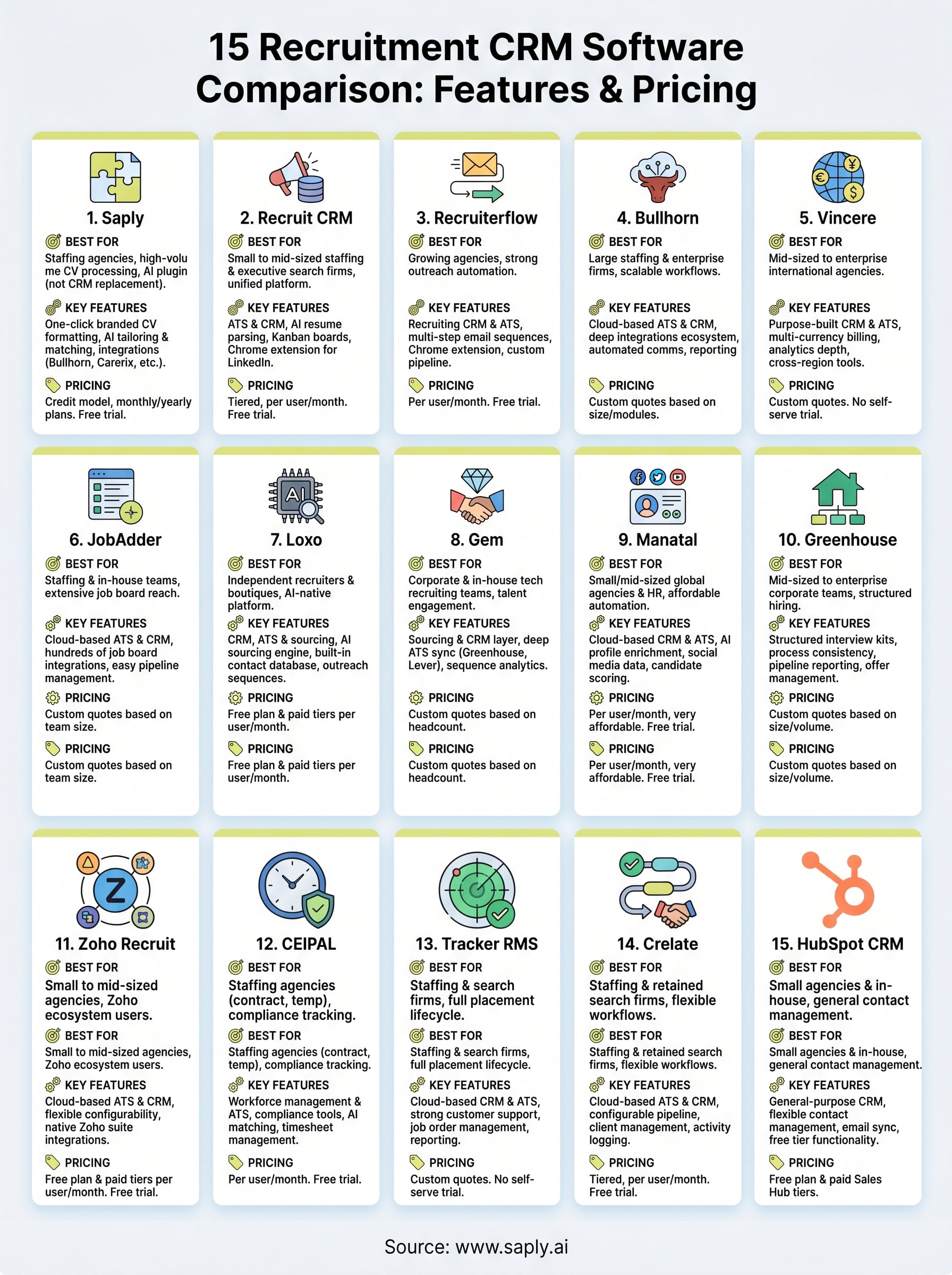
Below, we break down 15 recruitment CRM options across features, pricing, integrations, and real user feedback. Whether you’re running a boutique staffing firm or managing a large recruitment operation, this guide gives you the details you actually need to make a confident, informed choice, no fluff, no vague feature lists.
1. Saply
Saply takes a different approach than most tools in this recruitment CRM software comparison. Rather than replacing your existing recruitment CRM, Saply works as an AI-powered plugin that embeds directly into the tools you already use, including Microsoft Word, Google Docs, Outlook, Bullhorn, Carerix, and Spott. Its core purpose is to eliminate the manual, repetitive work of CV formatting and tailoring that quietly drains your team’s submission capacity every week.

Best for
Saply is built specifically for staffing agencies and recruitment firms that process high volumes of candidate CVs on a regular basis. If your recruiters spend meaningful time copy-pasting CVs into branded templates, adjusting formatting by hand, or rewriting content to match individual job descriptions, Saply targets that exact bottleneck. It works best for agencies with an established ATS setup that want to layer in AI capability without abandoning the systems their team already knows.
Key features
Saply’s standout features focus on automation and tight workflow integration. The platform applies your agency’s branded CV templates with a single click, automatically aligning sections and typography so nothing looks inconsistent before a submission goes out. Its AI tailoring engine reads a job description and adjusts the CV content to match, pulling requirements from either manual input or directly from your connected ATS. You also get CV-to-job matching scores and risk assessments that help your team pitch candidates with genuine confidence instead of guesswork.
Saply’s AI assistant draws on actual placement data to surface recommendations, not generic text rewrites, which means its suggestions are grounded in what converts to successful hires.
Here’s a quick summary of what Saply adds to your workflow:
- One-click CV formatting with automatic template application
- AI tailoring based on job descriptions from manual input or ATS import
- Match scoring and skill gap analysis per candidate-role pairing
- Integrations with Bullhorn, Carerix, Spott, Microsoft Word, Google Docs, and Outlook
- Custom agency template setup completed within 48 hours
- CV credit system with both monthly and yearly billing options
Pricing
Saply runs on a CV credit model, so your team buys credits and draws on them as CVs are processed. Billing is available on monthly or yearly cycles, with the yearly plan offering a lower cost per credit. Saply also provides a 14-day free trial with no credit card required, giving you a chance to test it inside your actual workflow before committing to a plan.
2. Recruit CRM
Recruit CRM is a combined ATS and CRM platform built specifically for staffing agencies and executive search firms. It handles the full recruitment cycle from candidate sourcing through final placement, keeping all your pipeline activity in a single system. If you’re running this recruitment CRM software comparison to find a tool that covers both candidate management and client relationship tracking without juggling separate products, Recruit CRM is worth a close look.
Best for
Recruit CRM works best for small to mid-sized staffing agencies and executive search firms that want one platform to manage candidates and client accounts simultaneously. It suits teams that need a structured system without the complexity or enterprise-level pricing that comes with larger, more established platforms.
Key features
Recruit CRM combines standard ATS functionality with CRM capabilities, giving your team a unified pipeline view across candidates and active job orders. Core features include AI-powered resume parsing, email sync, kanban-style pipeline boards, and built-in reporting tools.
Recruit CRM’s Chrome extension lets your recruiters source candidates directly from LinkedIn and push them straight into the system without switching tabs or copy-pasting profile data.
Here are the main features included with Recruit CRM:
- AI resume parsing and automatic candidate profile creation
- Kanban boards for both job pipelines and business development tracking
- Email and calendar sync with Gmail and Outlook
- Chrome extension for direct LinkedIn sourcing
- Trigger-based workflow automation
- Custom reporting and analytics dashboards
Pricing
Recruit CRM uses tiered pricing based on team size and feature access. Plans start at approximately $85 per user per month on annual billing, with higher tiers unlocking advanced automation and integrations. A free trial is available before you commit.
3. Recruiterflow
Recruiterflow is a recruiting CRM and ATS built for modern staffing agencies and recruiting teams that want automation embedded into their daily workflow. It covers the full pipeline from sourcing candidates to closing placements, with a strong emphasis on reducing the manual steps between each stage. In this recruitment crm software comparison, Recruiterflow stands out for its clean interface and the depth of its outreach automation tools.
Best for
Recruiterflow works best for growing recruiting agencies and executive search firms that rely heavily on email outreach and candidate nurturing sequences. If your team runs multi-step email campaigns to keep candidates warm or to develop new client relationships, Recruiterflow’s sequencing tools give you a level of control that most ATS-only platforms simply don’t offer.
Key features
Recruiterflow combines core ATS functionality with outreach automation, giving your recruiters a single workspace for candidate tracking and client development. Its pipeline views, email sequencing, and reporting tools are tightly connected, so nothing falls through the gaps between sourcing and placement.
Recruiterflow’s Chrome extension lets your team pull candidate data directly from LinkedIn into the platform without manual entry, cutting sourcing time significantly.
Here are the main features included:
- Multi-step email sequences for candidate and client outreach
- Chrome extension for LinkedIn sourcing
- ATS pipeline with customizable stages
- Two-way email and calendar sync
- Reporting dashboards for team activity and pipeline health
- API access and integrations with job boards and tools like Zapier
Pricing
Recruiterflow starts at $99 per user per month on annual billing. Higher tiers unlock additional automation and reporting features. A free trial is available so your team can test the platform before committing to a paid plan.
4. Bullhorn
Bullhorn is one of the most widely recognized platforms in any recruitment crm software comparison, and for good reason. It’s a cloud-based ATS and CRM built specifically for staffing agencies and recruitment firms, with a feature set that scales from mid-sized operations to large enterprise teams. Bullhorn has been around long enough to develop deep integrations across the recruitment tech ecosystem, making it a common anchor platform for agencies that rely on multiple connected tools.
Best for
This platform works best for larger staffing agencies and enterprise recruitment firms that handle significant placement volume across multiple verticals. If your organization runs structured, high-volume recruitment workflows and needs a platform with proven scalability and a broad integration library, Bullhorn is one of the strongest options available in this market segment.
Key features
Bullhorn covers the core recruitment workflow from candidate sourcing and tracking through client management and placement reporting. Its pipeline views, automation rules, and built-in reporting give your team visibility across the full cycle without needing to jump between tools.
Bullhorn’s integration ecosystem includes hundreds of connected apps, which matters significantly if your team relies on specialized tools for sourcing, CV formatting, or compliance tracking.
Here are Bullhorn’s main features:
- ATS pipeline with customizable workflow stages
- CRM tools for managing client accounts and job orders
- Automated candidate and client communication
- Built-in reporting and analytics dashboards
- Large third-party integration library
- Mobile app for recruiter access on the go
Pricing
Standard pricing is not published publicly by Bullhorn. Costs are customized based on your team size and the specific modules you need, so you’ll need to contact their sales team directly for a quote. Most agencies commit to annual contracts.
5. Vincere
Vincere is a purpose-built recruitment CRM and ATS designed for staffing agencies and executive search firms operating across multiple markets. It brings together candidate and client management in a single platform with strong reporting tools and an interface your team can navigate without a steep learning curve. In this recruitment crm software comparison, Vincere stands out for its combination of analytics depth and international reach.
Best for
Vincere works best for mid-sized to enterprise staffing firms that operate across multiple countries or verticals. If your agency needs a platform that handles complex multi-currency billing, international job postings, and cross-region team management, Vincere is one of the few mid-market options with these capabilities built in rather than bolted on.
Key features
Vincere covers the full recruitment cycle with tools for candidate sourcing, pipeline management, client relationship tracking, and back-office reporting. Its analytics suite gives managers real-time visibility into team performance, revenue pipeline, and placement trends without requiring data exports into a separate tool.
Vincere’s built-in analytics dashboard is one of the most comprehensive in this segment, letting you track KPIs across your entire team from a single screen.
Here are the main features Vincere includes:
- Unified CRM and ATS pipeline
- Multi-currency and multi-language support
- Analytics dashboards with KPI tracking
- Email and calendar sync
- Job board integrations and career portal tools
- API access for third-party tool connections
Pricing
Vincere does not publish standard pricing publicly. You’ll need to contact their sales team directly for a quote, which is typically structured around team size and module selection on an annual contract. No self-serve trial is available.
6. JobAdder
JobAdder is a cloud-based ATS and recruitment CRM designed for staffing agencies, in-house recruiters, and recruitment firms that want a clean, intuitive platform without the complexity of larger enterprise systems. It has built a strong reputation for its extensive job board integrations and straightforward pipeline management, making it a practical option for teams that want to reduce administrative overhead without a lengthy onboarding process.
Best for
JobAdder works best for staffing agencies and in-house recruitment teams that prioritize ease of use and broad job board reach. If your team places candidates across multiple industries and relies heavily on job advertising to fill roles, JobAdder’s native job board integrations give you a significant distribution advantage without requiring separate tools or manual posting workflows.
Key features
In this recruitment crm software comparison, JobAdder holds up well for teams that need a solid foundation of ATS and CRM tools without heavy customization demands. Its pipeline management, email sync, and reporting tools cover the standard recruitment workflow effectively.
JobAdder connects to hundreds of job boards globally, letting your team post and manage listings from a single interface rather than logging into multiple platforms separately.
Here are JobAdder’s main features:
- ATS pipeline with customizable stages
- Job board posting to hundreds of boards from one platform
- Email and calendar sync with Gmail and Outlook
- Candidate and client database management
- Reporting and analytics dashboards
- Mobile app for recruiter access on the go
Pricing
JobAdder does not publish standard pricing on its website. You’ll need to contact their sales team directly for a quote based on your team size and specific requirements.
7. Loxo
Loxo is an AI-native recruiting platform that combines a CRM, ATS, and sourcing tools into a single system. Unlike platforms that bolt AI features onto older infrastructure, Loxo was built from the ground up with automation at its core, covering everything from candidate discovery to outreach sequencing. In this recruitment crm software comparison, Loxo stands out for teams that want to consolidate sourcing, pipeline management, and communication into one workspace without patching together multiple tools.

Best for
This platform works best for independent recruiters, boutique search firms, and specialized staffing agencies that want a feature-rich system without enterprise-level pricing. If your team spends significant time sourcing candidates from scratch and running personalized outreach campaigns, Loxo’s AI sourcing engine and built-in contact database reduce the manual work between identifying a candidate and getting a response.
Key features
Your team gets an integrated set of tools that covers the full recruitment workflow without requiring third-party add-ons for sourcing or outreach. Loxo’s AI-powered talent intelligence layer continuously surfaces new candidate matches as job requirements shift, which keeps your pipeline active without constant manual searching.
Loxo includes a built-in contact database with hundreds of millions of profiles, meaning your team can source and reach out without switching to a separate tool.
- AI candidate sourcing and matching engine
- Built-in contact database with direct contact information
- Multi-step email and SMS outreach sequences
- ATS pipeline with configurable stages
- CRM for client and job order management
- Reporting dashboards for team activity
Pricing
Loxo offers a free plan with limited features for individual recruiters, making it one of the few platforms here with a genuine no-cost entry point. Paid plans start at $119 per user per month on annual billing, with higher tiers unlocking the full sourcing database and advanced automation tools.
8. Gem
Gem is a talent engagement and recruiting CRM platform that sits at the intersection of candidate sourcing and relationship management. Unlike the staffing-agency-focused tools elsewhere in this recruitment crm software comparison, Gem is primarily designed for in-house recruiting teams at technology and growth-stage companies that want a structured way to build and maintain candidate pipelines over time.
Best for
Gem works best for corporate and in-house recruiting teams at mid-sized to enterprise companies that run high-volume hiring programs and need a dedicated system for candidate relationship management separate from their ATS. If your team relies on proactive sourcing and wants detailed visibility into how candidates move through multi-touch outreach sequences, Gem gives you that level of control in a single workspace.
Key features
Gem connects directly to your existing ATS rather than replacing it, acting as a sourcing and engagement layer on top of your current stack. Its pipeline reporting and sequence analytics give recruiting managers a clear picture of where candidates are dropping off and which outreach approaches are actually converting.
Gem’s deep ATS integrations with platforms like Greenhouse and Lever mean your team avoids duplicate data entry between sourcing and pipeline management.
- Multi-step email sequences with performance analytics
- Chrome extension for LinkedIn sourcing
- ATS sync with Greenhouse, Lever, and others
- Pipeline reporting and conversion tracking
- Diversity sourcing analytics
- Team collaboration tools for shared candidate pools
Pricing
Gem does not publish pricing publicly. You need to contact their sales team for a custom quote, typically structured around headcount and hiring volume on an annual contract basis.
9. Manatal
Manatal is a cloud-based recruitment CRM and ATS that combines candidate pipeline management with AI-powered profile enrichment. It has gained significant traction among staffing firms and HR teams in Asia and globally, largely because it packs a strong feature set into a price point that most comparable platforms can’t match. In this recruitment crm software comparison, Manatal is worth evaluating if your agency needs capable automation without enterprise-level spending.
Best for
Manatal works best for small to mid-sized staffing agencies, HR departments, and recruitment firms that want a full-featured ATS and CRM without committing to high per-user costs. If your team operates across international markets and needs a platform with multi-language support and social media profile enrichment built in, Manatal covers both without requiring third-party add-ons.
Key features
Your team gets a clean pipeline interface paired with AI candidate scoring that ranks applicants based on how well they match open job requirements. Manatal also pulls public social media and professional profile data automatically to enrich candidate records, reducing the time your recruiters spend filling in profile gaps manually.
Manatal’s AI recommendation engine scores and ranks candidates against job criteria automatically, which helps your team prioritize the strongest applicants without reviewing every profile individually.
- AI candidate scoring and ranking against job descriptions
- Social media enrichment for candidate profiles
- Customizable ATS pipeline with drag-and-drop stages
- Career page builder for direct applications
- Reporting and analytics dashboards
- Integrations with LinkedIn, job boards, and 2,500+ apps via Zapier
Pricing
Manatal’s Professional plan starts at $15 per user per month on annual billing, making it one of the most affordable full-featured options in this comparison. An Enterprise plan is also available at higher pricing with additional customization and dedicated support. A 14-day free trial requires no credit card.
10. Greenhouse
Greenhouse is a structured hiring platform and ATS that has become a go-to choice for technology companies and growth-stage businesses building out their internal recruiting functions. Unlike most platforms covered in this recruitment crm software comparison that target staffing agencies directly, Greenhouse is built for corporate in-house recruiting teams that want a highly systematic, process-driven approach to hiring at scale.

Best for
Greenhouse works best for mid-sized to enterprise corporate recruiting teams at technology companies and scale-ups that run high-volume, structured hiring programs. If your team needs granular control over every stage of the hiring process and wants clear accountability distributed across hiring managers and interviewers, Greenhouse provides that structure more consistently than most ATS platforms in this segment.
Key features
Your team gets a robust pipeline management system built around structured interview kits, interviewer scorecards, and candidate evaluation workflows that keep every hiring decision consistent and properly documented. Greenhouse also offers a strong integration library that connects with your existing HR tech stack without requiring heavy configuration work.
Greenhouse’s structured interview tooling is particularly strong, making it one of the most defensible choices for organizations that need hiring process consistency across large, distributed teams.
- Structured interview kits and scorecards
- Pipeline reporting and conversion analytics
- Job board posting and sourcing integrations
- Offer management and approval workflows
- DEIB reporting and diversity sourcing analytics
- 500+ integrations with HR and recruiting tools
Pricing
Greenhouse does not publish pricing publicly. You’ll need to contact their sales team directly for a custom quote based on your company size and hiring volume, typically structured as an annual contract.
11. Zoho Recruit
Zoho Recruit is a cloud-based ATS and recruitment CRM that fits into the broader Zoho ecosystem, making it a practical choice for teams already using Zoho CRM, Zoho Mail, or other products in the same suite. In this recruitment crm software comparison, Zoho Recruit stands out for its flexible pricing tiers and deep configurability, which allow teams to build workflows that match their specific process rather than adapting to a fixed system structure.
Best for
Zoho Recruit works best for small to mid-sized staffing agencies and in-house recruiting teams that want a fully capable platform without paying enterprise-level pricing. It’s particularly well-suited for organizations already running Zoho products in their operations, since the native integrations across the Zoho suite eliminate the configuration work that third-party connectors typically require.
Key features
Your team gets a solid combination of ATS pipeline management, client tracking, and automation tools that cover the standard recruitment workflow without significant gaps. Zoho Recruit also includes a career portal builder and job board posting tools, giving you candidate sourcing capability alongside pipeline management in a single platform.
Zoho Recruit’s native integration with the broader Zoho ecosystem gives teams using Zoho CRM or Zoho Mail a unified data layer that removes the friction of syncing between separate tools.
- Resume parsing and candidate profile creation
- Customizable ATS pipeline stages
- Job board posting and career portal builder
- Email sync and communication tracking
- Workflow automation and trigger-based actions
- Reporting dashboards with configurable metrics
Pricing
Zoho Recruit offers a free plan for individual users with basic features. Paid plans start at $30 per user per month on annual billing, with higher tiers unlocking advanced automation and integrations. A 15-day free trial is available on paid plans.
12. CEIPAL
CEIPAL is a workforce management and ATS platform designed for staffing agencies that handle contract, temporary, and permanent placements. It covers candidate tracking, job management, and compliance tools in a single system, making it a solid option for agencies that need to manage diverse placement types without running separate platforms for each.
Best for
CEIPAL works best for staffing agencies managing a mix of contract, temporary, and direct hire placements, particularly in IT, healthcare, and other specialized verticals where compliance tracking and credential management matter as much as pipeline speed. If your team processes high volumes of contract workers and needs built-in tools for onboarding and compliance, CEIPAL handles that within the same platform without requiring third-party add-ons.
Key features
In this recruitment crm software comparison, CEIPAL’s standout capability is its workforce management layer, which tracks active contractors, manages timesheets, and monitors compliance requirements alongside your standard ATS pipeline. The AI matching engine scores candidates against open roles automatically, helping your team prioritize the strongest fits without manually reviewing every application.
CEIPAL’s compliance tracking is particularly valuable for agencies placing contractors in regulated industries where credential expiration creates real liability.
- AI candidate matching and scoring
- Configurable ATS pipeline stages
- Workforce management for active contractor tracking
- Timesheet and onboarding tools
- Job board integrations
- Reporting dashboards with customizable metrics
Pricing
CEIPAL’s ATS plan starts at $24 per user per month on annual billing, with workforce management modules available at additional cost. A free trial is available so your team can test the platform before committing to a paid plan.
13. Tracker RMS
Tracker RMS is a cloud-based recruitment CRM and ATS built for staffing agencies and search firms that need a system covering the full placement lifecycle. It handles candidate tracking, client management, and job order management in a single platform, with a particular focus on giving staffing agencies the operational tools they need to run structured, repeatable recruitment workflows without heavy customization demands.
Best for
Tracker RMS works best for staffing agencies and executive search firms that want an established, purpose-built platform with strong customer support and a straightforward onboarding process. If your team is running a recruitment crm software comparison and wants a system with deep staffing-specific functionality rather than a general-purpose CRM adapted for recruiting, Tracker RMS is worth including on your shortlist.
Key features
Your team gets a solid set of tools that cover the standard recruitment workflow from sourcing through placement, including a configurable ATS pipeline, client relationship tracking, and built-in reporting to keep everyone aligned on active job orders and team activity.
Tracker RMS’s customer support reputation is consistently rated highly by users, which matters significantly during rollout when your team is still learning the system.
- Configurable ATS pipeline stages
- Client and contact relationship management
- Job order tracking and assignment
- Email integration and communication logging
- Reporting and activity dashboards
- Integration with major job boards
Pricing
Tracker RMS does not publish standard pricing on its website. You need to contact their sales team directly for a quote based on your team size and specific requirements. No self-serve trial option is publicly available.
14. Crelate
Crelate is a cloud-based ATS and recruitment CRM designed for staffing agencies and executive search firms that want a flexible system covering the full placement lifecycle. It combines candidate pipeline management with client relationship tracking in a single platform, giving your team a unified view of both sides of the recruitment workflow without switching between separate tools.
Best for
Crelate works best for staffing agencies and retained search firms that need a purpose-built recruitment platform with strong pipeline customization and client management tools. In this recruitment crm software comparison, it holds up particularly well for small to mid-sized agencies that want a system built specifically for staffing workflows rather than a general-purpose CRM adapted for recruiting use.
Key features
Your team gets a configurable pipeline that covers candidate tracking and job order management alongside client and contact relationship tools built specifically for agency workflows. Crelate also includes email integration, activity logging, and reporting dashboards that give managers clear visibility into team performance and open job status without requiring separate reporting tools.
Crelate’s pipeline customization options give your team the flexibility to build recruitment stages that match your actual process rather than forcing your workflow into a fixed system structure.
- Configurable ATS pipeline with drag-and-drop stages
- Client and contact relationship management
- Job order tracking and candidate assignment
- Email sync and communication logging
- Reporting and analytics dashboards
- Job board integrations and resume parsing
Pricing
Crelate offers tiered pricing plans starting at approximately $99 per user per month on annual billing, with higher tiers unlocking advanced automation and reporting features. A free trial is available so your team can evaluate the platform before committing.
15. HubSpot CRM
HubSpot CRM is a general-purpose CRM platform that many recruitment teams have adapted for managing candidate and client relationships. Unlike the purpose-built staffing tools elsewhere in this recruitment crm software comparison, HubSpot was not designed with recruiters in mind. It works best when you need a flexible, highly customizable contact management system and are willing to configure it around your specific recruitment workflow rather than starting with built-in recruiting functionality.
Best for
HubSpot CRM works best for independent recruiters, small agencies, or in-house HR teams that already use HubSpot for marketing or sales and want to consolidate their contact management into a single platform. If your recruitment operation is relatively simple in structure and doesn’t require advanced ATS pipeline features, HubSpot gives you a capable foundation without adding another tool to your stack.
Key features
Your team gets a solid set of contact management and communication tracking tools that cover the basics of candidate and client relationship management. HubSpot’s pipeline views are customizable, and its email integration works reliably across Gmail and Outlook. The free tier includes more functionality than most comparable platforms offer at no cost.
HubSpot’s extensive app marketplace gives your team access to third-party integrations, though most recruiting-specific connections require configuration that purpose-built platforms handle natively.
- Contact and deal pipeline management
- Email sync with Gmail and Outlook
- Meeting scheduling and activity logging
- Reporting dashboards and contact analytics
- Workflow automation on paid tiers
Pricing
HubSpot CRM offers a free plan with core contact management features included. Paid Sales Hub plans start at $15 per user per month on annual billing, with higher tiers unlocking advanced automation, reporting, and outreach sequence tools.
Next steps
This recruitment crm software comparison covers fifteen platforms, but the right choice depends entirely on your agency’s specific workflow, team size, and integration requirements. Most options here offer free trials, so your best next step is picking two or three from this list that match your situation and testing them with your actual recruitment process before committing to an annual contract. No comparison article replaces hands-on experience with your own data inside your own workflow.
If your team already has a CRM in place and your real bottleneck is the time your recruiters spend on manual CV formatting and tailoring, that’s a separate problem worth solving in parallel. Saply connects directly with Bullhorn, Carerix, and Spott to automate that process without replacing your existing setup. You can test it inside your actual workflow with no credit card required. Start your 14-day free trial of Saply and see how much time your team saves on submissions this week.