
how-staffing-agencies-make-money
How Staffing Agencies Make Money: Fees, Markups & Models
Staffing agencies sit between employers who need talent and candidates who need jobs, and they get paid for making that connection happen. But how staffing agencies make money isn't always obvious, es...
Written by: Saply Team

How Staffing Agencies Make Money: Fees, Markups & Models
Staffing agencies sit between employers who need talent and candidates who need jobs, and they get paid for making that connection happen. But how staffing agencies make money isn’t always obvious, especially when you consider the range of fee structures, markup models, and contract types involved. Whether you’re running an agency, working at one, or considering starting one, understanding the revenue mechanics matters.
Most staffing firms earn through a combination of bill rate markups on temporary placements, flat fees on direct hires, and sometimes retainer agreements for executive search. The employer pays these costs, not the worker. But the specifics vary widely depending on the type of placement, industry, and client relationship. Getting the pricing model right directly affects profitability, and so does operational efficiency. The faster your team can format, tailor, and submit candidates, the more placements you close. That’s exactly the problem Saply was built to solve, cutting hours of manual CV work so recruiters can focus on revenue-generating activities.
This article breaks down every major way staffing agencies generate revenue, explains who actually pays the fees, and walks through the math behind markups and margins so you can see where the money really comes from.
Why staffing agency pricing matters
Understanding how staffing agencies make money starts with recognizing that pricing isn’t just a number on an invoice. The margin you charge on every placement determines whether your agency covers payroll, grows its headcount, and survives slow hiring cycles. Most agencies operate on thin margins, which means a small pricing error compounds quickly across dozens of placements over a quarter.
Pricing sets the foundation for profit
Your bill rate markup is the primary lever controlling agency profit. If you set it too low, you cover the worker’s pay but leave little room for overhead, benefits, recruiter commissions, and unexpected costs like early contract terminations. If you price too high without justifying the value, clients push back or move to a competitor without much hesitation.
Getting your markup right from the start of a client relationship is far easier than trying to renegotiate later, when the client already has a number anchored in their mind.
A straightforward example: if a contractor earns $30 per hour and you bill the client $42 per hour, your gross margin is $12, or roughly 28.5%. That sounds healthy until you subtract payroll taxes, benefits, workers’ compensation insurance, and recruiter overhead. Many agencies net 10 to 20 percent after those costs, depending on the sector and role type.
How pricing affects client relationships
Clients compare rates across agencies, especially in competitive markets where multiple firms are pitching candidates for the same role. Transparent, consistent pricing builds trust and reduces friction in negotiations. Agencies that can explain exactly what goes into their markup, and why it’s fair, tend to retain clients longer than those who just quote a number without context.
Your pricing structure also signals what kind of agency you are. A low-cost, high-volume model works differently from a specialized search firm charging premium fees for niche technical roles. Neither approach is wrong, but mixing signals, such as charging premium rates while delivering slow turnaround, erodes credibility fast.
Why operational efficiency changes the math
Pricing doesn’t exist in isolation from operations. The time your recruiters spend formatting and tailoring CVs is a real cost that appears nowhere on the invoice but chips away at profitability every single week. If a recruiter spends three hours manually formatting a batch of CVs before submitting candidates to a client, that’s three hours not spent sourcing, calling, or closing deals.
Multiply that across a team of ten recruiters, and the lost productive hours add up to a significant drag on revenue, not through bad pricing, but through preventable inefficiency. Faster submissions also increase win rates, since clients frequently move forward with the first qualified candidates they receive. Operational speed and smart pricing work together, and ignoring either one leaves margin on the table.
The main ways staffing agencies make money
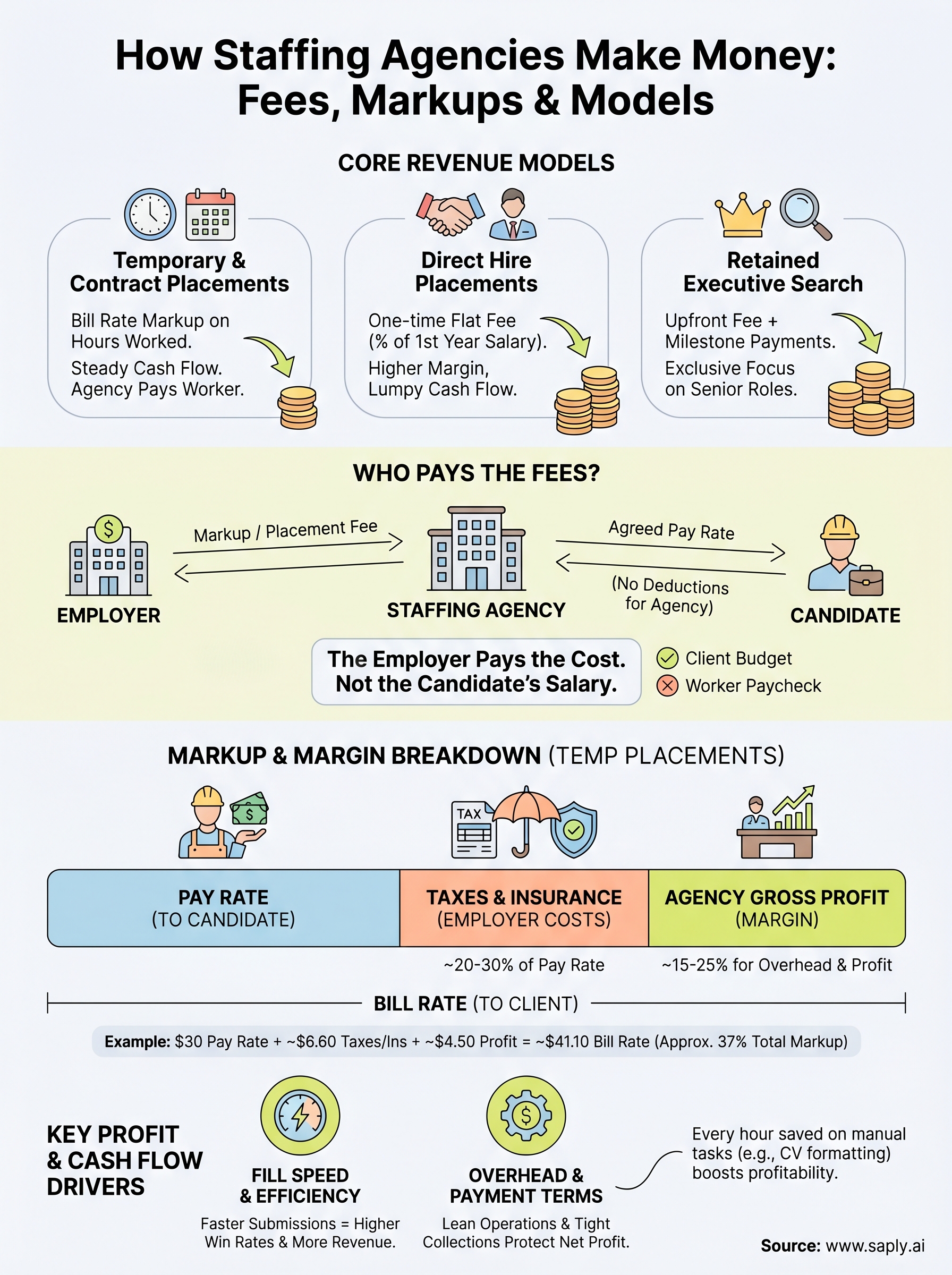
Staffing agencies use several distinct revenue models depending on the type of placement they handle. Understanding how staffing agencies make money requires looking at each model separately, because the fee structure, risk profile, and cash flow timing differ significantly between temporary work, permanent hires, and executive search.

Temporary and contract placements
The most common revenue source for most staffing firms is temporary or contract placements, where the agency places a worker with a client for a defined period. The agency pays the worker directly, then bills the client at a higher rate. That difference, the bill rate markup, is where the agency earns its margin. Temp work generates recurring weekly revenue as long as the placement continues, making it the most predictable income stream in the business.
Temporary placements create a steady cash flow base, which is why many agencies prioritize contract work even when permanent placement fees look more attractive on paper.
Direct hire and permanent placement fees
Direct hire placements work differently. Here, the agency recruits and screens candidates for a permanent role, then charges a one-time fee when the client hires one of those candidates. That fee typically lands between 15 and 25 percent of the candidate’s first-year base salary, though it varies by industry and seniority. The agency carries no ongoing payroll obligation, so margins can be strong, but the work is front-loaded and payment only arrives after a successful hire.
Retained search and contract-to-hire
Retained search is less common but financially attractive. A client pays a portion of the fee upfront to secure the agency’s exclusive focus on filling a senior or specialized role. Contract-to-hire sits between temp and direct hire: the worker starts on a contract, and the client pays a conversion fee if they bring that person on permanently. Both models add flexibility to your revenue mix and reduce dependence on any single income stream.
How markups and placement fees work
The math behind how staffing agencies make money is more straightforward than most people expect. Every revenue model ultimately comes down to either a percentage markup on hours worked or a flat fee tied to base salary. Knowing the exact numbers helps you price competitively while protecting your margins.
The markup formula for temp placements
Your bill rate is the hourly amount you charge the client. Your pay rate is what the contractor actually takes home. The difference between them, expressed as a percentage of the pay rate, is your markup. But that markup also has to absorb payroll taxes, workers’ compensation, unemployment insurance, and any benefits you offer, which typically adds up to 20 to 30 percent on top of the base wage before you see actual profit.

A 50 percent markup on a $30 pay rate sounds generous until you account for employer-side taxes and insurance, which can eat 20 points of that margin immediately.
Here is a simple breakdown of how the numbers stack up on a $30 per hour contractor:
| Component | Amount |
|---|---|
| Pay rate | $30.00/hr |
| Employer taxes and insurance (est. 22%) | $6.60/hr |
| Agency gross profit target (est. 15%) | $4.50/hr |
| Bill rate | $41.10/hr |
| Total markup | ~37% |
Direct hire fee structure
Permanent placement fees follow a different structure entirely. Rather than billing hourly, you charge the client a one-time fee calculated as a percentage of the candidate’s first-year base salary, most commonly between 15 and 25 percent. A $90,000 hire at 20 percent generates an $18,000 fee with no ongoing payroll obligation.
Your fee percentage should reflect the difficulty of the search, the seniority of the role, and the exclusivity of your candidate pipeline. Niche technical and executive roles command higher percentages precisely because the sourcing work is more intensive and the supply of qualified candidates is smaller.
Who pays and what staffing agencies cost
One of the most common points of confusion around how staffing agencies make money is who actually writes the check. The short answer is simple: the employer pays, not the candidate. Workers placed through a staffing agency receive their agreed pay rate without any deduction to cover agency fees. The agency’s revenue comes entirely from the client company on the other side of the transaction.
Employers carry the cost, not workers
Clients pay either a marked-up bill rate on every hour a temporary worker clocks, or a one-time placement fee when they hire a permanent candidate. In both cases, the cost lands on the employer’s budget, not the candidate’s paycheck. This arrangement is worth being explicit about with both clients and candidates, because misunderstandings here create friction early in relationships that’s hard to repair.
If a candidate ever asks whether the agency is taking a cut of their salary, you can tell them clearly: the client pays the agency separately, and it has no effect on what they earn.
Some clients push back on fees when they compare the bill rate to what they would pay a direct employee. Your job is to help them see the full cost of a direct hire, including recruiting time, HR overhead, benefits administration, and the risk of a bad hire, against the all-in bill rate they pay your agency. Framed correctly, the agency fee looks much more reasonable.
What clients actually pay across placement types
The actual dollar amounts vary by placement type, seniority, and industry. Here is a practical reference for the ranges clients typically expect across the main staffing models:
| Placement Type | Typical Cost to Client |
|---|---|
| Temporary/contract | 25 to 75% markup on pay rate |
| Direct hire | 15 to 25% of first-year base salary |
| Contract-to-hire conversion | 10 to 15% of first-year base salary |
| Retained executive search | 30 to 35% of first-year total comp, billed in thirds |
These ranges are starting points for negotiation, not fixed rules. Your actual fee structure should reflect the complexity of the roles you fill and the depth of your candidate pipeline.
What affects profit and cash flow for agencies
Knowing how staffing agencies make money is only half the picture. The other half is understanding what erodes that money before it reaches your bottom line. Profitability and cash flow depend on factors that go well beyond the fee you charge, and managing them actively separates agencies that scale from those that stay stuck.
Placement mix and fill speed
Temporary placements generate steady, recurring revenue but require the agency to carry payroll every week before the client invoice clears. Permanent placements pay larger one-time fees but create gaps in cash flow between successful hires. Most agencies that grow consistently maintain a balanced mix of contract and direct hire work so they’re not entirely dependent on either model.
The faster your recruiters submit qualified candidates, the higher your close rate, and close rate directly determines how many fee-generating placements you complete each month.
Fill speed matters more than most agency leaders acknowledge. Every day a role sits open is a day you’re not earning. If your team spends hours reformatting CVs or tailoring them manually before submission, that delay costs you placements to faster competitors. Submission speed is a revenue variable, not just an operational detail.
Overhead, payment terms, and write-offs
Recruiter salaries, benefits, office costs, and software all come out of your margin before you see net profit. High overhead forces you to either raise bill rates or accept thinner margins, and both options carry risk in competitive markets. Keeping overhead lean, especially by automating repetitive tasks like CV formatting and tailoring, directly improves your take-home margin per placement.
Payment terms with clients create a second pressure point. Many enterprise clients pay on 30- to 60-day terms, but you owe contractor payroll every two weeks. That gap strains cash flow even when placements are going well. Short payment cycles and tight collections processes protect the liquidity your agency needs to keep operating and growing through slower months.
Final takeaways
How staffing agencies make money comes down to a few core mechanics: markups on temporary placements, flat fees on direct hires, and retainers for executive search. In every case, the employer pays the fee, not the candidate, and your margin depends on pricing those services accurately while keeping operational costs under control.
Your placement mix, fill speed, and overhead structure all shape how much of that revenue actually lands as profit. Thin margins leave no room for inefficiency, which means every hour your recruiters spend on manual CV formatting is an hour that directly erodes your bottom line. Faster submissions close more placements, and more placements build the revenue base your agency needs to grow.
If you want to cut the time your team spends on CV work and put more hours toward revenue-generating activity, see what Saply can do for your agency.