
hard-skills-vs-soft-skills-on-resume
Hard Skills vs Soft Skills on Your Resume Examples & Sections
Every recruiter and hiring manager scanning a resume is looking for two things: can this person do the job, and will they work well doing it? That's the core of hard skills vs soft skills on resume se...
Written by: Saply Team

Hard Skills vs Soft Skills on Your Resume Examples & Sections
Every recruiter and hiring manager scanning a resume is looking for two things: can this person do the job, and will they work well doing it? That’s the core of hard skills vs soft skills on resume sections, and getting the balance right determines whether a candidate gets called back or gets skipped.
Hard skills prove technical ability. Soft skills show how someone operates on a team, handles pressure, and communicates. Both matter, but they serve different purposes on a resume, and they belong in different places.
This guide breaks down what qualifies as a hard skill versus a soft skill, gives you concrete examples for each, and walks through how to structure resume sections so both types land with impact. If you’re a recruiter formatting and tailoring CVs at scale, something Saply automates directly inside your existing tools, knowing how these skills should appear on a polished resume helps you submit stronger candidates, faster.
Hard skills and soft skills, explained
At their core, these two categories divide your professional abilities into what you know how to do and how you go about doing it. Hard skills are specific, teachable competencies you can measure, test, and verify. Soft skills are behavioral traits and interpersonal qualities that shape how you work with others and manage yourself. Every strong resume needs both, but understanding the difference helps you place each type in the right spot and phrase it in a way that actually registers with a hiring manager.
What hard skills are
Hard skills are concrete, learned abilities tied to a specific function or discipline. You gain them through formal education, training programs, certifications, or direct on-the-job practice, and someone can objectively test whether you have them. A hiring manager can ask you to run a SQL query, translate a document, or build a financial model, and the result either meets the standard or it doesn’t.
Common categories of hard skills include:
- Technical tools and software: Excel, Python, AutoCAD, Salesforce, Adobe Illustrator
- Industry-specific knowledge: financial modeling, medical coding, supply chain logistics, legal research
- Certifications and credentials: PMP, CPA, CompTIA Security+, Google Analytics certification
- Language proficiency: written and spoken fluency in a second or third language
Hard skills are the proof that you can perform the core duties of a role. They often appear in the dedicated skills section of a resume, but they also belong inside your experience bullets where you can attach numbers and outcomes to them to show real impact.
What soft skills are
Soft skills describe how you think, communicate, and interact rather than what technical tasks you perform. They’re harder to quantify, which is exactly why most people handle them poorly on a resume. Placing “good communicator” or “team player” in a skills section tells a recruiter almost nothing on its own.
The right way to convey soft skills is to demonstrate them through specific examples in your experience bullets, not to list them as standalone traits.
Leadership, adaptability, conflict resolution, and critical thinking are all soft skills, and each one only becomes credible when you tie it to a real situation with a measurable result. For example, “led a cross-functional team of eight to deliver a product launch two weeks ahead of schedule” shows leadership far more convincingly than simply writing the word.
How they work together on a resume
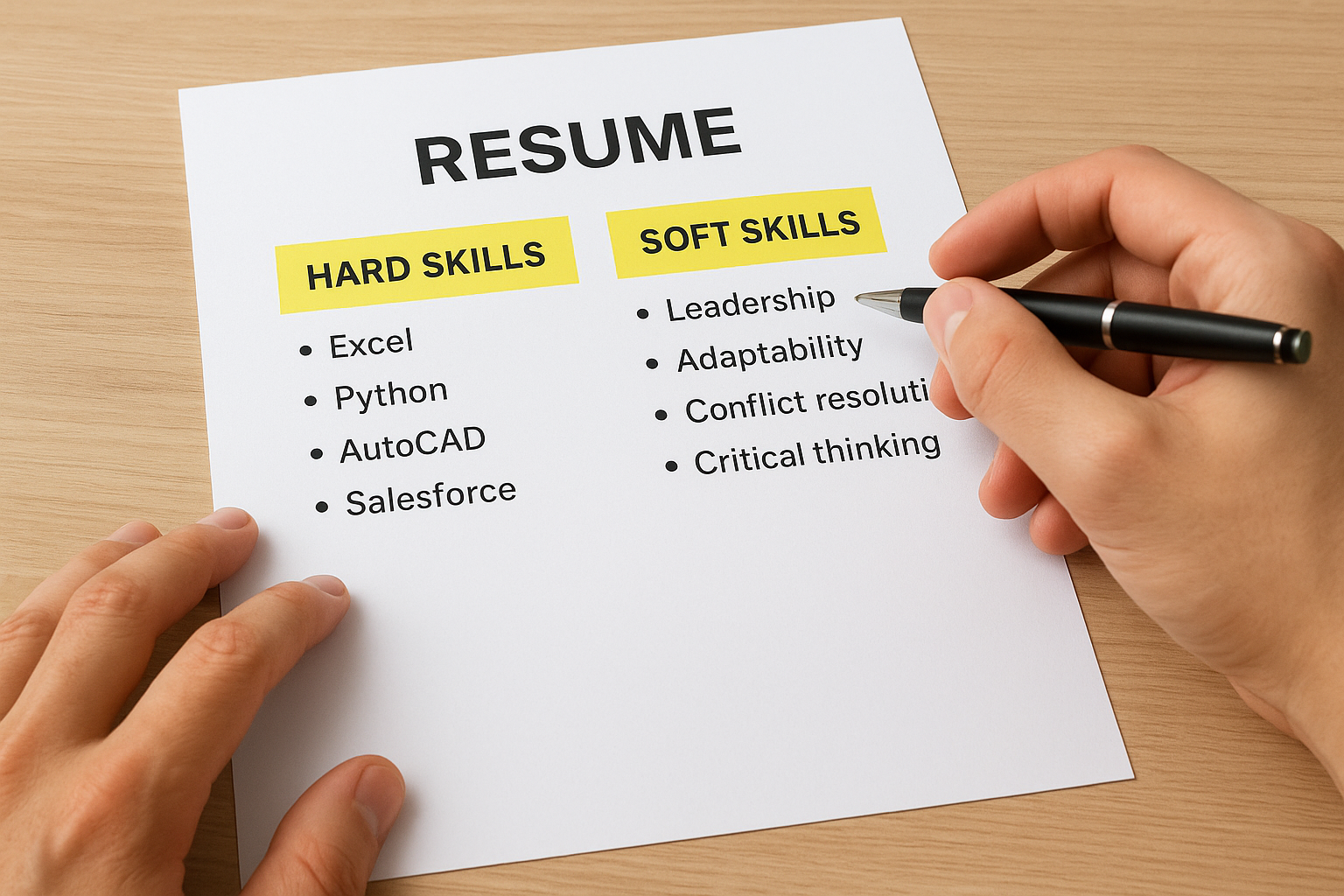
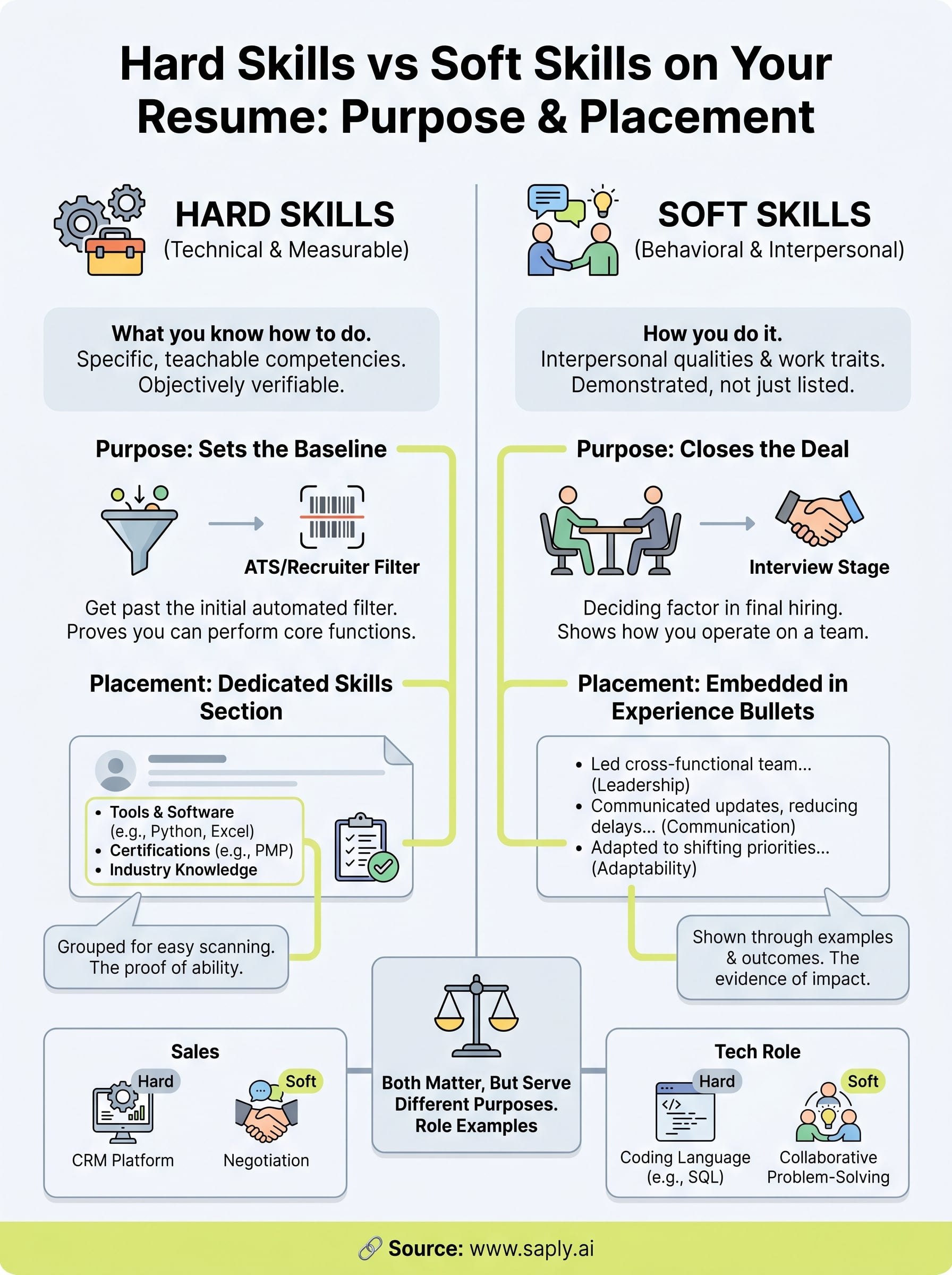
When you think through the hard skills vs soft skills on resume question, the answer is never one or the other. Hard skills get you past the initial filter, whether that’s an ATS scan or a recruiter’s first skim of the page. Soft skills carry more weight in the interview stage and often determine the final hiring decision when two candidates have similar technical backgrounds. A well-built resume weaves both together: hard skills listed clearly in a dedicated section, soft skills embedded as evidence throughout your experience entries.
Why hiring managers care about both
When a hiring manager reviews a resume, they run two separate checks at once. Hard skills tell them whether you can perform the job’s core functions, and soft skills signal whether you’ll work effectively with the existing team and grow into the role over time. Removing either from the picture creates a gap that’s difficult to overlook during screening.
Hard skills set the baseline
Most roles come with a defined set of technical requirements, and those requirements form the filter that every application gets measured against first. Applicant tracking systems scan for specific keywords tied to tools, certifications, and technical proficiencies before a human ever reads the file. If your resume doesn’t reflect the hard skills listed in the job description, it often won’t make it past that first automated pass.
Your hard skills determine whether you get seen at all, so listing them clearly and matching them to the job description is the first priority.
Matching your hard skills to the role also gives hiring managers a concrete basis for comparison when two candidates have similar experience levels. Certifications, software proficiency, and quantified technical achievements create measurable proof that separates one applicant from another in a way that general experience claims rarely do.
Soft skills close the deal
Once you clear the technical threshold, soft skills become the deciding factor in most hiring decisions. A hiring manager who understands the hard skills vs soft skills on resume question knows that technical gaps can often close through training, but someone who struggles with communication or collaboration rarely changes that pattern quickly. The soft skills you demonstrate through your experience bullets tell a much more convincing story than any list of traits ever could.
These qualities influence how well you perform under pressure, adapt when priorities shift, and build relationships with clients and colleagues. Communication, critical thinking, and adaptability consistently rank among the top attributes employers want across industries, and they carry real weight when the final hiring decision comes down to two equally qualified candidates.
Hard and soft skills examples for popular roles
Seeing concrete examples helps you understand where the hard skills vs soft skills on resume distinction actually applies in practice. The split looks different depending on the role, but the principle stays consistent: hard skills prove you can perform the core work, and soft skills show how you operate within a team, with clients, and under pressure.
Sales and account management
Sales roles demand a specific mix of technical knowledge and interpersonal ability. CRM platforms, pipeline management, and data analysis sit on the hard skills side, while active listening, negotiation, and persuasion show how you build relationships and close deals. Both types belong on a well-built resume for this role.
| Hard Skills | Soft Skills |
|---|---|
| Salesforce CRM | Negotiation |
| Sales forecasting | Active listening |
| Contract management | Relationship building |
| HubSpot | Persuasion |
Project management and operations
Project management tools and methodologies form the technical backbone of these roles, but the soft skills you bring determine whether a team actually delivers on time and within scope. Hiring managers in this space look for evidence of both on your resume, not just a list of software you’ve used.
Your ability to demonstrate both technical tools and interpersonal skills in project management directly affects how seriously a hiring manager considers your application.
- Hard skills: Asana, Jira, MS Project, budget tracking, risk assessment, Agile methodology, PMP certification
- Soft skills: Cross-functional communication, stakeholder management, conflict resolution, adaptability, prioritization
Software development and technical roles
Technical roles carry the heaviest weight on the hard skills side, but communication and collaboration skills still influence hiring decisions significantly. Developers who explain technical concepts clearly to non-technical stakeholders, contribute constructively during code reviews, and adapt when project requirements shift stand out from candidates who only list tools and languages.
- Hard skills: Python, JavaScript, SQL, cloud platforms (AWS, Azure), version control (Git), API integration
- Soft skills: Collaborative problem-solving, written communication, attention to detail, critical thinking
How to choose skills from a job description
A job description is essentially a checklist that tells you exactly what to include in your resume. The trick is reading it strategically rather than skimming it once and picking out whatever sounds familiar. Every posting contains both hard skill requirements and soft skill signals, and knowing how to separate the two helps you populate your hard skills vs soft skills on resume sections with content that actually resonates with the person reviewing your application.
Read the description in two passes
Your first pass through a job posting should focus entirely on technical requirements: tools, platforms, certifications, methodologies, and any specific qualifications listed as required or preferred. Highlight or list every concrete competency you can identify. Your second pass looks for behavioral language: words like “collaborate,” “lead,” “communicate,” “adapt,” and “prioritize” signal the soft skills the employer values most, even when they aren’t labeled as such.

The language a company uses to describe a role reveals the soft skills it prioritizes just as much as any formal requirement list does.
- Look for repeated words across multiple bullet points, since those carry the most weight
- Note any skills listed under both “required” and “preferred” sections
- Flag action verbs in the responsibilities section, because they map directly to soft skills
Match what you have, don’t stretch what you don’t
Once you’ve identified the skills from the description, compare them honestly against your own experience. Your goal is to match real competencies, not manufacture a resume that looks aligned but falls apart the moment someone asks about it in an interview. Skills you genuinely have but haven’t listed yet deserve a spot. Skills you barely touched in a previous role should appear in your experience bullets with honest context rather than in a standalone skills list where they look inflated.
Cross-referencing your experience against the job description also helps you prioritize placement. When space is limited, the skills that appear most prominently in the posting deserve the most prominent placement in your resume.
How to format your skills section and bullets
Knowing which skills to include solves only half the problem. Where you place them and how you frame them in your resume determines whether a hiring manager actually registers them. The hard skills vs soft skills on resume distinction matters here because each type belongs in a different format and a different location on the page, and mixing them together weakens the impact of both.
Build a dedicated skills section for hard skills
Your hard skills belong in a clearly labeled, scannable section near the top of your resume, ideally right after your summary or contact information. This placement lets ATS systems pick them up immediately and gives recruiters a fast reference point before they read deeper into your experience.
Keep your skills section focused on hard skills only - a list of soft skills in this spot reads as filler and weakens the overall impression.
Format this section as a short, grouped list organized by category rather than one long string of keywords. Grouping by type makes the section easier to scan and signals that you understand the role’s requirements well enough to organize them meaningfully.
- Tools and platforms: list specific software by name
- Certifications: include the full credential name
- Technical methods: Agile, Six Sigma, financial modeling
Embed soft skills inside your experience bullets
Soft skills never belong in a standalone list because a label without proof carries no weight. Instead, weave them into your experience section through action-driven bullet points that describe what you did, who it involved, and what result it produced.
Each bullet should follow a simple structure: action verb, context, and measurable outcome. “Coordinated weekly stakeholder updates across four departments, reducing project delays by 30%” demonstrates communication and stakeholder management far more convincingly than listing either term in a skills section ever could.
Write your bullets in past tense for previous roles and present tense for your current position. Keep each bullet to one or two lines, and lead with the strongest verb you can justify based on what you actually did.
A simple checklist before you apply
Before you submit your next application, run through this quick check to make sure your hard skills vs soft skills on resume sections are working together, not against each other.
- Hard skills section: Contains specific tools, certifications, and technical competencies grouped by category
- Soft skills: Embedded inside experience bullets with action verbs and measurable outcomes, not listed as standalone traits
- Job description match: Your hard skills reflect the keywords and requirements from the posting
- Bullet structure: Each experience bullet leads with a strong verb and includes a quantifiable result
- No filler: Words like “team player” or “detail-oriented” appear as evidence, not labels
Getting this balance right takes practice, but the framework stays consistent across every role and industry. If you’re a recruiter formatting CVs at volume, Saply handles the formatting and tailoring work so every candidate you submit looks polished and role-ready without the manual effort.