
how-do-resume-writing-services-work
How Do Resume Writing Services Work? Costs, Process & ROI
Resume writing services have been around for decades, but the way they operate has changed significantly, especially with AI entering the mix. Whether you're a job seeker wondering if it's worth payin...
Written by: Saply Team
How Do Resume Writing Services Work? Costs, Process & ROI
Resume writing services have been around for decades, but the way they operate has changed significantly, especially with AI entering the mix. Whether you’re a job seeker wondering if it’s worth paying someone to rewrite your resume, or a recruiter trying to understand how do resume writing services work so you can better evaluate candidate submissions, the process isn’t always transparent. Knowing what happens behind the scenes helps you make a smarter decision about where to spend your money or time.
At their core, these services take your raw career history and reshape it into a document designed to get results. Some do this manually with a dedicated writer. Others, like platforms built for recruitment teams, use AI to automate formatting and tailoring at scale. That’s exactly what we built Saply to do, give staffing agencies a way to transform candidate CVs into role-ready resumes without the manual grind of copy-pasting, reformatting, and rewriting for every job.
This article breaks down the full picture: how traditional and AI-powered resume services operate step by step, what they typically cost, what kind of return you can realistically expect, and how to evaluate whether a service is actually good. We’ll also cover the differences between services designed for individual job seekers and tools built for high-volume recruitment teams, so you can find the right fit for your situation.
Why resume writing services exist
Resume writing services exist because most people are not trained to write about themselves effectively, and the stakes of getting it wrong are high. You might know your job history inside out, but translating that into a document that gets read, passes automated filters, and convinces a hiring manager to call you back is a separate skill entirely. The gap between having strong experience and being able to present it compellingly on paper is real, and that gap is exactly where these services step in.
The gap between knowing your work and writing about it
Writing a resume is not the same as describing what you do at work. Most people default to listing job duties rather than communicating outcomes, which is one of the most common reasons resumes get ignored. Hiring managers want to see what you achieved, not just what your job title implied you were responsible for. When you write your own resume, you’re too close to your own story to see what’s missing or what’s buried under irrelevant details.
Self-assessment bias makes this harder than it sounds. You might undervalue skills that seem obvious to you but would stand out to a recruiter. Or you might overload your resume with technical language that reads well to you but means nothing to the person screening applications. A professional writer brings an outside perspective that helps surface the right information and frame it for the audience that actually reads the document.
The most common resume problem is not a lack of experience. It’s that the experience exists but is not written in a way the reader can quickly evaluate.
The ATS filter problem
Applicant Tracking Systems (ATS) are software tools that companies use to screen resumes before a human ever sees them. These systems parse your resume for specific keywords, formatting, and structure. If your resume does not match what the system is looking for, it gets filtered out regardless of how qualified you actually are. Understanding how do resume writing services work partly means understanding that a big part of the job is writing for this layer of the process, not just for human readers.
Many job seekers have no idea their resume is being rejected before anyone reads it. The ATS filter problem has made resume writing more technical than it used to be, and it is a significant reason why professional services became more popular over the last decade. Writers who specialize in this area know which formatting choices cause parsing errors and which keywords belong in which sections to give your resume the best chance of clearing the initial screen.
Why high-volume recruitment teams need something different
For individual job seekers, the challenge is personal. For staffing agencies and recruitment firms, the challenge is operational. A recruiter managing dozens of open roles at once does not have time to manually reformat every candidate’s CV, tailor it to each job description, and check it against the client’s requirements. The math simply does not work when you are dealing with high submission volumes under time pressure.
Tools like Saply were built specifically to solve this problem. Instead of a human writer spending 30 to 60 minutes per document, AI-powered platforms can apply templates, match CVs to job descriptions, and flag skill gaps in a fraction of the time. The service still exists for the same fundamental reason: raw career history needs to be shaped into something that gets results. The delivery method has just evolved to match the scale of the work that modern recruitment teams actually face.
What types of resume services you can buy
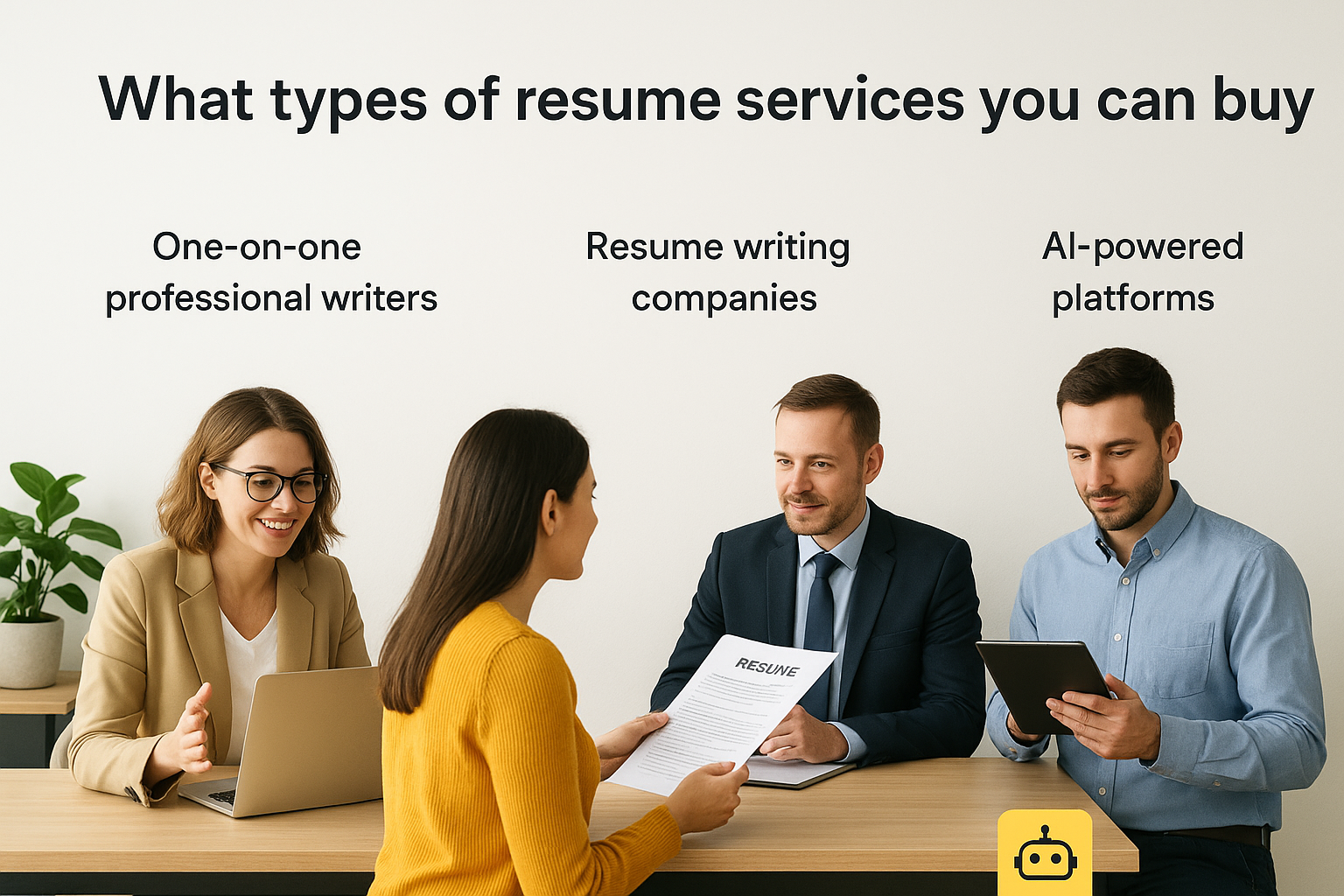
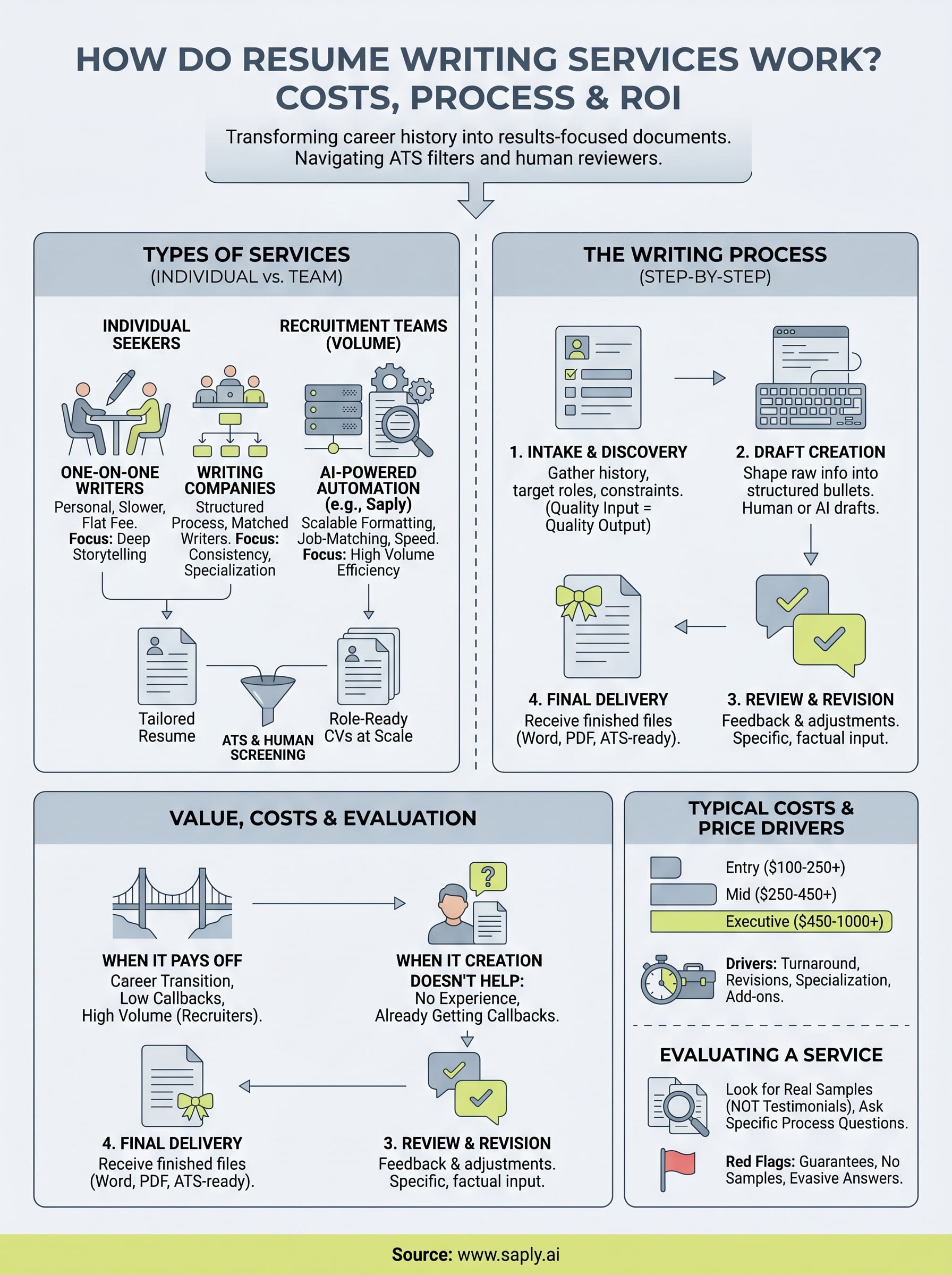
Not all resume services work the same way, and the differences matter more than most people realize. The market ranges from individual freelancers charging a flat fee to AI-powered platforms built for enterprise recruitment teams, and each model has real tradeoffs around speed, quality, and cost. Part of understanding how do resume writing services work is recognizing that two services with similar names can deliver very different experiences depending on their structure.
One-on-one professional writers
Freelance resume writers work with you directly, usually over email or a video call. You share your career history, target roles, and any existing resume, and the writer produces a tailored document from there. The quality varies significantly because no universal certification or licensing standard governs the industry. An experienced freelancer with a strong portfolio and deep knowledge of your sector can produce excellent results. The process is personal, but it is also slow by design, which works well if you have time and want someone deeply invested in your specific story.
Resume writing companies
Resume writing companies employ multiple writers and run a more structured service model. You typically complete an intake form or questionnaire, get matched to a writer based on your industry or level, and work through a defined process with set revision rounds and turnaround windows. These companies often offer specialization by sector, seniority, or geography, which can be valuable if your field has specific norms. The tradeoff is less direct access to the person writing your document, which can make it harder to catch nuances that only you would know to flag.
Consistency and process matter more than brand recognition when choosing between resume companies. Ask how they match writers to clients before you commit.
AI-powered platforms and automation tools
AI-powered tools represent the fastest-growing segment of the market. Some target individual job seekers with features like keyword scoring, formatting checks, and real-time feedback against specific job postings. Others are built for operational use inside staffing agencies. Saply falls into this second category, designed for recruitment teams managing high submission volumes where the bottleneck is not one person’s resume but dozens of candidate CVs that all need formatting, tailoring, and job-matching at speed. The core logic mirrors traditional services: take raw career content and shape it to meet specific requirements. The delivery method scales to match the workload that professional recruitment teams actually face.
What you should prepare before you hire one
Walking into a resume service without preparation wastes both your time and money. The quality of what you get back depends heavily on what you bring to the table, and most services can only work with the information you provide. Understanding how do resume writing services work means recognizing that the writer or platform is not a mind reader. The more specific and organized your input, the better your output.
Your career history in full detail
Start by pulling together a complete record of your work history before you contact anyone. Include job titles, employer names, dates, key responsibilities, and measurable achievements for every role you want to appear on the final document. Numbers matter more than you might expect: headcount managed, revenue generated, projects delivered, costs reduced. Writers build strong bullet points from concrete data, so dig into your memory or past performance reviews to surface specific figures.
A resume writer can improve your language and structure, but they cannot invent your achievements. That content has to come from you.
Your target roles and relevant job postings
Bring two or three job postings that represent the types of roles you are actively pursuing. These postings give the writer a direct signal about the keywords, skills, and experience levels the market is currently asking for. Without this context, the writer has to guess what direction to take your resume, which often results in a generic document that does not connect cleanly to any specific opportunity. Knowing your target role also helps the writer prioritize which parts of your history deserve the most space.
Existing resume drafts and past versions
Even if your current resume is outdated or poorly formatted, share it anyway because it gives the writer a foundation to work from. Past versions also reveal how you have framed your experience in the past, which helps the writer understand your instincts and where they need to push back or reframe. If you have a LinkedIn profile, share that link as well since the two documents should tell a consistent story.
Your practical constraints
Be clear about your timeline, how many rounds of revisions are included, and whether the final format needs to be compatible with a specific ATS. If you are a recruiter preparing candidate CVs at volume, clarify which templates apply and which job descriptions are in play. Setting these expectations upfront prevents confusion and keeps the process moving without unnecessary back-and-forth.
How the resume writing process works step by step
Understanding how do resume writing services work in practice means following the process from first contact to final document. Most services follow a predictable sequence, though the specifics vary depending on whether you are working with a human writer or an AI-powered platform built for recruitment teams. The core stages remain consistent regardless of which model you choose: gather information, produce a draft, refine it, and deliver a finished document.
Intake and discovery
The process starts with information gathering, which usually takes the form of a questionnaire, a call, or an intake form. You share your work history, target roles, current resume, and any specific requirements like template standards or ATS compatibility. This stage sets the ceiling for the entire project because the quality of your output is capped by the quality of your input. Recruiters using platforms like Saply go through an equivalent step, feeding in the candidate’s raw CV and the target job description so the system has everything it needs before producing anything.
Most services will ask you to bring at least three things to this stage:
- A complete work history with dates, titles, and specific achievements
- Two or three job postings that represent the roles you are targeting
- Any formatting or template requirements from your employer or client
Draft creation
Once the writer or platform has your information, the drafting stage begins. A human writer will typically spend several hours shaping your raw history into structured bullet points, selecting the right format, and aligning the language to your target roles. An AI tool completes the same steps in minutes by applying formatting rules, identifying relevant keywords, and organizing sections according to the job requirements.
The draft is never the finish line. It is the starting point for a conversation about what reads well and what still needs adjustment.
Review and revision
Most services include one to three rounds of revisions after the initial draft. You review the document, flag anything that reads incorrectly or misrepresents your experience, and the writer adjusts. This back-and-forth is where the document gets sharper, and it is also where your active involvement matters most.
Vague feedback produces minimal improvement. Specific, factual corrections like noting that a bullet overstates your authority on a project give the writer something concrete to fix and move the document meaningfully closer to accurate.
Final delivery
The final document arrives in the format you requested, typically a Word file, a PDF, or both. Some services also deliver a plain-text version built for ATS parsing. At this point, the document is yours to use and should require no further editing before submission.
How writers tailor for ATS and human readers
Understanding how do resume writing services work at a technical level means recognizing that a resume has two very different audiences: the software that scans it first and the human who reads it after. A document that clears the ATS filter but reads poorly to a hiring manager is only half a solution, and the reverse is equally true. Professional writers and well-built AI platforms approach both layers deliberately, and the techniques they use for each are not interchangeable.
Writing for ATS systems
ATS platforms parse resumes by extracting text and comparing it against criteria defined by the employer. The system looks for specific keywords, job titles, and section labels that match the language in the job description. Writers handle this by mirroring the exact phrasing from the posting rather than substituting synonyms that a human reader would accept but the software might not recognize as equivalent.
Formatting choices matter as much as word choice in this context. Tables, text boxes, headers and footers, and complex graphics often cause parsing errors that strip out key information before the system scores your resume at all. A skilled writer keeps the structure clean: standard section headings, readable fonts, and a straightforward layout that a parser can move through without dropping data.
Keyword stuffing defeats the purpose. The goal is to match language from the job description naturally within well-written bullet points, not to inflate a skills list with terms that do not reflect your actual experience.
Writing for the human reader
Once your resume clears the filter, a real person typically spends less than 30 seconds on an initial scan before deciding whether to read further. That means the document needs to communicate your value at a glance, not after careful study. Writers structure content so the most relevant experience sits in the top third of the first page, with strong action verbs and quantified outcomes leading each bullet point rather than passive descriptions of job duties.
Readability comes from deliberate choices about white space, line length, and visual hierarchy. A cluttered resume forces the reader to work harder to find the information they are actually looking for, which reduces the chance they will keep reading. Professional writers treat the reader’s attention as a limited resource and design the layout to guide it directly toward the evidence that supports the hire.
What resume writing services cost and what changes price
Prices for resume writing services vary widely, and the range is not random. Entry-level resume rewrites from individual freelancers start around $100 to $150, while executive-level documents from reputable companies can run $600 or more. Understanding how do resume writing services work at the pricing level helps you avoid both overpaying for a generic product and underpaying for something that will not hold up under scrutiny.

Entry-level, mid-career, and executive tiers
Most services segment their pricing by career stage, and the logic is straightforward. Early-career resumes require less content synthesis, which means less time and a lower fee. Mid-career documents involve more complexity: multiple roles to reconcile, a longer skill set to prioritize, and a stronger need for positioning around a specific next step. Executive resumes command the highest prices because they require strategic framing of leadership narrative, board experience, and high-stakes accomplishments that take significant time to extract and present well.
Here is a general pricing breakdown by career level:
| Career Level | Typical Price Range |
|---|---|
| Entry-level (0-3 years) | $100 - $250 |
| Mid-career (3-10 years) | $250 - $450 |
| Senior/Executive (10+ years) | $450 - $1,000+ |
What drives the price up or down
Several factors push the final cost in either direction beyond just career level. Turnaround time is one of the most consistent price drivers: rush delivery within 24 to 48 hours often adds $50 to $150 on top of the base fee. The number of revision rounds included also affects price, since unlimited revisions cost the writer more time and that cost gets passed on to you.
Paying more does not guarantee a better result. What matters is whether the service has demonstrated expertise in your specific field and level, not just a polished pricing page.
Specialization by industry adds cost for good reason. A writer with deep knowledge of finance, healthcare, or technology will charge more because their sector-specific vocabulary and understanding of role requirements is genuinely more valuable than generic writing. Add-ons like LinkedIn profile rewrites, cover letters, and ATS compatibility checks also stack onto the base price, so always confirm exactly what is included before you hand over payment. AI-powered platforms built for staffing agencies price differently still, typically on a per-CV or credit-based model that reflects volume rather than individual document complexity, which makes them far more cost-effective when your team is processing dozens of candidate CVs each week.
When a resume service pays off and when it does not
Knowing how do resume writing services work is only half the decision. The other half is figuring out whether hiring one actually makes sense for your specific situation. Paying for a service is not automatically a good investment, and assuming it is can cost you money without meaningfully improving your results. Context matters, and some situations generate real returns while others produce almost none.

When the investment makes sense
A resume service tends to pay off when you are making a significant career transition and your current document does not clearly connect your past experience to your target role. If you are moving between industries, stepping up to a senior position for the first time, or re-entering the workforce after a gap, a professional writer can help you reframe your history in a way that makes the leap readable to a hiring manager.
The clearer the gap between where you are and where you are trying to go, the more value a skilled writer can add by bridging it on paper.
The investment also makes sense when you have strong experience but keep getting poor results from applications. If you know your background is competitive for the roles you are targeting but your response rate stays low, the problem is almost certainly the document itself. That is a concrete, fixable problem that a good writer can address without requiring you to do anything differently in your actual job search.
For staffing agencies dealing with high submission volumes, the calculation shifts from individual ROI to operational efficiency. When your team spends 30 to 45 minutes manually reformatting each candidate CV, the cost compounds fast. AI-powered tools built for recruitment teams can recover those hours at scale.
When a service is unlikely to help
Paying for a resume service is unlikely to produce results when you are already getting consistent callbacks and simply want a cosmetic refresh. A new layout does not fix a weak candidacy, and spending money to polish a document that is already working rarely changes outcomes in any meaningful way.
A service also will not help much when you cannot provide the raw material the writer needs: specific job titles, measurable achievements, and a clear sense of which roles you are targeting. Writers can strengthen your language and restructure your content, but they cannot manufacture a work history that does not exist. If your experience is genuinely thin for the roles you want, building additional skills and credentials will move your job search forward far more than any rewrite will.
How to pick a trustworthy service or writer
The resume writing market has no licensing board and no universal standard for who can call themselves a professional writer. Anyone can build a website and charge for the service, which means your ability to evaluate quality before committing is genuinely important. Part of understanding how do resume writing services work in practice is accepting that the quality range varies enormously, and doing the right research upfront is the most reliable way to separate a strong result from a wasted payment.
Look at real samples, not testimonials
Most services display testimonials prominently, but testimonials tell you almost nothing useful about the quality of the actual work. What you need to see are finished resume samples across different industries and career levels, ideally ones that match your own situation closely. Study how they structure bullet points, whether outcomes and numbers appear consistently throughout, and whether the formatting looks like something you would confidently send to a hiring manager without modification.
A writer who refuses to share samples or only shows you heavily anonymized fragments is giving you an early signal about how transparent the relationship will be once you pay. Strong writers typically have a portfolio they are proud of and share readily.
Testimonials confirm a past client was satisfied. Samples show you whether the actual work meets the standard you need.
Ask specific questions before you pay
Asking direct questions before you commit is the most practical filter available to you. Ask how many revision rounds are included, what file formats you will receive at the end, and whether the writer has direct experience with your industry or career level. These are straightforward questions for any competent professional to answer clearly, and evasive or overly generic responses are a strong sign to keep looking.
You should also ask how they handle ATS keyword strategy. A writer with real technical knowledge will explain specifically how they review the job postings you provide and how that research shapes the document structure. If the answer is vague or sounds like a scripted talking point, their process is probably less tailored than their marketing suggests.
Checking whether the writer or company belongs to a recognized professional association adds one more useful data point. Membership alone does not guarantee quality, but it does indicate a degree of accountability to a broader professional community, which is worth factoring into your decision alongside samples and direct communication.
Common red flags and how to avoid scams
The resume writing industry attracts a small but consistent number of bad actors who charge real money for work that will not help you. Knowing how do resume writing services work at their worst is just as useful as understanding what a legitimate service looks like. The warning signs tend to appear early in the process, well before you have handed over any payment, which means you can protect yourself without losing anything if you know what to watch for.
Warning signs before you pay
Guarantees that promise specific outcomes are one of the clearest red flags in this market. No legitimate writer can promise you a job, a callback rate, or an interview within a set number of days. Hiring decisions involve too many variables outside any writer’s control, and any service making those claims is selling something it cannot deliver. Pressure tactics like limited-time discounts or urgency messaging designed to rush your decision are another signal that the service is more focused on closing a sale than delivering quality work.
Watch out for services that refuse to show you real samples or push back when you ask direct questions about their process. Writers with nothing to hide share their work readily, and they answer questions about revision terms, turnaround windows, and industry specialization without deflecting. If you ask how they handle ATS keyword research and the response is a vague paragraph about personalization, that is a concrete indicator that their process is less developed than their pricing suggests.
The moment a service stops being able to answer specific, factual questions about how they work, that is your signal to stop the conversation.
What to do if something feels wrong
Trust your initial read of the interaction. If the intake process feels rushed, the questionnaire looks like it was designed to collect the bare minimum, or the writer cannot demonstrate direct familiarity with your field, those are problems that will not improve once you pay. Walk away before the transaction, not after.
If you have already paid and the delivered document looks generic or contains factual errors about your own experience, document everything in writing and request a full revision immediately before the revision window closes. Most reputable services have a formal complaints process, and putting your feedback in writing creates a clear record. Disputing the charge with your credit card provider is a reasonable last step if the service refuses to address legitimate problems with the final product.
How to use your new resume to land interviews
Having a professionally written resume puts you ahead of most applicants, but the document alone does not generate callbacks. How do resume writing services work is a useful question for understanding what you received, but the more important question now is how you deploy it. Sending the same resume to every opening without adjustment treats a tailored document like a form letter, and that habit undercuts the work that went into building it.
Match your resume to each specific role
Your new resume is a strong starting point, not a finished product for every application. Before you submit, review the job posting and check that your resume reflects the specific language and priorities that employer used. A resume written for a project management role at a logistics firm needs different emphasis than one targeting the same title at a software company. Swapping a few keywords and reordering bullet points to foreground the most relevant experience takes ten minutes and meaningfully improves your chances of clearing the ATS filter for that specific posting.
The closer your resume mirrors the language in a job description, the better it performs in both automated screening and human review.
Track what you send and to whom
Keeping a simple log of every application you submit gives you visibility into patterns that would otherwise be invisible. Record the company name, role title, date of application, which version of your resume you sent, and any response you receive. This record helps you identify which versions generate callbacks and which ones go quiet, so you can adjust before you keep repeating the same approach.
Tracking also prevents submitting to the same company twice or sending a version that still has a placeholder from the writing process. A basic spreadsheet with five or six columns is enough to stay organized without creating meaningful extra work.
Follow up with purpose
Submitting an application is one action in a longer sequence, not a complete effort on its own. Where the role and company culture make it appropriate, follow up with the hiring manager or recruiter within five to seven business days. A short, direct message that references the specific role and your most relevant qualification keeps your name visible without being intrusive, and it signals the kind of initiative most hiring managers say they actively look for in candidates worth pursuing.
Next steps
Now you know how do resume writing services work from intake to final delivery, and you have the information to make a smart decision about whether hiring one is right for your situation. The gap between a resume that gets ignored and one that generates callbacks often comes down to how well the document matches the role, not how impressive the underlying experience actually is. That is a fixable problem, and you now know exactly how to fix it.
If you are a recruiter or staffing agency dealing with this same problem at volume, manual formatting and tailoring at scale is a different challenge entirely and one that individual resume services are not built to solve. Saply automates the entire workflow directly inside the tools your team already uses, from template application to ATS-ready job matching. You can see exactly how it works and start a free trial at Saply’s AI-powered CV formatting platform.