
staffing-industry-trends
10 Staffing Industry Trends for 2026: U.S. Stats & Forecasts
The U.S. staffing sector entered 2026 carrying momentum from a turbulent few years, rebounding from pandemic-era disruptions, adapting to AI-driven shifts in labor demand, and navigating an economy th...
Written by: Saply Team

10 Staffing Industry Trends for 2026: U.S. Stats & Forecasts
The U.S. staffing sector entered 2026 carrying momentum from a turbulent few years, rebounding from pandemic-era disruptions, adapting to AI-driven shifts in labor demand, and navigating an economy that refuses to sit still. For recruitment firms trying to plan ahead, understanding the latest staffing industry trends isn’t optional. It’s the difference between growing your book of business and falling behind agencies that move faster.
This year’s data tells a nuanced story. Temporary staffing volumes are shifting, AI adoption is reshaping how agencies operate internally, and client expectations around speed-to-submit keep climbing. At Saply, we see these pressures firsthand, our platform helps staffing teams format, tailor, and match CVs in seconds instead of hours, and the demand for that kind of efficiency reflects a broader industry reality: agencies that automate administrative work win more placements.
Below, we’ve compiled 10 data-backed trends shaping the U.S. staffing industry in 2026, covering market size projections, workforce shifts, technology adoption, and the economic factors that will define the second half of the year. Whether you run a boutique firm or manage operations at a national agency, these numbers and forecasts will help you make sharper decisions heading into 2027.
1. Saply
One of the clearest staffing industry trends heading into 2026 is that agencies are looking hard at internal efficiency. The firms gaining ground aren’t necessarily sourcing better candidates; they’re processing and submitting faster. That speed starts at the CV formatting and tailoring stage, and that’s exactly where Saply fits.
The manual CV bottleneck that slows submissions
Most recruiters spend 30 to 60 minutes per CV reformatting documents, adjusting templates, and rewriting content to match a specific job description. Multiply that across a desk handling 20 or 30 active roles, and you’re looking at a significant chunk of billable time eaten up by administrative work. Copy-pasting between systems, hunting for the right template, and manually updating skills sections all slow things down at the exact moment a client needs a shortlist.
Agencies that remove CV formatting as a manual step consistently submit candidates faster and report fewer delays caused by administrative backlog.
What Saply automates for agency workflows
Saply handles CV formatting, tailoring, and job matching in a single workflow. You feed it a raw candidate CV and a job description, and it applies your agency’s template, adjusts the content to align with the role’s requirements, and generates a match score with a gap analysis. What used to take an hour takes under two minutes.
The platform also runs risk assessment and match scoring, so you go into every client pitch knowing where the candidate is strong and where you need to manage expectations upfront rather than discover gaps after submission.
Where Saply fits in common recruiter tool stacks
Saply runs as a plugin inside Microsoft Word, Google Docs, and Outlook, which means your team doesn’t learn new software. It also integrates directly with Bullhorn, Carerix, and Spott, pulling job descriptions from your ATS and pushing formatted CVs back without manual transfers.
Custom templates go live within 48 hours, and additional ATS integrations are available on request. You stay in your existing tools; Saply just removes the manual steps between them.
What to measure after rollout
Track time-to-submit per role before and after adoption, then compare submission volume per recruiter week over week. A few other numbers worth watching:
- Client shortlist acceptance rate by recruiter
- CV formatting time per submission
- Placement rate on AI-tailored CVs versus manually formatted ones
If Saply is working, your team submits more candidates in less time without a drop in placement quality.
2. Speed-to-submit becomes the real battleground
Among the most consequential staffing industry trends right now, submission speed has moved from a nice-to-have into a core competitive differentiator. Clients increasingly award positions to the agency that delivers a qualified shortlist first, not necessarily the one with the deepest candidate pool.
Why clients push for 48-hour and same-day fills
Hiring managers face internal pressure to close positions quickly, and they track time-to-fill as a direct cost metric. When a role stays open, productivity suffers and projects stall. That urgency flows downstream to you, with clients setting 48-hour shortlist windows as a baseline expectation on contract and temp roles.
Agencies that consistently hit 24-hour submission windows report stronger client retention than those delivering equal quality on slower timelines.
The process changes that cut days out of the funnel
Most submission delays happen before the candidate ever reaches the client. CV formatting, tailoring, and internal review cycles are where time disappears. Standardizing templates, pre-building role-specific CV formats, and automating tailoring against job descriptions can cut your internal processing time by 60 percent or more on high-volume desks.
Metrics to track: time-to-submit, time-to-fill, falloff
Track time-to-submit as a separate metric from time-to-fill. Knowing how long your team takes from role receipt to first submission reveals exactly where your pipeline slows down. Also monitor falloff rates to confirm that speed gains aren’t producing weaker placements.
How to protect quality while moving faster
Speed without accuracy damages client trust fast. Build structured quality checkpoints into your submission workflow, such as a match score threshold before any CV goes to the client, so your team moves quickly without skipping the review steps that protect placement quality.
3. AI moves from pilot to production in recruiting
One of the clearest staffing industry trends in 2026 is that AI has moved out of proof-of-concept and into daily recruiter workflows. Agencies that spent the past two years testing tools are now deploying them at scale across sourcing, screening, and communication tasks.
The most common AI use cases inside agencies
AI now drives candidate matching, job description parsing, and automated outreach across mid-size and large agencies. Smaller firms typically start with CV tailoring and initial screening automation because those tasks require no major infrastructure overhaul and deliver measurable time savings within the first week.
Where AI helps most: sourcing, screening, scheduling
Sourcing and initial screening produce the biggest efficiency gains, compressing hours of manual review into minutes. Scheduling automation also eliminates coordination back-and-forth that consumes 20 to 30 minutes per candidate in a traditional workflow.
Agencies using AI for screening report up to 40 percent faster shortlist delivery compared to fully manual processes.
Candidate trust and bias concerns to address upfront
Candidates increasingly know that AI influences hiring decisions, and your team needs to communicate clearly that AI assists rather than replaces human judgment. Be especially transparent when candidates are rejected at an early screening stage to reduce complaints and limit legal exposure before regulations tighten further.
A practical AI governance checklist for 2026
Before scaling AI tools across your desk, confirm your agency meets these baseline standards:
- Maintain audit trails for every AI-assisted screening decision
- Require human review before any candidate rejection
- Run bias testing on model outputs at least quarterly
- Disclose AI involvement to candidates in writing
4. Hiring stays cautious, contract demand rises
Permanent hiring has slowed across most sectors in 2026, and that caution is driving one of the more predictable staffing industry trends of the year: contract and temporary demand is climbing as companies fill gaps without making long-term headcount commitments. For agencies positioned to move fast on contract roles, this shift is a real opportunity.

What a cooling labor market means for temp and contract
When employers pull back on full-time hiring, temp and contract fills accelerate as a substitute. Companies still have work to complete; they just want to limit fixed labor costs until economic signals stabilize. That creates a direct pipeline for staffing agencies willing to maintain contractor pools ready to deploy on short notice.
Indicators to watch: BLS, ASA staffing data, new orders
Track the Bureau of Labor Statistics temporary help services index and the American Staffing Association’s weekly staffing index to spot demand shifts before your clients mention them. New orders in manufacturing and logistics also signal contract hiring velocity two to three weeks ahead of actual requisitions.
Agencies that monitor leading indicators consistently deploy contractors faster than those waiting for client calls to confirm demand.
How to sell flexibility when clients freeze headcount
Position contract staffing as cost control, not a hiring workaround. Clients respond better when you frame temp placements as a way to match labor directly to actual workflow demand rather than as a replacement for permanent roles they feel pressure to avoid.
How to forecast demand by segment and region
Build a simple demand matrix by role type, sector, and geography. Review it monthly against actual fill volume and client order patterns so you adjust your sourcing priorities before a demand spike outpaces your pipeline.
5. Skills-based hiring accelerates across roles
Among the staffing industry trends gaining real traction in 2026, skills-based hiring has moved from a buzzword into a standard screening practice across tech, healthcare, logistics, and administrative roles. Clients are dropping degree requirements and asking agencies to surface candidates based on demonstrated competency instead.
Why degrees matter less and proof-of-skill matters more
Employers now recognize that a four-year degree often predicts very little about job performance on specific tasks. What they want instead is evidence: certifications, portfolio work, assessment scores, and verified on-the-job experience in relevant tools or environments. Your ability to surface that evidence quickly separates you from agencies still leading with credentials.
Agencies that present candidates with documented skill proof consistently see higher shortlist acceptance rates than those leading with education history alone.
How to screen for competency without slowing down
Build a standardized skills intake process so candidates document their top competencies before you begin CV tailoring. Short assessments, role-specific screening questions, and reference checks focused on task performance all help you move quickly without guessing.
How to present skills and certifications clearly to clients
Clients scan CVs fast, so lead with a skills summary section that maps directly to the job requirements. Pull certifications and relevant tools to the top of the document so decision-makers see proof of fit within seconds rather than hunting through a work history.
Where upskilling and redeployment improve fill rates
When a candidate is close but missing one certification, connecting them to a short upskilling resource keeps them in your pipeline rather than losing them entirely. Redeploying workers into adjacent roles using transferable skills data also raises your overall fill rate without sourcing from scratch.
6. Margin pressure increases as wage growth moderates
One of the less discussed staffing industry trends heading into the second half of 2026 is the squeeze on agency margins. Wage growth has moderated from its post-pandemic peak, and clients are using that shift to push back harder on bill rates than they did in 2023 and 2024.
Why clients benchmark rates harder in 2026
Procurement teams at larger clients now have more compensation benchmarking data than ever to justify rate challenges. When wage inflation cools, they expect your pricing to reflect that shift immediately, even when your actual overhead costs haven’t dropped proportionally.
How to explain bill rates without discounting reflexively
Discounting on demand trains clients to treat your pricing as a starting point rather than a fair rate.
Your bill rate covers more than candidate pay and payroll burden. When clients push back, walk them through your full cost structure: benefits, compliance overhead, recruiter time, and replacement guarantees. Clients who understand what they’re buying resist rate cuts more often than those who see only a markup percentage.
Rate card strategy by role, location, and skill level
Build tiered rate cards that reflect actual market variation by geography, role complexity, and required certifications. A flat rate across your entire book makes every conversation a negotiation. Structured pricing by segment gives you defensible numbers and reduces the time your team spends justifying every invoice.
KPIs: gross margin by client, spread, profitability by desk
Track gross margin by client and spread per placement monthly so you catch margin erosion before it becomes a pattern. Review profitability by desk to identify which recruiters or accounts are consistently underpriced, then correct before the end of each quarter.
7. Direct sourcing and freelance models keep growing
Direct sourcing programs and freelance platforms represent one of the fastest-moving staffing industry trends in 2026. More enterprise clients are building their own talent pools, and gig platforms are capturing a growing share of short-term project work. Your agency’s position in that landscape depends on what you offer that clients cannot replicate internally.
What changes when clients build their own talent pools
When clients invest in direct sourcing programs, they take high-volume, repeatable roles out of your order flow first. What remains are the hard-to-fill positions, compliance-heavy roles, and urgent placements where their internal team lacks speed or specialist knowledge. Shift your service model toward those gaps before clients formalize their programs.
Where SOW, IC, and gig platforms win and where they fail
Gig platforms handle short, transactional, and low-complexity work efficiently. They struggle with roles that require credentialing, background screening, onboarding depth, or ongoing client-candidate relationship management. Statement-of-work arrangements and independent contractor models also carry audit risk that most clients underestimate until a misclassification dispute surfaces.
Agencies that clearly define where their service outperforms self-service options hold margin better than those competing on price alone.
How agencies defend relevance with speed and insight
Your edge is delivery speed combined with candidate quality data that platforms cannot match. Clients using direct sourcing often return to agencies when fill rates drop or compliance problems emerge.
Contracting risks to avoid when blending worker types
When you mix full employees, contractors, and gig workers on the same client account, document classification decisions carefully. Misclassification risk increases when worker duties overlap, so audit each engagement type before you scale it.
8. Compliance and regulation tighten at the state level
Among the staffing industry trends that carry real financial risk in 2026, state-level regulatory changes sit near the top. New rules around pay transparency, AI use in hiring, and worker classification are rolling out unevenly across the country, and agencies operating in multiple states face a patchwork of requirements that changes quarter to quarter.

Pay transparency and pay equity ripple effects
States including Colorado, California, and New York now require salary range disclosures in job postings, and similar laws are spreading. For your agency, that means every job ad you publish needs a defensible, current pay range, and your internal compensation data must support what you’re advertising before a candidate or auditor asks.
AI hiring rules and documentation expectations
Illinois, Maryland, and New York City have already passed laws governing AI use in hiring decisions, and more states are drafting similar frameworks. Your team needs to document every AI-assisted screening step and confirm human review occurs before any candidate is rejected, or you risk formal complaints and regulatory penalties.
Agencies that build documentation habits now will spend far less time responding to audits when enforcement ramps up in late 2026.
Misclassification, overtime, and timekeeping risk points
Worker misclassification audits are rising in states with active labor enforcement. Review your IC and contractor classifications at least twice a year, and confirm your timekeeping systems capture hours accurately for every worker type you place.
State tax changes that can hit staffing services
Several states adjusted payroll tax rules and staffing services tax treatment in early 2026. Check with your tax advisor by jurisdiction to confirm your invoicing structure and markup calculations still hold up under current law.
9. Healthcare demand stays resilient but shifts
Healthcare remains one of the more durable staffing industry trends heading into late 2026. Overall demand holds steady, but the mix of roles and the expectations around credentialing speed have shifted considerably since the peak travel nurse market of 2022 and 2023.
The post-pandemic normalization in travel and temp needs
Travel nurse rates have corrected sharply from their pandemic highs, and hospital systems now negotiate harder on bill rates for temporary clinical staff. Travel assignment volume has declined, but per diem and local temp demand is filling part of that gap as facilities manage fluctuating census levels without committing to permanent hires.
Credentialing speed and accuracy as differentiators
Your ability to verify licenses, certifications, and compliance documents faster than competitors is now a direct revenue driver in healthcare staffing. Clients pick the agency that delivers a credentialed, compliant candidate first. Automated credentialing tracking reduces the manual follow-up that delays placements by days.
Agencies that cut credentialing time by 30 percent consistently win preferred vendor status at health systems that track submission-to-start timelines.
Where allied health and specialized roles grow fastest
Demand climbs fastest in physical therapy, radiology, and surgical tech placements as outpatient and surgical center volume expands. These roles require specific certifications that limit your available candidate pool, so building a pre-credentialed bench in high-demand specialties directly improves your fill rates before clients call.
- Physical therapists and PTAs
- Radiology techs and MRI specialists
- Surgical techs and sterile processing staff
KPIs: time-to-credential, shift coverage, redeployment
Track time-to-credential per placement and shift coverage rate by facility on a weekly basis. Also measure redeployment rate to confirm you’re keeping qualified healthcare workers active between assignments rather than losing them to competing agencies during gap periods.
10. Industrial and logistics reset around new demand
Industrial and logistics represent one of the more actively shifting areas across all staffing industry trends in 2026. Reshoring initiatives and infrastructure investment are generating new categories of demand that didn’t exist at the same scale two years ago, and agencies that reposition early will capture a disproportionate share of those orders.
How reshoring and data centers reshape hiring plans
Manufacturing reshoring and the data center construction boom are driving sustained hiring demand in skilled trades, electrical work, and general labor across regions that weren’t traditional industrial hubs. Your sourcing geography needs to expand alongside these projects, not lag behind them.
Agencies that map active reshoring projects by region and pre-build candidate pipelines consistently outplace competitors reacting to requisitions after they open.
Why industrial clients expect rapid placements
Industrial clients operate on tight production schedules, and an unfilled shift directly hits output. They expect your team to deliver a screened, ready-to-start candidate within 24 hours on standard roles, and they track your fill rate as a primary vendor performance metric.
What candidates now require: pay clarity and schedule fit
Industrial candidates in 2026 prioritize transparent pay rates and predictable shift structures above most other factors. Present both clearly in your outreach, and confirm schedule details before submitting to reduce falloff from candidates who accept then withdraw once they learn hours conflict with personal commitments.
KPIs: fill rate, attendance, safety, turnover by site
Track fill rate and first-week attendance by client site weekly. Also monitor safety incidents and 90-day turnover per location so you can identify which sites have conditions that consistently push workers out and address those conversations with clients before attrition compounds.
Key takeaways and a simple plan
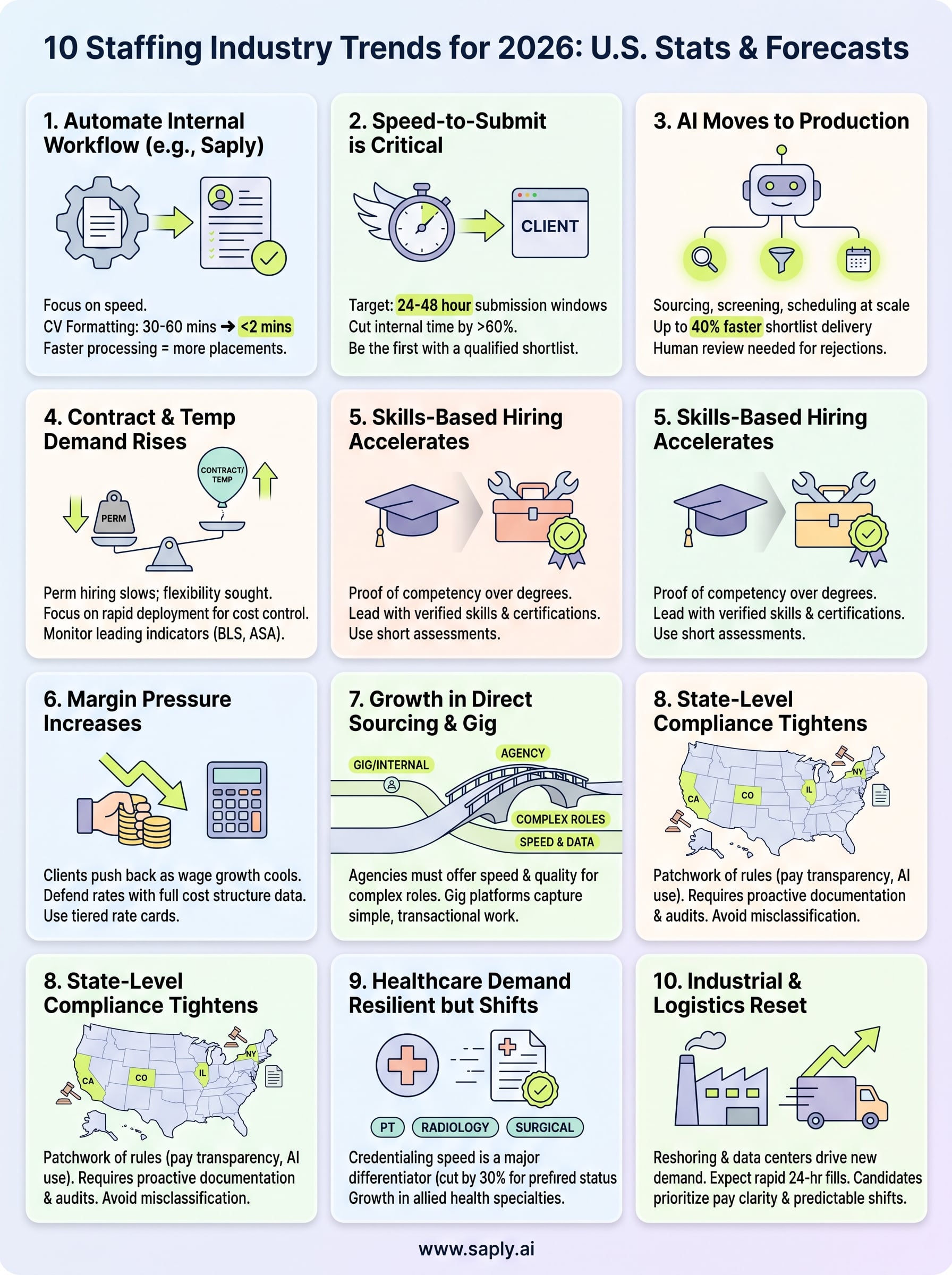
The staffing industry trends shaping 2026 share a common thread: agencies that reduce internal friction and move faster than their competitors win more business. Whether you operate in healthcare, industrial, or professional services, submission speed, compliance accuracy, and AI adoption separate the firms growing their client base from those defending margin on legacy accounts.
Your action plan doesn’t require a complete overhaul. Start by measuring your current time-to-submit across active roles, then identify where manual steps slow you down most. CV formatting and tailoring consume more recruiter time than most desks realize, and removing that bottleneck alone adds meaningful submission capacity without increasing headcount. Prioritize compliance documentation next, build your demand forecasting habits using the leading indicators covered above, and confirm your rate card reflects actual cost structure before the next client pushes back on pricing.
If your team still formats CVs by hand, try Saply free for 14 days and measure the difference before the end of the month.